

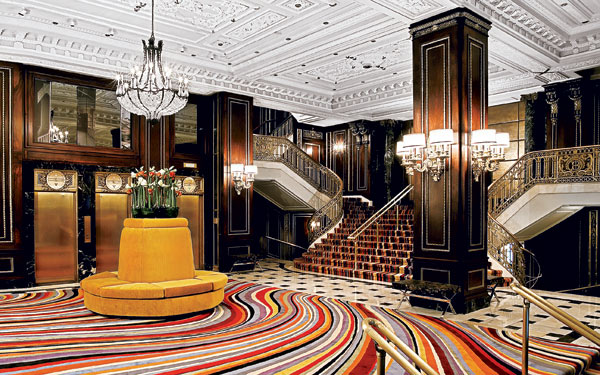
Go with the flow: the restored and updated Blackstone lobby
One afternoon last fall, two men were walking through the 23-story Blackstone, a historic hotel on South Michigan Avenue, checking out the progress of the extensive renovation then nearing completion. They seemed pleased. In a guest room with a pair of king-size beds, they paused, and Fletcher C. Mayes suddenly jumped up and fell back on one of the beds. “I just love these mattresses,” he shouted as he smiled at the ceiling. Walter Isenberg followed suit. They looked satisfied, as if they had pulled off a big prank. But perhaps they were simply acting out their understanding that aside from services and amenities, hotels should deliver a good time.
Distinguished-looking men with graying hair, Mayes and Isenberg are two of the top hotel executives behind the reclamation of the Blackstone, a long-languishing landmark designed by the Chicago architect Benjamin H. Marshall and completed in 1910. He went on to design The Drake and the Edgewater Beach hotels and many other elegant buildings, even while he eagerly pursued showgirls in an era when they were plentiful.
With more than 22 years in the business, Mayes was most recently the general manager of the Hyatt Charlotte in Charlotte, North Carolina. Isenberg is the president and chief executive officer of Sage Hospitality Resources, a 24-year-old company based in Denver, Colorado, that now owns or manages 47 hotels in 21 states. Of those projects, he says, before they were converted into hotels, 12 were threatened historic buildings—among them, a bank, a department store, and, most recently, a 1920s Masonic temple in Providence, Rhode Island. Sage bought the Blackstone, closed since 1999, in 2005 and is scheduled to reopen the hotel in March. The renovated building will feature 332 guest rooms, 12 suites, and almost 20,000 square feet of meeting space. In a franchise agreement with the Marriott Corporation, the hotel will be part of its high-end brand and will be called The Blackstone—A Renaissance Hotel.
“People want the places where they’re staying to be more than just a hotel,” Isenberg says. “And then, for us, there are what I call corporate citizenship issues—we’re bringing life to blighted buildings, adding value back to the community, and creating jobs.” Sage paid $22.3 million for the Blackstone and has spent $106 million restoring the hotel; the city contributed $18 million in tax increment financing.
Bob Rowan, a carpenter who worked on the project, remembers the hotel from his visits in the early sixties, when he was five or six. His father was a hotel detective for the Chicago Police Department. “It looked grand back then,” Rowan says. “Now it’s 100 percent restored. It’s gorgeous.” Tim Samuelson, the city’s cultural historian, also recalls trips to the Blackstone as a child. “I liked history, and I liked architecture,” he says. “And it was great going into the Blackstone because it was like stepping into another time.”
* * *
Photograph: Mike Schwartz
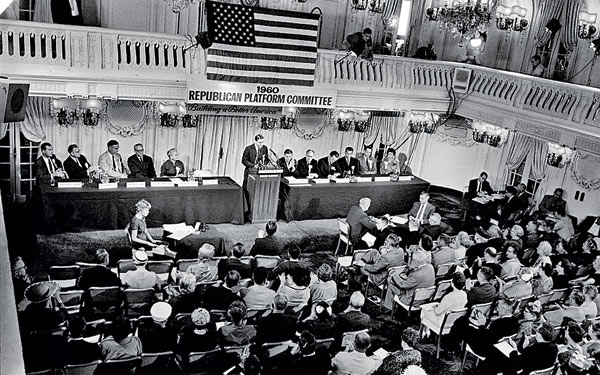
Republicans meeting in the Crystal Ballroom in 1960
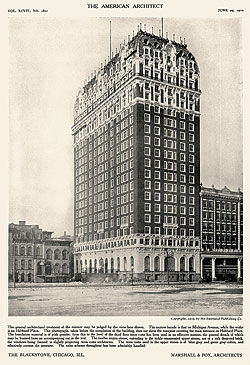
When the plan to build the Blackstone was reported in the Chicago Daily Tribune on April 18, 1908, the coverage was straightforward, explaining that the hotel would be named for the late Timothy B. Blackstone, the founder of the Union Stock Yards and the longtime president of the Chicago & Alton Railroad, and would occupy the site of his former mansion at Michigan Avenue and Hubbard Place (now Balbo Avenue). The Drake Hotel Company was the developer, and the establishment would be managed by Tracy C. and John B. Drake, the sons of the late hotelier John Drake.
The following month, when the drawings from Marshall & Fox, the architecture firm, were released, the poetry was already in motion. “To the height of three stories the treatment will be in polished pink Milford granite, and . . . the balance of the façade in warm shades of pressed brick and terra cotta. The frieze cornice, dormers, and balustrades will be of terra cotta, the whole crowned by a mansard surfaced with green tile.”
When it opened in 1910, critics saluted the stately Beaux Arts building for its lobby paneled in French walnut and detailed in gilt, its Art Hall promenade, its classically ornate ballroom, and its elegant private dining rooms. The Illinois chapter of the American Institute of Architects awarded Marshall & Fox a gold medal for the design, noting that “the interior combine[d] dignity with a feeling of homelikeness.”
And the people came. The acclaimed tenor Enrico Caruso appeared at the opening. Over the years, the Blackstone became known as the Hotel of Presidents. Every chief executive from William Howard Taft through Jimmy Carter (with the exception of Lyndon Johnson and Gerald Ford) was a guest. In 1920, a reporter for the Associated Press coined the phrase “smoke-filled room” when cigar-brandishing Republicans met on the ninth floor to determine that Warren G. Harding would be the party’s presidential candidate. The phrase entered the national parlance as code for a brokered deal. (In the future, all deals at The Blackstone will be wrangled over in a no-smoking environment.) Foreign dignitaries checked in to dine or briefly reside—Charles de Gaulle from France; Juan Antonio Ríos, the president of Chile; Princesses Birgitta and Désirée from Sweden; Charlotte, the grand duchess of Luxembourg.
Through the first half of the 20th century, when most people traveled by train, stars en route to Hollywood or New York often repaired to the Blackstone to await their rail connections. “A lot of Chicago’s identity as a celebrity center was based on the fact that people were changing trains,” says Samuelson. In 1926, a teary Mary Pickford and her husband, Douglas Fairbanks, stopped in, having just attended Rudolph Valentino’s funeral in the East. The opera singer Mary Garden lived in the Blackstone for many years, but she was just passing through in 1931 when she was interviewed in a suite there and made this proclamation about the prevailing mood of economic doom and gloom: “Pessimists bore me.”
In the late forties, the actress Ethel Barrymore, on her way to New York to pursue divorce proceedings against her adulterous husband, remained in seclusion at the Blackstone. In 1959, the peripatetic Duke and Duchess of Windsor took a time-out there with three pugs in tow.
The hotel was also high on the list of desirable destinations for Chicagoans. “For many years, the Blackstone was the in-city headquarters for people who lived in the suburbs,” Samuelson explains. “If they had business to conduct in Chicago, they would stay at the Blackstone. If you were to have a social event in the city, that was the place to be.” Stanley Paul, the society bandleader, started performing at weddings with his orchestra in the city in the late sixties. At the time, he recalls, “the big weddings were held at the Ambassador East, The Drake, the Conrad Hilton, and the Palmer House, and the Blackstone was at the top.”
By the midseventies, though, the building had declined. “I noticed things getting tattered around the edges,” Paul says. “The bones of the hotel were beautiful, but the building was beginning to look like an old dowager.”
In 1995, the Maharishi Ayurvedic University, then owned by the transcendental meditation guru Maharishi Mahesh Yogi, bought the building from a West Coast group, and it was managed by the Heaven on Earth Inns Corporation. Unfortunately, meditative philosophical goals trumped the exigencies of management. The city sued the hotel that year, citing 35 building-code violations. In 1998, the Blackstone was granted landmark status, and yet its fortunes continued to fall. Even after the hotel was voluntarily closed in 1999, city inspectors went on to charge the building with 103 code violations.
The Maharishi’s comeback plan was to convert the building into condominiums, and the Chicago architect Lucien Lagrange was hired to redesign it. That plan proved to be premature—the rebirth of the South Loop had not yet taken off, and Millennium Park had not been completed. And the prices were unrealistic—$1,000 a square foot, Lagrange says, when there was nothing on the market at that price. Long an admirer of the building, he was delighted to be selected by Sage to proceed with its rescue. “For many years, the Blackstone was just a dump,” Lagrange says. “Nobody would want to go there. But the history of The Blackstone is tied to the history of Chicago in my mind.”
Mayes, the hotel’s general manager, agrees. “We envision again making this Chicago’s hotel,” he says. “We won’t be the prettiest; we won’t be the flashiest. But we’re going to be able to connect with people emotionally. We’ll give them the ability to make their own stories, to have their own memories created here.”
Some longtime guests were already clamoring to get in last fall. “Well, shucks,” said Don Tucker, the president of a radiographic imaging company in North Carolina. Last year, hearing that the hotel was reopening, he had called to make a reservation for November, only to be told that it would not be completed by then.
He and his wife and their three now-grown sons had stayed at the Blackstone for years when he attended the annual meeting of the Radiological Society of North America. But Tucker’s return seems assured. “I like the lobby,” he says, “sitting by the fireplace, drinking a little toddy, all the hustling and bustling and watching everyone else come and go.”
* * *
Photograph: Bettmann/Corbis
|
|
Peter Psihas, the director of sales and marketing at The Blackstone, has been in the hospitality industry for 18 years, most recently at a Marriott hotel in Los Angeles. He expects Blackstone employees to share stories about the hotel’s rich history with guests. “You will have more of an attachment,” he explains. “You’ll have a dialogue, which is rare these days because most people are on their cell phones and BlackBerries and ignoring each other.” Psihas served as my principal hard-hat guide during the many months I followed construction work at the hotel. Resolutely fit, he sometimes walked down the 23 flights of stairs at the building three times a day, and he expected me to make at least one descent on almost every visit. After a while, clarity emerged from what at first looked like a chaotic obstacle course, and the completion of the project began to seem within reach.
Formerly an attic that held the machinery for the elevators, the 23rd floor was gutted and the equipment was moved to the roof. That floor will be the apex of the top four Hubbard Place levels, where rooms will range from $324 to $634 a night; the two suites will go for $2,700 and $3,000. Guests on those floors will have access to a lounge and daylong opportunities for nibbling and imbibing. With the exception of the presidential and the smoke-filled-room suites, all the guest rooms were reconfigured, Lagrange says, and they now have inviting entry hallways. Rates for standard rooms will range from $199 to $509 a night; the presidential and smoke-filled-room suites will cost $3,000 a night.
Gettys Chicago, a hospitality design and development firm, chose furniture, fixtures, and finishes that are a blend of the classic and the contemporary. “It became important to do something that had staying power,” says Ariane Steinbeck, a managing director of Gettys, “that had an element of fun in it, an element of contemporary thought.”
Her colleague Meg Prendergast, a senior vice president of Gettys, is even bolder in her assessment. “Hotels that work well have a really good level of sex appeal,” she explains. “At the end of the day, you want to feel sexy hanging out in the lobby or at the bar or in your room. You want to feel as if you’ve achieved a different sort of lifestyle from the one you walked in with.”
The Crystal Ballroom offers perhaps the most startling realization of that philosophy. Its wedding-cake splendor—the ornate plaster detailing, the sparkling chandeliers and sconces—has been restored. But Gettys has pumped up the volume with a rug in brilliant red and orange; at its center is a huge multipetaled chrysanthemum. The rug is Warholesque, a Monet-gone-mad masterpiece. Hot stuff!
Another crucial member of the gung-ho Blackstone turnaround team is Joel Straus, a Chicago-based art consultant. Although he has conceived visual programs for buildings such as McCormick Place South and the convention center in Washington, D.C., this is his first hotel project. The fifth-floor Art Hall will display rotating exhibitions of work by students, initially from the nearby Columbia College. By the end of February, Straus was close to completing the installation of about 1,600 works by 21 contemporary artists, most from Chicago, in The Blackstone’s guest rooms and public spaces. Among the contributors are Brian Dettmer, Ann Worthing, and Richard Hull.
“We believe that hotels do not have to have lousy art,” explains Isenberg, the president of Sage, a corporate museum sponsor in Denver. “Walter felt that the art was going to be a big player in the interiors,” Straus says, “a big part of the overall design. And the budget was certainly greater than what most hotels have.”
Most of the works in the guest rooms are high-quality digital reproductions of paintings and photographs for which the artists receive royalties. Michael Hernandez de Luna contributes sheets of perforated postage stamps featuring past presidential guests and other iconic figures. For the lobby, Lincoln Schatz has created a computer-generated video work. Cameras on the roof will record scenes from the lakefront and Grant Park and send collaged images of the landscape to two 50-inch plasma-screen monitors behind the reception area. A plan to film guests entering The Blackstone was abandoned when it was decided that some might be engaging in surreptitious visits.
Only one suitcase of archival material remained when Sage bought the hotel. Because the papers include personal correspondence that belonged to Evelyn S. Nelson, the publicity director of the hotel from the late forties through the early seventies, it’s possible that these limited remnants of the Blackstone’s history came from her files. A press release from 1949 announces a four-week engagement at the hotel by the singer Lena Horne; a menu and program from 1953 memorializes the poet Carl Sandburg’s 75th-birthday celebration in the Crystal Ballroom. Copies of the local high-society magazine Townsfolk from the fifties are filled with photographs of old-money Chicagoans at swell events in the Blackstone—ladies’ lunches, debutante balls, fashion shows, formal weddings.
Decades later, two institutions anchored the hotel with their long runs. From 1980 to 1995, the impresario Joe Segal’s Jazz Showcase drew raves from critics for performances by greats such as Dizzy Gillespie, the Count Basie Orchestra, Betty Carter, and George Benson. In a theatre across the lobby, Shear Madness, an audience-participation whodunit set in a hair salon, lasted for 17 years, reviled by critics and revered by fans. Apparently there was never an aesthetic contretemps at the Blackstone between attendees at the club and the musical. “They would all mix and mingle at intermission,” says Wayne Segal, the son of the founder and now the president of the Jazz Showcase (scheduled to reopen at Dearborn Station in May). “It was one of the liveliest lobbies in the city.”
* * *
Photograph: Courtesy of The Blackston—A Rennaissance Hotel
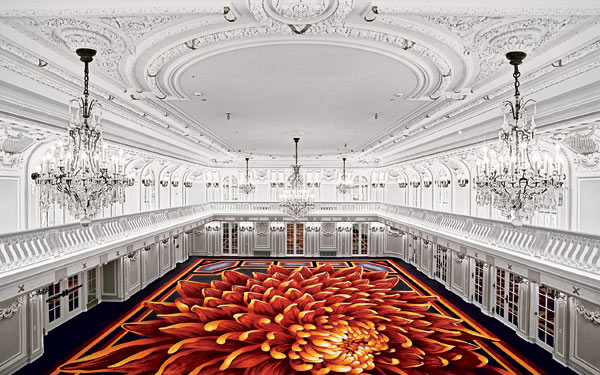
The site of almost 100 years of meetings, weddings, and fetes, the reimagined Crystal Ballroom pops with a Warholesque, Monet-gone-mad flowewr rug. On with the dance.
One afternoon when Psihas and I are making our routine promenade, Mayes comes along, and we go up to the roof of the hotel. Taking in the view, Mayes lets loose with his from-here-to-eternity speech in the sonorous tones of the Renaissance man Paul Robeson: “We’re a five-minute cab ride to Michigan Avenue,” he says. “Five minutes to the financial district, a short walk from Millennium Park and the Art Institute. Our front yard is Grant Park. We’re the closest hotel to the convention center.”
In a phone interview, Isenberg says that he expects The Blackstone to receive four to four and a half stars out of five from the two top hotel-rating organizations. “We will compete with hotels in the South Loop,” he says, “just because of location, and we will compete with other hotels based on rates, service, and amenities.”
When it comes to history—to lore and legends—The Blackstone has a definite edge. Many devotees of the hotel are wistful about the romance and adventures of the days gone by. With the rebirth of The Blackstone, there is a time and a place to begin collecting 21st-century memories in an almost 100-year-old hotel.
The Blackstone—A Renaissance Hotel, 636 South Michigan Avenue; 312-447-0955
Photograph: Mike Schwartz