

For the past two-plus years, Sean Berkowitz, a 39-year-old native of Northbrook, has worked on the Justice Department’s Enron Task Force, pursuing the executives responsible for the corporate scandal that shook the nation. The task force has brought charges against 34 former Enron managers-racking up 16 guilty pleas and eight
 |
|
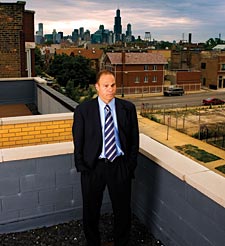
Berkowitz at home on his rooftop in West Town |
convictions so far. But in May, with Berkowitz as the lead prosecutor, the task force won its most important victory when a federal jury brought in guilty verdicts on fraud , conspiracy, and other charges against Enron’s former chairman Kenneth Lay and CEO Jeffrey Skilling, once widely hailed as “the smartest guys in the room.”
Berkowitz, a marathon runner who is divorced and currently single, graduated first in his class at Tulane University before attending Harvard Law School. He joined the Enron Task Force in December 2003, on the recommendation of his boss, Patrick J. Fitzgerald, the U.S. attorney in Chicago, and became the task force director last July.
Chicago caught up with Berkowitz just before he left for a well-deserved vacation in Vancouver. Although he is guarded about courtroom secrets, given that the defendants are expected to appeal, Berkowitz talks about the case and the verdict, and about having his mother watch him in the biggest trial of his career.
Q. How did you initially get involved with the Enron Task Force?
A. The call had gone out for talenmted prosThe call had gone out for talented prosecutors, and I was fortunate enough to have Pat Fitzgerald think of me. I was at a time in my life when I was ready to try something new.
Q. You’re a prosecutor with a reputation for winning cases. Did you ever consider the risks of losing the biggest trial of your career?
A. Not when I joined on, no-maybe foolishly so. Nobody had even been charged when I was brought on. So it was, I think, a case of looking at the facts and hopefully, if we decided to charge, which we did, it would be a case that we could win. As a prosecutor, you can’t be afraid to try the tough cases, or you’re not doing your job.
Q. How did you feel when the judge read off the guilty verdicts against Lay and Skilling?
A. There was a sense of relief, more than anything else. We had put on, I thought, a very strong case. It was a case that was being watched, with a lot of ramifications, by both the outside world and the victims of the case, and I had spent the last two and a half years of my life working on it. And, frankly, there was a sense of relief and exhaustion, more than anything else. There was a sense of relief, more than anything else. We had put on, I thought, a very strong case. It was a case that was being watched, with a lot of ramifications, by both the outside world and the victims of the case, and I had spent the last two and a half years of my life working on it. And, frankly, there was a sense of relief and exhaustion, more than anything else.
Q. How confident were you about the outcome of the case, which close observers say never seemed clear-cut?
A. I never let myself get confident or not confident about it. I really tried not to think about what the jury was going to do. It would’ve driven me crazy on a day-by-day basis to wonder, were we winning? Were we losing? And so I really just concentrated on whether we were doing a good job. And I felt that we were.
Q. Talk about the prosecution’s strategy.
A. The strategy was certainly to use the cooperating witnesses [Enron’s former treasurer, Ben F. Glisan Jr., and CFO Andrew Fastow, among others] to bring the jury inside of what was going on at Enron, and to use the documents that existed to corroborate their testimony and to do it in a way that was simple and understandable to a jury of laypeople. I don’t know if that’s a remarkable strategy or some sort of brainstorm, but what I thought was particularly effective was, in this case, we were actually able to execute on that strategy, using a number of different witnesses, who were among the highest-ranking people at Enron.
Q. Legal experts have said your cross-examination would be one of the most critical parts of the trial. How did you prepare for it?
A. I cross-examined Jeff Skilling, and one of my trial partners [John C. Hueston, of the U.S. attorney’s office in Los Angeles] cross-examined Ken Lay. With respect to Jeff Skilling, he was commonly thought of as ‘the smartest guy at Enron,’ and so cross-examining him was a tremendous challenge. I had to go toe to toe with him on the ins and outs of an extraordinarily complicated business and one that I could never hope to know as well as he did. But I had my themes, I had documents, and I had details. And I was able to ask him very hard questions, and, on occasion, catch him by surprise. Ultimately, he was extraordinarily knowledgeable about a lot of details and there were certain things which he, for whatever reason, had a lack of recollection about . . . I think that the jury found that significant-that somebody who was this bright, when asked hard questions, there were certain topics that he didn’t have a recollection of. The preparation that went into it was months in the making. I felt as prepared as I could have been for it, and I think we executed very, very well. But I do think the credibility of the defendants was very important. When defendants take the stand, a lot of times it comes down to whether the jury believes the defendants, or not. I don’t know what the jury thought or didn’t think; I’d like to hope that my cross-examination caused them to doubt his credibility.
Q. How did you catch Skilling by surprise?
A. There was an investment he had made in a startup company that did business with Enron-Photofete [an Internet photo company that was run by Skilling’s former girlfriend]. That was an area that he did not appear to be well prepared for. He had failed to disclose the investment, even though it violated Enron’s ethics policies. He was evasive and couldn’t recall key issues. It affected his credibility. He also had a lack of recollection about a trade that he had made. He sold 500,000 shares of Enron stock in September 2001, a month after he left the company. And when he was deposed, he said [the terrorist attacks on] September 11th [were] why he actually sold the shares. We were able to confront him with evidence that, the week before September 11th, he had tried to sell 200,000 shares, but it didn’t go through-which is obviously inconsistent.
Q. What was the toughest obstacle in the case, against Skilling and Lay in particular?
A. One of the challenges was just the sheer volume of documents-tens of millions of documents. They also had a very well-funded and well-resourced defense team that fought every step of the way, as they’re perfectly entitled to do.
Q. How difficult was it to unravel the Enron enterprise, especially its complex accounting mechanisms?
A. It was extraordinarily difficult to develop an understanding of all of the complexities in the business deals at Enron. But we had insiders to help explain things to us. And, at the end of the day, we didn’t need to present many of those to the jury. The case that we presented was one of lies and choices. We used [the defendants’] public statements to convict them, and evidence that was inconsistent with those public statements. And while I felt we needed to understand all of it, the jury didn’t need to understand all of it. And at the end of the day, we didn’t present many of those complicated structures to the jury because we didn’t feel that we needed to, to prove the case.
Q. What do you think was the most damaging evidence against Lay and Skilling?
A. It’s really hard to say. I think the weight of all the evidence is what convicted them. We put on seven cooperating witnesses and they went through days of cross-examination. I can’t point to one thing. The fact that the evidence was consistent with the documents is what ultimately convicted them.
Q. Lay and Skilling tried to have the trial moved. Do you think holding the proceedings in Houston affected the outcome?
A. This is an area that is going to be a subject of appeal. Obviously we filed motions and papers saying that they could have a fair trial. And there were other Enron officials who were acquitted in our cases (Sheila Kahanek, an accountant, was acquitted of fraud and conspiracy, and Michael Krautz, a senior accounting director for broadband services, was acquitted of all charges of conspiracy, fraud, and money laundering).
Q. Do you think Lay and Skilling’s crimes were premeditated-that they deliberately intended to cheat the company and its shareholders and employees?
A. What I said in my rebuttal-I think they didn’t set out to bankrupt the company. They were constantly hoping to get to the next quarter. But their conduct in doing that was dishonest. They lied and they weren’t fully honest with the public and with employees.
Q. After handing down guilty verdicts against Lay and Skilling, several jurors said that the defendants’ decision to take the stand didn’t particularly help their case. Do you think that defendants in other white-collar cases will now be more wary about testifying, based on the Enron case?
A. I think it’s an individual decision that a defendant needs to make, depending on the circumstances and after consulting with his counsel. I don’t think this is going to change somebody’s decision, if they think it’s in their interest to testify. What I think it does say is that if you’re going to testify, you’d better be prepared to answer hard questions.
Q. Do you think the guilty verdicts against the various Enron managers will make other executives think twice before committing similar crimes? Will the verdict change business ethics?
A. I honestly don’t know. Our task was to investigate and prosecute this case, and it was an important case for a variety of different reasons. But the stories of its importance are yet to be told.
Q. Did working in the U.S. attorney’s office in Chicago, which has plenty of experience with corruption cases, help you in the Enron case?
A. The experience and training I got in Chicago was invaluable. The people in our office in Chicago remain among the most talented lawyers and people I have ever worked with-from Pat Fitzgerald on down to many of the assistants in the office. I learned how to prosecute cases in the Chicago office. I learned how to investigate cases. I learned how to try cases, and so I really owe whatever results I achieved to the training and support I received from my colleagues in the Chicago office. It remains, to me, the best office in the country.
Q. How did the case affect you personally?
A. It was emotionally and physically exhausting. I worked seven days a week, 12-plus hours a day, for the better part of a year. As many people know, it’s hard to be away from home, working those hours, away from your family and friends. I did a lot of running to keep my sanity. I tried to make friends in Houston, socialize on occasion with the people with whom I worked. It was a great sacrifice for me and the other people on the task force, but one that we all felt was an important one to make.
Q. How much sleep did you get a night?
A. There were nights that I got a couple hours of sleep and there were nights that I got a full eight hours. It’s fair to say that from December to May I wasn’t sleeping regular hours.
Q. What memories will you take away from this trial?
A. I was fortunate enough to have my mother down there watching it. She was there when I delivered the final two hours of argument on the last day of trial. It was special for me to have my mom in the courtroom to watch me have the final word in the Enron case.
Q. What did you miss the most about Chicago while you were working in Houston?
A. My dog, Scout. He’s a mix of a collie and a samoyed. He’s been with me since 1994.
Q. How did you become a prosecutor?
A. Because they took me. I had applied to that office probably two and a half years before I was finally called in for an interview. It was something that I had wanted to do for some time. So, when the opportunity became available, I jumped at the chance. I don’t want to overstate or be Pollyannaish about it. The experience that you can get as a trial lawyer, I think that’s the best training ground in the city for young people who want to become talented trial lawyers. On top of that, you get to be a part of justice being done on a daily basis, and that’s a special feeling to have.
Q. So, what’s next for you?
A. I don’t know what’s next for me. I’m more ready to go on a vacation and get away from it than to decide what’s next.
Q. Will you now move to the private sector?
A. That’s certainly a possibility; I haven’t made any life-altering decisions.
Q. Will you stay in Chicago?
A. Absent some extraordinary opportunity, I’m looking forward to coming back to Chicago full-time.
Photography by Peter Wynn Thompson