

 |
|
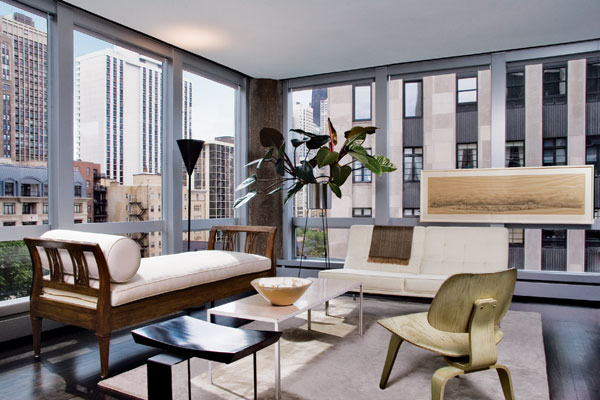
A day bed from the forties that belonged to Florian’s maternal grandmother and a reproduction of a Florence Knoll sofa define a corner of the living room. The coffee table by George Nelson came from Modern Times. |
“I’m a 57-year-old living in a student loft,” says Paul Florian, a principal of the Chicago firm Florian Architects. “I just like to perch-I don’t want to reach any resolution.” An optimistic realist, Florian knows exactly where he is bound, but he believes that now is not the right time to make that move. Five years ago, he bought a lot in Wicker Park and designed his own 2,500- square-foot glass, steel, and aluminum house; he keeps the model in his River North office. But at present, completing his firm’s commercial and residential projects seems more pressing than building his own place.
In the interim, he is living in a one-bedroom, 800-square-foot apartment on the Gold Coast, at the corner of Astor and Goethe streets-a destination that satisfies his needs for meaningfulness and style. The 28-story structure was completed in 1962 as a rock-star hotel by Bertrand Goldberg-the celebrated architect of Marina Towers. Downstairs, from the early sixties to the mid-eighties, Goldberg’s wife, Nancy, presided over Maxim’s, a restaurant and nightclub patterned after its soigné art deco predecessor in Paris. The club became a hip hangout for the city’s art-smart moneyed set. Today it is an event space managed by the Chicago Department of Cultural Affairs, and the hotel rooms are condominiums.
 |
|
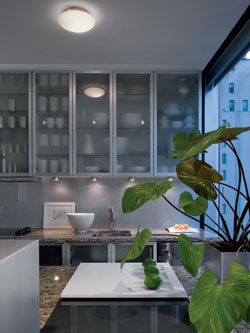
The kitchen looks out on a building from the thirties. |
“It was a real sixties phenomenon,” Florian says of the club. “And the hotel had a sense of privacy and mystery. It was a Darth Vader kind of building; it was the same color as the buildings adjacent to it, but all the windows were covered in black louvers. Then there were natural concrete columns that went all the way to the ground, and the plaza was black. You had one portico for the nightclub and one for the entry. The building was very dramatic for its day.”
That wasn’t Florian’s only source of nostalgia. His maternal grandmother was born nearby, at the northwest corner of Scott and Astor streets, in a Romanesque house built by her father, a fruit importer and real-estate developer. Florian’s parents-his mother was a fundraiser; his father, a business executive-moved from the city to Winnetka when he was five, but the family always spent holidays on Scott Street. And there was another Goldberg connection. Florian’s great-grandfather was the developer behind Bertrand Goldberg’s first public-use building-a media center on Rush Street, now an Urban Outfitters store.
The neighborhood met other criteria, as well. “I wanted to be able to walk to work and not be in good shape,” explains the ageless, always fit Florian, meaning that long distances and overexertion were not a goal. “I have this notion of an ideal benevolent urban environment, which comes from studying and working in London in the seventies.
“This area is the closest you can get to that when you come down to it,” he explains. “It’s too bad we have to ossify certain neighborhoods and then don’t have control over others.” In the past 20 years, Florian has abandoned both Lincoln Park and River North because of the relentless construction. “I love change,” he says, “but when everything is all ripped up, and what you see being built isn’t better, it’s disturbing.”
 |
 |
|
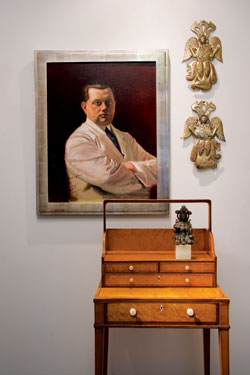
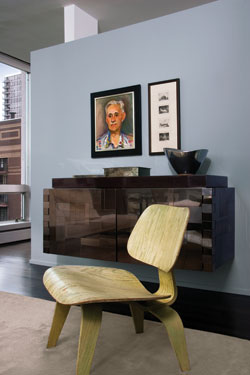
A 1910 portrait of Florian’s maternal grandfather (left) hangs in the entryway above an English Sheraton writing desk that belonged to his mother. A shelf holds a Japanese bronze. At right are two silver angels from Peru. In the living room (right), above a credenza by Evans from Wright, is a sixties portrait of Florian’s great uncle. The chair by Charles and Ray Eames was a junk-shop find. |
|
An eight-story building by Lucien Lagrange that was completed to the east of Florian’s in 2003, however, is a change for the better, he says, an improvement over the declining structure that was there before. And the park and playground beside it are still intact. A gardener, Florian prefers being on a lower floor, in a corner, where the view of the park is so near that it seems as if that ideal urban spot could be his alone.
The interior of Florian’s apartment is intimate in its own way and not simply due to its small size. His precision as an architect, his attention to scale, colors, and materials-talents usually summoned for the much larger projects of his clients-coalesce here. (Perhaps his firm should use this space as its own variation on a model apartment.) Within is a fascinating and highly personal collection of art, furniture, and objects-family portraits and mementos, finds by Florian from antiques and junk shops, works of his own design. This is an excellent example of home as autobiography.
One of the reasons that Florian chose the apartment is that readying the backdrop for his visual memoir would not be an overwhelming endeavor. “It was relatively cleaned up for a building of this period,” he says. “It had a new curtain wall”-the black louvers were long gone.
A previous owner had redone the kitchen, so it was not necessary to start from scratch on that. To make the space more open and sculptural in feeling, Florian removed some walls and doors and reconfigured others. Concealing hardware such as thermostats in closets made the three rooms-kitchen, living and dining room, and bedroom-quieter and sleeker.
 |
|
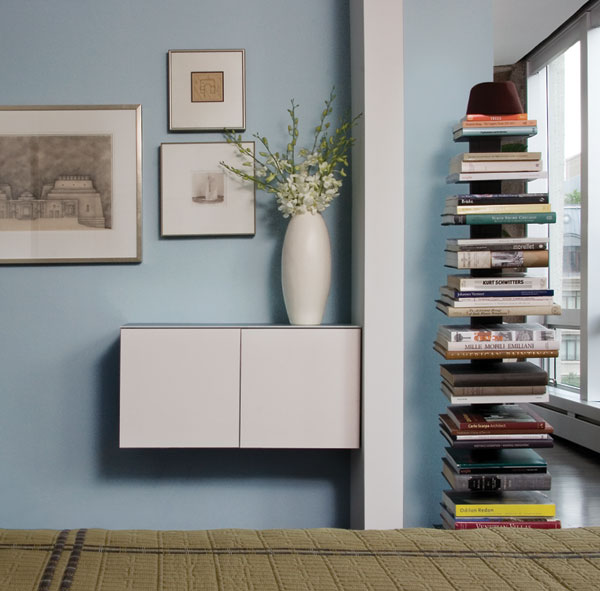
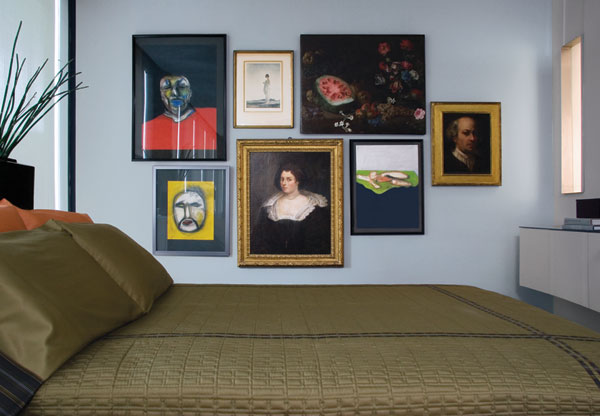
In the bedroom (above and below), off-the-rack kitchen cabinets conceal most of the books; near drawings by Florian and a photograph, a tower holds other volumes. The two pastels at left on the wall beside the bed (below) are by the former Chicago artist Tom Wasik; in the center is a relative in Austrian dress, and at right is the 18th-century Venetian playwright Carlo Goldoni. |
 |
Florian painted a partial wall in the living room gray-blue to echo the hues of the lake and the sky. “I like the idea of creating balance on the inside,” he explains. “Blue often recedes to the eye, so it adds some life without crowding a space.” The wall next to it, in the dining area, is a calm Naples yellow. “There’s sun on the periphery, but I wanted to bring light in to the interior,” Florian says. Adding to those unities are the buffs and pinks of the concrete columns on the perimeter of the apartment and the granite countertops in the kitchen. Silvery gray-greens appear in the Chinese silk rug in the living room and in the round dining table, a Florian design from the eighties.
Contrast comes from the oak floors, once blond and now brown-black, and furniture in creams and whites. An oak day bed from the forties that belonged to Florian’s maternal grandmother and a reproduction of a Florence Knoll sofa define a corner of the living room. The steel-and-laminate coffee table and end table by George Nelson are from Modern Times. The chairs are modern but all different. “I tend to buy one of each thing that I like to look at,” Florian says. “These are mostly junk-store finds.” Among them are chairs by Charles and Ray Eames, Harry Bertoia, and Zanotta.
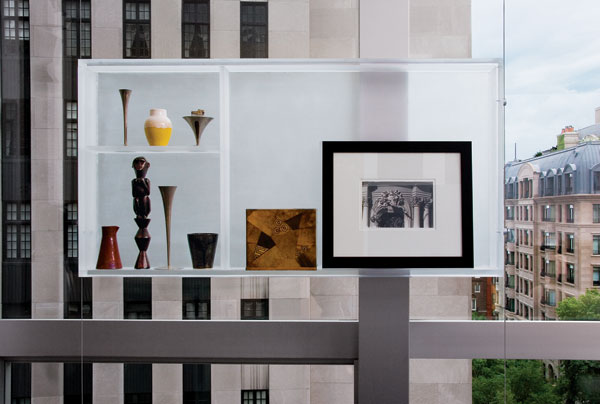
To anchor the dining area, diffuse light, and diminish the impact of the buildings across the street, Florian suspended an acrylic cabinet from steel cables in front of a window to the east. “I am interested in the furnished window,” he explains, “an idea first explored by the Italian architect and designer Gio Ponti in response to the glass curtain walls of modernism.” Among the objects furnishing the cabinet are postwar aluminum bud vases and a lighter, a sculpture from Bali, a photograph of the entry to the zoo in Rome, and a hammered-copper creamer from Sawbridge Studios.
Hanging from cables in front of a window at the far end of the room is a drawing that Florian did when he was in the architecture master’s program at the University of Illinois at Chicago. “The project was for a school in a park,” Florian says. “I did it in memory of the British landscape tradition of huge follies in private parks.”
The gray-blue inner wall holds a credenza in black chrome by Paul Evans. Above it is a portrait of a great-uncle of Florian’s from the sixties-an elegant man with high cheekbones, gray hair, and a mustache, he wears a brightly colored, open-collared shirt. “Emilio Bolognesi,” Florian says. “He was kind of a ladies’ man.” (And, judging from his looks, a great success.) Beside the portrait are framed lithographs from Chicago’s 1933 Century of Progress exhibition, a gift from a friend. The hand-hammered silver cigar box on top of the credenza, Florian believes, was a retirement gift for his maternal grandfather, Giulio Bolognesi, the Italian consul general in the city. The signatures engraved inside include a McCormick and a Field. “He was a popular guy, and that’s his crest on top,” Florian says. “He was a count. They’re a dime a dozen in Italy, but he had one of those dimes.”
Another vignette in the front hallway, brightened by an accent of Persian red, features a satinwood English Sheraton writing desk that belonged to Florian’s mother, two silver angels from Peru, and a 1910 portrait of his maternal grandfather, at that time a consular official in Lima. He is an imposing figure in a white suit with a looping scar on one cheek. “He was in a duel,” Florian explains. “The story goes that it was over whether a train window would stay opened or closed.”
 |
|
In the living room, an acrylic cabinet suspended by cables holds postwar aluminum objects, a sculpture from Bali, pottery, and an inlaid Japanese box. The cabinet was intended to anchor the dining area, diffuse light, and diminish the impact of the building across the street without reducing the airiness of the curtain wall. |
A wall in Florian’s bedroom holds pastels from the eighties by Tom Wasik and works inherited from his family-a 17th-century botanical still life, an 18th-century portrait of a relative in Austrian dress. The furnishings in the room are spare. Behind the bed and against the opposite wall are simple white cabinets-inexpensive off-the-rack kitchen cabinets. “They’re usually used over refrigerators, so they have a low proportion,” Florian says. “I just lined them up. I’ve had them in four apartments, and sometimes I stack them.” Beside his bed are a yellow fiberglass chair by Charles and Ray Eames and a tall standing bookshelf from Design Within Reach filled from top to bottom with art and architecture books-an impos-ing tower that marks an amusing counterpoint to Florian’s innate sense of order.
And apparently he sees no great distinction between poetry and design, either. One recent morning there was a collection of poems by Anna Akhmatova on his kitchen counter. “She never left the Soviet Union,” Florian says. “She insisted on staying. Some of the poems are really beautiful. They’re romantic but quite crisp, and she talks a lot about landscape. So all the lighting I did is new. . . .”
Photography by Barbara Karant, photo styling by Diane Ewing
RESOURCES
Alloyz, 432 North Clark Street, Suite 200; 312-670-2220. Custom-designed furniture and accessories by Paul Florian: the dining table, stainless-steel handles.
Arrelle Fine Linens, 445 North Wells Street; 312-321-3696. Klee pillowcases, Sydney pillow shams and quilted coverlet, Oasis quilted coverlet.
Barneys New York Chelsea Passage, 25 East Oak Street; 312-587-1700. The white glassware in the kitchen cabinets.
Bernacki & Associates, 424 North Oakley
Boulevard; 312-243-5669. Furniture restoration.
Bernardaud, 900 North Michigan Avenue; 312-751-1700. The white Luna plate and the white Douce bowls in the kitchen.
Chiasso, 2112 North Clybourn Avenue; 773-244-4100. The plant pot in the living room.
Chicago Copper and Iron Works, 3118 North Clybourn Avenue; 773-472-9283. Wall panels.
Designtex, 3-121 Merchandise Mart; 312-321-1204. The fabric for the Florence Knoll sofa.
Design Within Reach, dwr.com. The vertical bookshelves in the bedroom.
Elements, 102 East Oak Street; 312-642-6574. The Christiane Perrochon clay bowl on the coffee table in the living room, the Corian tray in the kitchen, the ivory vase in the bedroom.
VK Ferro Design, 3648 South Kedzie Avenue; 773-523-3770. Custom stainless-steel accessories.
Florian Architects (Paul Florian, principal), 432 North Clark Street, Suite 200; 312-670-2220.
Frederic’s Frame Studio, 1230 West Jackson Boulevard; 312-243-2950. Picture framing.
Knoll, 1111 Merchandise Mart; 312-454-6920. The couch by Florence Knoll.
LumenArt, 320 North Damen Avenue, Suite D-300; 312-829-3023. A fluorescent light fixture.
Manifesto, 755 North Wells Street; 312-664-0733. The ArmaniCasa Nestore bronze vase and wood-and-seashell Guapo box in the bedroom.
Modern Times, 2100 West Grand Avenue; 312-243-5706. The tables by George Nelson.
Peerless Imported Rugs, 3033 North Lincoln Avenue; 773-525-9034. The Chinese rug in the living room.
Practical Angle, 161 East Erie Street; 312-280-8118. Picture framing.
Room & Board, 55 East Ohio Street; 312-222-0970. The stainless-steel containers in the kitchen.
Sawbridge Studios, 153 West Ohio Street; 312-828-0055. The hammered-copper creamer.
Carl Stahl DécorCable, 660 West Randolph Street; 312-474-1100. The cables.
Welding Apparatus, 1668 North Ada Street; 773-252-7670. The metal grilles designed by Florian.
Wright, 1440 West Hubbard Street; 312-563-0020. The credenza by Paul Evans.
Zirlin Interiors, 5540 North Broadway; 773-334-5530. The MechoShade systems.