

  |
In 1969, Brian Flanagan and the radical antiwar group Weatherman unleashed mayhem on the streets of Chicago. Richard Elrod, an ambitious lawyer, worked for the city to stop the chaos. As the Days of Rage climaxed, the two men had a violent encounter that forever altered their lives-and produced an indelible image that reverberates still.
|
Photograph: © Bettmann/Corbis |
|
|


The man, 72 now, lifts the photograph with a grip light as a soft pinch and draws it toward his eyes like a jeweler holding up an exquisite but slightly flawed stone. He is natty in a gray pinstriped suit with a pink pocket square and a pale pink tie. His crutches lie on the floor just behind his immaculately ordered desk. Through the window of his 25th-floor judge’s chamber a gray sky pulls a cheerless curtain across the late afternoon.
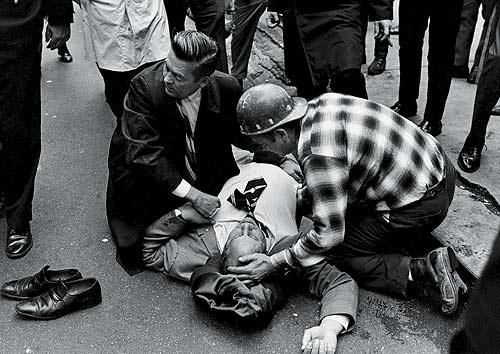
He is there, in the photo, sprawled on the ground, an arm flung over his head, mouth open, paralyzed on a downtown Chicago sidewalk. A step or two away, in a manner equally suggestive of violence, his adversary lies torso-twisted into the entrance of a doorway, hovered over by three men, one bearing a club. There is something intimate about the image, as if the two men were victims of the same assailant rather than ideological enemies whose bodies-and fates-had just collided. Only later would they realize how much that was true.
|
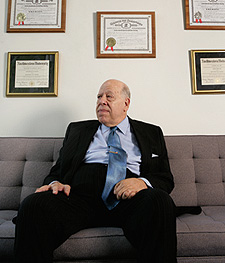

Richard J. Elrod, Cook County circuit court judge, former sheriff, brings the image closer. He has se
en other photos of that day, October 11, 1969. Usually they are tight shots of his face, his tie yanked to the side, a welt purpling his right temple. But before him now is a picture he has never seen, one that presents the full tableau of that darkling instant. And so, he is asked what he feels when he sees it-himself laid out, unable to move, the man he blames for his paralysis barely an arm’s length away. Bitterness? Anger? Sadness?
Immured on a gray summer afternoon in his judge’s chambers of finely bound books and polished wood, he doesn’t immediately say. Instead, he stares, silent and inscrutable, eyes fastened on the sidewalk where his younger self lies forever frozen in black and white. And for what seems like a long time he weighs his verdict on the moment in which the life he knew, and the future he envisioned, ended, and another began.
—
Take a stool. Have a drink. The other man in the photograph, the one with the construction boots and narrow pants, is buying. Tall and lean when the photo was taken, Brian Flanagan is a little heavyset now, his hair no longer a shaggy thicket of brown but a mop dipped in gray and silver. The dark eyes rarely flash the anger of that bygone day, but twinkle with sly amusement, as if he’s waiting for the end of a long-winded joke, the punch line of which he has already guessed.
At the moment, he is just opening his tavern, a low-slung, beer-damp dive tucked among bodegas and ethnic restaurants on the Upper West Side of Manhattan, a few blocks south of Harlem. The joint features a scarred, L-shaped wood bar, a pool table, a jukebox, and an old-fashioned cash register that bangs like a box of gravel when it’s closed. Flanagan likes to boast that the Zagat nightlife guide rated it dead last in New York for interior design. For him and his regulars, no distinction could endear it more.
|
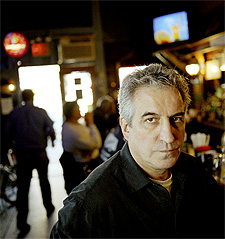

But Flanagan takes pride in certain adornments, ones you might not expect to find in other saloons. Behind the bar, for instance, a statuette of Lenin scowls next to a gap-toothed caricature of George W. Bush that leers with the “What, me worry?” grin of Alfred E. Neuman. A bumper sticker with the phrase “Bush lies, people die” clings to the bathroom door. Overlooking the pool table, rinsed in the neon of Coors Light and Heineken signs, a framed poster from the 1969 Students for a Democratic Society convention in Chicago-complete with clenched fist and “Power to the People!” slogan-competes for space with snapshots from parties at the bar.
Like Elrod, Flanagan has been asked his impressions of the photograph. Unlike his long-ago adversary, however, Flanagan scarcely hesitates before giving them. “It’s all right there,” he says. “There’s Elrod,” he says. “There’s me. . . . He’s crippled for life; I’m about to be hauled off to jail, and you’ve got a bunch of horrible wretched cops who are about to lie about the whole thing.”
He shrugs and offers a wry smile. But then, like a beer poured too quickly, irritation foams up and spills onto the bar. “You know, Elrod insists that I attacked him, but I did nothing but try to avoid him that day,” he says. “But Elrod continues to lie and say I’m responsible.” He starts to say something else when a customer orders a drink. “It’s wrong, probably, to totally hate him or resent him,” he says, fishing up a glass and dunking it in soapy water. “But I get sick of hearing every few years that I did this to this guy when it’s not true.”
—
The portentous moment erupted during a tumultuous four days of antiwar riots and demonstrations in Chicago that would come to be known as the Days of Rage. Elrod would forever insist that Flanagan-then a member of the militant anti–Vietnam War group called Weatherman (later known as the Weather Underground)-attacked and kicked Elrod viciously, damaging his spinal cord, paralyzing him. Flanagan has always maintained that he was fleeing an undercover police officer, and Elrod, then a lawyer with the City of Chicago, launched a flying tackle at him, missed, and hit the corner of a building, headfirst. The truth, at least as far as a jury was concerned, emerged during Flanagan’s trial for attempted murder, aggravated battery, felonious mob action, and resisting arrest; it was a three-week spectacle that dominated newspaper headlines and television coverage here and across a nation bitterly divided by war.
The collision between Elrod and Flanagan, which in some ways came to symbolize that deeply hostile divide, was captured by any number of other photographers. Shooters from TheNew York Times,TheWashington Post, UPI, and the Chicago Tribune all saw in the sprawled bodies an important, if not iconic, image.
What makes this picture of Elrod and Flanagan so powerful-what makes any photojournalism resonate deeply-is its ability to capture what the renowned photographer Henri Cartier-Bresson called “the decisive moment.” That single photograph does so by freezing all the major players at the highest point of the drama. “It’s a great photo because it tells the entire story right then and there,” says Walter Kale, a Tribune photographer who was at the scene and who took
several photos for the next day’s paper.
“It was such an important moment because of the stature of the person hurt. I happened to be at the right place at the right time, but the scope of my pictures was limited because of the lens I was using. That person’s photo tells the story much better. Whoever took it did a helluva job.”
Extensive efforts by Chicago to track down that photographer led to numerous other shooters who were there that day. But the person who took the image reproduced here remains elusive. The photo carries a UPI credit, but two of the UPI photographers that day, James A. Smestad and John Quinn, insist that the picture isn’t theirs. What is clear, beyond the drama of the image, is that whoever took it produced a telling frame in a story that would come to define a generation-and the lives of two men who still regard each other from opposite sides of a chasm.
—
Fuck the pigs. That was how they all felt-Brian Flanagan, John Jacobs, Terry Robbins, Bernardine Dohrn, Bill Ayers, Mark Rudd-the most stalwart members of the fledgling militant antiwar group Weatherman. To them, the police were simply tools of the state-brutal, corrupt, oppressive minions who carried out the bidding of a government engaged in an illegal, amoral war. What was worse was that the police had all the power. With their helmets and truncheons and paddy-wagon doors flung open like jaws, they could stand by and intimidate while peaceful marchers cowered. No more. As the winter of 1968 bled into the spring of 1969, a new type of dissident was born, one dedicated to the proposition that violence, not passivity, was the way to change: Weatherman.
Originally a faction of the more peaceful but increasingly splintered SDS-Students for a Democratic Society-Weatherman rose from the ashes of what was being perceived as a failed opposition to the seemingly interminable war in Vietnam. Unlike SDS, Weatherman-which took its name from the lyric in Bob Dylan’s “Subterranean Homesick Blues” (“You don’t need a weatherman / To know which way the wind blows”)-not only believed in violence as a way to achieve its agenda, but put those beliefs into practice by way of random, bloody attacks. The targets included anyone who did not support their cause of ending the Vietnam War, including innocent bystanders.
“We said, ‘We cannot let this go on in our name,'” Flanagan recalls. “We wanted to take a stand and let the world know that we were not an imperialistic nation and we’re not racists. And to prove it, we’re going to go to war. We’re going to take up arms and fight.”
By the summer of 1969, they had already begun to do so, though on a small scale. To spark the revolution they sought-which they hoped would result in the overthrow of the U.S. government-they needed to make a splash. They needed a battlefield, a place they felt would both grab attention and serve as a symbol. In June of that year, they settled on what was for them the perfect spot, the city they called “pig town”-Chicago. “It is here that thousands of young people faced the blind terror of the military state” during the police crackdown on demonstrators during the 1968 Democratic National Convention, their leaders wrote. “And it was also here that those same people began to fight back-to struggle against the betrayal, the lies, the oppressiveness, and the brutality of the state.”
Thus did Weatherman point the barrel of its Days of Rage at Chicago with rhetoric both brazen and ominous: “We came to Chicago to . . . tear the m—– f—-r apart,” the leaders boasted in a leaflet. In New Left Notes, they said, “We came to attack-because we know that the only things to defend in honkie Amerika are the privileges-the cars, the apartments, the hotels, the TVs . . . It was [to be] war-we knew it and the pigs knew it.”
The protest, scheduled to take place over four days beginning October 8, 1969, was being billed as a sort of coming-out party for the group and its philosophy of achieving social justice through the use of guerrilla attacks and campus rebellions. Already, Weatherman representatives had fanned out across the country to recruit college dissidents and disaffected working-class youth. The protest’s planners hoped to lure thousands to Chicago. There, the recruits would join with members of Weatherman for a bloody battle against police on a scale previously unseen. Thus ideologically armed, Flanagan, a member of Weatherman’s New York chapter, packed his car in early October and left Manhattan, bound for Chicago.
Twenty-two years old at the time, Brian Flanagan was the prototype Weatherman. Like many of his fellows, he was white, he was reared in a middle- to upper-class family, and he had reached the age of consent during the civil rights movement. With his longish hair and shabby clothes, he cultivated a persona that was part hippie, part working class. Like many others in the group, he saw his Ivy League education at Columbia University not as a sign of his capitulation to the bourgeoisie, but rather an opportunity to add to his counterculture bona fides from the inside.
Born and raised in Manhattan, near the northernmost tip of the island, Flanagan was introduced to politics by parents who supported the Illinois Democratic governor Adlai E. Stevenson, who ran unsuccessfully for president in 1952 and 1956. But Flanagan’s folks were no radicals. His father was an advertising executive and his mother left teaching to become a stockbroker and antiques dealer. Flanagan himself had caddied for “some of the barons of Wall Street,” as he puts it.
From early on, however, Flanagan felt the pull of militancy. For instance, he recalls, “I know that from a fairly early age, 11 or 12, I had really come to admire Fidel Castro. When he stood up to the United States, I thought that was a great thing.” Studying philosophy and economics at Columbia, he was an indifferent student (“I got mostly C’s”). Whatever passions academics failed to arouse, however, the rising opposition to the Vietnam War supplied. “That was the turning point for me,” he says. “Being in New York, being at Columbia during the Vietnam War, you could not be oblivious to what was going on. People were lining up on one side or the other. And so I took my stand.”
He began by dropping in on the occasional SDS meeting. Soon, he was attending demonstrations as a member. Almost from the start, he dismissed the notion of peaceful protest. “We did the mass movement and we did the hundreds of thousands of people in Washington,” he says. “But things just seemed to get worse.”
As a result, he began following people like Mark Rudd, a future Weatherman whose leadership in the takeover of several campus buildings at Columbia in 1968 marked a seminal moment in the nascent radical antiwar movement. Flanagan, who helped seize the mathematics building, had finally found kindred spirits. “These people were saying that there has to be an armed front against the war in this country. There has to be some teeth put into this resistance.”
He was a true believer and a ready-made soldier. Though he didn’t know it at the time, his conversion did more than give him a raison d’être. It put him on a collision course with a man who would become a lifelong enemy, one with whom he would forever be identified: Richard Elrod.
—
In Chicago, at around 3 a.m. on Saturday, October 11, 1969, Elrod awoke to a jangling phone. It was the final morning of the Days of Rage, and the night before, several protesters had been arrested. Elrod, an assistant corporation counsel for the city, needed to come downtown to determine what they should be charged with-disorderly conduct, resisting arrest, felony mob action. In the preceding days, Weatherman had unleashed a string of attacks and violent protests on the city, and Elrod had been busy filling out the necessary reports and filing the proper motions.
But Elrod, 35 at the time, had aspirations beyond the fate of a few protesters who he believed had strayed over the First Amendment line. “He was ambitious,” recalls Robert Beranek, the assistant state’s attorney who would wind up prosecuting Flanagan.
The son of 24th Ward Democratic boss Arthur X. Elrod, Richard Elrod had earned both his bachelor’s and law degrees from Northwestern University, and had been an assistant corporation counsel for the City of Chicago since 1958. By 1968, he had become the city’s chief prosecutor and had served in the Illinois General Assembly. But Elrod had set his sights even higher-on one of the most powerful positions in Cook County: sheriff.
Some would later wonder if his ambition was what led him-a lawyer-to patrol the streets during high-profile demonstrations and become involved in several confrontations. “He was supposed to be out there as a lawyer, not a cop,” says Warren Wolfson, who would eventually represent Flanagan. “At times, however, he would act the role of a policeman.” Three times in less than a year and a half he had been injured while working the streets.
Today, he says, he thought he was merely doing his duty. “I had been doing it since ’65. I felt it was important to be out there, because I could be there if someone needed counsel on exercising their First Amendment rights . . . or if the Chicago police overstepped their bounds.”
In any case, as the Days of Rage unfolded, Elrod again found himself in the eye of the storm. On the morning of October 11th, after determining charges that would be placed against some protesters arrested overnight, he and several other city officials attended a meeting called by Mayor Richard J. Daley.
The topic was the culmination of the week’s protests-a march scheduled for around one o’clock that afternoon. Permits secured by Weatherman had determined that the demonstration was to proceed east on Randolph to LaSalle, south on LaSalle to Madison, then end at Madison and State.
Now, however, just hours before the event was to begin, the mayor was having second thoughts, Elrod recalls. “He wasn’t sure it should proceed because of the violence of the previous days,” Elrod says. Daley’s concern was prompted by several incidents involving the Weatherman. Two days earlier, for instance, several hundred members of the group, wearing football and motorcycle helmets and steel-toed shoes and brandishing pipes and rocks, had surged into the Gold Coast, smashing windows, overturning cars, burning benches, and beating up bystanders.
The protesters, who had taken police by surprise, rampaged for nearly half an hour before officers beat them back with Mace and billy clubs. “Scores of pigs” were injured, the leaders would later brag in New Left Notes. In fact, 21 officers had suffered wounds, including an undercover policeman who was severely beaten after his cover had been blown. The melee had come on the heels of an even more spectacular attack, when Weatherman members dynamited the nine-foot statue of a policeman commemorating officers who died in the 1886 Haymarket riot.
Despite the mayor’s concerns, Elrod says he counseled against shutting the Saturday march down. “I told him, ‘Mr. Mayor, if you call it off they’re just going to court and it will be like the Selma [Alabama civil rights] march. The federal courts will order that they be allowed to peacefully demonstrate.'” Today, Elrod acknowledges the irony of the moment. “I think I was the only one arguing for it to go forward,” he says. “Maybe because I convinced [Daley], or maybe because he changed his mind on his own, he said, ‘All right, let ’em march.'”
|
Photograph: David Fenton/Getty Images |
|
|

Elrod hoped the event would be peaceful, though nothing in the preceding days had suggested that would be the case. Meanwhile, as if the pall of tension already hanging over the city weren’t enough, a police official, the head of the Chicago Police Sergeants’ Association, sounded an ominous warning: “SDS has declared war on the Chicago Police,” he said, according to Weatherman’s New Left Notes. “From here on it’s kill or be killed.”
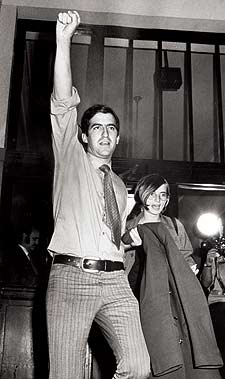
That Saturday morning, as a hard-core group of about 30 of the Weatherman swelled to a 300-strong collection of students, hippies, and anarchists, John Jacobs, a Weatherman leader, leaped onto the pedestal of the destroyed Haymarket statue and tried to rally his troops. Wearing a red football helmet and black leather jacket, “JJ” didn’t mince words. “‘We’ll probably lose people today,'” Flanagan recalls him saying. “When I heard that, I thought, Oh, my God.” Jacobs continued by saying, “We don’t really have to win here . . . just the fact that we are willing to fight the police is a political victory.”
Having again donned their riot gear-football helmets and athletic cups-and chanting antiwar slogans and glaring at passersby, the protesters set out. They proceeded in a seemingly orderly fashion at first. Then, shouting out war whoops and pulling pipes and sticks from under their coats, they scattered and ran into the throng of downtown shoppers, bystanders, and police, both uniformed and undercover. At one corner, a rock shattered a window at an abandoned railroad office to the cheers of the demonstrators. At another, Flanagan says, “someone threw a cop through a plate glass window.” When that occurred, he says, “it was on. The shit was on.”
At Madison and State, Elrod watched the mayhem unfold. Protesters charged wildly through the streets, attacking the police and then being repulsed by them. Officers beat on protesters and bystanders alike. Standing next to a reporter from WBBM radio, Elrod relayed intelligence to city officials over a walkie-talkie.
Suddenly, a flash drew Elrod’s attention. From down the street, he saw Flanagan running from an undercover officer. “What’s going on?” Elrod recalls the reporter asking. “And then I just remember seeing this person and the police behind him saying, ‘Stop! Stop!’ So I said, ‘Excuse me,’ and put down my walkie-talkie and I took off toward him.” Elrod, once a linebacker for the Northwestern Wildcats, streaked through the crowd, headed toward Flanagan.
Flanagan, meanwhile, barreled toward Madison and State. “I was trying to get away from the cops,” he recalls. “They were shouting, ‘Stop him!'” He threw a glance over his shoulder at his pursuers. Then, “I see a suit come running across the street.”
I have to get on the sidewalk, he recalls thinking as Elrod ran to cut him off. “But suddenly, he takes a flying tackle at me. He hits me right here,” Flanagan says, pointing to his hip. The next moments, he says, elapsed as in a projector reel slowed to flashing frames. “With some part of his body, he knocked me sideways,” Flanagan recalls. “He didn’t knock me down, but into that doorway in the photo.
|

The doorway, as Flanagan recalls, led to a stairway down. He fell sideways and tumbled into the entrance of the R and R Western Lounge. “It had these swinging doors like a Western saloon,” Flanagan says. “I got to my feet, but as I turned around to come back up, in comes a posse of police. They pushed me back down the stairs and started beating me. They were whacking me pretty good, when one guy comes around with the billy club. And either I duck or he misses me, but he hits his friend [another police officer] full in the face. This guy goes down in a heap.
“Now they’re not interested in beating the shit out of me anymore, but helping out the guy they hit. The blood’s pouring out of him. When I get back upstairs, they throw me down on the ground. That’s how I end up laid out in the picture you have.”
Elrod’s version differs surprisingly little from Flanagan’s-except in one crucial regard: Elrod insists that after he grabbed Flanagan around the waist, Flanagan threw him to the ground and began kicking him in the head and neck. “He had these big construction boots on,” Elrod recalls, “and he kicked me a few times to extricate himself. I imagine that’s what caused the injury I had.”
Both men agree on what happened next: Elrod cried out, “I can’t feel my legs! I can’t feel my hands!” For a few moments, the two men lay there, each immobilized in his own way. For Flanagan, the prospect of getting up and trying to flee seemed futile. “I said to myself, This is a lost cause. This is it. I’ll go to jail like everybody else. I’m done. I’m all in.” Flanagan was among more than 100 people arrested during the Days of Rage.
Meanwhile, with no precautions taken to make sure Elrod’s neck had not been broken, the lawyer was loaded into a police van and rushed to the hospital, an action Elrod believes may have aggravated his injuries. “They had picked me up with my neck bobbling,” he says. “Probably the pieces of the fractured vertebrae pierced the dura [the fibrous membrane that covers the brain and spinal cord] and caused near severance of the spinal cord.”
—
If the person paralyzed that day had not been a city lawyer, had Weatherman’s leadership not seen an opportunity to cash in on a publicity jackpot, the moment captured in that photograph might have faded like a dying cloud of tear gas. As it was, the trial of Brian Flanagan on charges of attempted murder, aggravated battery, felonious mob action, and resisting arrest became the latest cause célèbre in a growing list of high-profile cases against antiwar demonstrators. Just months before, Abbie Hoffman, Jerry Rubin, and six other activists who became known as the Chicago Eight stood trial in a federal courtroom in Chicago on charges of conspiring to incite a riot at the 1968 Democratic Convention. (Their convictions were eventually overturned.) That trial turned into a circus as the defendants battled with the obdurate judge, Julius Hoffman. Had Flanagan kept his original attorney, a Weatherman lawyer from out of state, similar shenanigans might have erupted. Instead, the group retained a brilliant young Chicago attorney named Warren Wolfson, who was after an acquittal, not publicity.
Born in Chicago and having earned both his bachelor’s and law degrees from the University of Illinois at Urbana-Champaign, Wolfson grew up in a law-and-order household as the son of a deputy with the Cook County Sheriff’s Department. By 1969, when he took on Flanagan’s case, he had already made a name for himself in private practice, having defended members of the Black Panthers, as well as several protesters at the 1968 Democratic Convention.
Along the way he had become known both for a tenacious courtroom manner and for a thorough knowledge of how to get things done in a Cook County courtroom during the 1960s. Flanagan marveled at how smoothly Wolfson operated. “I went with him a couple of times to get records,” Flanagan recalls. “He knew everybody and knew the ins and outs of how to deal with them.”
Wolfson knew that representing Flanagan posed risks to his career. “I made a lot of enemies by taking that case,” he recalls. “People thought I was anti-police. But I was just representing a guy charged with a crime, who needed representation.”
Getting Flanagan off seemed a long shot given the lack of public sympathy for the defendant and his colleagues. “These kids were disruptive; they had very little couth; they had ripped up the city,” recalls the lead prosecutor, Robert Beranek. “They were the antagonists of this thing. So in that sense, we started out ahead of them.”
“The mainstream public opinion at the time . . . was decidedly pro-prosecution,” lawyer Terrence K. Hegarty wrote in the Illinois Trial Lawyers Association Journal. “There appeared to be overwhelming public anger directed at Brian Flanagan and at what he represented. . . . No observers gave the defense any realistic chance for acquittal.”
Where observers saw an uphill climb for Flanagan, however, the city’s Democratic Party saw opportunity. The position of Cook County sheriff constituted one of the most powerful jobs in the state, a patronage plum coveted by both parties. Republican Joseph Woods had held the position since 1966, and before him another Republican, Richard Ogilvie, later governor, had occupied the job. As the November 1970 election approached, Democrats saw in Elrod a chance to wrest the office away. Not only did he have solid credentials, but his injuries during the Days of Rage had garnered him enormous public sympathy.
Elrod’s neck had been broken during the incident, and he had sustained damage to the C4, C5, and C6 vertebrae in his cervical cord. Pieces of the vertebrae pierced the dura, the fibrous membrane forming the outermost of the three coverings of the brain and spinal cord. Initially, doctors feared Elrod might be completely paralyzed. But after several surgeries and physical therapy, he regained some movement in his limbs. He continued his recovery at the Rehabilitation Institute of Chicago, but he would forever remain quadriparetic-a condition marked by weakness in all four extremities.
Despite the physical challenges, Elrod proved an energetic campaigner. Trading his wheelchair for crutches during public appearances, he took to the stump with a tenacity that surprised even the most optimistic doctors. The upcoming trial, it was expected, would only add to his image as a crippled hero by contrasting him with the ne’er-do-well hooligan-Flanagan. The outcome, it seemed, was a slam dunk.
—
In August 1970, in a cramped courtroom with no air conditioner, the trial commenced. Jury selection took two weeks. The prosecution’s case relied heavily on a group of police officers who said that Flanagan had attacked and beaten Elrod. The star witness was Ronald Smith, an off-duty Maywood cop who had attended the march as a moonlighting courier for CBS television. Smith testified that he was trying to subdue a protester when Flanagan leaped from a curb and kicked him. Smith took off after Flanagan.
When they reached Elrod, Smith testified, the lawyer was standing still in front of 56 West Madison Street. Smith said Flanagan ran at Elrod, lifted a two-foot club, and struck Elrod in the head. Both Elrod and Flanagan fell to the ground, he said.
Next up was the most controversial person to take the stand, an eleventh-hour witness named Leason Linzy. A Chicago police sergeant, Linzy was the only person to testify that he had seen Flanagan kick Elrod. He even stood up and demonstrated, performing what Wolfson would later call “a backward kind of toe dance.” Wolfson and Flanagan watched, half-amused and half-incredulous. None of the other officers had seen Linzy anywhere near the scene of the collision between Elrod and Flanagan. No photographs or footage showed the sergeant at the march. Yet Linzy testified that he was near enough to see Flanagan kick Elrod.
When it came time to cross-examine Linzy, Wolfson led the sergeant through his story. Then the attorney delivered the coup de grâce. Asking Linzy to look around the courtroom and identify the man he saw kick Elrod that day, Linzy hesitated, looking over at the three men seated at the defendant’s table. Two of the men were neatly dressed, with short hair. The third man, sitting in the middle, had longer hair and looked somewhat disheveled. Him, Linzy said. Wolfson, barely able to restrain a chuckle, informed the court that Linzy had just picked out Wolfson’s associate counsel, Jeffrey Haas.
The assistant state’s attorney, Beranek, felt the trial slipping away. “We knew we had problems,” he says now. “But what can you do? If somebody says to me, ‘As I came upon the scene I saw Elrod laying on the ground, and I saw the back of Flanagan’s shoe crushing Elrod’s vertebrae,’ what am I going to say? ‘No, you didn’t
see that’?”
To minimize prejudice on the part of the jury toward Elrod’s condition, members were led from the courtroom when the injured lawyer hobbled on crutches to the witness stand. From there, Elrod testified that the only thing he could remember from the incident was Flanagan’s face, then something hitting his head. The next thing he knew, he was on the sidewalk, paralyzed.
Wrapping up its case, the prosecution called Dr. Eric Oldberg. A renowned neurologist who had studied at Oxford University in England before returning to become head of neurological surgery at the University of Illinois School of Medicine, Oldberg provided prosecutors with the kind of gravitas they needed to recover from the inconsistent testimony of the police officers.
Oldberg suggested that Elrod’s injuries were the result of a compression fracture caused by a blow-or blows-to the neck. But on cross-examination, Wolfson pointed out a paper written by a neurologist in 1936 stating that there was almost no way a compression fracture could be sustained by a blow.
When Oldberg balked, Wolfson asked if Oldberg knew who had authored the paper. No, the doctor answered. Wolfson, in the kind of gotcha moment usually reserved for bad television courtroom dramas, informed the doctor that the author had been none other than Oldberg himself. To this day, Beranek remembers the air leaving the room. “Oldberg was just destroyed by Wolfson,” he says.
Up to that point, the prosecution’s case had gone so badly that the defense probably could have won an acquittal without calling a witness. As it was, Wolfson drove more nails into the coffin. He began by calling two people who had happened on the incident, neither of whom had any stake in the outcome. Kirby Smith, a photographer, said he saw Elrodlaunch a flying tackle at Flanagan. He saw no hitting or kicking of any kind afterwards, he said.
Richard Hinchion, an Indiana businessman, had been in Chicago on a shopping trip. He testified that he had a direct view of the incident, from the corner of Dearborn and Madison. He saw the contact, he said. He thought Elrod may have hit his head on the building. No kicking. No hitting.
Then came Flanagan-but not the Flanagan of news pictures, the shaggy-haired militant in construction boots and fatigues. “When Wolfson brought Flanagan into court he looked like an altar boy,” Beranek recalls.
“I was dressed to a T,” Flanagan says, chuckling. “I had a nice suit. My hair was cut. I was nice to everyone. But my blood was boiling inside.” Indeed, Flanagan recalls, “in the pretrial I went off a little. Beranek was ragging on me for something and I snapped back at him, and Wolfson said to me, ‘All right, Brian, here’s the thing. You do that during the trial, you just throw everything out. You lose.'”
To keep his own temper in check, Flanagan recalls, he took a tranquilizer. “When I was on the stand I was halfway to cloud nine,” he says now, laughing so hard it sends him into a coughing fit. “I had a drink, too. I had a Scotch. It was like getting morphine in the hospital. Nothing was going to get to me. I loved the police. I loved the prosecutor.”
—
In his closing argument, quoted in the next day’s Chicago Tribune, Beranek warned the jury that an acquittal would signal “an invitation to the SDS and other subversive elements to come here and adjudicate their differences in the street.”
Wolfson countered in what many would call a masterpiece of courtroom oration. “Much bitter feeling came out of that day,” he told the jury. The “feeling that young people somehow were our enemies, somebody to fear, even hate. I think we have had enough of that. It’s time now to heal the wounds, to close that gap, because this is one country and one nation; and a nation that hates its young people has no future.”
—
The jury of eight men and four women chose as its foreman Charles Schoenberg, a 63-year-old Republican banker. They deliberated a mere five hours before returning their verdict at 9 p.m. on August 20th: not guilty on all counts. Beranek snapped his pencil. Flanagan, who had handled himself with aplomb throughout the trial, punched the air with his fist. Mortified, Wolfson grabbed his client’s arm and yanked it down. Flanagan’s girlfriend at the time, Sylvia Warren, let out a whoop. Judge Saul A. Epton, whose brother would later lose a bid for mayor to Harold Washington, tried to restore order. The judge admonished Flanagan and others to restrain themselves until they left the courtroom.
Once outside, Flanagan tore off his brown double-breasted sports coat and raised his fist again in a “power” salute. Then he gave his opinion of Chicago. “I sat in that courtroom for a month,” he said. “Law and order in Chicago is a farce. I want to get back in the streets where I can fight. I want to live the way I did. . . . I plan to return to New York. I plan to make love and war.”
When reporters asked his reaction to Flanagan’s outburst, the crippled Elrod said it showed what type of person Flanagan truly was. “Mr. Flanagan was presented as a clean-cut kid throughout the trial,” he said. “But these statements were horrible ones to make. I understand that he espouses violence. I abhor violence. I am a victim of violence.”
Elrod added that the verdict “should have no bearing on my qualifications for the office which I seek. . . . I hope it won’t make a hero of Flanagan.”
Brian Flanagan’s acquittal reverberated across the country, and for a brief time, it seemed to both energize Weatherman and even give some validation to the group’s violent tactics. Beranek recalls being crushed. “You want to win,” he says. With benefit of hindsight, however, he acknowledges that justice was probably served. In the first place, he now believes, Flanagan should never have been charged with attempted murder. Moreover, the conflicting testimony of the police witnesses cast doubt even with him as to whether Flanagan ever hit Elrod. “I didn’t condone what these people were doing,” says Beranek, who is now a lawyer in private practice in Orland Park. “But as I reflect, [a conviction] wouldn’t have been right.”
Wolfson, meanwhile, sees the verdict through a looking glass tinged with irony. For starters, his father-a deputy sheriff-wound up working for Elrod. Within a few years, Wolfson himself was tapped to serve as a lawyer for Mayor Richard J. Daley and appointed as a special counsel for the Chicago Police Department in an investigation into undercover police activities. In December 1975, Wolfson was appointed as a Cook County circuit court judge, and in 1994 he moved to the Illinois Appellate Court, First District, where he is currently one of 24 judges.
In Wolfson’s view, the real losers in the Flanagan case turned out to be Weatherman. Flanagan’s acquittal actually “did the revolutionary movement great harm,” Wolfson says. “All the underground newspapers were talking about how Flanagan was being railroaded by the system and that you couldn’t get a fair trial in Cook County. His acquittal proved that to be absolutely wrong.”
Indeed, the trial did seem to herald the long, steady downfall of Weatherman. Shortly after Flanagan’s acquittal, the group went underground and began what would be a series of bombings and attacks on government buildings, including the U.S. Capitol and the Pentagon. That tactic, however, backfired spectacularly in 1970: three members of the Weather Underground were killed when a bomb members were preparing went off in a Greenwich Village townhouse.
—
For a few years after his trial, Flanagan participated in the group’s activities. He traveled to Algeria, for instance, to appear with Timothy Leary, the LSD guru, whom the group had helped to escape from prison. By the mid-1970s, however, most members of the Weather Underground, spurred in large part by the townhouse deaths, had reconsidered their credo of random violence.
Flanagan was one of the first to quit the group, having left in the mid-1970s. “I missed home; I missed my girlfriend,” he says. “All we were doing was putting bombs in bathrooms. One day I just walked out.” He worked as a carpenter for a while and then as a bartender for 12 years at the West End, a hangout popular with Columbia University students. Eventually, he began working for the Burgundy Wine Company. He became a trivia buff, even appearing in 1996 on the television game show Jeopardy, where he won $23,000.
In the early 1990s, he played pool on a professional billiards circuit for a year. In 2003, a little grayer, a few decades older, Flanagan took a stool at the bar he owned by then and began to speak into the movie camera as one of the featured voices in the documentary film The Weather Underground. Released in 2003, the film traced the history of Weatherman from its rise just before the Days of Rage to its disbandment in the early 1980s. On a small scale, the movie made Flanagan the star Elrod had feared.
Today, Flanagan tends bar five days a week at the Night Café, a small tavern near Columbia that he bought in the early 1990s. He recognizes the irony: that he has become the very thing he preached against for so long-a capitalist business owner. But he laughs at the suggestion. “Are you kidding?” he says. “Look at this place. It’s one step up from a pushcart!”
Business ownership is not the only bourgeois predilection he has developed. He is a dedicated foodie who likes to compare notes on the city’s best restaurants with his bar’s regulars. He is a connoisseur of fine wines, having toured regions in France and California. And he loves to play golf. “All I can say is that I like a lot of things that are bourgeois. I just don’t like the bourgeoisie,” he says.
—
In the movie, Flanagan expresses some disdain about the group to which he once dedicated his life. Nonetheless, if there’s any doubt that Flanagan still hews to the Far Left and to the use of violence as a means to an end, one merely has to bring up the issue of current politics. President Bush? “The worst president of our lifetime-but I despised [Massachusetts senator John] Kerry, too. The guy was a war criminal, bragging about killing Vietnamese teenagers.”
He’s getting revved up now. His eyes flash fire. His mouth pinches to a slash. His latest passion is the radical Palestinian group Hamas. Discussing it, Flanagan rants against Israel. And don’t get him started on the war in Iraq, in which he backs the insurgency and its use of violent attacks. Too many parallels with Vietnam, he says. “Get the fuck out of there!” he says. It’s obscene . . . illegal . . . immoral. . . . In fact, if he were 30 years younger he would get out there himself and . . . He catches himself. He looks up and his face softens. He shakes his head and begins to laugh. “See, you got me started,” he says.
—
From the vantage point of nearly 40 years and a last, long look at the black-and-white image of himself and Flanagan stretched out on a sidewalk, Judge Elrod is ready to pronounce his verdict.
Since his collision with Flanagan that October afternoon, his life has been an unbroken string of professional successes. He won a photo-finish race for sheriff against Republican Bernard Carey in November 1970-just three months after the trial in which a jury rejected his version of events. He would be elected again and again over the next decade and a half-finally relinquishing in 1986 the position he had held for 16 years.
In that year, he became a senior assistant attorney general for Illinois. Two years later, he was appointed by the Illinois Supreme Court to the Cook County circuit court judgeship he still retains. On the bench, Elrod “has served with distinction and compassion,” a 2002 evaluation by the Chicago Bar Association found. “He is rated excellent in all categories and his integrity is beyond reproach.”
Today, Elrod still struggles against the physical limitations imposed on him by his paralysis. To get around, he uses either crutches or canes or an electric scooter that sits in the hallway outside his judge’s chambers. Nonetheless, he says he harbors no bitterness-either toward Flanagan or about his fate: “I’ve got enough problems in life-and enough happiness. I have two good children and four grandchildren and a wonderful wife who has probably suffered more than I have.”
His lack of animosity toward Flanagan, however, does not extend to absolution or forgiveness. “It’s hard to forgive when the fact remains that Brian Flanagan was there and he was participating in a demonstration that turned violent,” Elrod says. He still believes that Flanagan was the aggressor that day. And he has never quite gotten over Flanagan’s defiant rant after the verdict.
And yet, in what may be a final unexpected turn, Elrod seems far less resentful than his adversary. In fact, he believes justice was served through Flanagan’s acquittal-at least on the charge of attempted murder. “I don’t think he ever meant to kill me,” Elrod says. “I also don’t think he felt sorry for anyone he has hurt. But I can’t go through life hateful or upset at people; life isn’t worth it.”
Thus it was that in 2001, just before the September 11th attacks, Elrod accepted an invitation to dinner with two of the onetime leaders of Weatherman-Bill Ayers and Bernardine Dohrn. At a restaurant in downtown Chicago, Elrod and his wife listened as the two former radicals, now long married, with a family of their own, apologized for the heartache and suffering Elrod endured as a result of that day. The pair made it clear that they did not believe Flanagan caused Elrod’s injuries, and that they were not disavowing their militant beliefs. Still, “they were remorseful,” Elrod says. “They said, ‘We’re sorry that things turned out this way.'” (Calls and e-mails seeking comment from Dohrn and Ayers were not returned.)
Thus, his comment about the picture is perhaps not surprising. “No reaction to speak of,” he says, handing it back. A moment later, however, he lifts his arm heavily and reaches out toward the photo. Grasping it with an almost feeble grip, he looks at it one more time. “Let me keep that,” he says, as he opens a desk drawer, drops the picture in, and slowly slides the drawer shut.