

|
On a hot July morning, the seats in room 208 of the Cook County Circuit Court at 26th and California fill up quickly, long before the lawyers arrive. The small room is lined with wooden benches; a glass wall separates observers from the courtroom, and microphones broadcast the proceedings to them. In many ways, the space resembles the crying room at the back of a church, where parents retreat with babies to avoid disturbing the service. It’s an ironic touch, since many of the observers are parishioners from St. Margaret Mary, a Roman Catholic parish of predominantly Irish American families on the Far North Side of Chicago. The personal-injury lawyer Philip Corboy grew up in the parish, and the Cook County state’s attorney, Richard Devine, is a current member of the church.
The draw today is the sentencing of the Reverend Mark Sorvillo, 55, the former pastor of St. Margaret Mary. In October 2006, the state’s attorney’s office charged him with stealing nearly $200,000 from his parish to support a lavish lifestyle of travel, attendance at Lyric Opera, and shopping at luxury department stores. Although not charged with it, Sorvillo also gave parish money to a married friend who lives in Kentucky but frequently traveled to Chicago to perform as a stripper at gay clubs. Sorvillo’s looting of the church funds so depleted the finances that the parish school was almost closed.
The parishioners caught Sorvillo through both a rebellion against his decision to close the school and a sting operation that proved he was stealing funds. They turned their evidence over to the Archdiocese of Chicago, which in turn presented it to the state’s attorney’s office. “It’s been a long and emotional road,” says Dan McGuire, one of three parishioners who led an internal audit that revealed Sorvillo’s financial extravagances.
When Sorvillo enters the courtroom, he avoids the parishioners’ glances. Relieved of his priestly duties by the archdiocese in February 2006, Sorvillo, tall, balding, and stoop shouldered, still dresses in black clothes. Accompanying him is an attractive 40ish woman dressed in a lavender jacket and wearing a gold cross around her neck. Sitting next to him on a bench, she frequently pats his shoulder.
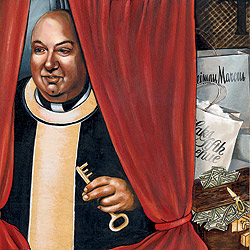
Stealing more than $100,000 from a place of worship is a Class X felony punishable by up to 30 years in prison. But Sorvillo and his lawyer, Brian Collins, have agreed to accept a plea deal for a four-year sentence. Called into the courtroom by Judge Diane Gordon Cannon, Sorvillo is asked how he pleads. “Guilty,” he answers. Dianne Ghaster, an assistant state’s attorney, asks to read the evidence, an idea that Collins fights. His reluctance is easy to understand once Ghaster starts her list of charges: that Sorvillo skimmed more than $40,000 of collection-plate money, stole parish funds to pay for expensive presents from Neiman Marcus and other stores, and tried to pass off the rental of a vacation house and the purchase of fishing equipment as expenditures for church vestments.
“This was an eight-year pattern of continuing deceit and greed,” says Ghaster. “The defendant took full advantage of his parishioners’ understandable reluctance to vigorously question the actions and explanations of their priest. He used the money not to aid the poor or bring comfort to the suffering but to shop at Neiman Marcus and Saks Fifth Avenue; to vacation in Paris, London, and Venice; to dine in expensive restaurants; and to purchase $970 of liquor in one trip to a store.”
When Cannon asks if he has anything to say, Sorvillo answers no. She then sentences him to four years (which means he could serve as little as two, says a source in the state’s attorney’s office). Sorvillo then is instructed to remove his black leather belt and his thin-as-a-wafer gold watch. As he walks away with the bailiff, he never looks at anyone in the observation room. He will be sent to the Vienna Correctional Center, a minimum-security facility, in Vienna, Illinois.
“It’s over,” says one of the spectators, and people begin to file out. In the hallway, the woman in lavender, who identifies herself only as “Mark’s cousin,” says, “We’re praying for him.”
“You know, this is only the tip of what he stole,” says McGuire. “We estimate the real number is between $500,000 and $600,000. And it won’t really be over unless some of that money is restored to the parish.” (Discussions with the archdiocese about the restoration of funds are just beginning.) Even then, some parishioners say, their trust in some of the church’s authority figures—both parish priests and the archdiocesan administration that oversees them—is shaken.
In recent years, scandals involving Catholic priests have overwhelmingly dealt with issues of sexual abuse. But the case of Mark Sorvillo and St. Margaret Mary suggests a new area of concern. In 2005, Brian Lisowski pleaded guilty to pilfering about $1 million from St. Bede the Venerable parish on the Southwest Side of the city. The following year, the pastor of Our Lady of the Snows, Robert Wielosinski, pleaded guilty to stealing more than $200,000 from the parish, also on the Southwest Side. Sources in the Cook County state’s attorney’s office say that it is currently investigating several cases of the possible theft of church funds.
In the past two years, the Chicago archdiocese has added a page to its Web site where people can report suspected financial improprieties. “In the case of St. Margaret Mary’s,” says Bob Milan, first assistant state’s attorney, “the problem was that the archdiocese didn’t take much action to stop what was happening until the parishioners forced the issue.”
“We followed all the outlined procedures,” says Tom Brennan, the director of finance for the Archdiocese of Chicago. “A number of corrective actions were taken with Father Sorvillo, which included clear definitions of personal versus parish expenses and how they should be separated. He was also advised on proper recordkeeping.”
“We followed the rules, and nothing stopped Sorvillo from stealing the parish’s money,” says Mike Dooley, a member of the parish’s finance committee from 1999 to 2006. “We saw the problem. We complained about the problem. And, finally, when nothing was being done, we devised a sting operation to catch him ourselves.”
* * *
Illustration: Lisel Jane Ashlock
|
|
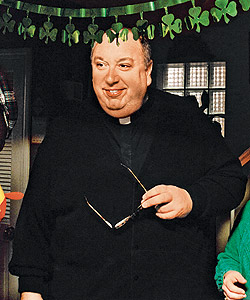
Mark Sorvillo is a historian as well as a priest. He earned his graduate degree in church history at the University of Chicago, and he loved to talk to people, including this reporter for a 2005 Chicago magazine story about the history of the city’s parishes. St. Margaret Mary was founded in 1921 by the Luxembourg and Irish families who lived in West Rogers Park. They envisioned a parish that would be woven into the fabric of their everyday lives—not a show-place church like St. Jerome in East Rogers Park. The first building, at 7318 North Oakley Avenue, is now the school. Then came the current church, in an Arts and Crafts style, at 2324 West Chase Avenue. In the 1980s, a parish assembly hall was built on one of the school’s blacktop playgrounds. The parish has always been one of fierce loyalties. Generations of families have gone to church there, have sent their children and grandchildren to school there. And underestimating that loyalty was a large part of Sorvillo’s undoing.
Sorvillo grew up in Westchester, Illinois; his father died when Sorvillo was young, and his mother raised him and his sister, Kathy, by herself. As an undergraduate, he attended the University of Notre Dame. Physically, he was hard to overlook: six feet five inches tall and, by the time he was ordained at Holy Name Cathedral in 1978, more than 300 pounds. Those being ordained wear red, and a fellow priest teased Sorvillo that day, calling him “the fattest tomato” at the altar. “He was always a very intelligent guy,” says John M. Collins, the pastor of St. Joachim on the city’s South Side, who became friends with Sorvillo while they were in the seminary together. “And for many years, he was a good priest. But who knows what happens in someone’s life to make him go off track and do something like this?”
“He has said he did it—that’s what pleading guilty means—and he accepts his punishment,” says Brian Collins, Sorvillo’s lawyer. “Other than that, there is nothing to say.”
Sorvillo completed his doctorate at the University of Chicago. His thesis was on the Chicago bishop Bernard Sheil and the founding of the Catholic Youth Organization in 1930. He worked as an associate pastor at parishes in Buffalo Grove and on the West Side of Chicago. He wrote occasional reviews of church history books for Catholic publications, and in 1993 his letter to the editor about the growing scandal of priest abuse was published in the Chicago Sun-Times. “It is our responsibility to set a high moral standard for the people of God,” Sorvillo wrote. “When any priest fails in this duty, it reflects negatively upon the entire presbyterate.”
In July 1994, Sorvillo was appointed the pastor of St. Margaret Mary. For the first time, he had a parish of his own. “He was very articulate, very informed,” says the parishioner Tim Murtaugh. “He could talk about architecture, opera, theatre, and traveling.” And he had sophisticated tastes in food and wine. But his sermons left many people uninspired, and, according to Peggy Cunniff, the school board president, “he lacked an interest in many family activities. You never saw him at softball or basketball games.” In fact, parishioners soon noted that they rarely saw him in his rectory office. Instead, he met with members of the school board in the pastor’s residence, which he had appointed with Tobyware jugs, comfortable chairs, and a massive book collection.
Before Sorvillo’s arrival, there had never been a parish credit card. He immediately signed up for parish cards from Visa, American Express, Marshall Field’s, and Neiman Marcus. He also told the finance committee that the rectory kitchen needed to be renovated. “We wanted to make him happy,” says McGuire. “But we also knew that the school needed new windows.” The finance committee budgeted $10,000 to $15,000 for the kitchen renovation. Then Sorvillo signed a contract for a $60,000 rehab.
In the Archdiocese of Chicago, a parish finance committee is only an advisory group to the pastor. Members of the committee are volunteers who have no check-signing or bank-account privileges. Those privileges belong to the pastor. “And it used to be that the pastor ruled with an iron hand,” says McGuire. “In recent years, the archdiocese has said that the finance committee has more oversight responsibility.”
Brennan, the archdiocese’s finance director, says that the fiscal oversight of a parish is a delicate balancing act. “It’s not run like a nonprofit, with a board of directors voting on all decisions,” he explains. “The pastor is, in effect, the chief executive officer of the parish. He makes the final decisions.” But starting in 2005, the archdiocese began supplying a system of safety nets for parishioners. These include the use of tamper-evident sealed bank bags for weekly collections, a codified system for handling weekly collections, and the oversight of parish finance committees as part of the diocese’s audit of parishes. The archdiocese’s Web site now includes an ethics e-mail system, and anyone can report suspicions about a parish’s financial situtation. “Any potential problem has someone from our office looking at the parish books within a week,” Brennan says.
But some of these changes came too late for St. Margaret Mary and its renegade pastor. “We could complain,” McGuire says, “but we had no power to stop him.”
* * *
Over time, people in the parish noticed that Sorvillo enjoyed the finer things in life. He led parishioners on trips to Europe, where he invariably chose expensive restaurants. He had tickets to Notre Dame football games and to Lyric Opera productions. He threw elaborate Christmas parties in the rectory for the choir. He used his extensive collection of fine china and crystal for these occasions, serving vintage wines and Godiva chocolates. “Still, it was hard to believe that your parish priest would be using your money for these kinds of things,” says Cunniff. “There was a basic trust there, although over time the trust started to wear thin.”
Sorvillo’s sister was married to Frank Fiascki, a stockbroker, and they lived in an affluent suburb of Philadelphia. Family money, parishioners believed, explained how Sorvillo could indulge his expensive tastes.
“I knew it wasn’t true,” says McGuire. When Sorvillo’s mother died in the late 1990s, he asked the finance committee if he could borrow $8,900 to cover funeral expenses until he received his mother’s insurance money. He paid the money back. “This wasn’t a con,” says McGuire. “My wife and I went to his mother’s funeral. There didn’t appear to be big family money.”
Between 1999 and 2000, St. Margaret Mary’s finances became more confused than ever. Control was in the hands of Sorvillo. His finance committee chair was James Brockhagen, who owned the Pinewood Tavern on Touhy Avenue and at the time also worked as the paid business manager of St. Jerome parish in East Rogers Park. “We had no access to any real records,” says finance committee member Dooley. “No receipts. We’d get a piece of paper that said, ‘Food and rectory expenses: $55,000 annually.’ And we’d say, ‘OK, what are we spending this on?’ Never an answer. It drove us nuts. The hidden truth was we were hemorrhaging money.”
Reached by phone, Brockhagen says, “I have no interest in talking about any of this. It was a long time ago.”
By 2000, Sorvillo had a lot to hide. According to the state’s attorney’s office, he had discovered a secret parish money-market account that had been opened by his predecessor for capital expenses. Neither the finance committee nor the archdiocese knew of this account. Sorvillo began to inflate its balance, primarily depositing bequests to the parish. He wrote 98 checks against this account, totaling more than $138,000; he used the money to pay his credit-card bills—including charges at Bloomingdale’s and for opera tickets and the rental of a summer home in Wisconsin.
Around this time, he met James Sosnicki, a 20-something married man. Sosnicki lived in Louisville, Kentucky, but he traveled to Chicago to work as a stripper in gay clubs such as Cocktail and Man’s Country. Sorvillo and Sosnicki met at a gay bar in Andersonville. Later, Sosnicki would claim that their relationship was never sexual but that Sorvillo had paid him $1,000 a month, had given him presents, and had taken him on trips. “He was like an uncle to me,” Sosnicki would tell investigators. (Sosnicki currently works as a carpet cleaner in Louisville, but his phone has been disconnected.)
In August 2000, the secret money-market account was discovered by the Archdiocese of Chicago after St. Margaret Mary’s finance committee complained to the administration about Sorvillo’s spending and his lack of recordkeeping. Sorvillo responded by saying that he had thrown away all his bank records and receipts. His superiors admonished him and gave him a copy of the archdiocese’s pamphlet Business Administration—Best Practices. From that point, Sorvillo’s spending only escalated. About the same time that he received a leadership award from the Rogers Park Community Council in 2001, Sorvillo was using parish funds to buy Sosnicki an Acura. The pastor also wrote about the Enron debacle in the church’s weekly newsletter, saying, “The web of deceit, rampant corruption, and pervasive lying which extends to the very board room is shocking. . . . How can anyone be so completely selfish, one wonders.”
Then Sorvillo bought Sosnicki a Dell computer and a motorcycle. He also ran up expensive restaurant bills on the parish’s credit cards, dining at Bice, Frontera Grill, Coco Pazzo, and Gibsons. The only time the spending slowed was in December 2003, when Sorvillo ended up at a hospital emergency room with chest pains. With his weight then up to 400 pounds, he took a leave of absence for gastric-bypass surgery. Sorvillo resumed his duties as pastor by the spring of 2004.
That was a time of contrasts for Sorvillo. Having lost almost 200 pounds, he felt better and began to buy himself new clothes, including an expensive leather jacket. Some young adults at St. Margaret Mary told their parents they had seen Sorvillo at a gay bar in Lake View. At the same time, his brother-in-law, Frank Fiascki, was found guilty of swindling 23 victims—many of them elderly pensioners—out of $2 million through a Ponzi scheme. The Pennsylvania judge who sentenced Fiascki to 8 to 20 years in prison called him a “calculating con artist.” (Kathy Sorvillo Fiascki did not return calls for this article.) “Later we wondered if he had been stealing money to send to his sister,” says McGuire, “but it turned out he was sending her only $100 a month. He spent more than that every time he ate dinner out.”
In the summer, Sorvillo and Sosnicki took a trip to New York, paid for by parish funds, where they saw Broadway plays. In August 2004, Sorvillo ran up a $607 bill at Le Bernardin, a four-star restaurant in New York. The next night, the tab at Jean Georges, another four-star establishment, was $927.
“You have to understand that, at the same time, we are always being told by Mark that we are not raising enough money, that the school is in dire trouble, that the church needs more funds,” says Cunniff. Sorvillo asked several parishioners to stand up at Mass and share their personal histories of the parish with everyone and then ask their fellow Catholics to donate more money. “He used people everyone respected to try to wring more money out of the parish,” says Dooley. “There were rumors about his spending and a lot of suspicions,” says Cunniff, “but he still might have gotten away with all of this if he hadn’t tried to close the school.”
* * *
On Friday, November 5, 2004—the day before the annual parish dinner dance and silent auction—a notice was sent to the parents of parish schoolchildren. It announced a special meeting the following Monday. “I was the school board president, but Sorvillo wouldn’t tell even me what the meeting was about,” says Cunniff. “He just refused.”
Most parishioners at St. Margaret Mary consider the grade school the heart of their parish. “There might be parishes that are vibrant and growing without a school,” says McGuire, whose family has had three generations attend the school, “but I can’t think of one.” Admittedly, by the fall of 2004 the enrollment at the grade school was at an all-time low of 163 students (the peak enrollment had been 14 years before with 560). But suggestions made by the school board and parents to reinvigorate the school by expanding the preschool and kindergarten had been rejected in recent years. “A preschool and a kindergarten are the engines that feed students into your system,” says Dooley, “but Sorvillo and the principal—someone who had taught me back in third grade—always flatly refused to consider the idea.”
At the Monday-night meeting, an anxious audience of 150 parents gathered in the assembly hall. Sorvillo and Brockhagen announced that due to financial difficulties the parish school would be turned into a charter school. Renting out the building for a charter school, they argued, would generate an annual income for the parish, providing a needed influx of funds.
“They presented the charter-school idea as a great thing, even though it was turning a parochial school into a public school,” says Tony Porto, the vice president of the school board. “Don’t worry about it, they said; the kids can have religious classes after their school day.” Sorvillo had more news: The part-time marketing and development person who had been hired for $20,000 a year had actually spent her time writing the charter-school proposal; a charter-school application fee of $10,000 had already been paid by the parish; and the teaching staff had been given bonuses, including $3,500 for the principal.
“The explosion of anger in that room was incredible,” says Cunniff. By all reports, Sorvillo and Brockhagen lost control of the meeting when parents refused to stop shouting questions and complaints. Finally, Sorvillo concluded the gathering by saying there would be a parishwide meeting three nights later to inform everyone about the charter-school idea. “It was the dumbest thing he could have done,” says Cunniff. “It gave us time to mobilize.”
Fliers were handed out. A notice about the upcoming meeting was posted on the marquee in front of the school. And then, on Thursday afternoon—several hours before the meeting—Cunniff heard that the sign on the marquee had been changed. It now read MEETING CANCELED. “I called Mark, and he said, ‘No, this isn’t the time to have a meeting. People are too upset.’ Then I found out he had changed all the locks on the buildings. The entire laity was locked out of every building.”
If Sorvillo had hoped that would deflate the momentum gathering against him, he grossly underestimated the level of frustration within the parish. Organizers decided to hold the meeting anyway; if they couldn’t get inside the parish buildings, they would meet in the parking lot. In bitterly cold weather, more than 400 people gathered outside that night. Sorvillo had turned off the floodlights that illuminated the parking lot, but people brought candles and cocoa. They also called television news crews, and images of bundled-up people fighting for their school filled the late-evening newscasts. “That night the majority of the parish finally stood up and said no to Sorvillo,” Dooley recalls.
The next day, Sorvillo left for a vacation in Hawaii.
* * *
The following week was a busy one. Another meeting was held in the school gym (by then the athletic director had new keys). Overwhelmingly, people wanted the school to stay open; it was decided that a committee would meet with the archdiocese. People also wanted a full accounting of parish finances; three former heads of the finance committee—Dan McGuire, Bill O’Connor, and James Nally—were asked to conduct an operational audit. And they wanted a special bank account set up for donations to the school—one to which only the school board would have access. A pledge program was started, and families promised that all the current students would return the next year. Plans were formulated for a toddler play group and an enlarged preschool and kindergarten. And Cunniff left word on Sorvillo’s voice mail that the operational audit committee and the school board wanted a meeting with him the evening he returned from Hawaii.
At that meeting, a delegation from the parish, which included the state’s attorney, Richard Devine, presented its demands: that a new principal be found for the school; that Brockhagen step down as finance chairman; and that the plan for the charter school be abandoned. Sorvillo agreed.
In January 2005, the operational audit committee produced its interim report. It detailed wild fluctuations in the weekly cash collections from services, extensive credit-card abuse, and poor financial recordkeeping. McGuire, O’Connor, and Nally—now being called the Three Amigos around the parish—also discovered that Sorvillo had inflated his salary by $1,000 a month (the amount he had been paying to Sosnicki for his company), had pocketed “stole fees” (money given for baptisms, weddings, and funerals), and had written checks from a special parish account for long-term goals to cover his own credit-card bills. The first check he had written from that account was for $10,000 to Marshall Field’s. Also, every Monday, Sorvillo made a cash deposit to his own personal checking account—which explained why the Sunday collections were always so low.
“It was flagrant,” says McGuire. “He just took and took and took.” McGuire says that the audit committee didn’t find evidence linking Sorvillo to Sosnicki. “We didn’t get the answer to everything; we found enough to see that there were terrible problems and that it needed to be turned over to the archdiocese.”
The archdiocese put Sorvillo on probation. A new system was put in place for Sunday collections. In the end, an audit concluded that Sorvillo had stolen more than $40,000 in cash from the collection plates.
For most of 2005, Sorvillo’s spending was under control. After all, he had no more credit cards and no more easy access to the cash collections. But in December, the bank bags for Christmas Eve, traditionally one of the most heavily attended and most profitable services of the year, showed almost no cash from the collections. “It was ridiculously unbelievable that there would be no cash from the Christmas Eve Masses,” says Dooley. Somehow, Sorvillo had managed to circumvent all the parishioners’ precautions. Dooley says the finance committee immediately complained to the archdiocese but was told to “wait a week or two” to see what would happen next. “That’s when we decided we had to devise our own sting operation,” says Dooley. Starting with the collections on January 22, 2006, serial numbers on the bank bags were secretly recorded. That day’s bags showed new serial numbers—an indication that the bags had been switched. “We informed the archdiocese, and we were told to do it again another week,” says Dooley. “And then another week.” Continuing through February 12th, the bags turned in to the bank had different serial numbers on them.
On February 14th, Sorvillo was called to a meeting at the archdiocese’s downtown office and confronted with the four weeks of evidence. He admitted he had opened the bags, taken out the cash, and put the remaining checks in a new bag, forging the ushers’ signatures. At the time, he estimated he had misappropriated about $10,000 of parish funds, a statement the state’s attorney’s office would later call a “gross underestimate.” Sorvillo was relieved of priestly duties, meaning he was no longer allowed to conduct sacraments, and he was told to leave St. Margaret Mary without packing up his belongings. He moved into the St. Joachim rectory on the South Side, where a longtime friend from the seminary was the pastor.
The state’s attorney’s investigation continued throughout the spring and summer of 2006. “This is a complicated, layered case that took a great deal of time and energy,” says Scott Cassidy, the supervisor of the special prosecutions unit.
Law enforcement officials uncovered Sorvillo’s relationship with Sosnicki. In the belongings Sorvillo had left behind at St. Margaret Mary’s rectory were several photos of Sosnicki. One showed him as a finalist in the 2004 International Mr. Leather competition; one showed him standing in front of the rectory’s bookcase, a boyish grin on his face; and another showed him naked, sleeping in Sorvillo’s rectory bed.
In October 2006, the state’s attorney’s office charged Sorvillo with felony theft. He spent a day in jail and then was out after posting 10 percent of his $100,000 bond. His mug shot made the papers, and the next week at the St. Margaret Mary Halloween party, an adult parishioner appeared with the mug shot blown up and turned into a mask. Completing his costume were a sports coat with fake money springing out of all the pockets, a Robin Hood-style hat, and big shopping bags from Bloomingdale’s.
* * *
On a Sunday morning in July, the temperature at St. Margaret Mary is not too high yet, which is good since the church is not air-conditioned. The 10 a.m. Mass is full, and before the service starts, the pews are abuzz with news about Sorvillo. The Sun-Times had printed a photo of Sosnicki that morning, along with its coverage of the former pastor’s sentencing. Parishioners recognize that Sosnicki was standing in the living quarters of their rectory.
The Mass proceeds without incident. The choir sings; the homily is based on the New Testament story of Martha and Mary. Then, at the closing, Father Hal Murphy reads a note from the current pastor, the Reverend James Barrett, who is vacationing in Ireland. “Many of us anticipated that our parish’s nightmare had ended with his plea bargain, confession, and sentencing,” says the note from Barrett. “Unfortunately, other information about Father Sorvillo has come to light. . . . It is our fervent hope that the storm clouds of scandal will eventually pass from St. Margaret Mary’s parish and that together, with God’s help, we can begin the process of rebuilding the morale of our community.”