

For nearly two centuries, the events that transpired in Chicago on August 15, 1812, had been known as the Fort Dearborn Massacre. With the dedication of a new park, the bloody encounter between 95 soldiers and settlers and some 500 Potawatomi has been recast as the Battle of Fort Dearborn. What really happened on that hot August morning in Chicago 197 years ago?
It didn’t matter that the snowdrifts stood tall as a man nor that an intense cold battered his tiny cabin. Simon Pokagon was hot. For most of his 67 years he had heard the tales of Potawatomi savagery at Fort Dearborn. Now, pacing the floor of his Michigan home and fulminating at a reporter from the Chicago Daily Tribune, the old man—the son of a great Potawatomi leader—vowed to fire back using the same weapon as others before him: a book.
“The whites have books, many books,” he said, clenching his fist. “And in those books they tell of the Indians—and what the white man writes, the white man reads and believes. I have read many stories of the fight in Chicago, and they all speak of the deviltry and the treachery of the Indians. I am writing a book that will tell of the treachery of the white man. I will tell the truth as my father told it to me when he was middle-aged and when he was old and dying, and all the time the tale was unchanged in the telling. Some men and a woman—whites, all of them—have written stories of the fight between the soldiers and the Potawatomi. Now let an Indian tell it.”
As his own words suggested, Pokagon was not yet born on that sweltering August day in 1812 when some 500 Potawatomi (likely accompanied by warriors from a few other tribes) descended upon a small column of white soldiers and civilians as they evacuated Fort Dearborn. But the tale told by his father—who had been there—differed from the narrative known to most Chicagoans. Now Pokagon promised to set the record straight.
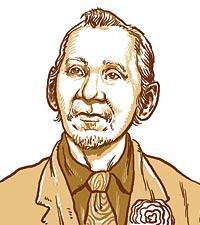
Unfortunately, Pokagon—a Potawatomi known for his occasional writings and his appearances at the World’s Columbian Exposition of 1893—never did write his book about Fort Dearborn. (In quoting Pokagon—his name is pronounced “poe-KAY-gun”—I compressed his remarks and modernized some spelling and punctuation.) On January 27, 1899, two years after his interview with the Tribune, he died in his Michigan cabin. Shortly after his death, a long article he had written appeared in Harper’s magazine under the title “The Massacre of Fort Dearborn at Chicago.” Pokagon might have balked at that use of the word “massacre,” presumably put in the title by an editor, though he used the word frequently himself. “When whites are killed, it is a massacre,” he had told the reporter from the Tribune, “but when Indians are killed, it is a fight.”
As it turns out, Pokagon’s comment anticipated a semantic controversy in modern-day Chicago. On August 15, 2009—the 197th anniversary of what for decades had been known as the Fort Dearborn Massacre—people gathered at 18th Street and Calumet Avenue for the dedication of a new park. The park occupied the site of the violent encounter, yet the rather unwieldy name chosen for that patch of green was the Battle of Fort Dearborn Park. Battle? What gives?
Naming the park was no snap decision. Sparked by the efforts of Mark Kieras, a resident of the historic Prairie Avenue district, city officials and neighborhood leaders, along with representatives of the Illinois National Guard and a local band of Potawatomi, had been discussing potential names for more than two years. Almost from the beginning, any inclusion of the word “massacre” had been off the table. “The problem with the word ‘massacre’ is that it’s a loaded descriptor,” says John N. Low, a member of the Michigan-based Pokagon Potawatomi and a visiting assistant professor in the American Indian Studies program at the University of Illinois at Urbana-Champaign.
Low helped decide on the name, and he describes a series of conversations conducted in a spirit of compromise and consensus. “History is not truth; it’s memory,” he says. “And a part of remembering is considering what we forgot. This name helps us reimagine history, helps us reconsider what’s important and not important to tell our grandchildren.”
So the Battle of Fort Dearborn Park it is. But lost in this debate over names were the more fascinating details of what happened nearly 200 years ago at 18th and Calumet. (“Calumet” is a French word for the long-stemmed ceremonial tobacco pipes used by various Native American tribes; today we might call it a peace pipe.) It’s not a subject that consumes people today, but in 1912, the centennial of the conflict, many Chicagoans were still wondering about the circumstances that left more than 60 men, women, and children dead on the shores of Lake Michigan.

At that time, there was one accepted authority on the subject: Juliette Magill Kinzie, the daughter-in-law of the trader John Kinzie, whose base of operations in 1812 had been a log house across the Chicago River from the fort. In 1844, Juliette anonymously published a pamphlet about the battle, and, despite its errors and assumptions, it instantly became the accepted account. Twelve years later her story achieved even greater circulation when Kinzie included it in her 1856 memoir, Wau-Bun.
That version might be the story told today were it not for the assiduous detective work performed by a dour historian named Milo Milton Quaife, who in 1913 published Chicago and the Old Northwest, a book that presents as definitive an account of the Fort Dearborn incident as we are likely to have. Nearly 20 years later, in his introduction to a new edition of Wau-Bun, Quaife worried that Kinzie’s tale had so “permeated the local mind, that not all the efforts of all the historians” would ever produce a correct understanding of what had happened.
But what Quaife could not have foreseen was that time and indifference would combine to obliterate the story of the incident from the minds of most 21st-century Chicagoans. A few astute urbanites might know that the first red star in their city’s flag represents Fort Dearborn or that a series of rectangular bronze plaques embedded in the pavement just south of the Michigan Avenue bridge represents the original site of the fort. Beyond that, most Chicagoans are clueless.
So what exactly did happen on that sultry August day in 1812? To use a Quaife-ism, let’s draw back the curtain and take a look.
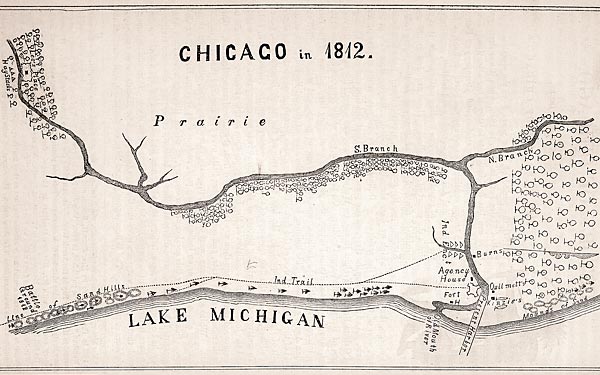
The first necessity is getting the lay of the land, geographically and politically. Two hundred years ago, the little fort at Chicago, manned by fewer than 60 soldiers, was the westernmost U.S. outpost on the Great Lakes. Around it stood hundreds of thousands of acres of prairie and woodland peopled by roving bands of Native Americans—not only Potawatomi, but also Shawnee, Miami, Ojibwa, Winnebago, and others. Small pioneer settlements were scattered helter-skelter across this area; at that time, Quaife estimates, the entire non–Native American population of the future state of Michigan comprised fewer than 5,000 people.
For the nascent U.S. government—just 23 years old in 1812—defending these settlers was as problematic as it was essential. Dependent on circuitous waterways and hazardous woodland trails, communication and cooperation among the tiny settlements and forts were difficult at best. What’s more, the settlers and their Native American neighbors were caught in a great international conflict. The Treaty of Paris, signed in 1783, may have ended the Revolutionary War, but England and the United States were still grappling for control of the vast North American interior. Displaced by encroaching settlers, and alternately siding with the British and the Americans, the Native American people intuitively understood that this moment might offer their last chance to preserve their vanishing way of life.
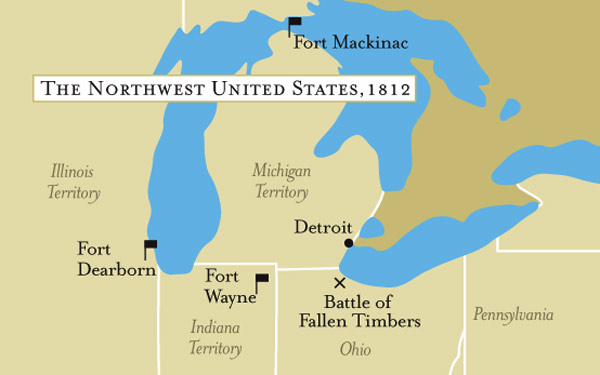
Though initially scoring several major victories over U.S. troops, a confederacy of local tribes was defeated by General “Mad Anthony” Wayne at the Battle of Fallen Timbers (near modern-day Toledo) in 1794. In the subsequent Treaty of Greenville, the Native Americans ceded much of modern-day Ohio to the U.S. government, as well as six square miles on Lake Michigan at the mouth of the Chicago River, an indication that the government already appreciated the site’s strategic importance.
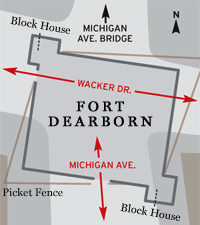
In 1803, a U.S. captain named John Whistler arrived at Chicago to design and build Fort Dearborn (named after Henry Dearborn, who then served in Thomas Jefferson’s Cabinet as the secretary of war). Fortunately, we know exactly what the fort looked like because Whistler, a capable draftsman—his grandson was the painter James McNeill Whistler—left behind an evocative rendering of the place. Nine years later, Captain Nathan Heald commanded the fort as war broke out with Great Britain during the summer of 1812.
Aided by their Native American allies, the British enjoyed early success. Crucially, that alliance compelled the surrender of the 79-man garrison at Mackinac, where a U.S. fort defended the strait that connected Lakes Huron and Michigan. With the fall of Mackinac on July 17, 1812, Chicago could neither be supplied nor reinforced; from his base in Detroit, General William Hull, the commander of all U.S. troops in the Old Northwest, ordered Fort Dearborn evacuated. Captain Heald immediately complied, setting in motion a chain of events that would lead to what Quaife calls “Chicago’s grimmest tragedy.”
As it was, the settlers at Fort Dearborn were already consumed by fear. Incited by the British and the exhortations of their own leaders—including the Shawnee chieftain Tecumseh—the Potawatomi and other Native Americans had been conducting raids on white settlements for months. That April, hostile Winnebago had killed two men at a farm on the South Branch of the Chicago River (in modern-day Bridgeport), and during the summer, young Potawatomi had taken brazen potshots at the fort’s cattle and sheep. When Hull’s evacuation order arrived on August 9th, Heald resolved to march overland either to Detroit or to Fort Wayne. Heald’s decision likely met some resistance—a case could be made to remain within the defensible fort, which had an adequate supply of food—but for the moment, let’s withhold any judgment.

On August 13th, as soldiers and civilians prepared to abandon the fort, a man named William Wells arrived from Fort Wayne. Essentially forgotten today, Wells in 1812 had already attained an almost mythic stature on the U.S. frontier. Born in 1770, he had been living in Kentucky around 1784 when a party of Miami tribesmen kidnapped him. Wells soon put aside his white ways, adopting a Miami name—Apekonit, or “Carrot-top,” for his red hair—and earning a reputation as a fierce warrior. Wells married into the tribe, taking as his bride Wakapanke (“Sweet Breeze”), the daughter of the great Miami leader Little Turtle. The couple eventually had four children and remained together even after Wells left the Miami and settled at Fort Wayne as the government’s Indian agent.
When news of Fort Dearborn’s pending evacuation reached Wells, he raced to Chicago, where his niece, Rebekah, was married to Captain Heald. Thirty Miami accompanied him. It’s unclear what role Wells played leading up to the evacuation—did he, for instance, try to convince Heald to consider options other than evacuation?—but ultimately those things don’t matter. “He alone of all the company . . . was present from choice rather than from necessity,” writes Quaife, who singles out Wells as “the real hero of the Chicago massacre.”
Now Heald made a fateful decision. Hoping to win over the Potawatomi and secure their help as escorts, he had promised to give them the contents of the fort—food, calico, and other provisions. But at the last minute he opted to destroy the fort’s supply of alcohol and ammunition, concluding that whiskey would only inflame the Potawatomi and that any powder or shot given them might eventually be used against the fort’s occupants. Simon Pokagon identifies Heald’s decision—a perceived violation of his original pledge—as one of the causes of the Potawatomi attack. John N. Low, the American Indian Studies professor, concurs, pointing out that the Potawatomi could have used the shot and powder for hunting, to feed their hungry families. “[Heald’s reneging] was just another in a long history of broken promises,” he says. “It really ignited a very volatile situation.”
On the night of August 14th, Heald received a visitor, a Potawatomi named Mucktypoke, remembered today as Black Partridge. A friend of the Americans, Black Partridge understood he could no longer restrain the angry young warriors. Speaking to Heald through an interpreter, he returned the medal of friendship given to him by the U.S. government. “I will not wear a token of peace,” he reportedly said, “while I am compelled to act as an enemy.” Heald had been warned.
At nine o’clock on the morning of August 15, 1812, a hot and sunny Saturday, a motley column paraded out of Fort Dearborn. Leading the way was William Wells, mounted on a giant thoroughbred, and 15 of his Miami, riding ponies so small that their feet almost scraped the ground. A onetime captain in the U.S. Army, Wells was likely wearing his old blue uniform jacket. Remembering his Miami heritage, he had painted his face black, like a warrior prepared for battle—and for death.
Behind Wells followed 55 soldiers, 12 civilian militiamen, 9 women, and 18 children. Some of the women were on horseback, and most of the children rode in one of the two wagons. The remaining Miami brought up the rear. Two fifers and two drummers played a tune that time has forgotten—although it seems preposterous that those desperate musicians would have been so tone-deaf as to perform the Dead March, as Juliette Kinzie reports.
In 1812, the main branch of the Chicago River did not follow a straight course into Lake Michigan. Instead, just east of the fort, it curved south (to near modern-day Madison Street) and then emptied into the lake. It’s also important to recall that the lake’s shoreline was then much closer to what is now Michigan Avenue. After the column left the fort, accompanied by the Potawatomi, it marched south along the river and shoreline, following a course that today would have lain a little east of Michigan Avenue. Around what is presently Roosevelt Road, a series of low sand dunes sprang up, separating the shoreline from the prairie. At this point the troops from Fort Dearborn kept to the shoreline, while the 500 or so Potawatomi kept to the west side of the dunes, where they were mainly hidden from view.
What occurred next happened hurriedly. Swinging his hat around his head, Wells rode back to the main column shouting that the Potawatomi were about to attack. Captain Heald ordered his troops to charge, and the soldiers gamely scurried up the dunes with bayonets pointed, breaking the Potawatomi line. (Simon Pokagon criticized the whites because they “rushed headlong through [the Potawatomi] lines before a bow was bent or a gun was fired,” but he’s alone in making this charge; even John N. Low acknowledges that the Potawatomi had gathered in ambush.) The Potawatomi fell back, allowed the soldiers in, and enveloped them on their flanks. Eventually the soldiers retreated to the shoreline, making a defensive stand on a high piece of ground. By then, the 30 Miami had fled.
The soldiers’ charge had led them away from the wagons, and there it was, writes Quaife, that “the real massacre occurred.” Even Pokagon, who insisted that the Potawatomi were only fighting a patriotic battle for their homeland, regretted what happened there, where, as he writes in Harper’s, “the Angel of Mercy seems to have been asleep.” Hundreds of Potawatomi surrounded the wagons, which were defended by the 12-man militia, desperate to protect their wives and children. The men discharged their muskets and then wielded them like clubs before they were all slain. A solitary Potawatomi climbed into the wagon with the children and indiscriminately bludgeoned them to death with his tomahawk—“for which he was hated by the tribe ever after,” writes Pokagon.
From the bloody melee, two incidents, essentially grounded in fact, emerge. Aware of the slaughter at the wagons, Wells rushed to the aid of the women and children. (Another account, told by Pokagon and others, had Wells rushing back to the Potawatomi camp intent on revenge.) Overcome by sheer numbers, he never made it, though his bravery earned the hyperbolic admiration of Pokagon. “[Wells] fought one hundred or more single-handed, on horseback,” he writes, “shooting them down on right and left, in front and rear, until his horse fell under him and he was killed.” One Potawatomi took Wells’s scalp, while another cut out his heart, divided it into small pieces, and distributed them among the other warriors. Honoring their slain antagonist and hoping to imbibe a little of his courage, the warriors consumed the heart of William Wells.
Then a Potawatomi—Pokagon says it was the same warrior who had tomahawked the children in the wagon—attacked Margaret Helm, the wife of the fort’s lieutenant. As the two grappled, a second Potawatomi stepped in, seized Mrs. Helm, and dragged her down to the lake, where he proceeded to drown her. Or so it appeared. In fact the warrior was Black Partridge, and the pretend drowning was a ruse to save Mrs. Helm’s life.
It must have seemed like an eternity, but only about 15 minutes had passed. The battlefield grew quiet. Captain Heald, seriously wounded—he would walk with a cane the rest of his life—agreed to parlay with the Potawatomi, who were led by a chief named Black Bird. After receiving promises that survivors would be spared, Heald agreed to surrender. By Quaife’s count, 67 people had lost their lives: Wells, 25 regular soldiers, the 12 militiamen, 12 children, 15 Potawatomi, and 2 women, including Mrs. Heald’s black slave, Cicely. (Though wounded, Rebekah Heald survived the battle.) The victorious warriors led their captives back to the fort and, that night, tortured to death several badly wounded soldiers. There may have been some confusion as to whether soldiers already near death were included in the surrender agreement.
On the morning of the 16th, the Potawatomi divided up the captives, set fire to the fort, and dispersed. Some of the whites would die among their captors, but most of them were eventually ransomed and returned to their families. (Protected by her mother, who was forced to run a gauntlet between club-wielding Potawatomi women and children, six-month-old Susan Simmons survived. She died in California in 1900, the battle’s last survivor.)
Four years later, when soldiers arrived at Chicago to build a second Fort Dearborn, the bleached bones of the battle’s dead still lay unburied on the Lake Michigan shoreline.
In laying out his sources for his version of the Fort Dearborn story, Milo Quaife bemoans the “history of lost manuscripts.” Nowhere is that loss more lamentable than when trying to reconstruct the early days of Chicago, a city that saw some of its most valuable archives destroyed in a great fire. But Quaife’s jeremiad obscures his own efforts at single-handedly tracking down crucial evidence relating to August 15, 1812. Without Quaife, any Chicagoan interested in the past would likely be telling the same story spun by Juliette Kinzie more than 150 years ago.
Born in Connecticut in 1806, Juliette Magill had married John Kinzie’s son, John H., in 1830. Three years later the couple moved to Chicago, where Kinzie’s family had registered and begun selling the 102-acre tract of land—extending north of the Chicago River between State Street and Lake Michigan—still known today as the Kinzie Addition.
Inspired by Eleanor Kinzie, her mother-in-law, Juliette started writing about her life in the West; she also recorded Eleanor’s recollections (augmented by other sources) of what had happened at Fort Dearborn. Juliette’s account depicts her father-in-law, John Kinzie, as a sage, calm presence during those fearful days at the fort. (Ably protected by their Native American friends, Kinzie and his family emerged physically unscathed from the battle; Eleanor wasn’t even at the scene, having sat out the fight in a boat anchored back at the mouth of the river.)
Captain Heald did not fare so well. He is rendered as a disliked officer whose incompetence bordered on imbecility. Most damning, in Juliette Kinzie’s opinion, was Heald’s decision to evacuate the fort. Regrettably, she based her evaluation on a terrible assumption. Though she had never seen the order from General Hull (few had), she quoted the dispatch. Hull, according to Kinzie, had ordered Heald “to evacuate the fort, if practicable” (emphasis added). Those last two words branded Heald as a fool—for in the face of 500 hostile warriors, what commander would abandon a well-fortified position and lead soldiers, women, and children to certain death? Even Simon Pokagon points to Heald’s decision as another reason the Potawatomi were in some ways blameless for what had happened.
Milo Milton Quaife—the man who would, among other things, rescue Heald’s reputation—respected Kinzie’s charms as a “literary artist.” (He also admired her “sympathetic appreciation” for Native Americans.) As for the “historian’s calling,” however, she had “but the vaguest comprehension,” writes Quaife. “Accuracy of statement is clearly not her forte, while to the objective detachment of the historian she is a complete stranger.” Ouch.
After earning a Ph.D. in history at the University of Chicago in 1908, Quaife taught at the Lewis Institute (a forerunner of the Illinois Institute of Technology) and began the serious research that would lead to Chicago and the Old Northwest (which covers the years from 1673 to 1835). Among other things, the book toppled John Kinzie from his perch as the city’s first settler; that honor, demonstrated Quaife, belonged to a black man, by then almost forgotten, named Jean Baptiste Point DuSable. Thrown into a “ruction” by these revelations, the Chicago Historical Society—which, according to contemporary reports, held the Kinzie family in high esteem—declined to publish Quaife’s book. The University of Chicago Press stepped in, and the book appeared in 1913.
Quaife’s greatest achievement was his success in unearthing some of those lamentably lost manuscripts—some of which had lain hidden in libraries across the Midwest. One of those discovered documents was Hull’s order to Heald, which Quaife found among papers stored at the Wisconsin Historical Society. “It is with regret I order the Evacuation of your Post,” Hull had peremptorily commanded from Detroit. Nowhere in Hull’s brief note appears the phrase “if practicable,” a qualification seemingly invented by Juliette Kinzie—and repeated by such esteemed historians as Henry Adams. Receiving Hull’s clear command, Heald, the dutiful soldier, had obeyed.
Hull’s order wasn’t Quaife’s sole discovery. Among other things, he uncovered Heald’s lost journal; a self-serving account of the battle by Lieutenant Helm; and a muster roll from Fort Dearborn dated May 31, 1812, that helped Quaife prepare the first definitive list of the fight’s participants, casualties, and survivors. Even Quaife, the sober historian, was moved by the resurrected names of those “humbler members” of the Fort Dearborn tragedy. In his account, just as the battle looms, he pauses to imagine the forgotten as they faced death. If not strictly history, it is a solemn moment of remembrance and three of the saddest pages of Quaife’s book—surpassed, perhaps, only by his account of the Potawatomi gathering one final time in Chicago in August 1835 on the eve of their expulsion from the land they had long regarded as their birthright.
Unlike the other people killed at Fort Dearborn, whose remains were not interred until 1816 (probably near Prairie Avenue and 17th Street), William Wells may have received an immediate burial. By one account, the morning after the fight on the shoreline, Billy Caldwell—a colleague of John Kinzie known as Sauganash—gathered up Wells’s remains and buried them near 18th and Calumet. Some 60 years later, the railroad-car magnate George Pullman, another Chicagoan with a troubled link to his city, built a mansion at the site.
In 1893, Pullman commissioned the sculptor Carl Rohl-Smith to create a bronze statue to commemorate the 1812 event. Called The Fort Dearborn Massacre, or The Potawatomi Rescue, the monumental work depicts the moment when Black Partridge stepped in to protect Mrs. Helm from the descending blow of an angry warrior’s tomahawk. The sculpture remained at the battle site until 1931, when it was restored and moved to the lobby of the Chicago Historical Society. In the late 1980s it returned to the Near South Side, staying for about a decade before being banished to a park district warehouse, ostensibly for a new round of repairs.
When it came time to name that new park in the South Loop, there was some talk of placing the statue there at its original location. The idea was resisted by local Potawatomi and ultimately quashed. “I don’t think Black Partridge more worthy of valorization than any of the other warriors that were there that day,” explains John N. Low. “I don’t lose any sleep over the fact that the statue is in a warehouse—but I would lose sleep if the statue had been in the park with a plaque and used as a teaching moment.” Others involved in the naming of the park eventually lined up in agreement. “They came to acknowledge that this wasn’t a symbol that people should associate with Chicago,” says Low (who does say he wouldn’t mind seeing the statue placed in a setting that could provide some context—a Potawatomi museum in Michigan, for instance).
No matter. Like so many other Native Americans, Black Partridge endured worse tragedies while he lived. In the fall of 1812, Ninian Edwards, the governor of the Illinois Territory, led a series of reprisal raids on the Potawatomi along the Illinois River around Peoria. One of the villages he attacked and burned to the ground belonged to Black Partridge. Angry at this betrayal, Black Partridge fought, unsuccessfully, alongside the British; the last we see of him is at Portage des Sioux in Missouri in 1815. There he signed a treaty between the Potawatomi and the government of the United States avowing that “every injury or act of hostility . . . shall be mutually forgiven.”
Having pledged himself to “perpetual peace and friendship,” Black Partridge probably returned to his ruined village on the Illinois River. No one is sure when he died or where he is buried, but if you would commune with his spirit—and the spirits of so many others, red, white, and black—you could do worse than visit the tiny park at 18th and Calumet.
Comments are closed.