

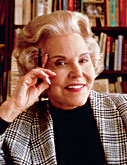
Cardinal Joseph Bernardin was dying. Earlier in the day, Monsignor Kenneth Velo, the cardinal's executive assistant, had held the phone to Bernardin's ear to take calls from Pope John Paul II and President Bill Clinton. But that night-Wednesday, November 13, 1996-Velo telephoned the cardinal's friend Eppie Lederer in her East Lake Shore Drive co-op. Bernardin wanted her with him as he succumbed to pancreatic cancer; the monsignor would send someone to bring her to the cardinal's Gold Coast mansion. Eppie threw a robe over her nightgown and a coat over that.
She arrived to find Joe, as she called him, in a deep sleep. She stroked his hand and talked to him, convinced, she later told friends, that he had heard her. Eppie Lederer, the daughter of Russian Jewish immigrants, was the last outsider to see him alive.
Five and a half years later, on a glorious Saturday afternoon in June, Eppie faced her own excruciatingly painful death from cancer alone in her bedroom with no one to comfort her except a hired caregiver. Her only child, Margo Howard, 62, was in Cambridge, Massachusetts, where she lives with her fourth husband. Margo has written that she had planned to fly to Chicago the following Monday. Eppie had reportedly discouraged her daughter from visiting to spare her the sight of her suffering. That final day, Eppie's beloved granddaughter, Abra, had flown from Minneapolis to be at her grandmother's side, but she was denied access by the building's doorman for reasons that remain in dispute.
When she died last June 22nd, Eppie was still at the top of her game as Ann Landers, the world's most revered and, she claimed, most widely syndicated advice columnist. Esther Pauline Friedman (her identical twin was Pauline Esther, known as Popo) was born on July 4, 1918, and she lived the American dream. She could pick up the telephone and talk to the President of the United States, a U.S. senator, a Fortune 500 CEO. And they called for advice, for fun. Bill Clinton asked her if he had been ruined by Monica Lewinsky. Walter Annenberg pretended to be a disgruntled reader. Her friends included Walter Cronkite, Warren Buffett, Barbara Walters, Kirk Douglas, and Helen Hayes. Locally, she mixed with the A list-Nikki and Ira Harris, Ben and Natalie Heineman, Cindy Pritzker, Marj and Charles Benton; journalists such as Roger Ebert, Bill Kurtis, Mike Sneed. And she was a flawless friend, counseling them on life's problems large and small. A friend who was sick could count on a daily call. Her fans sensed that she had the real stuff, and she eventually garnered 90 million readers in 1,200 papers and a prime spot in her hometown Chicago Tribune.
And yet, she somehow could never apply the sensible advice she gave others to the closest relations in her own life. Her husband, Jules, left her for a younger woman. Although Eppie and her twin sister, who would become the advice columnist Abigail van Buren, had once been inseparable, they feuded for years and reconciled only late in life. And Eppie's relationship with Margo (who would not comment for this article) was seldom smooth. In the 1990s, Eppie's closest companion, a Chicago priest, was forced to end the relationship because aspects of it troubled Margo.
Like the shoemaker's daughter who had holes in her shoes, Eppie, an adviser to millions, seemed unable to confront problems in her own family. She was obsessed with appearances-she once told the Chicago writer Eugene Kennedy that she wore so much makeup that "nobody knows how I really look"-and she wanted to apply an equally thick gloss to the blemishes of Jules and Margo. She encouraged her readers and her friends to tackle their problems head-on, but when hers hit too close to home and complicated her relationship with her husband or her daughter, she simply averted her eyes.
* * *
Eppie and her husband, Jules Lederer, arrived in town in 1954 and moved into an apartment at 1000 Lake Shore Drive. She started writing her column for the Chicago Sun-Times a year later, when she was 37, and by 1971, "Ann Landers" was a success. Eppie wanted an apartment that reflected her growing glory. So when she heard that a place was for sale at 209 East Lake Shore Drive, one of the city's most exclusive buildings on its most exclusive block, she hurried over to see it. The 14-room, 5,500-square-foot co-op, designed by Benjamin Marshall, the architect of the Drake Tower Apartments, had large public rooms with unobstructed lake views and featured an entrance hall so huge that Jules referred to it as "the bowling alley." There were three maid's rooms, a separate maid's dining room, a flower room, a phone room, and a linen room. This was an apartment built for the rich. Jules didn't want it, but that day, Eppie put in a bid of $250,000 and got it.
Eventually, she gave up on going to the office and did most of her work at home. Her assistants had offices at the newspaper, and her driver-Jules had decreed that Eppie, who had no sense of direction, should never be allowed behind the wheel of a car-came from the paper with letters, which Eppie often read in the bathtub; she would send him back with the columns that she wrote on an IBM Selectric. (A fax machine was as high tech as Eppie ever got; she never used a computer or a cell phone.) En route anywhere, she perused readers' letters in the back seat of the Cadillac limousine, license plate AL 1955, marking the year she began to write the column. "She worked like a dog," recalls her upstairs neighbor, Cindy Pritzker. She kept about six weeks ahead of deadline, and she never missed a column. When she traveled, she took letters with her. No matter where in the world she was, a Federal Express package was not far behind.
She preferred to work from 11 p.m. or midnight until 3:30 or 4 in the morning. She would focus on the column, but also on organizing her life, lining up schedules, and, after her divorce in 1975, calling and sometimes waking her latest escort to check on a meeting time. In the morning, she would seldom wake before 11. A neighbor, Joan Hall, cherishes a pile of notes from Eppie-affectionate, full of detail-and Hall is not the only one. If Eppie had been to a party or a lunch, or if someone had done something nice for her, she would write a note and her driver would deliver it the next day. She would often call another night owl, Father Theodore Hesburgh, her friend since the mid-1950s and now president emeritus of the University of Notre Dame. Sometimes she seemed to be desperate for conversation.
Adele Simmons, who had known Eppie as a child and who became reacquainted with her when she returned to Chicago to head the John D. and Catherine T. MacArthur Foundation, marveled at how Eppie always remembered what the Simmons children had last been up to-she would ask about each by name. Her secret was that she would make notes on her casual conversations, file them at home, then study them when she knew she might meet that person again. One friend calls it "almost an obsession." But it worked. Richard J. Klarchek, the head of Capital First Realty, a Chicago real estate management and development company, escorted her to Gridiron dinners in Washington and watched her in amazement as she conversed with the nation's top journalists, business leaders, and government officials. "Absolute instant recall," he says. "People came walking up to her, one after another, and just bam, bam, bam. Knew their names. Introduced them, bam, bam, constantly."
Eppie loved her apartment, which she had had partially renovated at the time she and Jules had moved in, and she was thrilled when Cardinal Bernardin told her that it was the nicest apartment he had ever been in. The place was brimming with antiques, reproductions, middling art, and knickknacks, although the most valuable object was always Eppie herself-expensively dressed, bejeweled, and accessorized. She didn't have much of an eye for art or fine furniture, but she had just enough so that the public rooms-the living room, dining room, and library-looked grand. As the decades passed, however, the rest of the apartment became dated, dark, and, finally, seedy.
"She'd come and see me," recalls one friend who lives nearby, "and she'd say, ‘Well, I think I'll go back to the ghetto now.'"
"She didn't cook, so she didn't care about the kitchen," says Joan Hall. The glass fronts on the original kitchen cabinets had been repeatedly painted, a refrigerator was far too short for the allotted space, and peeling paint marred the master bedroom in which she died.
Still, the apartment was worth plenty, and Margo, the sole beneficiary of Eppie's will and one of the trustees of the Esther P. Lederer Revocable Trust, got it, along with the rest of her mother's worldly possessions (according to a close relative, that is; the trust, unlike the will, is not a public document). Margo kept the jewelry and a few other items, put the co-op on the market for $4.4 million (an offer is pending board approval), and brought in Butterfields, a second-tier San Francisco auction house, to tag her mother's belongings and sell them to the highest bidders. (Sotheby's and Christie's weren't interested.) What Butterfields didn't want, Bunte Auction Services in Elgin took. By late September, the apartment, once the stage for Eppie's famous teas in honor of movie stars and senators, looked like a secondhand-goods shop, but soon everything had been shipped to San Francisco and Elgin, where it was auctioned the weekend before Thanksgiving.
According to news reports, people at the Butterfields show room in San Francisco wondered if Eppie had any family. So many of the things seemed personal-party dresses, handbags, a portrait of her by the society painter Roger Robles, a painting of a ballerina in a pink and white tutu that Jules had bought for her, believing correctly that the dancer bore a striking resemblance to Eppie. So many personal items ended up on the block-extensive, carefully filed correspondence from such icons as Eleanor Roosevelt, Helen Keller, and Winston Churchill; her honorary degrees; her high school and college yearbooks; a collection of owls, symbols of wisdom, many of them gifts from her closest friends; a complete set of her columns; signed photos of Eppie with such luminaries as Jimmy Carter, Bill Clinton, Michael Jordan, and Robert Redford that had lined her "brag wall."
Friends think that Eppie would have been mortified to know that some of her treasures-her scrapbooks, for example-didn't sell and that others went for a pittance. Butterfields took in $250,000. The San Francisco Chronicle reported that one man, who bought only items bearing her name, said, "It was going really cheap. No one seemed to want them. . . . I'll probably offer some of this for sale on eBay." The Chicago Public Library bought some of her papers for just under $6,000, says Cindy Pritzker, the chairwoman of the library foundation. A few years earlier, Pritzker had gone to tea at Eppie's with Mary Dempsey, the commissioner of the Chicago Public Library, and Maggie Daley, the mayor's wife. "I think she was pretty excited to [donate the papers to the library] and then it was kiboshed," says Pritzker. She recalls that Dempsey "made a point of telling Eppie how [her papers] would be displayed and cataloged." Now they have been picked over and scattered-five letters to Eppie from Jacqueline Kennedy Onassis, for example, were sold separately for a total of $1,116. (Pritzker, however, insists that in the end they got what they wanted for the library.)
Many of Eppie's friends found the auctions crass, and they fault Margo for having orchestrated them. Some say it was as if she wanted to sweep away her mother's belongings, get what she could for them, and move on with her own life. At least one old friend, who wonders why she never received any memento from Eppie's apartment, recalls that Eppie always said that each of her closest friends would get a piece of her art. "I'm kind of amazed," she said sadly. Margo explained to a reporter for the Associated Press her decision to auction her mother's possessions: "Because of who she was I thought that people who wanted to have that kind of connection to her should have the chance," adding that the proceeds would go to her mother's estate and to support research into multiple myeloma, the cancer that had attacked her spine. One of Eppie's closest friends rubs his thumb and forefinger together to indicate his idea of Margo's motives for dispersing Eppie's belongings.
Once the sale is closed on Eppie's apartment, it will surely be gutted and renovated. As the years pass, the memories of the vibrant woman who once held such sway will fade, even though her success was beyond what anybody could have imagined for the daughter of an immigrant family from Iowa.
* * *
Eppie's father, Abe Friedman, settled in Sioux City with his wife, Rebecca, and started by peddling chickens from a horse-drawn wagon. Soon, however, he traded up to owning movie and burlesque houses and pioneering the sale of popcorn, which he recognized as the most profitable part of the business. Eppie and Popo grew up in comfort. There were two older sisters, but their father doted on the twins, Eppie in particular. Their mother was somewhat reserved, but Eppie had a happy girlhood. The twins were extraordinarily close-they even slept in the same bed. They were also spoiled, mischievous-once, while their grandfather dozed on the sofa, they cut off his long beard-and lightly educated. They dropped out of their hometown Morningside College to marry in 1939 in a double ceremony-with matching gowns and veils and a double honeymoon at Chicago's Edgewater Beach Hotel.
Popo married Morton Phillips, the heir to a family liquor distributorship, among other thriving businesses. Eppie's new husband was a penniless but energetic ninth-grade dropout, a handsome Detroit boy named Jules Lederer. She followed this chain-smoking, Scotch-drinking workaholic through a string of Midwestern towns and tiny houses as he honed his extraordinary skills as a salesman. There wasn't much money, but Eppie found enough to have her nose fixed. (Popo left hers as is. She said that her husband loved the way she looked, an indication of the envy and ill feeling that nearly destroyed the sisters' relationship.) The Lederers' daughter, Margo, was born in 1940. For a time, Jules went door-to-door demonstrating pressure cookers, and Eppie sometimes went along to wash the dishes. Edna Brigham, who met the Lederers as young marrieds in Eau Claire, Wisconsin, recalls Jules as "sunny, affable, full of enthusiasm, the greatest salesman." Like Jules, Eppie was bursting with energy, moxie, gregariousness. She knew that there was much more than pressure cookers and motherhood in her future.
She discovered Democratic politics in Wisconsin and, with Brigham, helped elect the first Democrat from their district. "We wrote radio scripts and went door to door," Brigham recalls. In a tough contest, Eppie was elected county Democratic chairman. That was the heyday of the Wisconsin senator Joseph McCarthy, and the two women campaigned against him. "I think we were too dumb or too naïve to realize that it could be dangerous to oppose Joe McCarthy," recalls Brigham. "We just went at it as if we knew what we were doing."
In 1954, the family moved to Chicago. Within weeks, Jules was hired to head Autopoint, a company that produced pens and pencils that carried advertising. Eppie enrolled Margo, then 14, at the Francis W. Parker School and called on the Democratic political boss, Jake Arvey, assuming that she would repeat her Wisconsin success here and eventually run for office. Arvey warned her to forget it, according to Eppie: The Story of Ann Landers, Margo's 1982 biography of her mother. "If you persist," Arvey supposedly told her, "I will worry that you might wind up in Lake Michigan wearing a cement ankle bracelet."
But the five-foot two-inch, blue-eyed, dimpled dynamo, with her bosomy figure coaxed into form-fitting suits, her face painted to perfection, and her dark hair already sprayed into her signature flip, still believed that she was destined for something big. Through a friend at the Chicago Sun-Times, she arranged to try out for the job of Ann Landers, the paper's advice columnist. (Ruth Crowley, the registered nurse who was the original Ann Landers-under a pen name borrowed from her friend Fran Landers-had died suddenly.) All 27 candidates were given the same sample letters to answer, but Eppie drew on real experts-U.S. Supreme Court justice William O. Douglas, for example, an acquaintance from politics-in fashioning her responses. Although her journalism experience was limited to a college gossip column that she had written with her twin, Eppie managed to mimic the witty and sharp style that the original Ann Landers had pioneered. She clinched the job, though, with her performance on a psychological profile compiled on all the applicants. Larry Fanning, later the editor of the Sun-Times, told colleagues that "Eppie was off the scale on aggressiveness, that the company that they hired to administer the test said she had a higher score than anybody they had ever tested."
Fanning, who died in 1971, recognized that the column could become a huge moneymaker, and he could see that Eppie Lederer could make that happen. She was a self-promoter; all he had to do was teach her how to write an advice column. For 12 years he mentored her, at the start practically living with her in the newsroom and in the Lederer apartment, coaching her, editing her heavily, showing her how to hone that unique voice, at once wise and wisecracking. "He recognized right from the beginning that he had something far more interesting, conversation-making than most advice columns," says James Hoge, another former editor of the Sun-Times.
Fanning was the first of many editors in Eppie's life who did double service. During the day he blue-penciled her copy while explaining to her what he was doing and why; at night he escorted her to events, "held her coat," says Lois Wille, later the paper's editorial page editor. Meanwhile, Jules was often out of town or otherwise engaged in business.
* * *
Eppie's new success led to a bitter split with her twin. In the earliest months of her job, Eppie started sending readers' letters to Popo, who was then living in California with two children and a staff of servants. Popo wrote answers in a voice that mimicked the one that Eppie had been coached to adopt, and she did it so well that no one knew. When Fanning found out, he explained to Eppie that running Popo's responses under Ann Landers's name was unethical. Eppie stopped collaborating with her sister, but by then Popo was hooked. She marched over to the San Francisco Chronicle and sold the editors on a competing column. For years afterward, the twins didn't speak. "I brought up her sister once, and she said, ‘I don't want to talk about her,'" recalls Marshall Field V, whose family owned the Sun-Times and Eppie's syndicate. "That was the end of that, so I never brought it up again."
Represented by competing syndicates, both sisters would loudly claim to be carried in the most newspapers. Eppie could not stand the stalemate and would do almost anything to sign another paper. Field recalls the staccato click of her high heels, which presaged an avalanche of ultimatums. "Usually she was mad because her column wasn't in some paper in Aardvark, Arkansas. She was only in 400 papers, and her sister was in 401. She'd complain that our syndicate was doing a lousy job of getting her in every paper in the world, or that she wasn't getting enough money. She was famous for being pushy, so everybody would just sort of stand there, and if you yelled back at her as loud as she yelled at you, you were generally fine."
Eppie insisted on writing seven days a week so that there was no chance an editor could stick in a potential rival on an off day. She worked hard and with soaring enthusiasm as she realized how big an impact she could have. As the years passed, she began to advance favorite causes, mostly political, such as gun control and later abortion rights. A staunch Democrat, Eppie became a regular in Washington, usually without Jules.
Her focus on issues distinguished her from her sister, who was far less serious and political. At one point, Eppie urged readers to write their representatives and tell them to support more funding of cancer research. "If this great country of ours can put a man on the moon," Eppie wrote, "why can't we find a cure for cancer?" Members of Congress were deluged with mail, and readers sent thousands of her columns to President Richard Nixon in the White House. In late 1971, with Eppie present, Nixon signed the National Cancer Act.
If he imagined he was winning Eppie's affection, he was mistaken. A friend was in her office at the Sun-Times when Henry Kissinger, then Nixon's Secretary of State, called. "What's a nice Jewish boy," she asked him, "doing in a place like that?"
* * *
With both parents absorbed in their work, the Lederers' only child had grown up indulged and directionless. Margo left Brandeis University without graduating to marry a Bostonian, John Coleman, who went on to develop such small but sophisticated Chicago hotels as the Tremont and the Whitehall. Seven years and three children later, the marriage broke up.
That same year, 1970, with an assist from the film critic Gene Siskel, who had been impressed by Margo's wit when he was her dinner partner at a wedding, she began to write a column for his paper, the Chicago Tribune. Margo was pretty, stylish, and bold, with a sharp and sarcastic tongue. She soon switched to the Chicago Daily News, then edited by Larry Fanning. The column, entitled simply "Margo," sparked "a lot of griping at the features desk," recalls Lois Wille. "Eppie's daughter was given a plum job." Margo's quip-filled columns were clever, but as another of the paper's feature writers recalls, she often leaned on others for help. She would arrive in the newsroom in Gucci jeans, a fur jacket, and gorgeous jewels and ask the assembled, "Have you got any story ideas?"
Eppie rarely mentioned Margo in her column-in later years, she sometimes inserted a "confidential" birthday greeting to her "darling daughter"-but she did write tributes to her wonderful husband and best friend, Jules. Indeed, her carefully paced personal revelations cemented her ties to readers. Eppie and Jules, in fact, didn't see much of each other. "They were physically not in the same city at the same time very often," recalls Charles Laff, a close friend of both Eppie and Jules. "They were both so busy being who they were as individuals, they ceased being who they were as husband and wife."
If Eppie swooned for the powerful and the cultured, Jules was far more down to earth. "You no-good bastard, how the hell are you?" was a favorite greeting. In 1960, with a cousin of Eppie's in Los Angeles, he had started Budget Rent-a-Car, the first cut-rate car rental business, five dollars a day and five cents a mile. "Jules was one of the brightest marketing people you ever met," says Laff, who became Budget's chief financial officer. "He was extraordinarily charismatic." And he was tireless. "He used to brag about his ability to run guys 25 years younger into the ground," Laff recalls. Jules traveled nonstop, often abroad, as he expanded the business to England, Mexico, and elsewhere.
When he wasn't working, he wanted Eppie to relax with him. But she didn't have time. He called her the "general manager of the world," and he was only half kidding. Jules bought a weekend house in Michigan-friends recall that he would appear there with three Dictaphones-but Eppie was too busy, and, besides, she didn't understand why a drafty house in the middle of nowhere could be considered relaxing. She and the outdoors beyond Michigan Avenue didn't mix.
Jules also bought a small house in the mews in London and used it frequently while running Budget. He grew to like it-he preferred it to the show place on East Lake Shore Drive-and he suggested to Eppie that they make the house their home, that she could write from anywhere. But she liked her apartment and her adopted city, in the middle of the country, a place from which she could travel to see her political friends in Washington or to keep a speaking engagement in Los Angeles.
In 1968, Jules sold Budget to Trans-America. He was given a five-year contract, and by 1973 he was out. He had always been a heavy drinker and smoker, but with his reduced business role, both habits grew worse. Eppie, who never drank and who hated smoking so much that she once pulled the lighted cigar from the lips of a rewrite man at the Sun-Times, finally took note of what others had known for a long time. Jules was an alcoholic. She recognized it, she told Martin Janis, a close friend and escort, only when Jules's secretary called and told her that Jules was drunk by ten in the morning.
"How did Eppie handle conflict?" asks another escort in analyzing why Eppie would need to be told what everyone else could plainly see. "She would either dismiss it or rationalize it." She never admitted, he says, that she didn't have the time both to immerse herself in the public life she so loved and to dedicate herself to helping Jules. She miscalculated in thinking that she could manage him as one cog in the complicated machine her life had become.
Cindy Pritzker describes Jules in those years as no "world beater" and "overwhelmed by Eppie's success." But in London he could still be the visionary who had founded Budget, and so he spent more and more time there.
Charles Laff was in London with Jules in August 1972 when they went to a party at which they met a registered nurse named Elizabeth Morton. Twenty-eight years Jules's junior, Elizabeth, says Laff, had "long red hair, was down-to-earth, a girl-next-door type, not somebody who would knock your eyes out, but educated and articulate." Jules hated to eat alone, and dinners with Elizabeth soon led to more intimate pursuits.
One day in 1975, Eppie called Notre Dame's president, Theodore Hesburgh. "I just learned from Jules that he has been seeing a lady in London," she said. "I'm devastated. I must talk to you." En route to South Bend, she wrote a draft of the famous column in which she told the world that she was getting divorced.
"In one way, you hate to say it, but she probably outgrew him," Hesburgh suggests today. "People she knew, issues she was involved with. You don't have to be a genius to understand. If you're married to a lady who's 100 times more known than you are, you start getting introduced as Eppie Lederer's husband."
Eppie told Jules that he had to get out of the apartment, but, says Laff, the divorce proceedings were amiable. "Jules did not get divorced from Eppie because he didn't love her anymore," Laff explains. "They never stopped loving each other."
Presumably feeling some guilt, Eppie went to Marshall Field's and bought Jules underwear and socks, the wardrobe staples that she feared he would not know how to buy for himself. When Jules and Elizabeth returned from their honeymoon to an apartment in Sandburg Village, Eppie made sure the cupboards were stocked.
* * *
After the divorce, there would never be a time when Eppie would be without what she called "a gentleman friend." She was small, vulnerable, and instantly recognizable. She delighted in the attention, but she feared, says one friend, being approached by "somebody drinking or coming on too strong." Going to dinner or a charity function alone was out of the question. Her escorts were always handsome, well mannered, sophisticated; as she got older, they tended to be far younger than she. According to one of them, the Chicago public relations executive Martin Janis, who was ten years her junior, "in her mind, she was in her 40s."
Janis maintains that Eppie was "happily single. She used to say, ‘I don't want to have to share my closet with somebody.'" Cindy Pritzker disagrees. Eppie probably "would have liked to [remarry], if the right person had come along. She wanted somebody to care about and somebody to care about her. But it just didn't happen."
James Evans, then the chief executive officer of the Union Pacific Railroad, took her on a cruise and reportedly broached marriage. "She was crazy about him," says one friend. But he wanted her to move to New York, and she insisted on staying in Chicago. For a while she dated Warren Bennis, a professor of business at the University of Southern California, but he surprised her and married someone else. She also dated Bill Kirby, a widower who, until his death in 1990, was the general counsel to the MacArthur Foundation.
There was also the handsome Lester Hyman, a divorced Washington lawyer, younger by 13 years, who vetted President Clinton's Supreme Court and Cabinet picks. When he came to visit, she put him in a guest room at 209, and she hinted to friends that their relationship was sexual. (Hyman would not comment on that.) "She was a healthy, normal woman," Martin Janis says. "She was very warm." (Eppie would sometimes surprise her friends with sexual innuendoes. Another escort remembers walking by a vase of flowers in her apartment. A gladiolus was drooping, and she pointed to it and said, "Reminds me of my old boyfriend.")
Eppie's favorite events were dinners in Washington-at the White House, at the State Department dining room. She would sit like a queen, always at a premium table, Janis recalls, and "real big shots-governors, senators, financiers, chairmen of the boards of multimillion-dollar corporations-would come to her. Katharine Graham was one of the biggest snobs ever, and she'd come to Eppie and swoon, ‘Epp-
piiiiieeee!'"
Eppie was "crazy, gaga" over Bill Clinton, says Eugene Kennedy. She thought Clinton smart and handsome. "She was a nut for handsome men," says one friend. Given the booming economy and her support of Clinton's policies, she refused to condemn him for his sexual indiscretions, explaining, "He's human and he needs help." It irritated her that he squandered his talents and played into the hands of his enemies, but what really irked her, she told a friend, was, "Why would he go with somebody as ugly as Monica Lewinsky?" At a Gridiron dinner after the Lewinsky story had hit with full force, the President asked her, "Eppie, do you think I'm going to be all right?" "You're going to be all right, Mr. President," she assured him.
She also admired Hillary, who invited Eppie to a White House sleepover for Chelsea and her girlfriends. They sat around in their pajamas and Eppie gave the girls advice. When people said that Hillary stayed with Bill because it served her political purposes to do so, Eppie said, no, Hillary stayed with him because she loved him-and he her. Eppie slept in the Lincoln Bedroom during the Clinton years and boasted to friends that she did not have to pay for the privilege.
The Clintons were not the only high-level people who asked Eppie for advice. She tossed off a note to Jimmy Carter the day after he won the Presidency, telling him that his choice for Secretary of State should be "Cy Vance"-the man he eventually chose. When Ronald Reagan was the governor of California, he consulted her. "I'm thinking of running for President," he said. "Do you think it's a good idea?" "I think it's a very bad idea," she answered. "You're too old; you're a conservative; you'll never make it." When Bobby Kennedy was deciding whether to run for President in 1968, he sought her advice. "It's not your turn," she told him. She advised Lyndon Johnson to get out of Vietnam. And when she traveled there in 1967 to visit the troops, she later claimed to have "cajoled" a meeting with General William Westmoreland, commander of U.S. forces in the area, and to have harangued him on the wrong-headedness of the war. When she later saw him at a wedding and they danced together, he told her that she was "the very first person to help him understand what was going on in the country."
She considered it part of her job to advise her friends, as well, and her advice was never wishy-washy. Her friend Rosalind Whitehead, a consultant to medical and health organizations who was struggling with a divorce, recalls Eppie counseling her: "‘No matter what, never say a negative [about your husband].' I listened to her. Over time it was clearly the right thing to do, because [my ex-husband and I] became friends again, but also there is something magnificent about being larger than criticism." Eppie summoned Donna LaPietra, who plans more than her share of fundraising galas, to her apartment for tea. "Her advice to me," LaPietra recalls, "was, ‘You already know too many people.'"
Eppie went way beyond what anyone might expect. When she returned from her trip to Vietnam in 1967, she called the family of every wounded GI she had visited. She forwarded to Father Hesburgh the letters from some of the most desperately troubled people who wrote to her. "With the greatest secrecy she would put that letter in an envelope and send it to me and say, ‘I think we can help this person,'" Hesburgh recalls. He would refer the writer to someone, usually a priest, and Hesburgh says that many of those people were helped. "I'd write Eppie a note at the end and say, ‘Case solved.' She never boasted about this; no one ever knew that it happened."
* * *
In 1982, overbooked as usual, Eppie took a shortcut. A part-timer for the Daily Leader, a small newspaper in Pontiac, Illinois, discovered that Eppie was quietly reusing almost identical letters and answers across decades. The paper's managing editor called the Associated Press to help in its investigation. James Litke, then 30 and a general assignment reporter in the AP's Chicago office, spent weeks at the Chicago Public Library reading "Ann Landers" on microfilm and found additional duplication. The Pontiac reporter also found more. Litke repeatedly called Eppie's top assistant, Kathy Mitchell, asking to speak to Eppie, and got nowhere. Finally, Litke said, "Would you tell Ms. Landers we have conclusive proof of her recycling at least 30 columns, and we want to know if she wants to comment." Three minutes later, Eppie called. She invited Litke to her apartment that afternoon. "She was as charming as can be," Litke recalls. "She recognized in a heartbeat that she was caught."
James Pearre, the Daily Leader's co-publisher, who joined Litke at Eppie's apartment, was less charmed. She claimed that she had been asked by a phone company for permission to excerpt from some of her columns. In looking over old letters and answers, she was struck by how relevant they still were. "She then decided to incorporate some of that material into some current columns," Pearre says she told him. "She portrayed it as limited in scope, not an ongoing process."
Pearre recalls that as he and Litke got ready to leave, Eppie told them that she wanted to show them something. She led them into her bedroom closet and unearthed cardboard cartons of "hundreds and hundreds" of letters she had received from readers when she and Jules divorced. "[It was] fairly apparent to Litke and me that she was attempting to demonstrate to us how loved she was among a very broad cross section of readers and fans."
She gave Pearre her private number. "Please call me at any time," she said. After the initial accounts of her recycling ran, Pearre says, "I called on that line and explained that we had discovered many different examples extending back more years than she suggested was the case. For the first time, her reaction was uncooperative. She said, ‘Jim, this number you called me on is the number I only give to my very close friends, and I no longer consider you a friend,' and she hung up."
Pearre couldn't get over her being "less than honest with us." It rankled that she "preached her homespun morality to people all over North America. . . . What she did I considered unethical."
Should she have been fired? "Not even close," says Litke, although he says she should have identified the recycled columns as such. He thought she handled it in a "really admirable way," not calling in a public relations agent or a lawyer. Jim Hoge recalls advising Eppie, "Come clean, get it behind you, and move on. I didn't have to say, ‘Don't ever let it happen again.'"
* * *
When Rupert Murdoch bought the Sun-Times in 1984, Eppie was not happy. She didn't like Murdoch's sensational tabloid style, and her friends at the paper were crossing the street to the Tribune. Jim Squires, then the Tribune's editor, had recruited Lois Wille, whose move prompted Mike Royko to join her. The Sun-Times sweetened Eppie's deal-also giving her ownership of the name Ann Landers-and she stayed another three years. But in 1987, taking advantage of a clause that her lawyer and escort, Bill Kirby, had cleverly inserted in her contract, she took "Ann Landers" to the Tribune.
In one phone call, Squires gave Eppie all that she wanted, including the same salary. With income from her syndicated column, she was then probably making about a million dollars a year, but money was not her top concern. "I'm not interested in being wealthy," she told one friend. "I'm interested in being comfortable. I want to be well paid for what I think my hard work deserves." She thought it a Republican Party value, which she heartily rejected, that "there is never enough; that you have a right to accumulate as much wealth as you dare." Rick Newcombe, the president of Creators Syndicate, the last distributor of her column, says that he turned down "seven-figure endorsement contracts." The president of one lecture agency speculates that Eppie probably commanded $10,000 to $20,000 per speech, but she turned down many more offers than she accepted.
What she did want, and got, was prominent placement in the paper, an especially sensitive issue because the Tribune would now be running both Ann and Abby. Squires quickly soothed Popo's ruffled feathers, calling to reassure her that she would keep her same spot in the back of the "Tempo" section. Eppie got a spot in the front of "Tempo." Squires understood that these were women who liked to be courted. "Am I still your girl?" Popo called him to ask. "I was basically a basket of compliments to both ladies," Squires says.
Although the sisters had denounced each other in magazine articles over the years, they gradually reached a kind of truce. By the early 1990s, as Popo began to show signs of Alzheimer's and as her daughter, Jeanne Phillips, took over the writing of the "Dear Abby" column, they stayed in touch. "Eppie told me they faxed every day," says one close friend, "and if Popo would not answer, Eppie would take a piece of fax paper and write, ‘Popo, put your paw print on this and send it back.' Popo would draw something on it and send it back. They did it until it became obvious that Popo couldn't."
* * *
Eppie was seldom seen in clothes that would not be appropriate for a meeting with a banker. She wore St. John suits almost exclusively. Her heavily sequined ball gowns were from Italy; her heels, always high. She loved furs, and she once gave a "tutorial" to Joan Hall's husband on the difference between mink and sable.
She exercised daily. Wearing tights and an oversize T-shirt, she ran up and down 15 flights of stairs in her building. At a hotel in Gibraltar with Jay and Cindy Pritzker, Cindy heard a commotion in the hotel corridor; she opened the door, and there was Eppie. "I'm getting my exercise," she chirped as she ran up and back. When she visited Rosalind Whitehead in New York, she ran around her apartment. She would sometimes walk to the Tribune Tower, with her driver cruising alongside, says Lois Wille, "to make sure no one accosted her, or if she wanted a lift along the way."
Eppie had converted one of the three maid's rooms in her apartment into a beauty salon, complete with an old-fashioned hood dryer. A hairdresser came twice a week for a full set, and, when needed, for a "comb-out." Eppie's frequent plastic surgeries-she also gave Botox a try when it became the hot antiaging fix-were performed by Wafik Hanna, a well-regarded Hinsdale doctor. (He is also currently being sued by the family of Naguib Mankarious, Marilyn Miglin's second husband, who died at 72 of a pulmonary embolism after undergoing a smorgasbord of procedures by Hanna.) Ronald Yates, a former Tribune national editor and head of the journalism department at the University of Illinois at Urbana-Champaign, recalls once seeing her walk into the newsroom, "and I thought to myself, Don't anybody touch her or she'll break." (Eppie was no hypocrite about cosmetic surgery; she wrote approvingly of it in her column.)
Hanna and his wife were close friends of Eppie's. She promoted Hanna to her friends, some of whom didn't think they needed plastic surgery. Sitting at dinner with a recent acquaintance, Eppie patted the woman under the chin and suggested that she have a face-lift. Ann Gerber, who writes a gossip column for the Lerner newspapers, says that Hanna was not shy about promoting his connection to Eppie. "I just did Eppie," he told Gerber at a party. He advised her that she needed work on her eyes and her neck, and said that he wouldn't charge her. Gerber claims that Eppie, who could easily have afforded to pay, had the same understanding. Hanna would not comment for this story, and it is not known what their arrangement was. But Eppie quoted him in her column as an expert on questions of plastic surgery, once as "a highly regarded plastic surgeon," another time as "a superb plastic surgeon." But she did not disclose any personal relationship with the doctor.
* * *
"At the beginning she was prim and priss," says Cindy Pritzker, "but she changed with the times." The divorce from Jules, as well as Margo's multiple marriages-the third was outside her religion, to the actor Ken Howard-forced Eppie to change her views. Life was not neat and predictable, she understood. Her grandson has a daughter with a woman to whom he is not married, so the question of illegitimacy hit home.
On homosexuality she moved from believing that it was a choice that people should try to correct to believing that if one's child is gay or lesbian, that is the way God made them and parents ought to love and accept them. "She was not above changing her mind," says Father Hesburgh. "I think sometimes she changed her mind not for the better," he adds as he describes her liberal views on premarital sex and abortion. "However, by and large, she was on the side of the angels."
But there were some issues on which her personal views remained stuck in the past, and she avoided them in her column. In a tribute to Eppie after her death, the Sun-Times columnist Mary Mitchell, who is African American, wrote of going to Eppie's for tea. "Some of the things that came out of Eppie's mouth surprised me," Mitchell recalled. "For instance, she looked at me with a devilish twinkle in her eye and asked whether I only dated black men. . . . ‘Yes, I only date black men,' I said emphatically, afraid she was about to turn into a matchmaker. ‘Good,' she said. ‘I always say stick to your own kind. Marriage is hard enough. Why do people want to bring that kind of trouble on themselves?'" Lois Wille recalls Eppie questioning her in 1991 about an African American who had recently been hired for a high-level editorial position. "She said he seemed like a very fine man. . . . ‘Is it true his wife is white?' she asked. ‘I know this is wrong, but it just kind of bothers me to see a black person and a white person together. Does that bother you?' I said, ‘No, it doesn't.'"
Ken Howard remembers being surprised to hear his mother-in-law use the terms "shvartzer" and "shvartzeh" for African Americans. He called her on it, saying it was pejorative. "No, darling," she replied, "it means ‘black.'" (Once Howard showed her the definition, he says, "she made it a point never to use that term again.") She pointed out that she often referred to herself as a "Galitzianer," which she used to mean a "working Jew, not highborn," the opposite of a German Jew. Martin Janis sometimes heard her use the word "Polack," but "in a funny way, not in an angry way, not in a way of derision."
Such casual use of ethnic slurs landed her in trouble in 1995 when she gave an interview to Christopher Buckley for The New Yorker. Over two days, she bantered and flirted with Buckley, the son of William F. Buckley Jr., a casual friend. During the interview, she referred to Pope John Paul II as a Polack. She ended up apologizing to her readers in her column, again blaming no one but herself.
Hoge attributes the slur to Eppie's being "a very plain talker. She said it as a form of familiar colloquialism; she didn't mean it as real slap." In the pleasure of "trading quips, she forgot it was an interview." Only one paper, the Milwaukee Journal Sentinel, canceled her column, because, says Creators Syndicate's Rick Newcombe, the city has such a big Polish population. Eppie obtained a list of the paper's subscribers who had canceled, and she called them all to persuade them to re-up. Most did, but the paper never resumed running her column.
For the most part, in her private life, Eppie insisted on good manners. An editor at the Sun-Times once motioned her to go first when they came to a set of revolving doors. Imagining that he was being gallant, he was surprised when, in the lobby, she scolded him: "A gentleman never tells a lady to go first. He goes first, so he can slow it down and make sure it isn't going too fast for her." When she called a tea for 3 p.m. in honor of her friend Walter Cronkite and his new book, she meant it. "She ran a tight ship," says Donna LaPietra. "If it was called for three, 3:15 was about as late as you wanted to arrive." When she attended the Christmas parties given by LaPietra and Bill Kurtis, the documentary producer, "her thank-you notes arrived the next day," LaPietra says, "always filled with detail, handwritten with wonderful penmanship."
* * *
In 1982, Margo published Eppie, her sometimes affectionate, sometimes biting biography of her mother. The book portrays Eppie as controlling and as so obsessed with Margo's appearance as a little girl that she rouged her lips and peroxided her hair. "Father thought I was blond until I was in my teens," Margo wrote. "[W]hen someone would remark on what a beautiful child I was, Mother would demur and respond, ‘Oh, we don't care about that. What matters is that she's a nice girl.' Oh, really? What I finally figured out was that good looks were important but you should deny them, or at least pretend they didn't count."
Eppie gave the galleys to one close friend to read and then asked her what she thought. The woman considered the book terribly mean to Eppie and said so, but Eppie shrugged and said, "This is what Margo wants to do, and she should do exactly what she wants to do."
Margo also had complaints about her father, and despite unhappy marriages of her own, she stopped speaking to him in 1975, at the time of her parents' divorce. When Jules died 24 years later, he and Margo were still estranged.
After John Coleman, Margo married a funeral director, Jules Furth. That lasted about five years. Her next husband was Ken Howard, the actor who is best known for having starred in the television series "The White Shadow." (Currently he plays the father in "Crossing Jordan.") Margo is now married to husband number four, Ron Weintraub, a heart surgeon in Boston.
"Tempestuous," one friend calls the mother/daughter relationship. But most of Eppie's friends, like Martin Janis, say that Margo didn't seem to be around that much, and Eppie had little to say about her, beyond "She has to get her act together." Margo's best friend, the federal judge Ilana Rovner, disagrees vehemently with those characterizations, describing Margo as "the cream in Eppie's coffee" and adding that "they were chained at the waist. They were each other's best and dearest and most beloved friends."
Eppie was especially close to the eldest of Margo's three children, Abra. "She just loved that kid to death," says one friend. Abra, 39, who has three children of her own, has wonderful memories of Shabbat dinners at Eppie's, of summer visits, of long telephone conversations. She didn't get along well with her mother, and Eppie offered Abra this advice: "Put on your Teflon raincoat. Let it roll off of you."
* * *
Eppie had always been drawn to Catholics. "We're neighbors," she told Cardinal Bernardin on first meeting him, and she encouraged him to stop by for tea. The next Sunday he did, and he asked her for $100,000 for Big Shoulders, which funds urban Catholic schools. "I'm not going to give you $100,000," Eppie replied. "I'll give you $50,000."
She found "solace in the Catholic order of things," says Jim Hoge, "the moral order, so explicit." She had grown up around priests; her father often invited them home to Sunday dinner. Her decades-long friendship with Father Hesburgh brought her into contact with many of his Catholic friends and supporters. "She knew what I stood for," Hesburgh says. "She would always ask me about moral problems of hers. I think I probably knew her better than anybody."
But toward the end of her life, Eppie's deepening friendship with a Jesuit priest, a handsome man 25 years her junior, caused perhaps the greatest tension in her relationship with Margo. A Chicago native, a man of faultless manners, taste, and sensitivity, he dined, traveled, and attended charity galas with Eppie. Some friends thought that his being a man of the cloth made things easier for her as she got older-a guarantee that the relationship would never be more than platonic. But several friends and acquaintances of Eppie's say that Margo was troubled by the relationship. One friend says that Margo worried about her mother's reputation. But others counter that she was mostly concerned that Eppie would leave money to the church. (The priest asked not to be identified.)
Through the priest, Eppie became close to the city's top Jesuits, whose elite reputation in education she admired. In 1997, she was asked to join the development executive board of the Chicago Province of the Society of Jesus, whose chairman was her friend Dick Klarchek, of Capital First Realty. The board provides leadership in the areas of fundraising and public relations, and its members are expected to be generous in supporting the board's programs.
But then, early in 2000, Eppie was asked to resign. Her friends say that it was because Margo had called the priest's superiors and complained, suggesting something unsavory about the friendship. Eppie was devastated. She was accustomed to being asked to serve on boards; she had never been asked to leave one. She had a final dinner with the priest at the Chicago Yacht Club. His superior had told him that he must sever the relationship immediately. Eppie, then 81, trembled during the meal, realizing how her life was about to change. One friend of hers, who was appalled by Margo's behavior, talked to Eppie about it, "but for some reason she wouldn't get angry with Margo." Another close friend recalls how distressed Eppie was. "He was my blankie," she said.
Eppie feared her daughter's disapproval, friends say. When Margo visited, Eppie would remove the priest's photo from the wall and hide a pillow he had needlepointed for her.
* * *
In 1968, Jules received about $8 million worth of stock from the Budget sale. Over the next few years, he borrowed against the value of the stock to finance ideas for new ventures-hamburger restaurants in Europe, for example-but nothing worked. Eventually, the stock price fell, forcing Jules to sell his shares for less money than he owed. There was not a new idea to save him; his drinking had clouded his business judgment and his ability to spot talent.
"He was broke and broken," says Martin Janis, "and he needed money. He called Eppie and said, ‘I hate to ask you, but I'm desperate.' She gave him money. She wrote a check when nobody else would." She also invested in his deals. "It was really charity on her part," Janis says. Jules and his new wife returned to London and had a daughter, and Eppie supported all three, paying for the girl's education. (She is now about 18.) Eppie's generosity to an unfaithful ex-husband seemed to defy human nature. The explanation might lie partly in her guilt for neglecting Jules and partly in her character. "She believe[d] in forgiveness," says her friend Ruth Edelman. When friends probed, Eppie said simply, "Jules was very good to me."
He declared personal bankruptcy and continued to drink; after having a stroke, he was confined to a nursing home, which Eppie paid for. She asked to visit, but he didn't want her to see him in his diminished state. In 1999, Jules died of a heart attack. "She cried like a baby," Father Hesburgh recalls.
By then, Eppie was having health problems of her own. At a 1999 gathering to mark the publication of a collection of Mike Royko's columns-he had died in 1997-Lois Wille thought Eppie seemed to be having "a little trouble walking. At the time, I thought, Oh, Eppie's finally getting a little old." Still, she began to see Robert Gwinn, then a 92-year-old former chief executive officer of Sunbeam and Encyclopaedia Britannica.
Within two years, her problems had worsened. Mary Lou Fox, a new friend from Ohio, took her out for her birthday on July 4, 2001, and Eppie seemed not quite herself. In mid-December, at Dick Klarchek's annual Christmas party, she saw her priest friend again. She told him that she was "in great pain with her back" and spent the evening in a chair.
In January 2002, she went into the Loyola University Medical Center and learned that she had multiple myeloma of the spine, a cancer of the bone marrow. If she fought it aggressively, she was told, she could expect to live two years. She decided to forgo the conventional chemotherapy. Her ground rules were that she die at home in as little pain as possible and that the doctor come to her.
She told her friend, the priest, "They discovered cancer in my spine. . . . It's all over." Margo's husband recommended a doctor, a Jesuit priest named Myles Sheehan who was a gerontologist and an associate professor of medicine at Loyola's Stritch School of Medicine. Before she left the hospital, at her request, Sheehan gave her big doses of morphine. According to Father Hesburgh, Sheehan told her, "You're not going to get better, Eppie, but I'll make sure that you die with pride and dignity." He went to her apartment once or twice a week and left her with plenty of morphine.
Eppie took the phone off the hook, and those who called her private number got a perpetual busy signal. When they contacted her assistant, Kathy Mitchell, she told them that Eppie had a bad back, that she was suffering from osteoporosis and hoped to be in the swing of things again soon. Eppie even told her new caregiver, Carolina Miranda, that she had osteoporosis, sticking to that story as Miranda, who had been a teacher in the Philippines, was administering morphine.
In February, Eppie invited the gossip columnist Ann Gerber for tea. Eppie wore a St. John suit, but "she didn't look as good," Gerber recalls. "She had wrinkles around her eyes and mouth. She didn't look like she was keeping up her plastic surgery routine."
In April, Bob Gwinn took her to Ambria, one of her favorite restaurants. She seemed all right, he recalls, and did not complain. In late May, not knowing that Eppie was sick, Cindy Pritzker called and Eppie happened to answer. "How are you?" Pritzker asked. "I'm not good, and I'm not going to get any better," Eppie replied. She accepted Pritzker's invitation to have tea. "She came up the back elevator," Pritzker recalls. "Her houseman brought her-she was in a robe and slippers. I was shocked by how terrible she looked. That was the last time I saw her."
Until June 1st, Miranda says, Eppie would write in bed, with pillows propped against her spine. But then the pain became so intense that she stopped working. The few people Eppie allowed to visit saw her in full makeup with her hair done; she was always checking to make sure that her silk robe remained closed. When Klarchek visited in early June, she looked "as beautiful as she always had," he says, although she periodically drifted off to sleep. At about the same time, Lester Hyman reached her on the telephone. "We had talked about me coming to visit her," he recalls. "She agreed that I should come, but not until she felt well. She said she wanted to look her best. I told her, ‘I don't care how you look,' but she insisted." Margo has written that she visited her mother every few weeks. Miranda recalls two visits in four months and says that Eppie told her that she did not want Margo to see her suffer. When together, the caregiver says, they appeared to have a warm relationship.
Father Hesburgh saw Eppie twice in the last month of her life, the first time leaving her with rosary beads so "she'd have something that was blessed to hang on to when in pain." Later she told him that she "had some comfort touching that rosary," Hesburgh recalls. On that first visit, he just missed running into Bill Clinton, who had stopped up to see her.
On June 21st, Eppie's pain intensified, but Miranda was able to keep it under control by giving her frequent doses of morphine. When Miranda arrived the next morning, a gorgeous Saturday, Eppie's pain had become uncontrollable. She squeezed her caregiver's hand and arm with such force, Miranda says, that she feared that her bones would crack. The two were alone in the huge apartment-Sheehan was out of town-and Miranda just sat there, grimacing as Eppie held on for dear life. Finally she seemed to fall into a fitful sleep and started to mutter what Miranda thought was Abra's name.
Abra was at home in Minneapolis that morning. Her father, John Coleman, says that she called her grandmother at just about this time. Miranda told Abra that Eppie was "suffering, ready to die," and that she kept saying a name that might have been Abra's. Asking Miranda to tell the doorman to expect her, Abra rushed to get on a plane to Chicago. She arrived at Eppie's building at about 1:15, but the doorman told her that she could not go up. Coleman says the order barring Abra came from Margo, who had a difficult relationship with her daughter. Ilana Rov-ner claims that the order came not from Margo but from Eppie herself. (Miranda says she knows nothing about Abra's frustrated attempt to see her grandmother.)
Eppie died at 1:18 that afternoon, within minutes of Abra's arrival and with only the hired caregiver at her side. Following instructions, when Miranda ascertained that Eppie had no pulse, she called Kathy Mitchell and then went home.
Eppie's friends waited to hear about plans for a memorial service-she had no synagogue affiliation-but none were forthcoming. Margo told some that Eppie had asked to be cremated and to have her ashes scattered on the Oak Street Beach. Father Hesburgh confirms that Eppie wanted no funeral and no memorial service. "She had had plenty of notoriety while she was alive, and when she was dead she wanted that to be it." Ilana Rovner says that Eppie had been appalled by the "circus" that had accompanied Jackie Onassis's death. "The people, the flowers and dolls and candles and balloons. She wasn't like all these famous people with entourages and minions and press agents."
At 6 p.m. on August 24th, another lovely Chicago Saturday, Margo and a few others gathered on the east strip of the Oak Street Beach as walkers, bikers, and in-line skaters glided by. Also attending were Margo's three children; her new husband; Eppie's assistants Kathy Mitchell and Marcy Sugar; her driver and her housekeeper; Margo's friends Susan and Lewis Manilow; Ilana Rovner and her husband; and Myles Sheehan. Kaddish, the Jewish prayer for the dead, was not recited. "Isn't anyone going to say anything?" someone asked, and Margo said no. Judge Rovner recalled later that this event was a time when "the people who were closest in the world to [Eppie] came together." But many of her longtime friends expressed sadness that they had not had a chance to say goodbye.
Eppie had said repeatedly that the column would die with her, and it did. Margo writes an advice column, "Dear Prudence," for the online magazine Slate (it also appears twice a week in the Tribune). But she has said repeatedly that she didn't want her mother's column; that it was too much work. Kathy Mitchell and Marcy Sugar write a column called "Annie's Mailbox," a successor of sorts that is carried in the Tribune's online edition. Jeanne Phillips, Popo's daughter, has become Abigail van Buren, a role that she had actually filled for years as her mother slowly succumbed to Alzheimer's (Popo now lives in Minneapolis).
When Jeanne appeared on "Larry King Live" shortly after Eppie's death, and talked about how much she missed "Aunt Eppie," Margo called Eppie's last editor at the Tribune, Rick Kogan, and he reported that Margo was furious with her cousin. Margo claimed that Jeanne hardly knew Eppie and was only seeking to attract more customers for her column. Through her spokesman, Jeanne declined to comment for this article. And so the feud continues, although Abra, who lives near the Phillips family, reports that two members of the next generation, Eppie's great-granddaughter and great-niece, have become friends.
Eppie Lederer knew that she would leave a legacy and that millions would miss her-knowledge that had to give her comfort in her final pain-wracked days. "Eppie improved the health care of human beings more than any other person alive," says Daniel Charles Tosteson, who was the dean of the Harvard Medical School when Eppie served on committees of its board. She gave the school a million dollars, but Tosteson praises her more for educating her readers on medical matters.
That devotion extended to her circle of friends. If someone was gravely ill or had suffered a tragedy, Eppie would be on the phone, proffering help and advice. When Mike Royko's first wife, Carol, died, Eppie took him to dinner and tried, says Lois Wille, to "be a cheerful kind of companion." After Royko died, Eppie was often in touch with his second wife, Judy. "I don't know how she found time to care for all the people she cared for," says Wille. When Dick Klarchek called to ask her what she was doing on a coming weekend, she would sometimes tell him that she was going to a graduation for a student whose education she had paid for-always quietly.
Despite the fancy apartment, the jewels, and the driver, Eppie was a true democrat. Lester Hyman recalls being at lunch with her at the Ritz in London along with a mutual friend of theirs who brought as his guest an exiled king. "‘What should I call you?' she asked him, to which he replied, ‘You may call me Your Royal Highness.' ‘Oh, come on, what's your name-Manny, Moe, Harry, Jack?' ‘You may call me Your Royal Highness.'" So she called him nothing. "I asked her later," Hyman recalls, "‘Why did you do that? The guy is in exile. He has to feel good about something.'" But exiled king or not, she was offended by such pretensions.
For Hyman, the strangest experience of all was when he and Eppie were driving on a superhighway. A semitrailer pulled beside them, and a burly truck driver honked his horn and waved frantically. He liked her column and wanted to let her know.
"This girl had nothing more to offer than advice to the troubled," says Martin Janis. "Pretty schmaltzy. It would be different if she were writing on the political scene, the economic scene. It wasn't as if she was so gorgeous, so ravishing, so profoundly bright. She was not a great writer; she was not a great thinker. But she took all that, which is nothing, just dust, and made an extraordinary life because of it."