

Photography by Bob Coscarelli; Photo Styling by Taryn Bickley
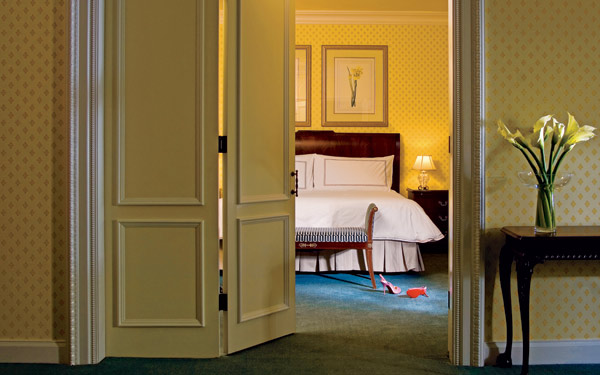
A night on the town at The Ritz-Carlton: Relax in a one-bedroom Premier Suite.
|
|
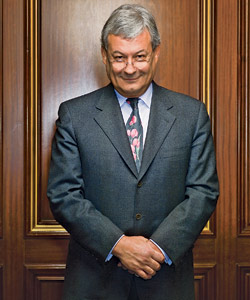
Every morning, Hans Willimann, the general manager of the Four Seasons Hotel Chicago, starts his workday with Bircher muesli cereal and a nine o’clock SAG meeting—a staff alert about VIP guests who might drop $10,000 in a night or need an extra room for their luggage or take offense if their children’s names are not pronounced correctly.
The acronym SAG stands for “special attention guest” and, in simple terms, refers to anyone whose stay requires extra preparation. The guest could be a movie star, of course, but also anyone who travels with a pet or has stayed at the hotel more than a few times. At the Four Seasons, SAG meetings run through special needs and pleasures, whether requested in advance by the guest or sniffed out through research by the hotel. The information resides in a database and gets passed around on spreadsheets.
The meeting is orderly and calm, and the Four Seasons staffers bring enough cool experience to bear that you might never suspect the SAG meeting is the closest thing to a war room in a citywide competition for big-spending travelers—VIPs, celebrities, and anyone else who can afford rooms ranging from $500 to $7,500 a night. The battle involves the city’s most expensive hotels (the Four Seasons, The Peninsula Chicago, The Ritz-Carlton Chicago, and the Park Hyatt Chicago) and newcomers looking to attract the same type of client (the Trump International Hotel & Tower and the soon-to-arrive Elysian Hotel and Private Residences; Mandarin Oriental Tower, Chicago; and Shangri-La Hotel Chicago). Others, including Canyon Ranch Living—Chicago and The Waldorf-Astoria, have plans to join the competition but have yet to break ground.
The rivals are leading with their strengths. The Trump Hotel promises the largest suites in the city, and the Mandarin Oriental and the Shangri-La bring internationally recognized brands, five-star ratings, and a reputation for Asian service—bend-over-backward but quiet hospitality. The city’s older hotels are countering with renovations and new programs. The Park Hyatt, for example, has recently rolled out a personal butler service, which assigns a well-dressed servant to wait on VIP guests. (One popular option: butlers drawing guests an evening bath.)
Within five years, nearly a dozen hotels could be fighting for what hoteliers say is the top 2 to 5 percent of the market. “Chicago is a vibrant city,” says Donald Trump, “and the luxury market has been underserved.”
Hotel analysts say that the influx of high-end rivals reflects a combination of developments: national occupancy rates surging toward pre-9/11 levels; local occupancy rates rising faster than the national average; the eagerness of financiers to get behind luxury hotels; and the downtown’s tourist-friendly transformation in the past decade. The power of a hotelier’s ego comes into play, too. “They honestly think they can step in, and new business will move to them, or they think that their existing clientele will follow them to Chicago,” says Ted Mandigo, a hotel industry consultant. “But the big question is whether or not there really is a lot of new business to be created.”
Consider the supply: There are about 30,000 hotel rooms in downtown Chicago, about 1,300 of which belong to the Four Seasons, The Ritz-Carlton, the Park Hyatt, and The Peninsula, the high-end properties with an undisputed place in the upper-market niche because they have minimum nightly rates of about $500 and a history of achieving, or coming close to, the industry’s most coveted hotel ratings: five stars in the Mobil Travel Guide and five diamonds in the rival AAA guide. Over the years, these four hotels have competed against one another, but there seemed to be enough guests to go around. There was also enough of a difference in, say, the décor, attitude, and cuisine of one hotel to distinguish it from the others. “We compete,” says Rick Segal, the managing director of the Park Hyatt Hotels. “But more than compete, we have become admirers of one another. There are three or four wonderful hotels here. One is playing classical music, the other is playing folk, the other is playing rock, and people stayed with their favorite music and never switched.”
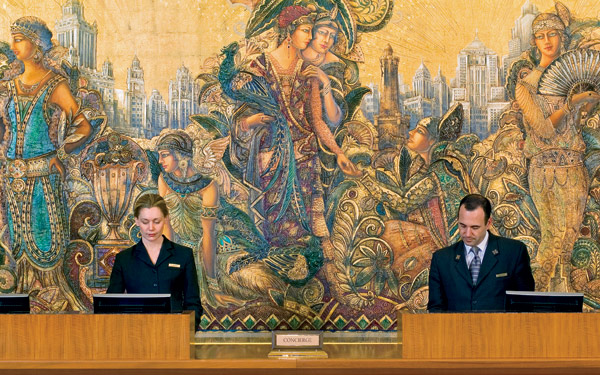
City of splendor: Behind the concierge desk at The Peninsula is a mural by the French artist Gerard Coltat with Chicago buildings as the backdrop.
Several years from now, those may be remembered as the good old days. “It’s still early,” says Rohit Verma, a professor at Cornell University’s School of Hotel Administration. “But it would be safe to describe the upcoming competition as somewhere between healthy and fierce.”
In the next few years, the total number of high-end hotel rooms could nearly double if the Elysian (188 rooms), the Mandarin Oriental (250 rooms), the Shangri-La (223 rooms), Canyon Ranch (126), and the Trump (339 rooms) stick to their current construction plans and, just as important, make good on their pledge to compete for the five-star, five-diamond rating. (Overshadowing this, of course, are the current slump in the residential housing market and the subprime mortgage crisis, which have once-eager lenders now rethinking their finance plans. Since each hotel is a “mixed-use property,” combining condos and hotel rooms, financiers cannot overlook the weak housing market when they review their loans. At presstime, for example, the Mandarin Oriental, responding to media reports of unpaid bills, said that a construction loan had been delayed due to the national credit meltdown. Groundbreaking, originally scheduled for last August, was pushed to January. The Trump project, meanwhile, was also reporting slow condo sales.)
As for demand: The number of occupied hotel rooms in Chicago has grown every year since the September 11th attacks, with the most recent annual data representing an all-time high: About 75 percent of the city’s 30,000 rooms were occupied over the course of 2006, according to the Chicago Convention and Tourism Bureau. (Luxury hotels declined to release occupancy figures.) Meanwhile, in the past six years, the number of occupied rooms in Chicago has grown at a rate of 5 to 7 percent annually, though some high-end hotel operators point out that their sector typically grows at a better pace. “There will be competition among hotels, but it will be friendly,” Trump said in a phone interview. “Each one makes the other better.”
Hotel optimists also take heart from bullish reports on baby boomer spending and from the sense that Chicago is no longer just a convention town, but a place with international tourist attractions (Millennium Park, renowned restaurants, the weak dollar, et cetera) and a shot at landing the 2016 Summer Olympics.
In addition, brands like Trump, the Shangri-La, and the Mandarin Oriental, which have established themselves in other markets, are betting that many of their guests will follow them to Chicago. “Let’s put it this way: If the increasing demand continues at the 5- to 7-percent range over the next three years, I’m not worried that it will take long for the increased supply to be absorbed,” says Stephen Darling, the regional vice president for Shangri-La Hotels.
Of course, that confidence comes from an executive whose brand will certainly benefit from its newcomer status. “It’s only natural that people are going to try the new places,” says Maria Razumich-Zec, the general manager at The Peninsula Chicago. “When we came into town [in 2001], the Four Seasons and Ritz-Carlton guests tried us. Some stayed and others went back, and I think the exact same thing will happen with the Trump Hotel, the Mandarin, Shangri-La, the Elysian, and the Canyon Ranch.” Then she adds a quick jab: “When the new hotels come online, check them out—and then check them out six months later, nine months later, and you’ll see a very different product.”
* * *

Christina Baumer, a butler at the Park Hyatt, prepares a bath.
All the hotels predict that the war will be fought over service aimed at the hearts and minds of SAGs. Back at the Four Seasons, on this particular Thursday, Hans Willimann takes the meeting in his seventh-floor corner office, overlooking a crowded, sunny Michigan Avenue and the John Hancock courtyard. Sitting behind a large wooden desk with three newspapers on his right and an orchid on the left, Willimann is surrounded by 18 staffers, most dressed in suits, holding stapled SAG printouts on guests checking in over the weekend. One by one, profiles are read out loud. Willimann nods and takes notes and occasionally chimes in. “Call me on my BlackBerry when she arrives,” he says. “Who ordered their flowers? I want to see the flowers.”
There’s an announcement of an advertising executive who needs an ashtray, a small refrigerator, 12-inch-tall drinking glasses, Grey Goose vodka, two packs of Marlboro Reds, and a bottle of Fiji water. Lest anyone think the man is planning a bachelor party, there is also an explanation on the SAG spreadsheet: “gentleman’s poker evening.” Then come notes about the arrivals of a network TV news anchor and a well-known American painter. A late-breaking report explains how the checkout of a Grammy Award–winning singer involves 85 pieces of luggage. (Out of respect for privacy, the hotels have asked Chicago not to name the guests in this story.) Midway through the SAG list, a note points out that a certain guest must be addressed by his job title (doctor) and not his courtesy title (mister) because, according to the spreadsheet, he is “very sensitive” about that sort of thing.
“The only reason people go to luxury hotels is for the service,” Willimann says, evidence of his Swiss upbringing still apparent in his English. “You don’t go because of the flat TV screen, you’re not going to go for the chandelier, you’re not going to go for the marble in the rooms. You’re going to go if the doorman remembers your name, and the concierge remembers your name, and they remember your idiosyncrasies.”
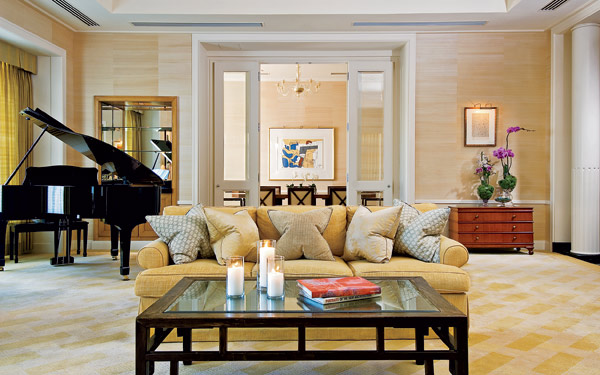
The priciest suite at The Peninsula, with flowers by Kehoe Designs, has a grand piano and a gas fireplace in the living room.
Another SAG meeting, this one at the Ritz-Carlton. Twenty-four staffers gather at 10 a.m. inside an orange-painted room hung with a banner that says In the Race For Quality, There Is No Finish Line. For a “frequent-return guest,” a couple on their 161st stay, the SAG sheet reports that they will be greeted at 7 p.m. when their limousine pulls up to the front entrance. The hotel’s special-services manager checks her SAG spreadsheet and adds: “Must have extra floor lamp in the bedroom corner. He must have a key for his closet. Please replace the cards in the desk drawer. He does use the stationery often. Extra feather pillows. Do not turn on the radio at turndown. And also a humidifier in his bedroom as well as the living room.”
“He likes that even in the summer,” a colleague interjects.
“Yes, all year long,” the manager replies. She returns to the profile: “A scale in the bathroom. An extra dresser in bathroom…. He doesn’t like voice mail. All of his messages must be written, and with his breakfast orders please always have a toaster and apricot jelly.” Separately, the manager issues an order to the chief engineer: “Jim, if you could make sure every light is working; I think last time his closet light was out.”
Mistakes, when they happen, must be indemnified in kind, and beyond. Over lunch in the Ritz-Carlton Café, the general manager, Christian Clerc, recalls a problem involving a doll. A guest had ordered the hotel’s American Girl package for her daughter and, after a day of shopping, expected to see an American Girl doll bed when they walked into their suite. But the reservation desk had switched the family’s room and did not alert housekeeping that the doll bed needed to make the switch, too. To soothe feelings, the hotel sent a doll bed to the room, but also dispatched staffers to the American Girl store and bought the little girl a few books about her doll. During turndown service, the staffers left the books on the doll bed.
“In the past, you’d come to the hotel to find things that you didn’t have in your home,” says Clerc. “The hotels were always ahead of what you could afford. Today, it’s the other way around. If you have the plasma TV but not the high level of service, it’s not valuable to the guest.”
* * *
|
|
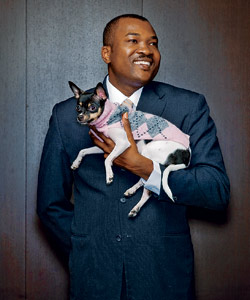
For the record, the service mantra makes particular sense for the old guard, since they can hardly keep up with newcomers in a can-you-top-this? competition over the latest amenities. Still, the new spots also tout service. The Trump Hotel, for example, arrives with attachés—personal servants who will be on hand to do anything for guests “as long as it’s legal,” says the attaché director, Rose Dizon.
“Anyone can build a fancy building,” says Darling, the regional vice president for Shangri-La Hotels. “But the magic comes from the way that the service is orchestrated and how they anticipate rather than respond.” Put another way, the strategy is based on the fact that, among certain clients, all presidential suites, spas, and porcelain teacups begin to look the same.
As a result, all hotels find themselves in the anticipation game. At the Park Hyatt, the reservations staff begins researching guests at least three days before they arrive, Googling names and contacting travel agents, secretaries, and personal assistants to figure out why they’re visiting and what they prefer. Hypoallergenic pillows? A specific vodka? An in-room training session with the city’s best yoga instructor? Again, “as long as it’s legal,” says Gerry Feltmann, the hotel’s executive housekeeper who, not too long ago, spent a good part of his morning separating M&M’s at the request of a guest who wanted a bowl filled only with the turquoise variety.
Often, the intelligence will be used to prepare an “amenity” or welcome gift for the guest. This fall, in advance of a visit from a California winemaker, the Four Seasons found one of his 2005 chardonnays, sawed the bottle in half, and filled it with flowers. On another morning, the staff left a present for a visiting American artist—a model of one of his paintings using white- and dark-chocolate-covered strawberries, blueberries, and raspberries. “It’s an icebreaker,” says Willimann. “We are trying to figure out what makes you tick and then supply it.”
At The Peninsula, a guest’s profile grows with every order and, certainly, whenever the staff notices something particular. “If someone doesn’t like scallops we’ll update their profile so it never happens again,” says Graham Elliot Bowles, the chef de cuisine at Avenues, a restaurant in The Peninsula. “Everyone dictates whatever experience they want to have.”
“What we are trying to do is anticipate what you need,” says Rick Segal of the Park Hyatt Hotels. “It’s so difficult to read your mind, but that is what we are trying to do.”
The hotels are less open about another form of marketing—associating their brands with celebrity guests. “It’s a clear mark that you’re the best of the best when a specific celebrity stays with you,” says Robert Prohaska, the director of sales and marketing at the Trump Hotel, “because celebrities are very—what’s the word I’ll choose very carefully—’demanding’ in their approach. By having a celebrity stay with you, it’s almost a mark of approval.” Although no hotel admits to actively recruiting specific celebrities or confesses that it publicly discloses who stays there, all acknowledge that, yes, word gets out, and the attention helps in marketing. Call it luxury by association.

From left: at the Four Seasons; a Peninsula dessert of a white-chocolate-covered strawberry; high tea in the Four Seasons Lounge
Then again, to hear some entertainment columnists tell it, Chicago hotels leak information as well as any well-schooled Washington politician. “In every case, when I have found out where somebody is staying, it has always come from a person who works for the hotel,” says Bill Zwecker, the Chicago Sun-Times columnist and CBS–Channel 2 entertainment reporter. “Trust me—they are ranking people within the hotel who clearly know what they are doing.”
High-end hotel executives admit they have a dedicated marketing staff to target the entertainment industry in New York and Los Angeles: agents, personal assistants, production companies, and Hollywood studios. “They’re out there consistently building that rapport and that reputation with the celebrity market,” Prohaska says. The entertainment industry is crucial, he adds, because it’s filled with business travelers who book entire floors, meeting rooms, and also big suites for its stars.
When The Peninsula opened in Chicago, for example, it relied in part on the celebrity connections cultivated at The Peninsula Beverly Hills to create badly needed buzz and business during the dramatic downturn following September 11th, says Zwecker. “They aggressively went after the movie-studio business,” he explains. The exposure burnished the hotel’s reputation among celebrities and eventually helped The Peninsula edge out its competitors in the celebrity game of who stays where. Rooms like the $7,500 Peninsula Suite, at 3,100 square feet, help, too. The suite has a foyer as big as a New York hotel room, a 2,000-square-foot balcony, a grand piano, a workout room, and, perhaps most important, entryways and exits that allow stars to come and go without being seen by the paparazzi.
But what if all the good efforts aren’t enough? No matter how optimistically hotels describe the new market, the numbers are hard to spin and history suggests that even the most firmly established luxury hotel is vulnerable. Chicago has seen luxury hotels compete before. The Blackstone held sway, only to be surpassed by The Drake, which itself was overtaken by The Ritz-Carlton. “The Drake is the classic example,” says Ted Mandigo, the hotel industry consultant. “It used to be the property in the city.”
Still, 19 years ago, the Four Seasons joined a market that “everyone said was already saturated,” recalls Willimann, who has been the hotel’s general manager since it opened here. Back then, travelers with money to spend stayed at the Ritz, the former Park Hyatt on Chicago Avenue, the Ambassador East, and the Nikko, which eventually became The Westin Chicago River North. “Everybody predicted that this hotel would go belly up,” Willimann says. That didn’t happen, of course, and now the general manager finds that the roles have been reversed. Sitting in his ErgoChair, not long after another SAG meeting, Willimann finishes the thought by taking a shot at the competition: “Probably some will close or be converted into condominiums or apartment buildings.”