

 |
You could cut the tension with a knife.
Instead, we are about to cut the pizza. Here in the Kraft test kitchen in Glenview, it is the hour of reckoning. A platoon of Kraft chefs stand by their ovens. Kraft’s senior research chef, Paul Pszybylski, is here, as is Kraft’s pizza brand manager, Chad Mulder. From the West Coast has come the team from California Pizza Kitchen, which is expanding its frozen pizza partnership with Kraft. CPK’s cofounder Larry Flax, a bit the worse for wear after the redeye and a mild case of the flu, perks up as the first offering is ceremoniously laid on the table before us. The outer ring of crust is browned to a perfect caramel; the pizza itself is a symphony of red and yellow and green. This is the Chicken Fajita, a revolution of sorts, since the 12-inch pie will first appear in grocery freezers and only then, maybe, at CPK restaurants. Flax lifts a triangle to his mouth as the room collectively holds its breath.
He dabs at his mouth, shuts his eyes.
“Too much going on. We’ve overcompensated with herbs. Let’s bring up the Parmesan.”
There are quick nods of agreement. Not a problem. Cut down the oregano. Bring up the Parmesan.
The next pie is placed on the table and expertly sliced. Confident looks are exchanged around the table. The Mediterranean is a bold move but one that Flax personally backed. Eggplant, caramelized onions, and, yes, kalamata olives—a Kraft breakthrough. Previous pizzas had sported olives, but only drab rings of tasteless black olives. Kraft has dared to use the more flavorful kalamatas, slicing them lengthwise, and figured out how to freeze them.
Flax squinches up his face. “It’s, what, too bitter? The problem’s the eggplant. It’s very different if you don’t get a bite of olive.”
“We could drop the Parmesan a bit.”
“Bring up the salt. Take the olives down.”
Not so long ago nobody talked herbs and kalamatas in the test kitchen. The millennium passed with cheese and pepperoni firmly atop the doughy rising crust. But beneath that bubbling cauldron of cheese, the forces of change were silently at work. New gourmet toppings had begun appearing in restaurants like CPK. As carb counters grew ever more vigilant, the dominant doughy pie gave way to a thin, almost crackerlike crust. Adult consumers craved more gourmet ingredients. Buyers were ready to pay for quality. It was, as the Kraft folks like to say, a “perfect storm” in the freezer.
“Premium and thin are the drivers now,” says Mulder. “Thin is in.”
As it happens, a great deal is riding on the stylish thin crispy crust and its increasingly exotic toppings. Last fall, Kraft introduced three new CPK pizzas into grocery freezers, and the stakes could not have been higher. Since Kraft and CPK launched the Crispy Crust pizza in 2005, CPK’s sales have doubled, passing the $100-million mark in November 2006. Kraft has long dominated the pizza category, controlling 33 percent of the market with its four brands: DiGiorno (1), Tombstone (3), CPK (8), and Jack’s (10). But in Minnesota, rival Schwan has been steadily nibbling away at Kraft’s lead. Its top brands, Freschetta, Red Baron, and Tony’s, give Schwan a 28 percent market share, and the company vows a bigger bite.
“We’ve had a great year; we intend to challenge Kraft for product leadership,” says Mark Jansen, the vice president of marketing and product strategy at Schwan. The company’s new Freschetta Pizzamoré will feature bake-and-serve trays and pre-sliced pies that Jansen promises will “crack the code” of pizza delivery.
It’s no surprise that the higher-quality frozen pizzas, the so-called premiums, have put a scare into the pizza delivery chains, which have countered with lower prices and innovations like bake-at-home versions. But the rising costs of fuel and ingredients such as tomato paste and cheese have merely propelled the frozen folks on to greater ambitions. “We’re going after an even bigger slice of the pizza pie,” John Boswell, a senior vice president and the general manager of Kraft’s pizza category, crowed to Frozen Food Age early in 2007. “We’re setting our sights on the $20-billion local pizzeria business.”
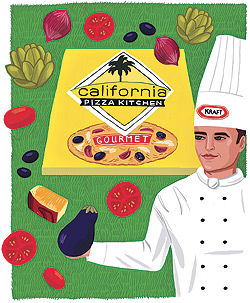
Illustration: Jackie Besteman
Unfortunately for Kraft, few of the headlines in the first half of 2007 had much to do with pizza. In 2006, concerned with sluggish earnings, Kraft had dumped its veteran chief executive officer, Roger Deromedi, in favor of Frito-Lay’s Irene Rosenfeld, who soon shook up the ad world by withdrawing six top Kraft brands from J. Walter Thompson, depriving the Chicago office of $130 million in business. Then, before you could say “mac and cheese,” she was dealing with a new problem: investor Nelson Peltz. The hedge-fund billionaire had previously bought up large chunks of other food giants, then used that leverage to compel the company to sell off subsidiaries or buy new ones, whether management wanted to or not. Soon after he snapped up a 3 percent share in Kraft, the company bought the cookie unit of Groupe Danone for an eye-popping $7.2 billion, which Rosenfeld dutifully called “a great fit for Kraft.” This past November, Rosenfeld brokered a new deal with Peltz, adding two board members in exchange for his pledge not to campaign against the company during her turnaround plan.
For Kraft, snack food brands like Oreo and Nabisco far outsell pizza, but the “convenient meal” category (which, besides pizza, includes Oscar Mayer and Macaroni & Cheese) brought in $4.9 billion in 2006. A good slice of that comes from Chicago, the number-one frozen-pizza market in the world, which generates an annual $128 million in pizza sales.
Somewhere near that great pie in the sky, James Kraft, who started selling cheese to Chicago grocers out of a horse-drawn wagon in 1903, will surely have his eyes peeled this winter. If the Mediterranean flops, it’s fair to say there will likely be a serious case of freezer burn in Glenview.
It was only June, but I was already worried about the Mediterranean. It was good—I’d sampled a slice myself—but how good? Would my kids want it? They’re twin ten-year-old boys and so far have not cracked the premium-food frontier when it comes to pizza. Worse, their taste buds are acutely tuned to the slightest innovation. A new cheese in their grilled cheese sandwiches (mild Cheddar—we’re not talking aged goat) had them writhing in disgust. True, the Mediterranean is not intended as a “crossover,” a dual sell to an upscale mom and her habituated kids (that would be Kraft’s third upcoming “brand extension”—the Four Cheese ten-incher). But would CPK’s medley of strange vegetables in the grocery cart get past the boys’ discerning eyes? Could we avoid a scene at Jewel?
For the answer I went to an expert, Harry Balzer, a veteran food analyst and vice president with The NPD Group in Rosemont. Balzer quickly brought me up to speed with a crash course on pizza history. Twenty years ago, pizza was the family food in America. It fed kids; it was a snap to prepare; delivery was king. Then companies like Kraft figured out how to make a crust that didn’t taste like the box it came in. Next they figured out how to get the crust to rise with raw dough instead of precooked dough. (An aside here: Such was the import of the innovation—pumping yeast into the raw crust—that when Schwan introduced its own version, Kraft sued, charging that a double-agent mole had stolen its new pizza-base secret. The suit was settled, but the details remain confidential.) In the nineties, “restaurant-style” pizza got all the attention: esoteric new toppings, gourmet pies from Wolfgang Puck—all fueled by baby boomers who fancied ingredients that looked as if they came from a garden. Balzer was very big on this last demographic.
“The driving force is boomers,” he told me. “They’re always talking about what’s new, so that’s what we can expect. New flavors, new tastes, new shapes.”
“Do you think Kraft’s Mediterranean will sell?”
“I can’t comment on that. Kraft is a client.”
“Suppose Schwan produced a Mediterranean?” I say.
“I can’t talk about Schwan. They’re a client. But know this,” said Balzer. “Pizza is a family food. Family is still the primary business.”
“Will families go for something new like the Mediterranean?”
“There’s one thing you can count on,” he said, cheerfully ignoring my question. “With pizza there will always be something new.”
I assumed that for their money, Kraft and Schwan got more specific insight than I did from Balzer. At the Glenview tasting, a member of the Kraft team had dismissed several new ingredients as “polarizing.” Cilantro was one. Artichoke, another. I worried that Balzer would find it tricky going, navigating his clients between the opposite pull of family—loyal to the big three of cheese, pepperoni, and sausage—and baby boomers, apostles of the new.
* * *
I had underestimated the R & D people at Kraft. It seemed they were mulling that very challenge! Even as the big yellow CPK box with its tantalizing flavors headed through design, sales, and marketing for its fall launch, Mulder’s pizza group came up with another idea at a “brainstorming” session early this summer. The idea was so simple that it seemed almost profound—pepperoni, but pepperoni with a CPK twist.
Get the pepperoni crowd with, well, pepperoni. But also grab the novelty seekers by adding surprise ingredients to the meat, including—a stroke of genius—”premium” pepperoni. (Who knew the existing pepperoni was second-rate?) Call it a “limited edition”—a packaging logo. Then test the pie as an “in-and-out”—industry parlance for a product that appears for a limited time, say weeks, on retail shelves.
The strategy, of course, has its downside. The “in-and-out,” as its sexual connotation suggests, tends to leave the consumer frustrated. There you are, the unwitting buyer, in, say, the cookie aisle. You come to a sudden stop. What’s this? Oreo cookies encased in chocolate? What a concept! You grab a package and take it home for a tasting. It’s a huge hit. You can live with the calories. Two weeks later you go back for more—but the product is gone. Your child is inconsolable. You try to explain the ways of marketing. Your child is not interested in doctorate work at the Kellogg School of Management—he wants his cookie.
Kraft, for its part, uses the strategy to track a supermarket product, running the numbers on scanners. It places the product in chains like Wal-Mart. It’s a good sale to the club market, such as Sam’s Club and Costco, which lure shoppers with a “treasure-hunt mentality.” Consumers troll the aisles, eyes peeled for dirt-cheap surprises, even as they load up on toilet paper. Not surprisingly, when the thrilled clubber goes back two weeks later for the $20 tub of crackers, the product is gone.
Such concerns are not on the minds of the Kraft team gathered bright and early this morning for another tasting, this one at the CPK restaurant at the Westfield Old Orchard mall. It’s 8 a.m., hours before the restaurant opens, but the CPK chefs have been toiling since dawn. Flax has not made the trip, but CPK is represented again by Brian Sullivan, the vice president of culinary development. The Kraft team includes Mulder, naturally, and the senior research chef, Pszybylski, who introduces the first offering, a cheese bubbler that’s laden with thin- and thick-sliced pepperoni.
Sullivan shakes his head. He hasn’t even tasted it yet. “The thick pepperoni’s too fat. It looks like sausage. Consumers can’t relate to fat pepperoni.”
He’s happier with the next offering, a “four-cheese platform” with thin pepperoni atop a blend of mozzarella, Fontina, Parmesan, and smoked Gouda.
“It’s got depth,” offers Mulder.
“I like the flavor,” Sullivan says. “Maybe pump up the Gouda.”
Nobody likes the Three Cheese with Fat Pepperoni. The Premium Pepperoni gets
a thumbs-up.
“Definitely some back heat,” says Sullivan. “It’s the onion I’m pulling out. I’m not sure about the raw white. Maybe grill or roast it first.”
“Can we review the sauce?” Mulder asks.
“Good point,” says Sullivan. “The bigger vegetable units are more CPK. You get the quality clues.”
It takes 40 minutes to declare a winner. The favorite is a mix of the “artisan” pepperoni and the “all-American” pepperoni.
“So the Double Pepperoni,” sums up Pszybylski.
Sullivan thinks. “Pepperoni Duo?”
“I like it,” says Mulder.
Late in the summer, my curiosity bursting, I return to Kraft’s Glenview headquarters. This time Mulder and I meet in the atrium just outside the company store, where employees get discounts of up to 50 percent on a staggering variety of Kraft products. Who knew that Kraft owned Belgian Chocolate and Tazo Tea?
Mulder is buoyant. He shows me the big yellow CPK box with the words mediterranean style across the top. Turns out that Flax prevailed; they took down the olives and dropped the seasoning a notch.
“We think it’s great,” says Mulder.
“Of course.”
CPK is all about ingredients, which Mulder demonstrates by pointing to the new CPK box for the Mediterranean. “Amazingly detailed” is how he describes the picture: the sliced olive perfectly positioned to show the wound where the pit was extracted; the tiny chunk of eggplant embedded to reveal both skin and interior. Lean close and you can even spot the atomic flecks of seasoning.
“And this isn’t even high-resolution yet,” says Mulder.
The Kraft marketers had also produced a set of “clings”—the 3-D promo cardboards that are stuck on freezer doors. There are three possible tag lines: “Shout ‘Oopah!’ for Mediterranean Flavor”; “No Passport Required”; and “Flavor That Might Just Inspire a Belly Dance.” Mulder admits that the “No Passport” option doesn’t work; it says nothing about ingredients. I volunteer that “Belly Dance,” to me, evokes the Middle East—not the Mediterranean. Which leaves “Oopah!” which I always thought was spelled “O-pah!” and makes me think of Greece, where they don’t eat much pizza. Apparently, Kraft thought the same thing and ended up going a different route: “The Flavor That’s All Greek to You.”
I’m being picky, of course. Like Mulder, I’m excited about the Mediterranean. So what if my kids don’t like it? If it’s a hit in the freezer, then CPK will likely introduce it in its restaurants, and then Mulder and his team will have plenty to please their CEO, Rosenfeld.
But what of the “in-and-out”? Cooler heads, thankfully, have prevailed. The pizza is in, but the “fat pepperoni” is out. It was actually a sausage—linguiça, by name—and was tossed because, as Mulder puts it, nobody knew what it was. A new pepperoni, different from the “base pepperoni,” is on track to replace it.
I leave Kraft with a renewed faith in the individual. Here in Glenview, merchandising is more than a bunch of anonymous focus groups. It’s the personal palate that can make a difference. Harry Balzer could be dead right about the new. Who knows? Maybe one day I’ll even see a CPK box with the polarizing artichoke. Then my kids will really have something to gripe about.