

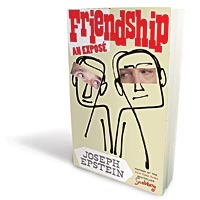
Copyright © 2006 by Joseph Epstein. This excerpt is drawn from Joseph Epstein’s upcoming book, Friendship: An Exposé, to be published by Houghton Mifflin in July 2006.
|
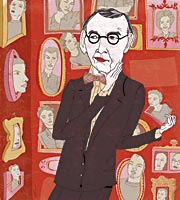
Illustration: Kim Rosen
 |
 |
When I first set out to write about friendship, I began with a vague sense that the standard idealization of friends was somehow false to the truth of friendship, at least as, day by day, we all live it. I also sensed my own slight discomfort at sometimes being put off by the mild but often insistent demands of friends, though I enjoyed being with my friends and think myself a friendly person. I recognized that I was promiscuous in my friendships, and would sometimes feel trapped in a friendship I hadn’t really wanted. For reasons that were less than clear to me, what was supposed to have been one of life’s pure pleasures had become complicated and sometimes confused.
Friendship, I came to realize, ought not to be considered so free and easy a thing as it generally is, but needs to be treated as an art. Like any other art, it requires perspective, craft, a careful and experienced touch. It calls for regular maintenance through thoughtful cultivation. To know oneself is the first and best step in the training for friendship, and from there one hopes to go on to know one’s friends. In friendship the golden rule-treat others as you would yourself be treated-doesn’t always apply. Some friends, after all, wish to be treated quite differently than one wishes to be treated oneself. But treating friendship as an art, and not as a series of social accidents or spontaneous happenings, is essential.
The very word “friendship,” like “stewardship,” “editorship,” “governorship,” and several other words with a -ship suffix, implies not passivity but an active hand; it suggests taking control, charting a course, planning a future. Most of us, I suspect, do not look upon friendship in this way. Until beginning to write about friendship, I certainly didn’t. Instead I took my friends as they came. Some have been a continuing delight to me, some have seemed burdensome, some I regret ever having started up with and, given the opportunity, would prefer to trade away for players to be named later.
“The name of friend seems to me even holier [than that of relative],” wrote Quintilian, the first-century Roman advocate. “For the one comes from the intellect, comes from a decision; the other chance bestows, circumstance of birth and things that are not elected by our will.” Quintilian is correct when he says that one’s friends are a matter of conscious decision. True, sometimes one’s choices are limited by circumstances. But if many of one’s friends seem given, like cards dealt out, perhaps one does best to think of the game of friendship as five-card draw, in which one can toss away some cards and ask for others. One doesn’t have to stick with the hand one was dealt.
Only of late have I begun to be more selective, in effect to attempt to edit my friendships. I not long ago learned that the mother of my physician had died. He is a man I like; we have long called each other by first names. It occurred to me to send him a note of condolence, but then I thought better of it. Such a note might draw us closer together. But is more closeness needed? Our middle-distance friendship seems fine as it is. I’m certain he doesn’t want more closeness from me. I decided not to send the note.
The columnist George Will occasionally calls me when he is in Chicago, where he has a son and grandchildren living. Sometimes we go to lunch or dinner together; he recently took me to a Cubs game, treating me to a front-row seat. Soon after, I happened to read an interesting article on the relief pitcher Dennis Eckersley in GQ, which I’m fairly certain he doesn’t read. I cut it out of the magazine intending to send it to him, then decided not to do so. Why put him under the obligation of having to read it, write to me about it, perhaps call to tell me an odd fact or two (he has a vast quantity of such facts) about Eckersley? I like the occasional nature of my friendship with George, who is a man much on the go, and see no reason to take it any further or deepen it in any way. It’s quite all right as it is.
I have developed a taste for highly qualified, nicely defined friendships-the equivalent, I suppose, of prenuptial agreements but applied to friends. I have a friend who lives in Arizona and who, on his annual visit to Chicago, meets me for a single lunch. I see another friend perhaps four or five times a year, always for coffee. I once suggested that we get together with our wives, but there were complications on his side in doing so. I have not suggested it again. Things are OK as they are, I have decided, and I shall not again suggest meeting with wives.
A man who lived in the same apartment building I do went to my high school four years before I did. We had had many acquaintances in common. A year or so ago, he died of a heart attack while out exercising on his bicycle. Ours was largely an elevator and lobby friendship. I was always pleased to see him, and I like to think he felt the same about me. We were never without things to tell each other: news of old schoolmates, fresh jokes, chitchat about sports. I don’t believe that we ever had a conversation lasting beyond 20 minutes. I could have invited him to lunch, where with more time our friendship might have become richer, but I never did. Nor did he ever invite me to lunch; a wise man, perhaps he instinctively understood the art of friendship. The first rule of the art of friendship, I have come to believe, is that not all friendships need to be deepened.
Another rule I have devised is never to allow friendship to be reduced to a sharing of afflictions; friendship oughtn’t to consist mainly, or even secondarily, of sharing weaknesses or troubles. One mustn’t unload, as we say nowadays, on one’s friends one’s terrors, disappointments, and (until now hidden) resentments at the world’s putative injustices. The art of friendship entails deliberate repression. A friend, a cliché definition has it, is someone whom, when you are in crisis, you can call at 4 a.m. I’d say that’s true, but with the qualification that one is permitted only one such call.
Yet another rule of the art of friendship is to look beyond the mere opinions of potential friends in the attempt to discover that deeper thing, their point of view. Everyone has opinions, lots of them, but not everyone has a point of view, which is much more than the collectivity of a person’s opinions. A point of view is one’s particular angle on the world, one’s ways of viewing life that imply a well-considered position on a range of much larger questions than that of the reform of Social Security or the future of NATO.
I am myself guilty of breaking a serious rule of the art of friendship, the Aristotelian stricture against polyphilia, or having too many friends: “for it would seem,” Aristotle wrote, “actually impossible to be a great friend to many people.” In a talk I once gave on friendship, I mentioned that I had 75 or so friends. A sensible woman in the audience said that that seemed an unusually, almost unbelievably, high number. I now think that the number 75 was probably on the modest side, at least if one thinks of friends as people with whom one has had past and expects to have continuing relations, with all the conviviality and obligations entailed in a friendship. Doubtless it is now too late, but if I could, I shouldn’t mind cutting down my roster of friends. On the other hand, if I had had a severely limited number of friends, I might not have been able to write on this subject.
***
Part of the art of friendship, I have also decided, includes reassessing the pleasures of acquaintanceship, which may be underrated. I once thought I would have a chapter in this book called “Let Old Acquaintance Be Forgot,” but I’ve come to think there is much to be said on behalf of acquaintances, not least the absence of obligation that they bring.
Friendship requires participation. Not all fields of endeavor permit the time that full participation in friendship needs. The choice of being an artist, which is to say an observer, greatly reduces the appetite for frequent engagements with friends. From Thoreau to James Joyce, from Tolstoy to Samuel Beckett, from Melville to Saul Bellow, literary artists, while not without friends, have never been notable for devoting much energy to the enterprise of friendship. (Nor, from Napoleon to Bismarck to Franklin Delano Roosevelt to Winston Churchill, have great political figures done much better.) “Friends are a costly luxury,” wrote Ibsen. “When a man invests his capital of energy in a profession or mission, he will lack the means to have friends.”
Her biographer Richard Sewall wrote of Emily Dickinson that “she never achieved a single, wholly satisfying relationship with anybody she had to be near, or with, for any length of time.” Henry James was kind and generous to many people, but his first obli-gation was to his art. One of his biographers writes about Isaac Bashevis Singer that he “was a consummate master of casual acquaintance,” which is another way of saying that he knew how to keep people at a proper distance. Céleste Albaret, Marcel Proust’s housekeeper, in her memoir of her employer, writes “that he must have let, or even made, a lot of people think he felt affection and friendship for them, whereas in fact-it was the thing that always struck me-he could do without all of them with the greatest ease.”
One finds such coolness over and over in artists. In a song called “Being Alive,” the finale to his show Company, Stephen Sondheim writes of a close friend that he may be someone you need too much and you know too well, someone who’ll put you through hell. For all their astonishing gifts, Michelangelo, Mozart, Beethoven, Dostoyevsky, and Picasso seem not to have had much of a gift for friendship. The last great modernist artist, the choreographer George Balanchine, who had five wives, seems to have had fewer friends. Loyal and generous though he was to the people in his great dance company, “he was a person you could not get close to,” as one of his male dancers remarked. Balanchine himself said, “I can’t cope with human relationships, difficult relationships.” His art, the reason surely is, came first.
Dorothy Rowe, an Australian writer and psychotherapist, in a book titled Friends and Enemies, asked a number of people who participated in various workshops she ran to end a sentence that began, “After it’s all said and done, what matters most in life is . . . .” The four things that were most often listed were “a sense of having achieved something”; “a sense of having made a contribution to the world”; “being able to accept yourself and so be at peace with yourself”; and “loving relationships.” She notes: “What was listed most often was loving relationships. What most people feared was dying unloved and alone.”
My guess is that most artists would have written one of the first two responses, and the more passionate they were about their art, the less that the last one was likely to have entered into their thinking. In the division of people between those who live for their work and those who work chiefly in order to live, artists fall preponderantly on the live-to-work side. Alexis de Tocqueville, despondent at the end of his active political career, writes: “For without the resource of a great book to write, I truly do not know what would become of me.” People who are more devoted to the pleasures of daily life are likely to be more intensely interested in the cultivation of friendship.
One of the toughest rules of the art of friendship is to take friends as they are. It hasn’t always been easy for me to do so. I have a strong critical sense, with a passion for analysis, and an abiding interest in the motives, known and secret, of others, not least those of my friends. I feel a need to understand the vanities and weaknesses of friends along with their virtues and strengths. I want to know what movie is playing in their minds in which they think they have a starring role. I believe I am willing to take friends as I find them, but only after taking the most precise measure of them possible, so I have a strong sense of who, exactly, they are.
The art of friendship involves knowing what you want, need, expect, and are willing to give to other people in a friendship. In late middle age, what I most want from friends is amusingly engaging talk. From some people, I have come to expect talk that cuts deeper than it does from others. Although such talk can be quite enough, I also hope that sometimes my friends will cause me to discover things about myself and the world that, without their intervention, I would never have discovered on my own. In recompense, I hope I can sometimes do something similar for them through such insights and observations and amusements as I might have to bestow.
Friends have conferred favors on me. One friend regularly bails me out of small computer problems, sometimes at the cost of nearly a full day of work; another often calls bits of journalism and scholarship to my attention that I might not otherwise have known about; yet another, a woman who goes to house sales, keeps an eye out for things that she thinks might charm me: a pair of unused dove-gray spats is one re-cent delightful gift of hers in this line.
I also obtain from friends an unacknowledged reinforcement of my belief in my own worth. I am more than a little pleased, for example, to think that I have become friendly with most of the men and women I admire who work in the realms of art and intellect. This suggests that they may also have some tincture of admiration for me and what I do, which of course delights me.
***
Mine has been a lucky enough life for me not to need to call upon friends for loans of money, or the gift of bone marrow or a kidney, or much in the way of emotional support. I have a friend who recently wrote to me in the most heartfelt way about the death of a friend of his who had been immensely helpful to him when his, my friend’s, wife was undergoing something close to a nervous breakdown and he had no one in his own family to talk with about his troubles; and he had done something similar when his friend’s own wife died. “No matter how stupid or crass or idiotic they may occasionally be, friends are friends,” he wrote to me shortly after this man died. They are, he said, “the people you connect with.”
As for what I expect from friends, I mainly expect consideration, which includes a set of reasonably correct assumptions about the sort of man I am. A friend ought to know something about how another friend’s mind works, how his tastes run, what he finds amusing, and what intolerable.
In the line of expectations, friends ought to be able to ask friends favors. The extent of the favors, however, is what is in question.
I am up for doing any favors I can for friends. I am ready to use such connections as I have to help friends, or the children or cousins of friends, find editorial jobs and literary agents, or offer advice on their careers.
I stand prepared to drive friends wherever they need to go. I have loaned some friends small sums, never more than $1,000.
Favors in friendship need to be carefully calibrated. Aristotle said that no friend should ever ask one to do anything that is (morally) wrong. But at a level below the moral, things get more complicated. In a Seinfeld episode, Jerry meets the Mets’ first baseman Keith Hernandez, who soon thereafter asks Jerry if he would help him move his furniture into a new apartment. A subtle, convoluted, and amusing discussion follows among Jerry’s friends about the appropriateness of the request, given that the two men have known each other so brief a time; the point is that the favor, given the short acquaintanceship between the two men, seems out of line.
Sometimes a favor will be offered that one hadn’t expected and is so delighted by that one looks upon the person bestowing it in an entirely different way. One evening, as we were setting out for a concert, our car didn’t start. A neighbor with whom I had previously done nothing more than ex- change polite greetings, noting my problem, without hesitation offered me the use of his car for the evening. I was much im-pressed by the offer, which I gratefully took him up on. The generosity of the gesture moved him for me out of the mere neighbor category. We were talking the other day about the agreeable way that the people in our building keep a proper distance from one another. I acknowledged that this was so, adding only that he and I were in serious danger of becoming friends. He smiled.
A generous impulse ought never to be stifled, or so I have always felt. But if friendship is to be practiced artfully, even generosity may sometimes have to be measured. Overkill may occur; how, one wonders, will one ever be able to square things, put them back on a fair basis, so that a favor doesn’t come to take the form of an obligation? Sometimes you can do a friend a real favor by not doing him too great a favor.
Perhaps the first rule in the art of friendship is never to idealize a friend. A friend is not a dog, a Lassie, a Benjy, a Rin Tin Tin, a permanently affectionate, unconditionally loving creature who offers uncritical adoration and who is always going to come through for you. Owing to such general idealization, altogether too much pressure is placed on friendship, with the result that one comes to expect perfection, which isn’t likely to be available even in the best of friends. Friends, in fact, figure to be unsteady, contradictory, not perpetually obliging-rather, if I may say so, like you and, it pains me much more to say, like me.
If one had to draw a brief character of myself, it might well be that I am a gregarious melancholic, a highly sociable misanthrope, a laughing skeptic. On different days, or on the same day, I am distinctly more or less hospitable to the delights and obligations of friendship, welcoming it warmly one day, doing very nicely without it, thank you very much, the next. Life without friends is unimaginable, but life with them perpetually around is no picnic on the grass, either.
The idealization of friendship may be owing to the fact that the most intense time for friendship, for men and women, is during adolescence. This is also a period when time itself seems inexhaustible, and life’s pressures are well off in the distance. Friendship can be explored, friends cultivated, unambiguously enjoyed, luxuriated in. My own adolescence, I see now, was devoted wholly to friendship. Each morning I thought of myself as going off not to school, in which my interest wasn’t even minimal, but to the prospect of exchanges with a wide circle of friends, close, middle-distance, and happily negligible friends. Every day was spent at play in the fields of friends, bopping from circle to circle of pals in gym, at the school store where we all gathered at lunch and after school, and usually continuing through the evening, with time out only for dinner at home, laughing and splashing my way through the day in the warm waters of friendship. I am supposed, I believe, to regret this extended frivolousness. It was a thorough waste of time, during which I could have learned ancient Greek or taken up the oboe; it was completely irresponsible; it was paradise.
Not that friendship is one of those childish things that must be put away once one attains adulthood, or that one must henceforth view it, as the First Epistle to the Corinthians says, through a glass, darkly. But life contrives many ways of pushing friendship off center stage the older one grows. From its high point in adolescence, it tends to descend from centrality next to marriage, family, passion for work, and sometimes, too, with a heightened consciousness of the rush of time passing.
Enough has changed over the past 50 or so years to alter the nature of friendship substantially. Begin with the changed status of women. As we have seen in the classical writers, wives in the good/bad old days were generally not considered candidates for friendship with their husbands. Until the advent of labor-saving devices such as washers and dryers, only aristocratic or wealthy women had much time for friendships of their own, even with other women. The emergence of women in the workplace, with the greater affluence and freedom it has sometimes brought them, has changed much about friendship, not least the old strict division into exclusively male and female friends.
The phenomenon of women out working in the world has obviously changed the way the family works, and with it the older formation of friendships. The family is now a less tightly controlled ship than it was when one person (the wife and mother) was at the wheel. Men are now called upon to help out, and are fools if they don’t agree to do so. With both parents often working, the feeling of frenzy, even when there is increased income to buffer it, is fairly standard. Add to all this the frequency of divorce, which can lend the leaden note of guilt to that of frenzy.
This feeling of frenzy has a good deal to do with the heavily increased amount of attention that children now receive. Most homes with young kids today are child-centered to an extent that would astonish parents of my mother and father’s generation, who brought up their children in the 1940s and ’50s. Neither of my parents felt that their first duty was to their children. They went off on vacations to Montreal or New York and left my younger brother and me in the care of professional babysitters or a childless aunt and uncle. My mother didn’t begin driving until her late 40s, and my father was always off at work during the day, including Saturday, so I was never picked up or taken anywhere by my parents; I bicycled or took public transportation wherever I went. True, the world seemed a safer place then-less crime, no drugs-and kids could be left on their own more readily. But I never felt in the least neglected or maltreated by being so much on my own; on the contrary, I relished the freedom. Few parents today would themselves feel free enough to extend such freedom to their own children. Such is their worry about bringing up their children properly that they are willing (‘feel compelled’ is more like it) to expend a vast outlay of time on a full-court press of attention for their kids-time taken from, among other things, the cultivating of friendships.
Given the changed status of women, the demands of career and especially those of family in the contemporary scheme of living, friendship has been demoted to a leisure time activity and consequently has come to seem an altered, even a radically changed, institution.
At moments in the course of writing this I had the staggering thought that I seemed to be coming out against friendship-turning out one of those drab volumes carrying a title like The Death of Friendship. That is not at all what I had in mind when I began, and it is not what I have ended up with. What I wanted was to take some of the air out of the idealization of friendship, so that a friend, like a teacher or a clergyman, need not always feel that he or she is falling short of an impossible ideal.
Friendship is often an amusement, sometimes an education, at least a reprieve from loneliness, at best a human connection of the highest and grandest kind. Contradiction is implicit in the very nature of modern friendship. F. Scott Fitzgerald said that the sign of an intelligent person is the ability to keep two contradictory ideas in his or her head at the same time and still function. With friendship, the two contradictory ideas are these: first, friends can be an immense complication, a huge burden, and a royal pain in the arse; and, second, without friendship, make no mistake about it, we are all lost.