

Looming like icebergs, the white tents rise from the grass at Fullerton Parkway and Cannon Drive, the busiest intersection in Lincoln Park. They dominate the front of the Peggy Notebaert Nature Museum, but there is still enough space on the contemporary building’s façade for a light show of dancing purple butterflies.
The ninth annual black-tie Butterfly Ball, the museum’s biggest fundraiser of the year, is this evening in early May. The event has always been elaborate and glamorous (one gala focused on magic illusions, with guests entering the museum through a 15-foot-high house of cards), and tonight’s-a Victorian-themed celebration-is no exception. More than six hundred guests, who have paid $600 a ticket, walk through a gazebo swagged with roses and peonies; overhead, mechanical butterflies flutter against a gauzy ceiling. The crowd is young and happy. Most of the gowns are backless, and black is the color of the night, although Desiree Rogers, the senior vice president of Peoples Energy, bucks the trends in a mercury silver gown; and Donna LaPietra, a vice president and executive producer of Kurtis Productions, wears a brightly colored striped dress with a short skirt that flutters away from her body like butterfly wings.
|
THE ACADEMY
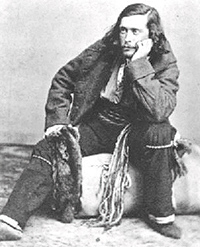 Robert Kennicott founded the museum’s parent institutionin 1857.
|
|
THE PATRONS
|
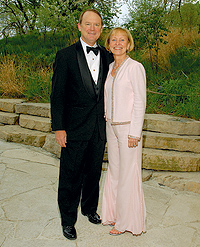
Other high-powered names in attendance include Barbara and David Speer, the latter the chief executive officer of the Illinois Tool Works, a corporate sponsor of this year’s ball; Michael Ferro Jr., the former chief executive officer of Click Commerce, another corporate sponsor (his wife, Jacky, was in Lexington, Kentucky, with their horse, which was running trials before the Kentucky Derby); and Peggy Notebaert, whose husband, Richard, originally paid $4 million for the naming rights to the museum as an anniversary present for her. (Richard, now the chief executive officer of Qwest Communications, stayed in Denver, where he had just finished testifying against the former head of the company, who is accused of insider stock trading. He is also awaiting a Supreme Court decision on a class-action shareholder suit arising from the collapse of Tellabs stocks. The central question in the case is whether Notebaert, once the chief executive officer of the Naperville company, violated security laws.)
Before the sit-down dinner of lobster and beef tenderloin, before the announcement of who won the raffle prize of the butterfly-shaped diamond-and-pearl earrings donated by Tiffany & Company, there is the cocktail hour. To one side in the museum’s foyer is the silent auction, with fierce bidding over the Aspen ski-lift tickets (value: $2,370), an Alaskan cruise ($7,545), and a trip to Shanghai ($14,176). Beside the security desk, a sign reads: To All Security Guards: It is very important that every hour you check on the rattlesnake in the Mysteries of the Marsh exhibit.
The conversations are robust and fueled by excitement or vanilla-flavored martinis, the signature drink of the evening. “There were 52 of us on the yacht, and by noon every day we were plastered,” one man tells his friends. In another group, a woman with sun-kissed hair says, “I thought, You have to be kidding me. There is no way I’m paying that for highlights. But then, they couldn’t look more natural.” Later, at a dinner table covered in butterfly-patterned damask, a woman says to her companions, “I’ve never been to the museum itself. It seems like a nice place, and it’s a great location, but I’m a little confused about what happens here.”
She isn’t the only one. The Nature Museum, a $31-million eco-friendly building tucked into 6.35 acres of Lincoln Park, opened in 1999 as the public center of the Chicago Academy of Sciences, an institution founded a century and a half ago by a remarkable Chicago naturalist and adventurer. For years, the academy, once located at Armitage Avenue and Clark Street, had little to offer the public beyond some dusty dioramas of sand dunes and taxidermied animals. Then the Nature Museum opened, with its jewel exhibit, a butterfly haven where visitors can walk through an indoor garden, complete with a 14-foot waterfall, and interact with more than 75 varieties of butterflies.
From the beginning, there was a build-it-and-they-will-come attitude. But the visitors-originally expected to number 250,000 annually-did not materialize. Since then, the Nature Museum has struggled to establish its identity. In many ways, the first eight years have been more like a roller-coaster ride than a leisurely stroll in the park. Peaks include large crowds and high revenues in 2002 for the museum’s Grossology exhibit on runny noses and body odor, and the quickly established success of its annual Butterfly Ball as a see-and-be-seen fundraiser of the Chicago social set (this year the Butterfly Ball raised $1.5 million, and an anonymous donor matched the funds). Lows include critics who carp about the museum’s sagging attendance, heavy debt load, and identity crisis.
“Their problems go back many years to when they were making the decision to build a new facility,” says Greg Simoncini, the vice president of the Scofield Company, a Chicago-based advisory group for nonprofits and cultural institutions. “They didn’t take seriously the challenge of rebranding the place from an obscure destination with musty collections to a new nature museum. The challenge for the Notebaert is to distinguish itself, to demonstrate a need so people will understand why it exists. Right now the mission isn’t clear to the public.”
“Definitely there were issues five years ago,” says Charles Douglas, the museum’s board chairman and a partner at the law firm Sidley Austin. “And in some ways, we struggled to find ourselves and our audience. But I think we’ve found our way now.”
Certainly those in charge of the Nature Museum hope so. Insiders say there is pressure from city hall for the Notebaert to merge with its neighbor, the Lincoln Park Zoo-an idea that dismays the Nature Museum’s old guard members, who want the place to remain independent. Museum executives and board members are now promoting the museum as an environmentally centered destination, one where people can “find their own green paths.” This year, which marks the 150th anniversary of the Chicago Academy of Sciences, the question remains: Can the Notebaert Nature Museum find a path of its own?
* * *
|
TIGER LONGWING 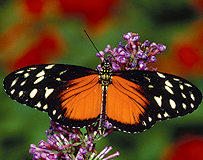 More than 75 species of butterflies take flight in the museum’s junglelike 2,700-square-foot haven. |
AIRBORNE 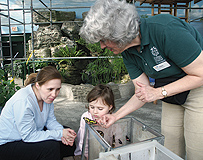 Butterflies-both Midwestern and tropical-are released at the Nature Museum twice a day. |
SCIENCE DIGEST 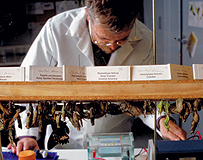 The challenge for the museum is to distinguish itself, to make it clear to people why it exists. |
In the hothouse heat, the butterflies swarm everywhere. Painted ladies-all mottled brown, red, and orange-flit above the heads of flowers. Mon-archs descend on feeding-station platforms for the sliced oranges. Luna moths, as big as salad plates, float by. And dancing overhead, toward the vaulted glass ceiling, are swallowtails, checkered whites, and variegated fritillaries.
This is one of two daily butterfly releases, showcasing the first flights of dozens of butterflies-both Midwestern and tropical-in the Judy Istock Butterfly Haven at the Nature Museum. (Istock is a board member of the museum; her husband, Verne, is a former president and chief executive officer of First Chicago.) The 2,700-square-foot haven is breathtakingly lush: purple-and-orange birds from South America and Australia perch in the shrubs; trees arch over the winding paths, and the sound of the waterfall, whose artificial rocks were cast from real ones in Cook County’s Sagawau Canyon, helps mask the shrieks of excited schoolchildren.
“I would call us a hidden gem,” says Laurene von Klan, 48, the chief executive officer of the museum since 2005. “A lot of people don’t know we’re here, and they don’t know the quality of the experience we can offer.” A native New Yorker, von Klan moved to Chicago 26 years ago to complete her master’s degree in international relations at the University of Chicago. Before moving to the Nature Museum, she was the executive director of the nonprofit organization Friends of the Chicago River. In her office, with its sweeping views of the museum’s prairie plantings and nature trails, von Klan projects confidence in changing the perception of the Notebaert. Revenue from admissions in 2002, during the heyday of the Grossology exhibit, reached $500,000 compared with $230,000 today. The 1998 prospectus for the museum projected an annual attendance of more than 250,000; last year the museum drew 197,000. (By comparison, the neighboring Lincoln Park Zoo has three million visitors annually, the nearby conservatory has 300,000, and a niche-based institution like the National Museum of Mexican Art, which opened 20 years ago in Pilsen, welcomes 150,000 visitors a year.)
“Even before this museum opened, there were challenges,” von Klan says. “First, when the prospectus was written, it was assumed that a 400-car parking lot was going to be built.” But Lincoln Park is mainly landfill, so any plans to dig a lower-level parking lot had to be scrapped early on-diggers would have quickly reached Lake Michigan. Also, von Klan points out, admission to her neighbors, the zoo and the conservatory, is free, while the museum charges seven dollars for adults and four for children.
“From the beginning, this has been a concept that was underthought,” says one former board member. “From exactly who it was going to serve and how it was going to operate, where the school kids who were visiting would eat their lunches-everything was a bit of an afterthought.”
* * *
The Chicago Academy of Sciences grew out of the passion for nature of a vigorous early Chicagoan. Born in 1835, in New Orleans, Robert Kennicott was a year old when his family moved to South Northfield Township (now Glenview). Through a land grant, they took possession of about 150 acres of land along Milwaukee Avenue and built a massive Gothic-style house. Kennicott’s father, the first doctor in the area, pursued his interest in horticulture by starting the Grove Nursery.
Robert Kennicott received little formal education; he was allowed to roam the property, recording and studying the plants and animals. He developed a reputation for clear descriptions and accurate observations of nature. In 1857, he founded the Chicago Academy of Sciences as a base for his collection of natural history specimens. The emphasis was on creating a center for scientific study.
Two years later, Kennicott took off on a three-year expedition, jointly sponsored by the Smithsonian Institution and the Hudson’s Bay Company, to northern Canada and Alaska. He traveled thousands of miles on foot and by dogsled, sending more than 1,700 specimens back to the Smithsonian. Upon returning, he settled briefly at the Smithsonian as a cataloger, then returned to Chicago in 1865 to become the curator of the Chicago Academy of Sciences.
Originally the academy was housed in a new building at Wabash Avenue and Van Buren Street. Its natural history collection, bolstered by loans from the Smithsonian, quickly became one of the finest in the Midwest. But by the end of 1865, Kennicott was eager to go back to exploring. “It’s all very well to talk of the delights of the civilized world,” he wrote, “but give me the comfortable North where a man can have some fun, see good days, and smoke his pipe unmolested.”
This time Kennicott, as the lead scientist for an expedition sponsored by Western Union, traveled north through Alaska in search of a way to bring telegraph lines from Russia to North America. The trip was excessively difficult. Eventually, Kennicott found himself stranded in the lower Yukon with two companions. In May 1866, Kennicott died in the field. Some reports say he suffered a heart attack; others claim he committed suicide.
In 1871, the Great Chicago Fire destroyed the academy’s building and its holdings. A small owl, sent back by Kennicott’s last Alaska expedition, proved to be a new species. It was named the Western screech-owl, and formally known as Otus kennicottii.
* * *
|
LAUGHLIN BUILDING
The academy’s home was at Clark Street and Armitage Avenue from 1894 to the mid-eighties. |
LIVE AND LEARN
For more than 150 years, the academy has been a leader in environmental education. |
DISCOVERY CENTER
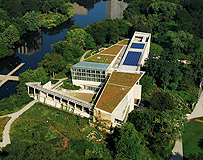
The Nature Museum is situated near the zoo on more than six acres in Lincoln Park. |

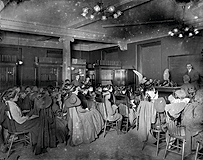
Without a home, the Chicago Academy of Sciences languished for several years, operating out of small rented spaces. When the new Field Museum-with one of the largest natural history collections in the world-opened in 1893, the academy fell into a “little brother” role. In 1894, the academy built the Matthew Laflin Memorial Building, named for a donor, at 2001 North Clark Street, where Armitage Avenue runs west from the park. The Chicago Park District donated land and $25,000; this relationship formed the model for the city’s Museums in the Park arrangement, in which, through a sales tax, Chicagoans contribute to the maintenance of the museums in the city’s parks.
For decades, the academy flourished as a research institute, but as a museum it floundered, offering little to the public besides some wildlife and environmental dioramas. By the mid-eighties, the infrastructure of the Laflin Building was outdated; the choice was to expand or close. Walter Netsch, an architect and a commissioner and board president of the Chicago Park District, suggested giving the Laflin Building to the Lincoln Park Zoo and offered the academy 6.35 acres along North Pond, the site of a turn-of-the-century park district maintenance building. The result would reduce the amount of paved area in Lincoln Park, returning land to green space.
“In the old days, the academy was just a mini-destination,” says Albert Pick III, a long-standing board member. “But then in the 1990s, this idea of building a new museum started to get a life of its own. By the mid-nineties, it caught a little traction.”
Still, the capital campaign was an uphill effort, in large part because the planning was haphazard. “They didn’t do a lot of work about how a new museum relates to its neighbor, the zoo, and nearby residents,” says one insider. “Does the city need this? Is there support for it? No nonprofit can assume that people just understand them and what they have to offer.”
“When the Notebaerts gave the money to name the museum, that helped tremendously,” says Judy Istock. While the Chicago Tribune reported the museum took on $31 million in debt to complete the building, von Klan says the museum raised nearly half the funds to pay for the project. (Thanks in part to a recent gift of $1 million from the Notebaerts, the debt is now down to $6.7 million.) Shortly after the Notebaerts’ original gift of $4 million, Istock’s husband gave the museum $1.6 million to endow the butterfly haven. When the museum opened in 1999, the first butterfly to take flight was a dark-green spicebush swallowtail, a native of the Indiana Dunes.
* * *
From the opening days, the Notebaert lacked emotional support from its neighbors and the city. At the dedication of the new building, witnesses say, Mayor Richard Daley got out of his car, took one look at the starkly modern building in the middle of Lincoln Park, and uttered the f-word. Neighbors complained about the unkempt look of the prairie plantings, and Daley, who thought the idea of planting a prairie in well-manicured Lincoln Park was absurd, lobbied hard through his landscape advisory committee to have the planting contained in some way. Today, it is ringed by crabapple trees, which give a neater look to the park’s landscape.
Then there was the problem of exhibits. In the beginning, the butterfly haven was the only exhibit to see at the museum. “It took a while for us to develop things,” Charles Douglas, the board chairman, admits, “but I think we have some great exhibits now.” The permanent exhibits include the Mysteries of the Marsh, with the rattlesnake and insects living in scaled-down environments. Through hands-on exhibits of water, rocks, and barriers, the RiverWorks explains how the Metropolitan Sanitary District’s Deep Tunnel system works with the Chicago River to manage rainwater.
Overall, von Klan sees a shift from mega-crowd shows to intimate experiences. “We’re not trying to be an amusement park where kids run through and push buttons,” she says. Robots + Us, a show sponsored by the Illinois Tool Works, continues until fall, showing how designers of computers and robots look to nature for inspiration. And this October, a reptile show will open, complete with vipers, alligators, pythons, and snapping turtles.
“Can the Notebaert distinguish itself from the Field Museum and the Museum of Science and Industry?” asks the museum consultant Greg Simoncini. “That is the question they have to answer with the public.”
Having just completed a three-year strategic plan, von Klan says, she is looking forward to the challenge. Part of her focus is on achieving modest admission gains of about 10 percent annually; she believes-as do others in the museum world-that the days of blockbuster shows are over. She also wants to increase the programs for adults at the museum, with speakers and workshops concentrating on environmental and green issues. And there is the continuing mainstay of the museum-working with children and teachers to increase their knowledge of science and nature.
What about suggestions of a possible merger with the museum’s neighbor, the Lincoln Park Zoo?
“We’re interested in collaborating with the zoo,” von Klan says. “And we’re talking about doing so with the upcoming reptile show.”
Kevin Bell, the director of the zoo, is more direct. “Laurene and I are in a series of ongoing talks about how we can best work together,” he says. “But there’s no talk of the zoo taking over the Nature Museum.”
Not from Bell, but those in the know say the mayor is all for the idea. “It’s a matter of how these resources in Lincoln Park can best serve the public,” says one person who has heard Daley’s concerns. “The mayor thinks the two belong together, and so the Nature Museum is going to have to prove him wrong.”
“Mayor Daley has no issues with the Notebeart Museum,” says Lance Lewis, city hall’s assistant press secretary.
Von Klan feels that the Nature Museum has its own story to tell. “The world is increasingly complex, and people are removed from nature in their lives,” she says. “Nature is closer than people think-we just have to get them to understand that.”
Illustration by Daniel Chang; Photography: (Image 1) Courtesy of the Peggy Notebaert Nature Muesum; (Image 2) Dan Rest/Courtesy of the Peggy Notebaert Nature Muesum; (All other images) Courtesy of the Peggy Notebaert Nature Muesum.