

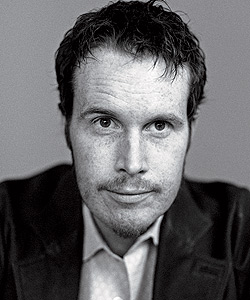
Grant Achatz, chef of Alinea: "I was like, You're going to cut my tongue out? There's no way!" |
If you're ever looking for Grant Achatz, just go to Alinea, his restaurant in Lincoln Park. He's always there—usually in the kitchen, as was the case on a recent day in March. "I'm shelling fava beans. You know why?" he asked me. Is this a quiz? Because there's no one else to do it? "It's spring!" he answered, brightly, in a little boy voice that's a bit higher than its usual register.
It's an awfully upbeat answer from a guy who basically shouldn't still be around. Last July, Achatz, one of the best chefs in the city, if not the entire country, received devastating news: An oral surgeon told him that the painful raw spot on the left side of his tongue was cancer—specifically, squamous cell carcinoma of the tongue. The tumor had grown so large that the malignant mass now occupied nearly the entire organ and was swiftly working its way toward the back of his throat.
* * *
"It was the weirdest thing," Achatz recalls. "It was a Friday. There was nobody in the waiting room. I remember it being really dark. There was only one receptionist and one doctor in the whole place. Here's this probably 42-year-old doctor and he comes in and he looks like somebody just killed his mother. You could just see it all over his face: I gotta tell this 33-year-old kid, a chef no less, that he's got tongue cancer? How fucked up is this world?"
That question rippled through the restaurant world when the news came out a couple of weeks later. How could this happen to someone so young and so completely on the brink of greatness? And how weird and Shakespearean was it that a chef would have not just cancer, but cancer of the tongue?
What followed in the next several months was a cascade of predictable events: confirmation of the diagnosis, second and third and fourth opinions, the brutal calculus of weighing options in the face of death, chemotherapy, radiation, surgery—and now the long slog of recovery. The good news is that right now Achatz appears to be cancer-free and the tumor eradicated. Moreover, Achatz still has his tongue, probably thanks to a targeted new drug called Erbitux, which he received as part of a clinical trial at the University of Chicago. And he's back to work at Alinea, his serious, four-star foodie destination, and apparently more ferocious than ever, creating a whole new raft of the otherworldly, high-tech dishes that have become his calling card (see Dining Out: From There to Alinea). Of course the threat of recurrence hums in the background: The disease could strike back at any time and, statistically speaking, the next two years are the danger zone.
* * *
Photograph: Tom Maday
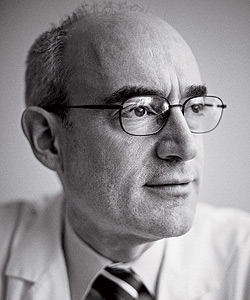
Dr. Everett Vokes: "I'm an expert in head-and-neck cancer, but cases like this are really rare." |
Achatz still has no idea why he got sick. Neither does his oncologist, Everett Vokes at the University of Chicago Medical Center. "I'm an expert in head-and-neck cancer, but cases like this are really rare," Vokes told me recently. Of the 34,000 cases of mouth and throat cancer diagnosed in the United States every year, about 90 percent originate, as did Achatz's, in the squamous cells, the flat, scale-like cells that cover the tongue like a skin and also line the oral cavity and the pharynx. It's a relatively rare cancer—by comparison, lung cancer struck more than 200,000 Americans in 2007—but squamous cell carcinoma is considered very deadly in its late stages and has proved difficult to cure without recourse to radical, disfiguring surgery.
Achatz is an unusual case for a few reasons: The typical patient is a male in his 60s with a history of smoking and heavy drinking. Achatz says he has never smoked, and his doctors say that even his occupational drinking—one or two glasses of wine a night—would not have been enough to trigger the cellular mutation that leads to a malignancy, because Achatz is simply too young. Oral cancer also tends to be fast-moving, spanning a couple of months from initial symptoms to stage-four malignancy; Achatz appeared to have lived for years with something slower-growing. Finally, younger patients with the disease increasingly test positive for the human papilloma virus, the same virus that is recognized as a cause in cervical cancer; Achatz did not.
The thought has crossed Achatz's mind that perhaps the disease took root in his youth: He grew up in a small Michigan town that received its drinking water from the nearby St. Clair River, which Achatz believes to be contaminated with industrial pollutants. "A lot of people—a lot of young people in my hometown have cancer," he tells me. But at this point, he realizes, speculating about why gets you only so far. (Midway through his treatment, Achatz remembered that an aunt had survived bone cancer in the jaw; but Vokes dismisses the suggestion that the cause is genetic.)
Sometime in late 2003, Achatz noticed a "little white dot" on the left side of his tongue that was sensitive when his tongue rubbed against his teeth or when he talked in a certain way. He also noticed the dot flared up when he ate very spicy food. But those were busy times for the young chef. Two years before, he had taken over as the executive chef at Trio, a four-star restaurant in Evanston that became an improbable breeding ground for emergent top chefs. Now Achatz was attracting national attention for his playful brand of technically experimental cuisine that seemed more like edible abstract art than something you might otherwise call dinner. In 2002, Food & Wine magazine named him one of its 11 best new chefs and the James Beard Foundation nominated Achatz for its coveted "Rising Star" award, which he didn't get but won the next year. In 2003, the Los Angeles Times dropped by for a visit; later, Amanda Hesser from The New York Times showed up; then the hordes descended. Meantime, Achatz's homelife was busy, too: His second son, Keller, arrived in December 2003, joining his two-year-old brother, Kaden. Needless to say, the annoying white dot wasn't getting much attention.
Even so, the pain was persistent enough to prompt a visit to the dentist. She thought Achatz was biting his tongue, probably from stress. Achatz later went to see a general practitioner, who was puzzled by the patchy white lesion and recommended a biopsy. Finally, in November 2004, about a year after he first noticed the dot, a surgeon took a biopsy—and the results came back clean. "Everybody said, 'Aw! See! You've got two kids. You're running a four-star restaurant. You're working too much. You're biting your tongue,' " Achatz remembers. "In my mind, this is all making sense."
After all, he had just lived through the busiest time at Trio since he started, culminating in June 2004 when he announced that he was leaving to open his own restaurant. "So, I'm going, OK, nothing to worry about. It'll go away. Whatever," Achatz recalls. Of course, it didn't go away. Tragically, this plausible hypothesis—that Achatz was chewing his tongue raw—carried him along for two and a half years, from the initial negative biopsy all the way to his stage-four cancer diagnosis last July.
In retrospect, Achatz blames his extremely busy work life—which delayed his response time from appointment to appointment—but also an almost comically bad string of wrong diagnoses from his dentists and doctors. The timeline goes something like this: In November 2005, a year after the biopsy, Achatz complained to his dentist that the pain hadn't gone away and, in fact, was getting worse. He had been so busy running Alinea since its May opening that he was self-medicating with a topical numbing gel. The dentist measured the lesion and assured him that it was probably nothing more than a stress wound. In July 2006, having moved from Evanston to Chicago, Achatz switched to a new dentist, who fitted him for a mouth guard to prevent his lower teeth from rubbing against the irritated part of his tongue. In August, she fitted him for a second mouth guard, this time to cover his upper teeth.
Nearly a whole year passed until, in June 2007, he went back to his dentist because his tongue had begun to swell. "I would wake up in the morning and I could see on the left side of my tongue there was an imprint of my teeth," Achatz recalls. "I said, Look at this! What the hell is going on?" (Later the same day, Achatz went to see a doctor for a lymph node in his neck that had blown up to the size of a golf ball. The doctor told him that his tongue was probably infected, which would explain the puffed lymph node, and prescribed antibiotics.) The dentist referred Achatz to a periodontist—a gum specialist. Two weeks later, the periodontist took one look and made an emergency appointment for the chef to see an oral surgeon. When Achatz finally showed up at the Lincoln Park Institute, an oral and cosmetic surgery practice near Alinea, he was in so much pain he could barely talk; he typed up his symptoms and simply handed the printout to the receptionist. The doctor there took a biopsy, and four days later, on July 13th, Achatz received the news.
* * *
Photograph: Tom Maday
At first, Achatz says, he could not quite absorb the blow, in part because he knew very little about the disease. A physical examination at Advocate Illinois Masonic preliminarily verified the results of the biopsy: The little white dot had become a tumor about the size of a toddler's thumb; the mass was rigidifying his tongue and the malignancy had likely spread to the lymph nodes in both sides of his neck. "I'm a cancer idiot at this point," Achatz recalls. "I didn't even know that stage four was the highest level. I thought maybe there's ten stages." He was also shocked to hear the doctor's recommended treatment: In order to save his life, the doctor said, it would be necessary to surgically excise the tumor by cutting away most of his tongue and possibly part of his jaw, if the cancer had spread there. It might be possible, the doctor told him, to reconstruct his tongue using a piece of muscle from his arm. The chef could not believe what he was hearing. "I was like, You're going to cut my tongue out? There's no way! There's just no way!" Achatz recalls.
Three days later, Achatz flew to New York City and underwent PET scans at Memorial Sloan-Kettering, the renowned cancer treatment center; the imagery later confirmed that the cancer had spread to the lymph nodes but, luckily, not the lungs. That day, he also met with a Sloan-Kettering cancer surgeon who recommended the same grim approach: cut out the tongue, as well as part of the jaw, to save the life. Achatz asked the surgeon to elaborate, which he did by drawing a picture that showed the size and the location of the tumor and an incision line that encompassed the entire organ except for a crescent-shaped sliver—in other words, a near-total glossectomy. Tasting and swallowing, the surgeon said, would be "severely compromised." And talking with a quarter tongue? "This guy mimics how someone would talk and it wasn't even talking; it was like grunting," Achatz recalls. "It was barbaric." And if he chose to do nothing? The doctor told him he would be dead in four months.
With that visit, any hope Achatz had for good news evaporated. "Best cancer clinic in the country," he remembers thinking. "They're either going to tell me I don't have cancer, or it's a different kind, or it's treatable. Crushed that." He spent the next few hours tearfully talking through his options with his girlfriend, Heather Sperling, a food writer who lives in Manhattan. They poured strong gin cocktails, at 11 in the morning, and sat on the roof of her apartment building. He wondered what would be better for his boys—the presence of a disfigured father, or to die and let them simply forget. Maybe Angela, his ex-wife, would remarry, giving them a new dad, one who could talk, who could eat, whose disabilities they wouldn't have to explain to their friends.
Later that afternoon, Achatz broke the news to his staff by speakerphone from Sperling's apartment. By now, he was barely able to eat and had lost about 20 pounds. He had been looking increasingly haggard, but only a few people at the restaurant knew that something was ailing him physically, even as some cooks noticed that he had stopped eating solid food during staff meals. Nick Kokonas, Alinea's principal investor and Achatz's business partner, gathered with everyone around a telephone in one of the restaurant's dining rooms. Forcing himself to talk over the pain, Achatz tried to sound upbeat about his prognosis and the future of the restaurant—but he could sense that the staff was stricken. "I had to ask three or four times if we had gotten disconnected because there was zero sound on the other side of the phone," he remembers. "Nobody was laughing at my jokes, nobody breathing, no nothing." On the Chicago end of the connection, Kokonas says, people were stunned; after the call, a couple of cooks who were close to Achatz went outside to cry in the alley.
Within a few days, Achatz met with Harold Pelzer, the head-and-neck cancer surgeon at Northwestern Memorial Hospital who had operated on Roger Ebert's salivary glands in 2006. Pelzer told Achatz that surgery indeed represented the first line of defense in cases like his. "If your question to me is, By your experience, Dr. Pelzer, what is the absolute best way for me to try to cure this disease regardless of functional deficiencies? I would say radical surgery followed by chemo and radiation," Pelzer said to Achatz. However, since Achatz already had an appointment to see Vokes at the
U. of C. to get another opinion, Pelzer reassured the chef that Vokes's approach—start with chemotherapy and radiation to shrink the tumor, and spare the organ if possible—was an attractive alternative, one that Pelzer believes could become the standard of care in the future. "Music to my ears," Achatz says.
* * *
In this age of high-tech cures, the University of Chicago Cancer Research Center, widely considered one of the most progressive in the country, seems quaintly removed, headquartered as it is in the aging Gothic architecture of a sprawling multiwing building that includes the hospital, numerous laboratories, and the medical school. Everett Vokes, its deputy director, is one of an army of oncologists there who treat patients in a way that is intertwined with clinical investigation. A head-and-neck and lung cancer specialist who had moved to Chicago from Germany to do his post-medical school residency, Vokes joined the medical school faculty at the U. of C. in 1986 and three years later became the director of clinical research for oncology and hematology, which seeks out new treatments for cancer and blood-related diseases and brings them to the research center's patient population for testing. He has since cycled through a number of prominent posts there and currently also serves as the section chief for hematology and oncology.
Despite being initially buoyed to hear about an alternative treatment, Achatz was not optimistic. "What's the point?" he asked Kokonas. "We've been to three of the best doctors." By the next day, Achatz had decided not to go to the U. of C. "I basically dragged his ass over there," Kokonas says.
The meeting was a revelation. Vokes and his team weighed the options with their prospective patient. On the one hand, there was surgery. "Grant said to us, 'No matter what happens, I don't want to have my tongue cut out,' " recalls Elizabeth Blair, the surgeon on the team. "I understand, but [the patient's preference is] not necessarily what drives us." The first goal, they told him, was to save his life and cure the cancer. The survival rate after five years for this kind of advanced oral cancer is less than 50 percent, killing possibly as many as two of every three. But Vokes thought he and his team—including Blair and Daniel Haraf, the chief radiation oncologist—had a reasonable shot at organ preservation.
One of their active trials appeared to be a good fit: A relatively new drug had earlier shown impressive results in shrinking head-and-neck tumors when combined with radiation, and also when combined with conventional chemotherapy. Now, the question was, Would this drug, called Erbitux (generically known as cetuximab), work even better when applied throughout the treatment procedure. In other words, Achatz would first undergo chemotherapy with Erbitux added; then, radiation with Erbitux and chemotherapy added. If this heavily loaded combination therapy worked as they hoped, the tumor might disappear altogether and surgery would be necessary only to remove the remaining diseased lymph nodes.
Erbitux is one of several in a class of new drugs known as targeted therapies; specifically, Erbitux is what's called a monoclonal antibody. First produced in the laboratory by two British scientists in 1975, a monoclonal antibody is a copied version of a protein that interferes with a specific cell function by blocking a receptor like "sticking gum in a lock," in the words of its primary U.S. innovator, John Mendelsohn. As a group, such targeted therapies—including interferon—were hyped in the late 1980s as a "magic bullet," relying as they did so elegantly on microbiological mechanisms to undermine a cancer cell's ability to reproduce, repair damage, or maintain its blood supply. More recently, Erbitux had entered the public consciousness in 2002 when the drug came up in the insider-trading scandal involving Martha Stewart and the selling of her shares in ImClone, the then-obscure biotech company devoted entirely to the development and sale of Erbitux.
To the doctors, the chef was no different from any other person entering the trial: While the approach to his case would be tailored to his needs as an individual, once Achatz signed on, his course of treatment would strictly follow an established regimen. In his favor, Achatz was young and in good health otherwise. But entering the trial was not without risk. First, Achatz might not respond to the drug. Or, more urgently, he could have side effects that might delay surgery or make continued treatment more difficult or impossible. And because Achatz had no known risk factors, Vokes says, there was some trepidation about whether he would respond to the treatment in the ways they expected. "With a case like this, you don't really know for sure if you can apply everything you know with the same certainty," he says, adding that outcome statistics for cure, relapse, and mortality are more predictive for patients who fit the majority profile. That said, Vokes told Achatz that the survival rate so far appeared to hover at around 70 percent of participants in comparable studies. "So, limited surgery and a higher success rate," Achatz remembers thinking. "Where do I sign?" A week later, he started treatment.
* * *
Achatz may have avoided what is perhaps one of the most debilitating surgeries that exist: Survivors of total glossectomies—removal of the whole tongue—can barely talk and must drink their food using gravity. But his treatment was punishing in its own way: He started with eight weeks of daily chemotherapy, followed by six weeks of chemo plus radiation, with a radiation boost every day in the final two weeks. In December, he underwent a bilateral neck dissection to remove all the lymph nodes on the left side from the top of the neck to his collarbone, and a cluster from the right side.
From the beginning, resoluteness—bordering on what seemed like denial to the people around him—was Achatz's way of coping. During his hours-long chemotherapy sessions at the U. of C. hospital, he tapped away on his laptop, e-mailing and working on the text of his cookbook-in-progress. He went straight from the hospital to the restaurant throughout his chemotherapy and all but the final week of his radiation treatment, often closing up the place well past midnight. He also insisted on driving himself to and from his appointments, occasionally needing to pull over on Lake Shore Drive to vomit. Except for a handful of moments, he did not cry. "I'm not an insensitive or an emotionless person," he says. "I realize that it's serious and I realize that I could die. But I'm not just going to curl up in a ball in the corner."
Then there was his kooky and grimly reality-based sense of humor. "Right off the bat we were calling him cancer boy," recalls his close friend Christopher Gerber, the maître d' at Alinea until March 2006. Gerber remembers one episode in particular: One afternoon, toward the end of chemo, Achatz was home with his sons and, while talking to Gerber, absent-mindedly twirled a lock of his hair. "He fluttered his fingers and this hair fell out," Gerber says. "He said to Kaden, 'Hey, pull my hair!'" Kaden and Keller took turns grabbing little fistfuls of Daddy's hair. "They got the biggest kick out of that," Achatz remembers. Later that day the two boys helped Achatz shave what was left into a Mohawk—clean sides with a narrow strip on top; in a show of solidarity, a number of cooks, including a bald guy who had only a beard to work with, followed suit.
Vokes thinks that Achatz's fixation on working helped him endure the rigors of treatment. "I actually think it distracted [him] from the pain and discomfort," Vokes says. Achatz's response to Erbitux, the focus of the clinical trial, was excellent. According to Vokes, the drug may improve conventional treatments by disrupting the cell's ability to repair itself after the damage caused by chemotherapy and radiation. Or Erbitux may work by arresting a tumor cell in a phase during which it is especially susceptible to damage and, thus, eradication. "These are all proven in the lab . . . [but] we never can prove the specific mechanism in people," Vokes says. "What we know is that the cure rates are higher." In Achatz's case, after Erbitux and chemo, the tumor shrank by more than half. Then, with radiation, the tumor vanished entirely.
His tongue now contains scar tissue where the tumor once lived, but the pain is gone and mobility is returning. He can also talk without slurring, although his voice has changed—it sounds strained and a bit tinnier—because of damage to the voice box during radiation. Achatz says his taste is coming back, too, but slowly. "Two weeks after radiation I couldn't taste a thing. You could put anything in my mouth and it would taste like cardboard," he told me in February, about three months after radiation ended. "What's coming back first is sweet. Savory, salt, is coming back slow." In his first meeting with the doctors, they told him that most people recover 90 percent of their taste. Achatz thinks that percentage is only a guess, but he's hopeful. By late April, Achatz was still in transition. "What I've realized is that the recovery process is not linear," he says. "One day I'll be like, My taste is back! And the next day I won't be able to taste anything." Savory flavors are still mostly absent, alcohol burns, and even slightly spicy food is painful.
Achatz has asserted in the past that he could still run Alinea even if he could no longer taste food—and he could be right. In October, after radiation had made it too painful to eat much besides chocolate and vanilla milk shakes, Achatz and Jeff Pikus, one of his trusted sous-chefs, who stepped into the role of second-in-charge, were able to invent several new dishes together. Achatz's idea for one was to create a silky bean purée and pair it with a dozen or so complementary flavors. In brainstorming sessions, he and Pikus worked out the components—for example, deciding that lemon as a flavor would appear in the dish as a lemon marshmallow—but this time, Pikus took the lead in executing the prototype. The bean purée was too grainy at first, and required several versions—which Achatz could only look at, smell, and touch with his fingertips.
But more challenging was perfecting the flavors. "It's hard to pinpoint how to make something taste good," Pikus says. "It's almost an intuitive thing." For the bean dish, Pikus could no longer just hand over a sample to Achatz; he had to work in a new way that was purely verbal. "I had an idea of what he wanted based on the other components, but it was me that had to say, It's sweet but not too sweet, or It's acidic, but do you want to push the envelope of acid or be more mellow?" Pikus remembers. "Based on that we made tweaks and adjustments." The result—called Beans with Many Garnishes—was a classic of the Alinea genre: an ethereal purée of navy beans surrounded by about a dozen garnishes including the lemon marshmallow, a vanilla-and-bay-leaf gelée, and dehydrated mango and tomato strips.
During his treatment, which lasted from July 31st through December 13th, the date of his surgery, Achatz kept busy in this way but says he was also sustained by a huge outpouring: loads of e-mail from fans of the restaurant and fellow chefs, heartfelt looks from his customers, and the intense bonding that accompanies hardship. Midway through Achatz's treatment, Sperling, his girlfriend, arranged a special dinner at Gramercy Tavern, a well-known restaurant in New York. She somehow knew that Michael Anthony, the executive chef, had lived through a similar ordeal: A close relative had had his tongue removed to fight the same cancer nearly a decade earlier. His meal for Achatz was a lovely array of foods that were either very soft or drinkable. Achatz and Sperling also embarked on a marathon of last suppers in the three months leading up to radiation, which loomed like D-day in his mind. They were showered with excess at Jean-Georges in New York, Charlie Trotter's, and Avenues, where Graham Elliot Bowles prepared more than 20 courses for the couple.
Of course, there were many low moments, too. Beyond the usual side effects of chemotherapy, the intense radiation—twice a day in the final two weeks—burned the inside of his mouth and throat so severely that he couldn't swallow water, let alone any kind of food. Near the end of radiation, he weighed just 131 pounds, down from 165. The recovery has gone as well as can be hoped for, his doctors report, but what has surprised Achatz is his yearning to be healed. "There's a letdown point after surgery," he says. "At that point, you're going, I made it, guys! Hello! I'm done! Can I feel better now? And the answer is no. You get the flu and you're sick for a week. I've been sick for eight months."
In January, Achatz stole away with Sperling for a ten-day vacation on St. Barts island in the Caribbean. "The kicker was, we had this beautiful little villa on the beach and it was absolutely gorgeous and St. Barts is French," he remembers. "You walk into a grocery store and there's fresh foie gras and beautiful charcuterie and artisan-baked bread. And I'm sitting there going, Are you kidding me? And I couldn't eat it." Instead of picnics on the white-sand beaches with wine, cheese, and his new girlfriend, Achatz could manage only scrambled eggs and overcooked pasta.
Then there was the stress of watching cooks file out the door—by his count some 14 line cooks—and his restaurant strain under the pressure. Some of the cooks who left took job offers they couldn't turn down; others, Achatz thinks, simply freaked out when the bad news hit. At one point the kitchen, normally staffed with up to 20 cooks during the service shift, limped along with a skeleton crew of just nine that included many newcomers. "I was more scared for this place than I was for my life," he says.
* * *
With the exception of two weeks in the fall and a scattering of days in between, Achatz has reported to work throughout his entire ordeal. He points out that his long vacation with his girlfriend happened during a week when Alinea was closed anyway. He says he would have gone back to work immediately after his surgery except that he had drainage tubes hanging from his neck, which might have been uncomfortable for, you know, other people. Jeff Pikus remembers that when Achatz came back from treatment he displayed a lot more aggression than normal—sometimes yelling loudly enough for diners to hear, uncharacteristically getting in people's faces. "I think even that short period of time made him feel that he wasn't a part of it anymore," Pikus says. "And the natural response of a chef is to want to take it back."
These days, the kitchen at Alinea feels busier and buzzier than ever: One day not long ago, it was packed with bodies and the cooks were up to some crazy shenanigans. A guy in the corner was smoking ice—literally, trying to make a smoky haze impart its flavor to cubes of frozen water. Pikus was transforming a piece of squab into a candy bar. Greg Baxtrom, one of the sous-chefs, coated jagged glaciers of brioche purée with melted bittersweet chocolate sprayed through a motorized paint gun. Nathan Klingbail, another sous, pondered the technical aspects of freezing English-pea foam in a water balloon.
Achatz was doing his usual thing: answering the phone, e-mailing, conferring with his lieutenants, and making himself available for troubleshooting. But glimpses of his quieter inner world hung all around the place: On big pieces of white drafting paper tacked to the white-tile walls, Achatz had sketched ideas for new dishes. Some were doodles; some were illustrated platings; some were just strings of words. One burst of free association read: "Capture spring. What is it? New, fresh, ice, sprouts, delicate, fragile."
Goodbye, winter.