

|
RELATED STORY A Gunthorp Farms Sampler |
1998 was an ugly year for pig farmers. They remember it the way Cubs fans remember 1969. The year of the Monster Pork Glut. In 1996 and '97 pork on the hoof sold for 45, 50 cents a pound, sometimes more—enough for pig farmers to make a healthy profit. So they produced like crazy in '98, and by December the price had dropped to eight cents a pound in some spots. Pigs were everywhere. Slaughterhouses couldn't kill them fast enough. The government announced it would buy pork and give it to the Russians. Farmers were losing an estimated $20 to $75 on every pig they took to market.
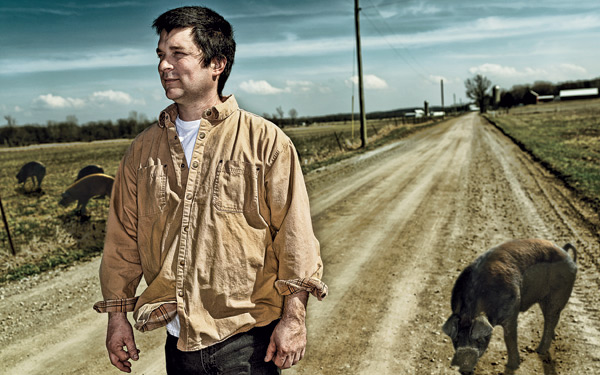
It was Greg Gunthorp's fourth year as a pig farmer, if you don't count the time he put in on his father's and grandfather's farm. He likes to call himself a fourth-generation pig farmer, but in '98 he feared he'd be the last generation. "I actually sold pigs for less than what my grandpa sold them for during the Depression. I decided it's time to either quit or do something different. And I couldn't imagine the thought of quitting." So he did something different. He called Charlie Trotter's.
* * *
Gunthorp, now 37, remembers riding the tractor with his grandfather before he was old enough to go to school. "I'd go every morning with my grandpa to feed the sows and baby pigs. I was maybe four years old. It's a neat experience for a little kid: the sows in their huts and the little baby pigs running around. It's just something you can't get out of you."
Gunthorp's father and grandfather (and his great-grandfather before them) worked a 600-acre farm not far from the place Gunthorp farms now, near LaGrange, Indiana, in the northeastern part of the state. They grew corn and soybeans and kept about 40 acres in woods and another 100 acres in pasture grasses and clover. The pigs would wander the property helping themselves to the grasses, rooting in the woods for acorns, and "hogging down the corn" in the fall. Today you'd call it raising pigs on pasture, but then it didn't need a name—that's just the way it was done. Where today crop farmers grow corn and soybeans and sell them at an elevator that sells them to a feed processor that turns them into pig food and sells it to a pig farmer—a convoluted supply chain requiring tractors and trucks and gallons upon gallons of chemicals and diesel fuel—in those days the pigs simply walked to their food. Where today pig farms consist mostly of buildings equipped with heaters and huge fans for ventilation, with pigs packed so close inside that liberal amounts of antibiotics are needed to keep them from infecting one another, the Gunthorp property was dotted with half-round metal shelters where the pigs happily endured the winter by snuggling together on beds of insulating straw. (Amazing fact: The Union of Concerned Scientists estimates that 70 percent of all the antibiotics used in the United States are fed to livestock prophylactically.) Where today pig excrement is collected into vast foul-smelling lagoons whose contents are then sprayed on nearby fields or trucked away, in those days the pigs naturally spread their manure in the course of their daily travels, fertilizing the fields that produced their feed. And pig farms didn't stink.
It was a sane, sensible, and relatively sustainable way of making pork. But it vanished in little more than a generation. In 1965 the USDA counted more than a million "hog operations"—farms that raised at least one pig—and a national population of about 50 million pigs. The average herd was about 48 pigs per farm. At the end of 2007 the pig population was more than a third higher—nearly 67 million—living on fewer than one-tenth as many farms. And a tenth of those farms—a mere 7,772 with herds of 2,000 or more—accounted for more than four-fifths of the pigs in the country. Most of these producers work under contract to one of the big packers, promising to deliver a certain number of pigs over a certain period of time. Sometimes the contract specifies a price, protecting the farmer from fluctuations in the market, but more often the price is pegged to the spot market, which ensures the packer a steady supply without guaranteeing anything to the farmer. Sometimes the packer owns the pigs, and provides the feed and the drugs, and even employs the vet. The owner of the land might call himself a pig farmer, but he could just as accurately be described as the production manager of a protein factory.
This industrial style of pork production—the "concentrated animal feeding operation," or CAFO—was sold to farmers on a few different levels. For one, it was presented as a solution to common problems like parasites. Because they are fond of rooting in the dirt, pigs are highly susceptible to parasitic worms, whose eggs can lie viable for years in the soil. One way to manage that problem is to put the pigs in a building with slatted floors and carefully control what they eat. CAFOs were also seen as modern, scientific, businesslike—a way for farmers to maximize productivity and get with the de facto government program embodied in the now immortal words of Eisenhower-era secretary of agriculture Ezra Taft Benson: "Get big or get out." A third selling point was lifestyle: Why slog through the mud and wrangle stubborn animals on a cold, rainy day when you could be indoors managing a dry, well-lighted mechanized feeding facility?
The Gunthorps didn't buy it. "We never had pigs in a building. My dad and grandpa didn't feed all the chemicals and all that crap, and they got production just as good as the guys who put their pigs in barns. And it's mostly because they understood the animal and worked along with nature. Lots of guys told my dad, and even told me when I started to get bigger, 'Man, that's way too much work—you guys are stupid. You ought to put up some barns and raise pigs the way you're supposed to.'
"All those guys who told us that, they don't have pigs anymore."
* * *
Photograph: Kevin Banna
|
RELATED STORY A Gunthorp Farms Sampler >> |
Greg Gunthorp studied agricultural economics at Purdue, but after two years he bailed out and went home with an associate's degree. What he was hearing in college did not jibe with the way he was brought up. "It's the industrial mantra the whole time you're down there: Get big or get out, go in debt, get efficient. I always tell people if I would have listened when I was down there in West Lafayette, I would have come home and built confinement buildings, and I would have gone bankrupt in 1998. Guarantee it, without a doubt."
The pork market has always been cyclical, but Gunthorp believes—and one of his Purdue professors, the agricultural economist Christopher Hurt, agrees—that the cycle swings wider in the CAFO era, because supply is now much less elastic. A small pig farmer can adjust to a glut by trimming his herd or even idling it—cutting back to just enough breeding sows so he can start up again when the market improves. But adjusting is not so easy for the modern pork producer: He has capital expenditures to amortize, buildings and exotic machines bought with borrowed money. Prices may go down, costs may go up, but the farmer's loan payments always seem to stay the same.
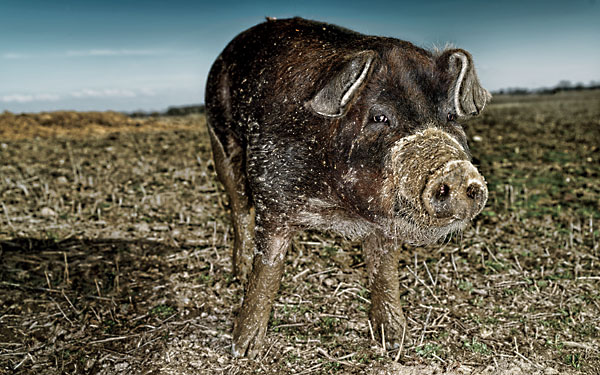
Hurt predicts that 2008 may be as bad as 1998 or even worse, largely because the use of corn for ethanol is driving feed prices out of sight. But Gunthorp is not worried about the pork market this year, because in 1998 he decided it was a "race to the bottom" and started looking for a way out. He was reading about new trends in small-scale farming—organics, free-range, specialty markets—and he recognized that beyond the confines of LaGrange County, Indiana, pork raised his grandfather's way might look desirable rather than weird. Gunthorp was raising Duroc pigs and other old breeds whose meat is better marbled than the lean hybrids bred to make "the other white meat." He was making their feed himself, without antibiotics, from corn and soybeans grown mostly on his own farm. Although "pastured pork" had not yet become a trendy term, free-range was all the rage. So Gunthorp took up a new implement—the telephone—and began a second career in niche marketing.
At least he tried. "I don't know how many phone calls I made trying to get my foot in the door somewhere. I called every grocery store, I called every restaurant, I called every small meat processor—anybody I could think of I called, and I tried every kind of approach imaginable. And had just about zero success. I couldn't even get anyone on the phone."
His luck changed at a sustainable agriculture conference in Missouri, where he gave a talk about raising pigs on pasture. Afterward a man from the audience told him he ought to call this restaurant in Chicago: The man had a friend out West who was raising pigs for this restaurant, but the friend was getting out of the business and the restaurant needed a new farmer. "It happened to be Charlie Trotter's," Gunthorp recalls. "I didn't know anything about nice restaurants or the food industry. I didn't know who Charlie Trotter was. But I thought what the heck, I'll give them a call."
Ten years later, Gunthorp still regards it as a stroke of fate, if not divine intervention, that the phone was answered by Trotter's chef de cuisine, Matthias Merges. "To this day I do not know why he picked up the phone, because normally he doesn't, he's so busy. I must have picked exactly the right time. I probably talked to him for 15 or 20 minutes that day. We talked about how we raised the pigs, how long the family's been raising pigs, what kind of pigs we have, and he said, Why don't you bring me a pig over? So me and my wife, Lei, took our first pig up there. We had a little hatchback at the time, a Suzuki Swift. It barely fit in there. We put a plastic tank in the back, laid the pig in there, covered it up with ice, covered the top with a sheet of plastic, and headed for downtown Chicago. I still remember that day. By the time we got to the restaurant I was white knuckled, 'cause I never drove in anything like that in my life.
"They gave us a tour of the restaurant, and when we got out of there me and my wife go, Man, we're way out of our league here." When they got home they did some research and learned that Wine Spectator had just named Trotter's the "Best Restaurant in the World for Wine & Food."
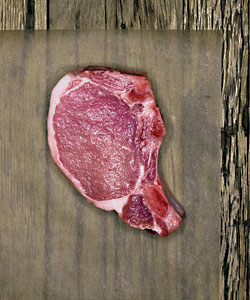
Merges also remembers that day. "He brought a pig that was slaughtered the day before, and it was beautiful and well taken care of—beautiful fat, great dark red meat. He talked about it like it was a member of his family almost, it was almost that intense. We tasted it, we did comparison side by side, and it turned out to be a superior product. We took the head and made headcheese. We took all the bones and made stock. We used the hams at our Trotter's To Go store, for a special we were doing. We used the shoulders to do a pulled-pork tortellini that we were running, with boudin sauce and caramelized turnips. We also used the tail. If you braise it really slowly, you're able to take the bone out and the tail will remain consistent, and then you roll it back on itself and you're able to cut these beautiful medallions. We used every single part of it. Everything." A few days later Merges called Gunthorp and ordered another, and soon he was buying a whole pig every three weeks.
And though Gunthorp may not have known much about Foodie World, he knew what to do next. He went back to the phone and when he got someone on the line he'd say something like, "I'm going to be delivering a pig to Charlie Trotter's next week. I wonder if I can bring you some samples."
Within a few months he was delivering pork to Va Pensiero, Campagnola, the Ritz-Carlton, and Blackbird, among others. One chef would lead him to the next. And several chefs pointed him toward Rick Bayless and Frontera Grill. When Gunthorp made that connection, his fledgling business went into a new orbit.
* * *
Photograph: Kevin Banna
|
|
Although Bayless doesn't toot this particular horn very much, Chicago chefs consider him a leader in the use of local food and support of local farmers. In high season, Bayless estimates, about 85 percent of what he serves is grown within a five- or six-hour drive of Chicago. His Frontera Farmer Foundation, now in its fifth year, has made grants of more than $350,000 to help local farmers buy equipment, develop marketing channels, and extend their growing seasons.
Bayless says he was interested in local food when he opened Frontera Grill in 1987; he tells a funny-sad story about naïvely trying to buy local strawberries at the South Water Market. In the mid-nineties, after his restaurants were firmly established, he asked his staff to turn his preference into a priority. Much of this work was taken up by Tracey Vowell, who was then a managing sous-chef and later became managing chef, the equivalent of chef de cuisine in Bayless's kitchens. (About two years ago, she left the restaurants for an organic vegetable farm she had started near Kankakee.)
|
RELATED STORY A Gunthorp Farms Sampler >> |
Vowell remembers when Greg Gunthorp started coming around. She was buying eggs from a Michigan farmer named George Rasmussen, and at the time Rasmussen and Gunthorp were making their deliveries together in a sort of joint sales effort. "Every week I had this guy standing out behind my restaurant, killing time waiting for the other guy to do his delivery, and I got to know him, and the fact of the matter is he's one of the sweetest people you'll ever come across. Even though he wasn't selling things to me, we started developing a strong relationship." Vowell and Bayless both stress the importance of personal connection with their suppliers. Designations like "organic" and "free-range" don't tell them much about the way food is grown; they'd rather talk about it. "Greg seemed like a really good farmer," Vowell recalls. "His whole family has lived right in that area for so long. They're settled in; they know their land. They grew up with it. It's in them." She looked him up on the Web and found he was also something of a proselytizer. "He had made a little bit of a name for himself as a noisemaker on the Internet talking about sustainable agriculture, and why the world doesn't need confinement-pig operations. I thought, Not only is this guy thinking the right kind of things and wanting to do the right kind of things, but he's a little bit outspoken about it."
Rick Bayless was also impressed with the guy standing out in the alley. "He comes off as a sort of farm boy kickin' in the dirt, but he is anything but that."
The Frontera people had just one problem with Gunthorp: He was a pig farmer, and they already had one (Tom Mueller of Maple Creek Farms in Pewaukee, Wisconsin). "When it comes to supporting farmers, they're extremely loyal," Gunthorp says. "I could not talk them into even trying my pork."
What Vowell wanted instead was chickens. At the time she was buying from a supplier that was close to home but too big for her taste. They were "nameless, faceless," and she wanted a chicken farmer she could look in the eye. "I really liked Greg, and I really wanted to see him succeed. So I kept going back to him saying, 'Greg, chickens. Need chickens. Don't need pigs. Really need chickens.'"
Gunthorp had never raised chickens commercially, but he figured he could learn. And he did learn—over a couple of years and through numerous misadventures, most of them having to do with slaughtering and processing. To sell his meat outside Indiana, Gunthorp needs a USDA-inspected meat-processing plant. There are plants that will do the work for him, but they won't do it the way his finicky chef customers want. He tried becoming a partner in a processing operation in Michigan, but that effort failed for a few reasons. Finally he achieved a feat that is nearly unheard of for a small-scale farmer: Through powers of wit and sheer persistence, he threaded his way through a thicket of regulations and an army of bureaucrats to finance and build a fully functional USDA-inspected slaughter and processing operation on his own property, including what used to be his garage. Today he's selling about 20,000 chickens and 6,000 ducks a year to Frontera Grill and Topolobampo—virtually all the duck and chicken they use. He doesn't think he would be in business without them. Bayless still won't buy his pork, but Gunthorp knows he is safe if another chicken farmer starts hanging around in the alley. And he's counting on Bayless to help him take the next step in his business plan—to seasonal production.
* * *
Photograph: Kevin Banna
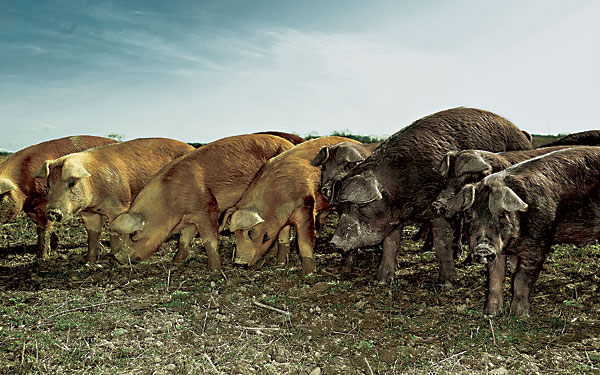
Gunthorp's pigs are lean, handsome animals, with rusty-red hair like an Irish setter's
|
RELATED STORY A Gunthorp Farms Sampler >> |
Though it probably escapes the notice of many sophisticated diners and even some chefs, there's a contradiction inherent in the idea of locally raised pastured meat in Chicago in January. Gunthorp's Duroc pigs are hardy enough (and have enough fat) to make it through the Midwestern winter outdoors, but they're certainly not eating pasture grass and acorns. His chickens might survive, but they wouldn't like it and they probably wouldn't do well. But restaurants want their supplies year-round. Though no chef worth the title would expect to buy a fresh local strawberry in October, there are many who want their local pasture-raised chicken even when the pasture in question is covered with snow.
Gunthorp thinks the answer to this contradiction is freezing. Most chefs hate the idea and insist on fresh, but that will have to change, Gunthorp says, if they want locally, sustainably raised meat. "There's a time, you know? All products should be raised seasonal. Animals should be raised when grass is green; baby pigs should be born in late spring or early summer. I'm convinced nowadays that we have the technology to put all this stuff up—you take something, put it in a vacuum machine, seal it, freeze it right away—it's gonna come out of the freezer as nice as it went in."
Bayless stands with him on that. "I think the freezer is a really good tool," he says. "We went through this period back in the seventies, eighties, when people would say if you had anything frozen in your place, you were an awful restaurant. And if you're talking about frozen prepared foods, or choosing frozen ingredients when you could get the best stuff fresh, then, yeah, that is awful. But we have huge freezers. We buy fruit all summer long and we freeze tons of it so we can use it in ice creams and dessert sauces. We just put on our menu [in January] this Michigan apple and blueberry tart that is to die for. It's all local fruit. What else would we be doing, shipping in underripe stuff from halfway across the world? If you know how to use a freezer, and you understand that you can only freeze certain things, and you know how to defrost slowly at the right temperature, you can serve great local food year-round." It's not a matter of compromising for the sake of sustainability, Bayless insists. It's a matter of serving the best stuff available at your given time and place. He'd rather buy a correctly frozen chicken breast from a farmer he knows than a "fresh" one killed two weeks ago and shipped from who-knows-where.
* * *
Today Gunthorp sells pork, chicken, duck, and the occasional rabbit to about 40 restaurants in Chicago and Indianapolis. The name "Gunthorp Farms" appears on the menu at Frontera Grill, Bistro Campagne, Crofton on Wells, Nacional 27, Custom House, Lula Café, Carnivale, and Atwood Cafe, among others. Chefs pay extra for Gunthorp's meat: $3.59 a pound for pork shoulder, for example, which can be had elsewhere for less than $1.50. What's more important, probably, is that Gunthorp's best customers will pay his prices no matter what happens on the commodity market. Bayless says, "We're not gonna tell Greg, 'Oh, you know what, the Amish chicken just dropped a dollar a pound on the market, so we're not gonna need any of your chicken this week.' He knows he can count on us as a partner in this whole project." This year Gunthorp hopes to break a million dollars in sales, a phenomenal amount for a 65-acre farm. He's just added a small retail store behind the house where he can sell hams, sausages, and other pig parts the restaurateurs don't buy. (See A Gunthorp Farms Sampler.)
It's more than he dreamed when he started phoning restaurants and grocery stores back in 1998: not only more success but also more work, more headaches, and more debt than he ever thought he'd take on to build that highly unusual processing plant—which, now that he has it, he really ought to operate at full capacity, which means more customers, more employees, more equipment . . . just the kind of treadmill he and his father avoided when they resisted the lures of confinement feeding. The irony isn't lost on him, but he doesn't see a better way. This is what he has to do if he wants to raise pigs the way they ought to be raised—and that's what he wants more than anything.
On a bitter cold day last winter, with about five inches of fresh snow on the ground—the kind of day that drove many pig farmers into CAFOs—Gunthorp is bombing around his farm taking feed to his pigs. His little Kawasaki Mule is stuck in two-wheel drive, so he gets caught in the snow occasionally, but the day is bright, his crazy little dog is chasing the Mule and nipping at its tires, and the pigs come to greet him when they see supper coming. What person in his right mind wouldn't rather be out here than choking on the dust and stink of a confinement barn?
He climbs a wire fence to walk among his pigs, as he must have done with his grandfather more than 30 years ago. They don't look much like "pigs." They are lean, handsome animals, with rusty-red hair like an Irish setter's. Smart, too, Gunthorp says—smarter than dogs, and each one has its own personality. A few little ones come over to nip at his boots. He pats a couple of the mature sows on the shoulder; some tolerate the attention for a second and then walk away. One snaps at his hand.
"This sow here, number 14, she's the meanest pig I ever saw when she has babies." He points to a shelter about 30 yards away. "She won't let you get any closer than that when her babies are one day old. If you approached, she'd walk out this far to meet you. You can't get a look at her babies until they're two, three days old."
In a confinement operation, he says, she'd spend most of her life in a gestation crate just a few inches longer and wider than she is. "She can't move, can't turn around—all she can do is stand up and lie down." To give birth she'd be moved to a farrowing crate, which would give her just enough room to nurse her babies for 10 or 14 days. Then she'd be sent back to the gestation crate to turn out another litter of artificially inseminated piglets.
"That's no way for an animal to live," says the pig farmer. "I mean, I know we're just gonna eat 'em someday, but still, an animal deserves a better life than that."
Photograph: Kevin Banna