

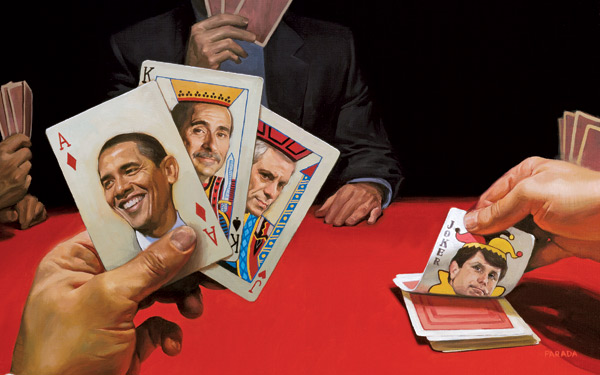
In the days following his arrest on corruption charges last December 9th, Governor Rod Blagojevich did his best to appear busy. He visited his 16th-floor suite at the Thompson Center, once even showing up in a jogging outfit. He signed bills, issued press releases, expunged criminal records. And he hardly wasted an opportunity to sling mud at other local Democrats, taking particular delight in sullying the veneer of President-elect Barack Obama and his Chicago team headed for the White House.
“Give me a chance to call in witnesses like Rahm Emanuel, the president’s chief of staff, who said there was nothing inappropriate in his conversations with me,” Blagojevich said on NBC’s Today show, during one in a round of interviews he gave in the weeks before he was ousted from office. “Give me a chance to bring in Valerie Jarrett,” now a White House senior adviser. When Greta Van Susteren of Fox News asked if he would try to call Obama as a defense witness, the governor replied, “I would not rule anything in or rule anything out.”
“His whole thing was—dirty everybody up, show that everybody’s just as dirty as him,” says one former aide to Blagojevich. “He never wanted to go down alone.”
Whether the ex-governor succeeds in soiling others will be determined in the coming months, as federal prosecutors press their case against him. An indictment handed down in April charged Blagojevich and a small circle of aides and colleagues with wide-ranging corruption, including the notorious effort to personally profit from filling Obama’s vacated U.S. Senate seat. More charges may follow as the investigation continues.
At this writing, U.S. attorney Patrick Fitzgerald had said nothing to implicate Obama or his aides in wrongdoing. Still, with at least 40 references to Obama and his associates in the original 76-page criminal complaint, the scandal has cast a shadowy light on the connections between Blagojevich, Obama, and Emanuel, whose careers often overlapped, and who all drew on the skills of David Axelrod, the architect of Obama’s Senate and presidential campaigns and now a White House senior adviser.
Understandably, the Obama camp has tried to downplay the connections, most notably with a report by the future White House counsel Greg Craig asserting that no one on the president-elect’s staff, including Obama, had “inappropriate discussions” with the governor about deals for the Senate seat. But the Craig report focused exclusively on Blagojevich’s alleged wheeling and dealing around the seat, and beyond that time frame, the interplay of Blagojevich, Obama, Emanuel, and Axelrod goes deep into the recent history of Illinois politics. None of those four principals would talk for this article, but interviews with three dozen sources and an examination of the record tell a complex story spun within a world where relationships are nuanced and, in some cases, baffling. For years, these four talented and ambitious men worked with and around each other. There are indications that Obama and Axelrod were wary of Blagojevich, though they never publicly broke with him. Until the arrest, Emanuel stayed in close contact with the governor—perhaps closer and longer than the Craig report indicated. As Blagojevich’s career tumbled, his jealousy of Obama grew. In all, the mix of alliances, deals, and resentments makes up a potent brew that could yet stain the White House.
* * *
“I come out of the alleys of Chicago politics,” Blagojevich told a New York Times reporter on the January day he was removed from office. “That’s a tough place. The politics there is not motivated by idealism or high purpose. It’s nuts and bolts, and you scratch my back, I’ll scratch yours.”
Growing up in a small rented apartment near Cicero and Armitage on Chicago’s Northwest Side, Blagojevich was always something of a street-savvy operator, and politics was the great equalizer, the best chance for the son of a steelworker and a CTA ticket clerk to become a big shot. He saw his opening one night in March 1988, at a fundraiser for Alderman Dick Mell at Zum Deutschen Eck, the old German restaurant in Lake View. Bruce DuMont, the veteran radio host, recalls that Blagojevich, then 31, introduced himself and made small talk before asking, “Mr. DuMont, which one is Patti Mell?” DuMont pointed out the alderman’s 23-year-old daughter. She and Blagojevich married two years later.
Blessed with Alderman Mell’s imprimatur—and more significantly, his money, his connections, and his army of precinct workers—Blagojevich served two terms in the state legislature, then set his sights on the Fifth District congressional seat, which at the time was held by a Republican, Michael Flanagan. Blagojevich and Mell knew that the alderman’s 33rd Ward operation wouldn’t be enough to carry the much larger congressional district—a jagged, splinter-shaped area that spans miles from the lake to the western suburbs. So, they called David Axelrod.
A former political reporter at the Chicago Tribune, Axelrod left the paper in 1984 to work for Paul Simon’s U.S. Senate campaign, and by the early 1990s he had earned a name as “kingmaker” in local political circles, working for, among others, Harold Washington and Richard M. Daley. Blagojevich’s primary opponent, Nancy Kaszak, also sought out Axelrod’s services, recalls John Kupper, a partner in Axelrod’s former consulting firm. “We found Rod to be a more attractive and compelling personality,” says Kupper. Insiders recall the campaign as fun—nonstop sports talk, practical jokes, and Elvis Presley. “There was a lot to like about Rod,” says Peter Giangreco, a top consultant to Blagojevich’s congressional and gubernatorial campaigns. “He had a very ’85 Bears kind of feel about him, a very Chicago kind of thing.”
But along with the fun came conflict. “There was always a strain between Axelrod and Mell, particularly with regard to how money was spent and what the priorities were, what Rod should do,” recalls a second former Blagojevich aide. (Several of the former aides to Blagojevich, Obama, and Emanuel who were interviewed for this article did not want to be identified by name out of concern for their careers.) Mell, the old-school ward boss, preached that “yard signs win elections,” and he pushed for more cash for the ground game. Axelrod, the media guru, countered that to get to Congress you needed TV ads.
Meanwhile, Blagojevich and Mell were also at each other’s throats—explosive shouting matches, hanging up on each other’s phone calls, going days, sometimes weeks, without speaking. “They had a loving relationship, but it was love with knuckles, not with kisses,” says Giangreco. “Rod preferred to have people around him who didn’t call him on his shortcomings. And Dick did nothing but call him on his shortcomings.”
Of Blagojevich’s shortcomings, retail campaigning was certainly not one of them. He was a natural—always smiling, upbeat, and eager to hit the el stops, to shake hands and kiss babies. “Nobody could work a room like Rod—nobody,” says Jan Schakowsky, the Democratic congresswoman who served with Blagojevich in Springfield and Washington.
That talent didn’t escape Axelrod’s practiced eye. A master image-maker, he mines a candidate’s biography for compelling details and then builds a supporting narrative that resonates with the concerns of average voters. With Blagojevich, Axelrod spun a yarn highlighting the rise from an immigrant family’s blue-collar roots—the storybook American Dream. One memorable Axelrod spot showed various lunch-bucket locals bungling Blagojevich’s tongue-twisting Serbian name, ending with a down-home waitress advising, “Just call him Rod.”
Axelrod was also a fierce protector of his client. He brought in his friend Carol Ronen, a progressive state representative and vocal gay-rights activist, to be campaign manager—a move intended to put a good-government face on Blagojevich, who was seen by many as simply a Machine hack. And when Axelrod got word that a team at the Tribune was working on an investigative series on Mell (and, by extension, his young protégé, Blagojevich), the ex-Trib reporter complained vociferously. He argued, as the former city editor Hanke Gratteau recalls today, that the paper was “conducting the equivalent of a proctology exam” on Blagojevich. When the Tribune finally ran its story—a probing but not particularly hard-hitting portrayal of Mell that extolled Blagojevich as the “perfect candidate” with “good looks a soap opera star would envy”—some inside the newsroom suspected that Axelrod’s aggressive pushback had killed a tougher version. Gratteau told Crain’s Chicago Business, “The only thing he killed at the Tribune was his good name and reputation.”
Today, she is more circumspect. “From David’s perspective, it seemed like the might of the entire Tribune investigative team had been unleashed against a congressional candidate, just because of his connection to Dick Mell.”
At the time, Axelrod told Crain’s that he was willing to sacrifice his reputation to help his clients. Privately, he was less sure. “It was after that that Ax sort of felt like he didn’t want to be a part of this anymore,” recalls Giangreco. “He said to me, ‘You know what—I can’t keep putting my integrity on the line for this guy.’” Still, Axelrod stayed on as Blagojevich won the primary and general election.
* * *
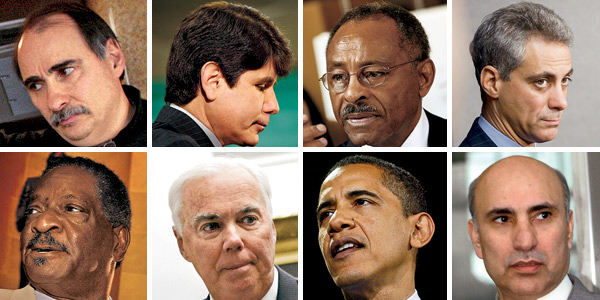
Clockwise, from left: Axelrod, Blagojevich, Burris, Emanuel, Rezko, Obama, Mell, and Jones
To some colleagues, Blagojevich seemed bored on Capitol Hill. Schakowsky recalls that he regularly blew off caucus meetings and subcommittee hearings, and behind closed doors he would often complain about the congressional leadership. “Rod has this incredible anti-authoritarian streak in him,” says Schakowsky. “No one was going to tell him what to do: not the speaker of the Illinois House, not the leader of our party in the U.S. House, Dick Gephardt, nobody. He had all kinds of things to say even about Bill Clinton, the president.”
Shortly after Blagojevich was reelected for his third congressional term in November 2000, he and Mell started eyeing a run for the governor’s office in 2002. Until then, Axelrod had remained an indispensable adviser but he had misgivings about a gubernatorial run and advised Blagojevich not to fritter away a good thing—he could be Congressman for Life. Blagojevich wanted no part of that. He saw Congress as a backwater.
For months, Blagojevich pressed Axelrod to come on board his campaign for governor. Axelrod refused to commit. He had other clients weighing gubernatorial bids, and Bill Daley, the younger brother of Axelrod’s close friend the mayor, was talking about running. But even after Daley and the Axelrod clients all passed up the race, the back-and-forth between Blagojevich and Axelrod continued. Several associates of Axelrod’s say he worried about Blagojevich’s prospects. The state had been rocked by scandals involving the Republican governor George Ryan, and Axelrod thought that the former schools chief, Paul Vallas, who was considering a run as a Democrat, would be a more credible “reformer” than the son-in-law of a ward boss.
Axelrod also had serious doubts about Blagojevich’s readiness to be governor—his ethics, his maturity. “At one point, David asked Rod, ‘Why do you want to be governor?’” says Forrest Claypool, the Cook County commissioner and a longtime friend of Axelrod’s. “And the best that Blagojevich could come up with was, ‘It’ll be fun.’ There was no mission, no principles. It was just, sort of, a game to him.”
Ultimately, Axelrod sat out the contest. Blagojevich was beyond hurt. “To have your longtime political consultant not do your next-level campaign—I’m sure any candidate, not just Rod, would take that very personally,” says the second former aide to Blagojevich. Adds Giangreco: “There was really a brotherly and affectionate relationship, but Ax just got worn down with everything that came along with being around Rod. And, in fact, what he said to me was, ‘I’m just too close to the guy.’”
* * *
One summer day in 2001, Blagojevich went jogging around his Ravenswood Manor neighborhood. Afterward, he called a colleague. “Guess what?” Blagojevich asked him. “I just ran by Rahm Emanuel’s house. There he was, and we started talking. I told him I was definitely running for governor, and I said, ‘Rahm, you should run for my seat.’”
What Blagojevich didn’t tell Emanuel was that he had offered similar advice to several other prospects who lived in the district. Truth be told, Blagojevich didn’t really care if Emanuel succeeded him or not. (He didn’t much care if the Fifth Congressional District even existed after he gave up the seat, according to a former aide to Emanuel with knowledge of Blagojevich’s dealings. Blagojevich and Mell undertook a failed attempt to reapportion the seat out of existence in return for gubernatorial endorsements from the two downstate Democratic congressmen, whose seats would be spared.)
The 2002 Fifth District Democratic primary settled into a contest between Emanuel and Nancy Kaszak, making her second try. Even with an enviable political resumé that included time in the Clinton White House, Emanuel was actually considered the slight underdog, so he brought in his longtime friend David Axelrod as chief strategist. The two had first worked together on Paul Simon’s Senate race in 1984, and, together in that race with David Wilhelm and Forrest Claypool, they formed a tight bond over progressive politics and killer instincts. Like competitive siblings, Emanuel and Axelrod would occasionally butt heads. “It was more intellectual combat, but with no hard feelings,” says the former Emanuel aide.
As the congressional race unfolded, Blagojevich offered to support Emanuel, if Emanuel would endorse him for governor, according to the former aide to Emanuel. By this account Blagojevich mostly hoped that Emanuel would get his pal Mayor Daley to join the Blagojevich camp. Emanuel declined to trade endorsements—“Rahm felt strongly that we just wanted to run our race,” says the aide—and Daley ended up staying out of the gubernatorial primary fray. In the end, Emanuel easily prevailed over Kaszak in the primary and then cruised to a general-election victory against a token Republican opponent.
Beyond occupying the same political geography and sharing a proclivity for profanity, Blagojevich and Emanuel had little in common. Emanuel, the brainy, overachieving son of a pediatrician, grew up in Wilmette and belonged to the Paul Simon progressive wing of the state’s Democratic Party—a rather antiseptic counterpart to Blagojevich’s ward-based background. At times in private conversations, Blagojevich would ridicule Emanuel as the “ballet dancer,” riffing on the fact that Emanuel once studied ballet. At the same time, Blagojevich also had grudging respect for Emanuel. He knew that Emanuel was a shrewd political tactician and money wrangler with a thick Rolodex. “Rahm was a nut-cutter, a tough guy, and he could raise a lot of cash,” explains Giangreco. Indeed, Blagojevich complained that Emanuel didn’t do enough to raise money for him. The fundraising issue comes up in the federal indictment released in April. The document charges that, in 2006, Blagojevich tried to extort Emanuel by holding up a $2 million state grant for the Chicago Academy, a public school in Emanuel’s district, unless Emanuel’s brother Ari, a big-time Hollywood agent, held a fundraiser for the governor. (The fundraiser was never held, and it’s not clear whether the Emanuels knew about the alleged scheme.)
For his part, Emanuel didn’t care much for Blagojevich, but associates say Emanuel stayed practical. “Rod was the governor—so it’s smarter to have a relationship than not,” says Giangreco. “It was a political friendship, purely political.”
Over time, the two got a bit chummier. One of their most striking (and disastrous) collaborations came with the I-SaveRx program, a plan to import lower-cost prescription drugs from Canada and Europe, in defiance of a federal law. Emanuel seized on the idea as a hot-button populist issue, but the legislation went nowhere in Congress. So Emanuel devised a plan to open up a new battlefront in the states, beginning with his home state. “Rahm saw an opportunity,” says a third former Blagojevich aide familiar with the initiative. “He knew Rod would be a willing partner, someone who would push the envelope.” Blagojevich made the plan a centerpiece of his agenda—even after it was declared illegal by the Food and Drug Administration and the state’s auditor general. Blagojevich’s flouting of the law and the waste of state money on the scheme later became a charge in the impeachment case against him.
Emanuel has not spoken publicly about the I-SaveRx debacle, but Blagojevich has, most notably in his closing argument at his impeachment trial: “If you’re impeaching me on providing safe and affordable prescription drugs by going to Canada and getting the same medicines made by the exact same companies, then . . . let’s demand that President Obama fire Rahm Emanuel because Rahm Emanuel was the one who gave me this idea.”
Over time, Emanuel struck up a friendly relationship with a close Blagojevich associate, the lobbyist John Wyma, once Blagojevich’s congressional chief of staff. Besides lobbying for clients such as AT&T, Harrah’s, and Kraft, Wyma was a prodigious Democratic fundraiser. In December, the Associated Press reported that Wyma’s clients had contributed more than $100,000 to Emanuel’s congressional campaigns and causes and $445,000 to Blagojevich’s gubernatorial races.
In January, the Sun-Times reported that Emanuel called Wyma in the days after the presidential election with a message for Blagojevich: Obama would not offer anything but “appreciation” in return for the appointment of an Obama favorite to the vacated Senate seat. It is unclear why Emanuel contacted Wyma rather than Blagojevich or the governor’s chief of staff, John Harris. At the time, unbeknownst to Blagojevich, Wyma had turned against him, secretly providing information to federal investigators about the governor’s alleged pay-to-play schemes.
The relationship between Emanuel and Wyma could turn out to be a crucial missing link to knowing the full extent of Emanuel’s role in Blago-gate. As the third Blagojevich aide puts it: “Wyma was the bridge between Rod and Rahm.” (Repeated calls to Wyma were not returned.)
* * *
Barack Obama never got as close to Blagojevich as Emanuel did. In fact, when Blagojevich first ran for governor in 2002, Obama supported Roland Burris in the primary, standing and cheering on the porch of the Burris home in Chicago’s Chatham neighborhood on a rainy Sunday afternoon in September 2001 when Burris announced his run. It wasn’t that Obama was a tried-and-true supporter of Burris; the two hardly knew each other. Obama had no other choice, politically speaking.
Since getting creamed by Bobby Rush in a run for Congress the previous year, Obama had been taking pains to mend fences with the city’s black leadership. He had been thinking about running for the U.S. Senate, and he knew he couldn’t do it without the support of black voters, who typically account for about a quarter of the vote in a statewide Democratic primary. Endorsing one of Burris’s white opponents, Paul Vallas or Blagojevich, would have ended Obama’s political career.
By several accounts, Obama didn’t play much of a role in the Burris campaign, which ended with Burris finishing a distant third in the primary. Ever the loyal Democratic warhorse, Burris endorsed Blagojevich in the general election and urged Obama to back Blagojevich as well. “When Blagojevich beat me, I told Barack to get on board with him,” Burris told the Washington Post last December. “It was kind of like swallowing his pride a little bit, because [Obama] didn’t really see that they had anything in common.”
If Obama was uneasy about backing Blagojevich, he didn’t sound like it during an appearance on the local public-access program Public Affairs that summer: “Right now, my main focus is to make sure that we elect Rod Blagojevich as governor . . . ,” Obama said to Jeff Berkowitz, the show’s host.
Berkowitz interrupted him. “You working hard for Rod?” he said, sounding surprised.
“You betcha,” Obama replied.
“Hot Rod?” Berkowitz asked again.
“That’s exactly right.”
This past July—when Blagojevich’s legal troubles were well known, but five months before he was arrested—Emanuel told The New Yorker that he and Obama, along with the campaign cochair David Wilhelm and another unnamed aide, were the top strategists of Blagojevich’s 2002 gubernatorial run. Emanuel described participating in “a small group that met weekly,” adding, “We basically laid out the general election, Barack and I and these two.”
A Blagojevich spokesman confirmed Emanuel’s account for the magazine, though the assertion puzzled some politicos. In the same article David Wilhelm said that his old friend Emanuel had exaggerated. Rich Miller, who writes the newsletter/blog Capitol Fax, looked into the dispute and found that Emanuel was hastily running away from his claim. He gave Miller a terse statement: “David [Wilhelm] and I have worked together on campaigns for decades. Like always, he’s right and I’m wrong.”
Several other Blagojevich campaign staffers also report that Obama and Emanuel did not play significant roles in the 2002 race. One of those staffers says that Obama’s participation was “on par, if not less so than other elected officials who came by the office.” Emanuel was somewhat more involved, by these accounts, and played the part of Blagojevich’s Republican opponent, Jim Ryan, as the candidate prepared for the gubernatorial debates. But Emanuel was smack in the middle of his own congressional race.
In any case, Blagojevich didn’t need much help, let alone from a little-known state senator from Hyde Park. He had a large lead in the polls and money was pouring in. His campaign coffers flush with cash, Blagojevich probably paid little notice to two checks—one for $2,000, and the second, for $1,000—that Obama’s campaign fund gave Blagojevich shortly before the election.
Privately, Blagojevich considered Obama an overeducated elitist, a symbol of his neighborhood. “There are two places that you don’t want to be from if you wanted to curry favor with Rod Blagojevich—the North Shore or Hyde Park,” says Giangreco. “He despised people from either place.”
On the other hand, on the few occasions when their paths crossed, Obama came away impressed with Blagojevich’s political skills—his talent for churning out charm, his memory for names and faces. At the time, Obama was still trying to find his political groove. He was often stiff and wonkish, and he was uncomfortable with the folksy grip-and-grin style of politics that Blagojevich could do in his sleep. “Rod’s style did influence Barack’s style, because he saw the importance of one-on-one retail campaigning,” says Dan Shomon, Obama’s Springfield aide. “Nobody could work a room like Rod. [Obama] saw that and mentioned it . . . and over time his style changed.”
Obama noted, for example, how Blagojevich used humor to overcome the handicap of a difficult name. Early on in his U.S. Senate race in 2004, Obama would often refer to himself as “the skinny guy with a funny name,” and he told his audiences: “There are some who might say that somebody named Barack Obama can’t be elected senator in the state of Illinois. They’re probably the same folks who said that a guy named Rod Blagojevich couldn’t be elected governor of the state of Illinois.”
Shomon says Obama also took note of Blagojevich’s extraordinary fundraising prowess—he collected a jaw-dropping $58.3 million during his two gubernatorial campaigns, more than a third of which came from 435 donors who gave $25,000 or more, according to the nonprofit group the Illinois Campaign for Political Reform. “I think Barack learned from that,” Shomon says. “I think it gave Barack a certain confidence, because nobody had done that in Illinois before Rod.”
Shomon, now a lobbyist based in Chicago, recalls observing Blagojevich in action: “One guy—I’m not gonna say who—was having a fundraiser, and Rod said, ‘I want you to raise me 40 [thousand].’ Rod calls him about a week before the fundraiser and says, ‘How’re you doing on that fundraiser?’ The guy said, ‘I’m gonna make it, I’m gonna make 40.’ And Rod said, ‘That’s not enough. You can do 70. Get me 70.’”
Over time, Shomon says, he saw a similar aggressiveness in Obama: “If somebody said, ‘Barack, I can do five’ [as in, $5,000]. He’d say, ‘I want you to feel a little pain and do ten.’ He’d actually use those words.”
With Blagojevich’s easy victory in November, a Democrat reclaimed the Illinois governor’s office after 26 years in the hands of Republicans. “Tonight, Illinois has voted for change,” Blagojevich told the jubilant crowd of supporters who packed the room at A. Finkl & Sons on election night.
But when U.S. senator Dick Durbin met with the new governor in his office two months or so after the election, he says he didn’t exactly see a genuine change agent. “He was excited about filling jobs and contracts,” recalls Durbin. “That stopped me cold. I remember, he said to me, ‘It’s all good.’ He kept saying it over and over—‘It’s all good.’”
* * *
Photography: Chicago Tribune photos by (Mell) Scott Strazzante, (Axelrod) Zbigniew Bzdak, (Rezko) Charles Cherney, (Blagojevich) Scott Strazzante, (Emanuel) Pete Souza, (Burris) David Pierini, (Jones) Jose More, (Obama) AP photo/Gerald Herbert
By the time Democrats took full control of the General Assembly in January 2003, Obama was officially in the U.S. Senate race and he knew he needed some legislative successes in Springfield to beef up his relatively thin resumé. Eager as he was to build a record, Obama didn’t go out of his way to cozy up to the new governor. “At the end of the day, Rod is about Rod,” says Jim Cauley, a veteran Democratic operative who managed Obama’s U.S. Senate race. “Why bother?”
Instead, Obama focused on networking within the governor’s office and among the top policymakers inside the state agencies. He would talk shop with Lon Monk, Blagojevich’s chief of staff, at the East Bank Club, where they both worked out. More often, he’d call staffers in the governor’s office for long policy discussions. “He wanted to figure out how the levers of government could work for his legislation and his issues,” says Shomon. “He knew he needed to be productive, and he needed to know who’s who.”
Obama also drew on his political patron, senate president Emil Jones Jr., arguably the most powerful black politician in Illinois at the time. After the Democrats swept into power and Jones took the reins of the state senate, Obama went to see him. “He said to me, ‘You got a lot of power now,’” recalls Jones. “I said to Barack, ‘What kind of power do you think I have?’ He said, ‘You have the power to make a United States senator.’ And I said, ‘That sounds good. Do you know of anybody I can make?’ He said, ‘Me.’”
Jones threw his support to Obama for the Senate race, and since Jones and the governor were politically close, the senate president became the proxy between Blagojevich and Obama. With Jones’s help, Obama found real success for the two years that he was in the state legislature and Blagojevich was governor. During that time, Obama sponsored nearly 800 bills and Blagojevich signed more than 280 into law, by the Tribune’s count. By contrast, Obama’s biographer, David Mendell, says that Obama introduced, or had a hand in sponsoring, 116 bills in his first three years in Springfield, and 25 were signed into law.
Still, Obama suffered occasional run-ins with the Blagojevich team. In early 2004, as Obama maneuvered to pass a controversial measure that required police to tape homicide interrogations, he learned at the last minute that Blagojevich’s office was negotiating changes to the bill with the Fraternal Order of Police. Obama called the governor’s office and complained to a Blagojevich aide, who raised the concerns to Bradley Tusk, then the deputy governor. “You can tell Barack that we do the politics in this office,” barked Tusk, according to the second former Blagojevich aide, who witnessed the encounter. “He’s just a law-school professor! If he wants to pass this bill—or go anywhere in politics—he’s gotta work with us!” (Tusk, now the campaign manager for New York’s Mayor Michael Bloomberg, did not return messages seeking comment.)
As two ambitious politicians, Obama and Blagojevich occasionally vied to claim credit for the state’s progressive agenda. “That is where the rivalry between Rod and Barack really started—who’s getting credit for all of this?” says Giangreco. At a signing ceremony for criminal-justice reforms—including Obama’s measures to tape interrogations and to curb racial profiling—Jim Cauley recalls that Blagojevich barely acknowledged Obama’s contribution. “Barack was like, ‘Damn, I did that bill and that’s the treatment I get,’” Cauley says. At the conclusion of the event, Obama started working the room, talking to any reporter he could corral. “[Obama] saw an opportunity to get on Chicago TV and Rod was trying to elbow us into the corner,” Cauley says.
* * *
The federal indictment handed down in April charges that even before taking office Blagojevich orchestrated a scheme with his close friends and members of his inner circle to use the governor’s office to enrich themselves—an effort that prosecutors have dubbed the “Blagojevich Enterprise.” The associates charged include Lon Monk and the governor’s main moneyman, Christopher Kelly. Prosecutors allege that Antoin “Tony” Rezko, a Syrian-born real-estate developer who has already been convicted on corruption charges involving the Blagojevich administration, was a co-conspirator in the “Enterprise.”
Around the same time that he was allegedly co-managing the Blagojevich Enterprise, Rezko—who had a fondness for politicians—was also helping to fill the campaign coffers of Barack Obama. One of Obama’s earliest supporters and biggest fundraisers, Rezko raised at least $159,000 for Obama over the years, in some cases collecting from the same donors he was hitting up for Blagojevich. (Obama later donated to various charities an amount equal to the Rezko-tainted contributions.) In one respect, Rezko was even more valuable to Obama than to Blagojevich, providing crucial financial support when Obama was a political nobody. “When you’re an outsider and you’re trying to build relationships and you’re getting ‘No, no, no, no’ all the time—to have somebody come to you and say, ‘I believe in you, I want to help you, I want to raise money’—that’s irresistible,” says Giangreco.
Besides raising money for Obama’s campaigns, Rezko helped place one of Obama’s closest friends, Eric Whitaker, in the job as the state’s public health director. Then a state senator, Obama recommended Whitaker to Rezko, who had an unofficial role picking people for top state jobs in Blagojevich’s administration. During Rezko’s trial, workers in Blagojevich’s patronage office testified that if Rezko wanted somebody hired, it usually got done—quickly.
Rezko remains the most troubling common tie between the president and the disgraced former governor. Obama has repeatedly insisted that Rezko never sought anything except small favors here or there, such as an internship for the son of a business associate. Assuming that’s true, why did Rezko act like a crook with Blagojevich and not with Obama? One veteran political operative offered this explanation: “Rezko was, basically, forming political sleeper cells. He didn’t know which ones would be useful. He was right about Barack’s promise, not about his usefulness.”
And was Obama simply naïve about Rezko? “Maybe so,” says John Kupper, who worked on Obama’s U.S. Senate and presidential campaigns. “But the fact is: He never asked Barack for anything in return.”
Blagojevich, however, was infuriated that he—and not Obama—was taking most of the political heat for Rezko. Recalls a fourth former Blagojevich aide: “A lot of Rod’s resentment was—‘How come I wear the jacket for Tony?’”
* * *
After the 2002 elections, David Axelrod was drumming up business for the next election cycles. He had taken side work as a consultant to the Ontario Liberal Party, and in 2003 he also advised Mayor Daley, who cruised to his fifth term. Looking ahead to the 2004 political season, Axelrod wanted to be a part of something bigger. He worked briefly for John Edwards in his bid for the 2004 Democratic presidential nomination. But when that proved an awkward fit, Axelrod turned his full attention to Obama and the 2004 Democratic primary for U.S. Senate. (At first he thought Obama was aiming too high, according to the Mendell biography, Obama: From Promise to Power. Mendell reports that Axelrod told Obama after his loss to Bobby Rush, “If I were you, I would wait until Daley retires and then look at a mayor’s race because then the demographics would be working in your favor.”)
Axelrod produced three 30-second biographical TV ads that introduced Obama to voters in the crowded primary’s closing weeks—by luck, just around the time records of a domestic dispute were damaging the image of the leading contender, the rich ex-trader Blair Hull. The commercials’ now famous mantra, “Yes, we can” galvanized voters across the state. “Ax basically created 90 seconds of ads that catapulted this guy into a national contender,” says Cauley.
Blagojevich never endorsed any of the Senate candidates, but it was a well-known secret that he was pulling for Hull, who had contributed $260,000, plus the use of his private jet, to Blagojevich’s first gubernatorial campaign. As far as Blagojevich was concerned, Obama was practically invisible. Cauley recalls: “Every time we were around Rod, he acted almost royalty-like—‘You’re down there, I’m up here; do you want to kiss the ring?’”
By then, Blagojevich had set his sights on higher office. “It wasn’t long after he got elected governor that he said, ‘Well, maybe I should go out to Iowa,’” recalls Giangreco. Several sources say Blagojevich had sketched out a plan, of sorts, to run for president in 2008. Mell explained it to me during a 2007 interview: “He would’ve been able to make a great case of this Kennedyesque, dynamic leader coming into the fifth-largest state and sweeping Republicans out of office after 26 years, then being this charismatic, idealistic governor cleaning up the state. Iowa’s right next door, and when he’s running for reelection, he sends all of his commercials out of the Quad Cities right past Des Moines. He would’ve been a known factor before he’d even start [campaigning in the Iowa caucuses]. That’s the way he envisioned it.”
Blagojevich told some of the people around him that he was basically a lock to be on John Kerry’s vice presidential short list in 2004—a notion that Whitney Smith, a spokeswoman for Senator Kerry, flatly refutes. Later, the governor felt doubly snubbed by Kerry’s campaign when he wasn’t even asked to speak at the Democratic convention in Boston, according to several Blagojevich associates. Kerry, of course, plucked Obama from obscurity to deliver the keynote speech.
Blagojevich watched the speech from the floor of the Fleet Center. At a backstage reception afterwards, Blagojevich could barely conceal his envy. According to a Democratic insider who asked to remain unnamed, Blagojevich told Obama, “Great speech, Barack.” Then he added, backhandedly, “But, remember, this is as good as it gets.” Obama shot back, “We’ll see.”
The budding rivalry between Blagojevich and Obama was one of the hidden story lines of the 2004 convention. As Giangreco explains it: “If this were a mathematical problem, and you were plotting it out on a chart and you could put a pin in the place where the axes where Rod’s descent hits Barack’s ascent, I would say it would be at the convention in Boston. That’s where Rod was done as a national figure, and for Barack, it was: The sky’s the limit.”
* * *
By the time of the 2006 gubernatorial race, the clouds of scandal had grown darker over the Blagojevich administration. Suspicions—and subpoenas—were flying around state government. U.S. attorney Patrick Fitzgerald had already nabbed half a dozen Blagojevich insiders in various hiring, extortion, and bribery schemes. At the center of these scandals was “Public Official A,” as court documents put it—Governor Blagojevich.
With more than $20 million to spend on his reelection—more than twice what was available to his Republican opponent, the state treasurer, Judy Baar Topinka—Blagojevich unleashed a punishing barrage of attack ads. The campaign, devised by Bill Knapp, a respected Beltway veteran who replaced Axelrod in Blagojevich’s circle, tied Topinka to the corrupt ex-governor George Ryan and helped sink her campaign.
Throughout, the leading state Democrats stood with Blagojevich. By then, Obama had tried to distance himself from the governor, and several Obama associates say he was put off by Blagojevich’s seeming scratch-your-back manner of governing. So, why would Obama—the supposed Mr. Clean of politics—support a scandal-ridden governor’s reelection bid? In July of that year, a reporter for the Daily Herald asked Obama that very question. “I have not followed closely enough what’s been taking place in these investigations to comment on them,” then-Senator Obama said. “Obviously, I’m concerned about reports that hiring practices at the state weren’t, at times, following appropriate procedures. How high up that went, the degree at which the governor was involved, is not something I’m going to speculate on.” Obama added that he was unwilling to condemn Blagojevich, and he even offered to help him out: “If the governor asks me to work on his behalf, I’ll be happy to do it,” he told the Daily Herald.
Blagojevich never asked—his jealousy of the Illinois senator, by then, bordered on outright hostility. Giangreco recalls that the governor would often derisively refer to Obama by his childhood nickname, Barry, typically in a nasally voice—“Baaaaary Obama.” Blagojevich seemed genuinely stunned that the same guy who got clobbered by Bobby Rush and coddled by Emil Jones was now the hottest political phenom on the planet. In the Mell interview in the fall of 2007, I asked the alderman—who by then was estranged from his son-in-law—if he knew how Blagojevich felt about Obama’s rapid rise. “It’s eating him, I guarantee, it’s eating him,” Mell told me. “He looks at Obama and asks himself, ‘Why isn’t that me? I’m as charismatic as you. I can deliver a speech as well as you can. I can seem as sincere as you.’ I can guarantee you that he wants Barack to fail so bad.”
People close to Obama cite several reasons why he supported Blagojevich in 2006. For one, “No Drama” Obama didn’t want to “make waves,” in Chicago parlance. “It would make news if he hadn’t [supported Blagojevich],” says Giangreco. “You’re the junior Democratic senator from Illinois and you’re not going to endorse the Democratic governor? We’re Democrats; we elect Democrats. That’s what it came down to with Rod.” Indeed, only a handful of elected Democrats spurned Blagojevich in 2006, most notably the Illinois attorney general, Lisa Madigan, who stayed out of the race, and Bobby Rush, who broke ranks and supported Topinka. (In an illustration of how baroque Illinois politics can get, Blagojevich’s archenemy, the Illinois House speaker, Michael Madigan—Lisa’s father—cochaired the governor’s 2006 reelection campaign.)
Obama had another reason to back the tainted governor. With a run for the presidency in mind, Axelrod and Obama’s other top advisers felt that Obama should keep far away from state political infighting. “Remember—after he got elected to the U.S. Senate, he was not ‘Barack Obama.’ He was ‘Barack Obama Mick Jagger,’” says Shomon. “He didn’t have time to get involved in Springfield.”
Obama’s critics see his endorsement of Blagojevich as cowardice or, worse, hypocrisy—proof that he is no better than your typical Chicago machine pol. As the Tribune columnist John Kass once put it: “Is Obama corrupt, the way the caricature of Chicago-style corruption is often drawn, with some beefeater alderman reeking of gin, stuffing an envelope into his breast pocket? No . . . but Obama looked the other way in order to prosper and assiduously avoid conflict with the machine to the point of embrace. In this, he offered . . . a glimpse at the real man inside the nice suit, the Chicago Way.”
* * *
On the night of Obama’s election as president, Blagojevich put on a brave face and grudgingly joined the crowd of a quarter million at the victory celebration in Grant Park. He would have preferred to stay home. “We really had to push him to go,” says the first former Blagojevich aide. “I think it hurt him too much to see Barack.” Blagojevich left after just half an hour, well before Obama took the stage.
But the governor still had a couple of political chits left, and one in particular was the “fucking golden” (as he put it on tape) opportunity to fill a U.S. Senate vacancy. For weeks, his phone had been ringing, as wannabes promoted themselves. “I’ve never had more friends than I do today,” Blagojevich cracked to reporters the day after the election. In the days that followed, the scramble for the seat intensified. And Blagojevich gleefully stoked the flames, ordering his staff to leak names to the press. “He really wanted to keep everybody off balance,” says the former aide. His alleged efforts to cash in on the opportunity led to his arrest on December 9th—before he could pull off the scheme, Fitzgerald said at a news conference that day.
Two days after the election, on November 6th, Emanuel accepted Obama’s offer to become his chief of staff. Even some inside Obama’s inner circle were somewhat surprised by the choice. Emanuel had never been an integral adviser to Obama’s Senate and presidential campaigns—maybe a valued sounding board here or there, but hardly a principal. Indeed, Emanuel had stayed neutral during the heated presidential primary, unable to choose sides between his old friend Hillary Clinton and Obama. But right after the election, Emanuel became indispensable to the president-elect. David Axelrod told The New Yorker that “months before the election,” Obama had mentioned that Emanuel would make a great chief of staff, given his experience in the White House and Congress. Axelrod himself added that Emanuel was “a friend who the president has known for a long time from Chicago and whose loyalty is beyond question, and who thinks like a Chicagoan.”
As the game played out with Blagojevich, Emanuel became the key participant for the Obama team, though Emanuel’s precise role remains unclear. Greg Craig’s report concluded that Emanuel had just a handful of conversations with the governor’s office pertaining to the Senate seat—one or two with Blagojevich and four more with his chief of staff, John Harris. Craig concluded that the discussions were all appropriate.
The Craig report also related that Emanuel called Blagojevich when he took the chief of staff job to give him a “heads up” that he would soon be resigning his House seat. During that conversation or in a second that followed, Emanuel suggested that the governor appoint Valerie Jarrett to the Senate seat. Craig’s report claimed that Emanuel advanced Jarrett only because “he knew she was interested.” Two sources with knowledge of the discussions—one close to Obama and the other to Blagojevich—say Emanuel’s motives were more complicated. “Rahm wanted her out of the White House,” says the Obama insider. New to Obama’s inner circle, Emanuel had heard the stories from others inside Obama’s campaign that Jarrett could be difficult. “Emanuel was hoping she’d be senator so he wouldn’t have to share Obama with her in the White House,” the former confidant of Blagojevich says. In the end, Jarrett took herself out of the Senate-seat derby.
At the same time Emanuel was discussing the Senate seat, he was also talking about the status of his own seat. By accepting the chief of staff job, Emanuel had to give up—at least, for the time being—his dream of being the first Jewish Speaker of the House. According to the first former Blagojevich aide, Blagojevich and Emanuel discussed the possibility of finding a “seat warmer”—someone who could temporarily fill the vacancy until Emanuel could reclaim the seat after his stint in the White House. Blagojevich told Emanuel that he would look into it, according to the aide. By law, the governor didn’t have the authority to name Emanuel’s replacement. But Blagojevich instructed his legal counsel, William Quinlan, to explore his options. (Quinlan did not respond to questions.)
In one conversation recorded by the feds on November 13th, the governor told John Harris that in exchange for an unknown favor involving Emanuel’s old Fifth Congressional District seat, he wanted Emanuel’s help raising “10, 15 million” for a new nonprofit organization that Blagojevich would oversee. “When [Emanuel] asks me for the Fifth CD thing I want it to be in his head,” Blagojevich said to Harris on the tape. Though it’s not publicly known whether Harris relayed Blagojevich’s message to Emanuel, the exchange suggests that Blagojevich considered the congressional seat as another valuable bargaining chip. (In the end, Emanuel’s seat was filled by an election.)
Was Emanuel as uninvolved as the Craig report disclosed? In December, the Sun-Times—citing sources close to the investigation—reported that Emanuel had been recorded on 21 wiretapped calls to Blagojevich’s camp, at least 15 more than Obama’s internal report revealed. The Craig report also did not disclose Emanuel’s alleged conversations with John Wyma, also reported by the Sun-Times. (A White House official, speaking not for attribution, called both newspaper accounts “false,” and said the White House stands by the Craig report.)
* * *
Shortly before the start of the December 30th news conference in which Blagojevich would defy and confound the political world by appointing Roland Burris the state’s new junior senator, the governor met with Burris and a small group of aides in the governor’s office in the Thompson Center. They made small talk, discussing logistics for what was surely expected to be a three-ring media circus. Then they prayed.
Throughout, Blagojevich was bouncing with excitement, almost gloating, according to two people who were in the room. “You watch, you watch,” he kept muttering, as if anticipating the trouble he would cause his political enemies—Barack Obama, Rahm Emanuel, David Axelrod, others uncounted. “You watch, you watch. . . ."