

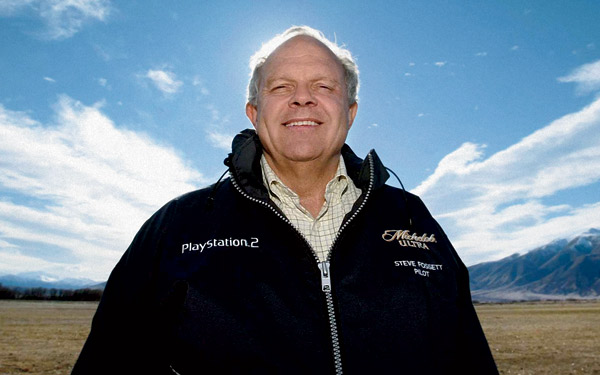
Fossett in New Zealand in 2002 after a failed attempt to break the world gliding altitude record. He finally succeeded four years later, establishing a record—50,722 feet—that still stands.
The plane trundled down the runway, bumping over the nubs and nicks of the remote desert airstrip, and rose on the warm late summer thermals toward a landscape of mountains as bleak and silent as a block of tombs. At the stick sat perhaps the most famous aviator since Chuck Yeager, a man who had tempted and beaten death so many times that his life seemed to be in the hands of angels. Among his best-known feats were his balloon flights, including the first solo trip around the world. There were also his airplane adventures—again, he became the first person to circle the globe nonstop. He set two transcontinental air speed records in a single day and, among dozens of other milestones, boasted the highest glider altitude (50,722 feet) and the top speed for airships. As if flying feats weren't enough, he climbed 350 mountains, including several of the tallest peaks in the world, set sailing records, and competed in the Iditarod dog race and the 24 Hours of Le Mans.
|
RELATED MULTIMEDIA
|
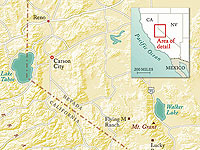
He also nearly killed himself—again and again. While climbing Mount Olympus, he slipped near the summit, rocketing toward a cliff, desperately digging an ice ax into a smooth, snow-covered slab to stop the slide. When he did at last find purchase, the lower half of his body dangled over the side of the cliff like a comic book hero at the end of a white-knuckle thriller. Swimming the English Channel, he stayed in the water so long— 22 hours, 15 minutes—that he suffered hypothermia, a cracked rib, and so much saltwater in his lungs that the pH of his blood was more fish than human. On one of his balloon trips, a lack of fuel caused him to ditch in India, where he banged into a forest of 50-foot trees, then bounced into a small village. He emerged from his capsule to find himself worshiped as Hanuman, the Monkey God.
The capper came in August 1998, when he was trying yet again to circle the globe in a balloon. Sailing along at a jetliner's cruising altitude of 29,000 feet, having traveled more than two-thirds of the way to his goal, he found himself drifting into a line of dark clouds just off the eastern coast of Australia. Suddenly, hail. Lightning. Violent winds. His balloon ruptured, and he plummeted toward the shark-infested Coral Sea. He opened up his burners. He cut away propane tanks to slow the fall. Still, he hurtled down, through the hail and lightning and thunder. The capsule plunged into the water, briefly knocking him out. It rolled over and began filling with water. He came to and scrambled into a raft under storming skies so dark he could not see to activate his locator beacon. Seventy-two hours later, a French military plane rescued him and an astonished world marveled that again he had survived.
On this day, last September 3rd—Labor Day—no such drama was anticipated. In fact, the two-hour or so pleasure flight hardly qualified as an adventure. The sun was bright. The sky was clear. The pilot, now 63, told friends he would be back in plenty of time for the daily lunch extravaganza Barron Hilton threw for the rich and famous who were guests at his Flying M Ranch. Situated in the middle of a forbidding desert wilderness, the ranch was an off-the-radar playground, a redoubt as clandestine as a top-secret military base. Among its other amenities was an airstrip that could accommodate both corporate jets and the fleet of planes Hilton kept on hand for fellow aviation enthusiasts.
For his pleasure flight, the pilot had chosen Hilton's Bellanca Super Decathlon, a single- engine two-seater made of fabric and steel tubing, a sort of glorified barnstorming stunt plane. The aircraft was capable of acrobatics, but the pilot had no intention of loop-the-loops, or any other fancy maneuvers. For all his adventuring, he wasn't after mindless thrills.
The engine buzzed. The craft soared into the blue, banking slightly left toward the eastern slope of the Sierra Nevada. On the ground, friends watched the plane grow smaller and smaller until, at last, it stood as a speck against a swath of blue. The pilot's precise destination was unknown, but if his past proclivities held, he would almost certainly cross a favorite spot, a canyon that cut through the mountains like a mammoth city boulevard. Only later would the name of the place assume the deep irony that, in retrospect, would come to dominate nearly every aspect of this flight. The last journey of Steve Fossett, the "Greatest Adventurer Alive," the world's most famous pilot, the man who had made a career of cheating death, likely led straight through Lucky Boy Pass.
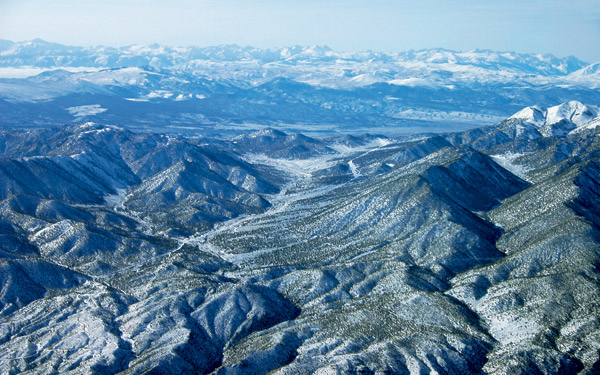
Lost: Fossett disappeared into this Rhode Island-size landscape of corrugated mountain peaks and deep canyons.
Take a plane ride over this majestic, wind-thrashed landscape of corrugated mountain peaks and deep ravines, gorges, and gulches, and you quickly realize that there would be nothing lucky about going down here. Tucked into the back of a tiny Nevada Civil Air Patrol search plane, I saw firsthand. The high desert mountain ranges stretch over this Rhode Island–size region like a vast white-capped ocean.
"Look out there," Stan Campbell, a search pilot who spent weeks hunting for signs of Fossett, said to me through his headset mike, his voice a tinny buzz. "You can see what we were up against trying to find him."
|
RELATED MULTIMEDIA
|
Fossett vanished without a trace September 3rd somewhere amid these millions of acres, setting off one of the most extensive searches for an individual in U.S. history. Forty airplanes and helicopters—including 15 aircraft flown by private pilots operating out of the Flying M Ranch—scoured the area. Black Hawk helicopters equipped with infrared technology swooped in and crisscrossed the terrain at altitudes low enough to spot foraging coyotes. Sonar-equipped boats combed lakes in the area. Internet users around the world logged on to DigitalGlobe, the biggest supplier of satellite imagery in Google Earth, to see if they could spot some indication of wreckage. The Civil Air Patrol (CAP) pilots found eight previously undiscovered crash sites, some decades old, but no sign of Fossett. "He could have gone down in one of a thousand crevasses," Campbell explained during a two-hour flight over the region, a search on which he and his copilot, Terry Vanzant, allowed me to tag along. "He could have crashed into those aspens right there. Nobody knows."
The mystery recalled the unsolved disappearance of the pioneering pilot Amelia Earhart, who vanished en route from Lae, New Guinea, to Howland Island in the Pacific Ocean, in 1937. How could a man who still holds so many speed and distance flying records, who has crash-landed more times than some people have flown, utterly disappear on such a pedestrian trip in such ideal conditions? How does a man famous for his obsessive preparation and precautions travel over such a remote region with no cell phone, without his GPS-equipped Breitling watch, and wearing only a track suit, T-shirt, and tennis shoes? By law, the plane was required to have an emergency locator beacon, one that would automatically activate in a crash or could be manually turned on. But no distress signal has ever been detected.
Fossett's wife, Peggy, and friends and supporters of the aviator have added to the puzzle—unintentionally perhaps—by their reticence about the disappearance. Other than released statements, Peggy Fossett has not spoken publicly about her husband. Likewise, most of the couple's friends have refused to talk.
There's no doubt the search was exhaustive. Barron Hilton, at Peggy Fossett's behest, put so many planes in the air the day the aviator went missing that Campbell and other CAP pilots worried about collisions. Private helicopters were trucked in on 18-wheel flatbeds. C-130 military aircraft equipped with infrared detection equipment flew 24-hour sorties. At one point, some 40 CAP, military, and private planes were in the air, while dozens of searchers plunged on foot into the deep, brush-choked canyons. "We were pulling in crews from all over the place," recalls Lt. Col. Cynthia Ryan, a CAP spokeswoman. "We had a guy from New Mexico, a guy from Idaho, from Pennsylvania—all [CAP] members, all volunteers."
After weeks of exhaustive searching proved unsuccessful, however, the search was called off early last October. It remains suspended, though Nevada's CAP wing launches an occasional mission.
In November, Peggy Fossett filed documents in Cook County circuit court's probate division to have her husband declared legally dead. Doing so was the first step in taking control of his estate, estimated in court papers to be in the "eight figures in liquid assets, various entities and real estate." Peggy, who had been married to Steve for nearly 40 years, said in a written statement, "As anyone can imagine, this is a difficult day for our family. We will continue to grieve and heal, but after nearly three months we feel now that we must accept that Steve did not survive."
The Lyon County sheriff's office isn't ready to close the books, however. "We have not made, nor do we plan on making, any declaration that Mr. Fossett is deceased," Lyon County undersheriff Joe Sanford told me. "Unless there's a change of events that makes that evident, this agency still has an open case on a missing person and an open case on an overdue aircraft."
Peggy Fossett's lawyer, Michael LoVallo, insists that the lack of any final declaration from the sheriff's office should not affect a probate judge's decision. "Obviously, if there were a death certificate, that would be additional evidence and fairly conclusive," he says, but maintains that Fossett could be declared dead without one.
Photograph: Bryan Smith
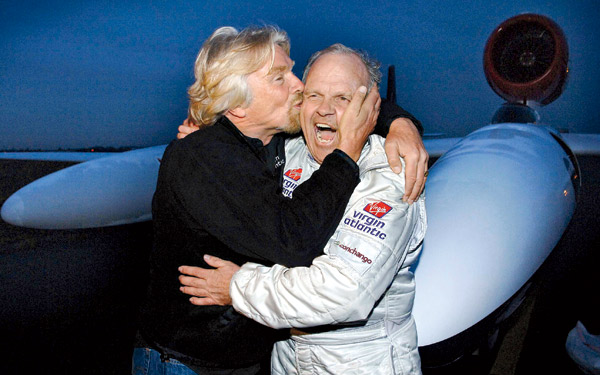
Fossett with Richard Branson in 2006
Since the disappearance, the Internet has buzzed with conjecture—much from "the wacko contingent," as Cynthia Ryan describes it. Did Fossett stage his own disappearance? Could he have committed suicide, having been driven by some deep and hidden sense of melancholy? He disappeared within range of Area 51—the top-secret government airfield that has long been a darling of conspiracy theorists. Perhaps he was shot down and "disappeared" in an elaborate cover-up. There have been rumors that Fossett and Peggy had a serious argument the morning of his flight. Might he have been distracted at a crucial moment? (She has refused all comment.)
Friends and searchers alike express doubt that this was anything other than an accident, citing a variety of factors. Among other things, Fossett was too well known to have arranged some kind of staged disappearance. In any case, the logistical challenges posed by such a ploy would have been huge. "Fossett is a very recognizable man and the media coverage has been intense, which would make a planned disappearance … nearly impossible," asserts the petition to have Fossett declared legally dead. What's more, investigators have ruled out the possibility that Fossett left the airspace being searched, and no money has been withdrawn from Fossett's accounts since his disappearance.
|
RELATED MULTIMEDIA
|
As for suicide, both of the friends with whom I spoke said the idea is virtually unimaginable, given Fossett's upbeat nature. "Out of the question," says Jay Levine, chief correspondent with CBS 2 Chicago and a longtime friend.
Peggy Fossett seems to confirm that notion in an affidavit in support of the petition to declare her husband dead. "[He] did not have any reason to disappear," she says. "Steve was happy and passionately involved in his pursuit of adventure."
Still, the disappearance was so unlikely, both friends and searchers have admitted to momentary doubts. "If he wanted to disappear, yes, it's possible," says Ron Ryan, Cynthia Ryan's husband and a CAP pilot who was deeply involved in the search. "A lot of people have had theories like that and it's not impossible. Highly unlikely, but not impossible. That's part of what's so fascinating about this."
Patrick H. Arbor, the former chairman of the Chicago Board of Trade and a longtime friend, agrees. "It's just such a mystery, such a conundrum. Certainly some of those things crossed my mind from time to time. But I dismissed all of them. He was happily married; he had no money problems. He loved life, loved his adventures."
And yet, friends have struggled to believe that Fossett, so charmed, so skilled at escaping death, could succumb to something so mundane as a small plane crash. "I thought for sure when I heard the story that he would survive," says Arbor, echoing the view expressed by many in the first days after the disappearance. "I have traveled all over the world with him and been with him in all kinds of situations—I used to kid him that it was like traveling with a Walgreens store. He would have medication and antibiotics and Band-Aids. He was always so well prepared with water filters and gadgets and stuff like that. I thought he would walk out of there."
"Steve is a tough old boot," billionaire Richard Branson told reporters shortly after Fossett's disappearance. "I suspect he is waiting by his plane right now for someone to pick him up."
Photograph: AFP Photo/Pool/David Dyson
|
|
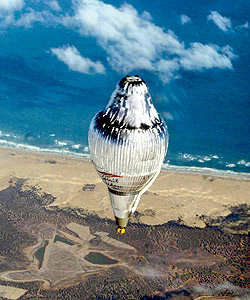
Irony underscored more than Fossett's disappearance. It defined his life. I say this having met him many years ago while working as a reporter for the Chicago Sun-Times. At the time, Fossett was preparing for his fourth attempt to fly solo around the world in a balloon, and I had traveled to Beaver Creek, Colorado, where he had a winter home, and where he had stashed his capsule. More than any of the other adventures Fossett had pursued, the balloon quest awakened a worldwide sense of wonder. The romance of the adventure was irresistible.
In researching Fossett's long résumé of risky achievement, I expected a dashing, perhaps swashbuckling figure. Instead, I encountered the same bearing that so many would come to describe as enigmatic. Guarded, almost taciturn, Fossett was a middle-aged man who looked far better suited for hammock snoozes than death-defying adventures. He was stocky and soft looking, with cherub cheeks that made him appear to be faintly smiling at all times, which he was not.
|
RELATED MULTIMEDIA
|
So unimposing was Fossett that on first meeting Richard Branson—the Virgin Atlantic entrepreneur who competed against and eventually teamed with Fossett—the pair chatted for several moments before Fossett famously had to tell Branson who he was. "When I look back at my friendship with Steve," Branson recently recalled for Time magazine, "I realize we were very different people, but there were many things that we had in common. Steve put it best when he told me, 'People often assume I am a thrill seeker, but I am not. I do not enjoy roller coasters, and you won't find me bungee-jumping…. It is a disadvantage that my pursuits are inherently dangerous. A large part of my effort is to reduce the risk.'"
In his 2006 autobiography, Chasing the Wind, Fossett seemed to revel in the disparity between his appearance and his accomplishments. "My appearance is strictly average, my athletic ability is mediocre, and there is nothing dramatic about my speech or demeanor," he wrote. "I am bemused when people are surprised that I am such a low-key person because it adds to their curiosity."
Stories of the real Fossett only stoked that curiosity—such as the time Fossett bit the ear of his lead dog in the Iditarod sled race to "show him who the alpha male really was."
"Here's a guy who was a little roly-poly and looked a little out of shape, but could go from sea level in California to the mountains in Colorado and climb a 14,000-foot peak the first day he was there," says Levine, who first met Fossett while covering his balloon quest. "I remember asking him once how he did it. We were climbing a mountain together, and I was huffing and puffing, and he said, 'Here is what you have to do: You have to set a pace you can maintain, and then just maintain it.' And you know something? I think that was true in life with him. He found the pace that he could maintain and then he just maintained it."
Adding to the enigma, Fossett showed only the slightest interest in the particulars of what drove him. He spoke of no demons, no childhood slight or deep-seated psychological wound he was out to heal. The only hints can be found in his autobiography. There Fossett remembers that, while in college, he happened upon The Royal Road to Romance, the 1925 book that recounts the postcollege globetrotting of Richard Halliburton (another adventurer who went missing—in 1939—and was never found). "I think from that point forward," recalled Fossett, "my focus in my early adventuring years was to do things that many people would like to do, but never get around to doing."
Later in the autobiography, he drops another clue when describing his reaction to his mother's death in 1996. "She was my biggest fan," Fossett wrote. "Standing at her graveside watching the sunlight begin to slowly recede from the winter sky … I made a promise to myself that day. I would continue to make my mother proud of me." Interviewers always asked Fossett what drove him, of course. But whether out of humility or a simple disdain for introspection, he refused to gild the lily of his extraordinary adventuring with some contrived motivation for the benefit of a journalist looking for Deeper Meanings. When asked, he would simply shrug. "I don't have to jump up and down to tell everyone how thrilled I am," Fossett told me a decade ago during our interview. "Achieving those goals is enough."
Photograph: Trevor Collens/UPI/Newscom
|
|
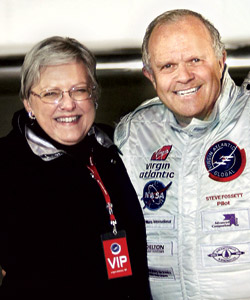
Still, myths persisted about Fossett—in particular, the notion that he came to adventuring late in life—that he was little more than a bored rich guy with nothing better to do than spend money glorifying himself. The truth is, a love of adventure defined his life from the start.
Born J. Stephen Fossett in 1944 in Jackson, Tennessee, the adventurer credited his father, Richard—a soap production manager for Procter & Gamble—for instilling in him a passion for the outdoors. In his autobiography, Fossett recalls his father choosing campsites on the basis of available mountains to climb. Thus, when Fossett was a boy working to become an Eagle Scout, he and his father scaled Mount Kaweah in the Sierra Nevada region of California, a 13,802-foot peak in the center of Sequoia National Park. Over the next decade, father and son summited about 30 peaks in Southern California, much to the puzzlement of his older brother, Richard III, his younger sister, Linda, and his mother, Charalee, none of whom shared their ardor.
|
RELATED MULTIMEDIA
|
If his father was his mentor, danger was his teacher. Just after high school, Fossett decided to climb Mount Lassen in northern California alone. He had neglected, however, to check the weather forecast and found himself caught near the top in a major winter storm. Winds shredded his tent and his food supply was exhausted. Whiteout conditions left him unable to find his base camp. He escaped only when he found some mountaineering skis he had stashed and was able to maneuver down the mountain through four feet of powder snowdrifts. After that, he vowed never to be unprepared again.
Accordingly, while in college at Stanford, he swam the length of the Golden Gate Bridge only after carefully consulting tidal charts. He also made sure to prepare when later, as part of a fraternity prank, he braved eight hours in the frigid waters and strong tides of San Francisco Bay to swim back from Alcatraz to show that he could have escaped the "unescapable" island.
After graduating from Stanford in 1966, Fossett earned his MBA at Washington University in St. Louis. He also met his wife-to-be, Peggy Viehland, at a mixer. Fittingly, their second date was a trip to an air show—one in which Fossett was a participant. "For some crazy reason, I asked her to fly with me," Fossett recalled. "She simply said, 'OK.'" Within a few months the couple had married.
They moved to New York, where Fossett worked for IBM for a time, then Detroit, where he held a management job at Deloitte & Touche (then known as Touche-Ross). The couple eventually landed in Chicago, where Fossett found his career calling as a trader on the Chicago Board Options Exchange, and Peggy made her own mark as a portfolio manager in the trust department of the First National Bank of Chicago.
Throughout, Peggy supported her husband's adventures, including a brief foray into racecar driving. Aside from the air-show date, however, she did not participate. It turned out she was a white-knuckle flier who preferred the lodge to the ski slopes. On a camping trip in Ontario, Canada, Fossett recalled in his autobiography, "[she] couldn't sleep at night. Every foreign noise made her jump. In the morning when a squirrel darted across the top of our tent … it was clear to me that she had had enough of camping for a lifetime."
She provided a stable counterpart to her husband's go-for-broke business career, however. Although Fossett made millions on the exchange, he also went bust several times. At one point he found himself a systems analyst for Marshall Field's. His nadir came while driving a taxi for Chicago Yellow Cab.
Eventually tiring of the boom-and-bust cycle of the financial markets, he turned over management of his company, Lakota Trading, to his friend Bob Kirkland in 1990. He still traded occasionally, but left the high risk and rewards to the hungry young employees he had hired to work under him. Meanwhile, he sold his two seats on the board for eight figures. His fortune now safe, he began his pursuit of adventures in earnest.
The results were astonishing. Fossett would set 115 records in five different areas of adventure: balloons, airplanes, sailboats, gliders, and airships. About the only goal that eluded him was reaching the summit of Mount Everest. He launched two attempts, but fell short both times.
Photograph: David Dyson
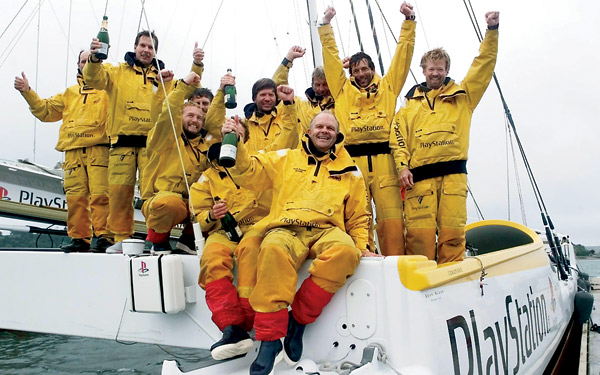
Fossett and crew celebrate their record-setting 2001 Atlantic crossing.
Throughout his adventuring career, he insisted that he wasn't in it for the adrenaline—or for the glory that came with achievement. "He never sought publicity," says Jay Levine. "We [in the media] were the ones who made him the story he was. I think he would have been just as happy to do what he did in a vacuum. Setting the record was what he lived for, not the publicity. He was the opposite of a swashbuckler."
That's not to say that Fossett lacked ego. He intentionally chose to pursue "firsts"—first to fly around the world solo in a balloon, first to circumnavigate the globe solo in a plane—specifically so that his accomplishments would remain in the record books.
|
RELATED MULTIMEDIA
|
Even so, his friends say, he displayed remarkable humility. "He was understated, always understated," Arbor says. "He would casually mention he did this or that—that he had climbed all 54 peaks [over 14,000 feet] in Colorado. He did these things quietly, with dignity."
His balloon trips were the exception, but not because Fossett encouraged the extra attention. Media outlets were simply fascinated by the quixotic quest. When Branson entered the picture, Fossett's own celebrity soared. True to form, he found a way to put his newfound status to practical use, says Arbor. "He wanted everyone to know where he was in case he went down," Arbor says.
Records, headlines, and accolades accrued, followed right behind by criticism and resentment. "I won't mince words. I hate Fossett," Sun-Times columnist Neil Steinberg wrote in 2006 when Fossett was seeking to set another aviation record—this time for distance traveled in an ultralight aircraft. "I hate everything about the millionaire and his endless quests to set new world's records."
After Fossett nearly died in the Coral Sea crash in 1999, Richard Roeper of the Sun-Times wrote he would be glad "not to cover this guy's self-indulgent, expensive hobbies as if he were the millennium version of Ferdinand Magellan."
Today, Steinberg says he's sorry that Fossett has gone missing, but he has not softened his views. "I don't want to be dancing on his grave," Steinberg told me. "Frankly, I'd rather he be around so I can ridicule him some more. I just have a hard time working up a lot of sympathy for him." Steinberg says he never bought claims about Fossett's humility and sees nothing socially redeeming or particularly noteworthy about spending millions to accumulate esoteric records.
Even his disappearance rankled. Worldwide expressions of sympathy were tempered by questions about the amount of public resources spent to find him—an estimated $1.4 million. Some people wondered whether a similar effort would have been made for someone less celebrated. Cynthia Ryan acknowledges that Fossett's high-profile status played a part in the magnitude of the search, but only in terms of private efforts—funded by some $1.2 million from Peggy Fossett alone. "From our standpoint," says Ryan, "we did this search just like we would have for anyone else. Any extra assets came from the Flying M Ranch."
Photograph: AFP Photo/Gerry Penny/Newscom
|
|
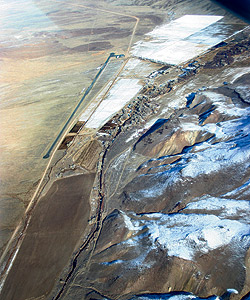
It was from that ranch, a remote spread near Yerington, Nevada, that Fossett launched his ill-fated flight. The ranch lies half-hidden about 80 miles southeast of Reno at the end of a molar-rattling 17-mile-long dirt road. Apropos of its rich owner, the hotel magnate Barron Hilton, the spread features a mansion, a skeet shooting range, and gourmet chefs, among other amenities. Hilton's aerial fleet includes a Cessna Citation V Ultra jet, five gliders, a 1943 Beech Staggerwing, and three hot-air balloons. For the earthbound, the ranch offers a first-class way station between Los Angeles and Las Vegas. Over the years, the high-roller guest list has included everyone from Sylvester Stallone to Hilton's granddaughter Paris. Fossett had visited several times, mostly to take advantage of the hot, dry air that makes the area one of the best glider sites in the world. In fact, it was at the Flying M that he decided to pursue the nonstop around-the-world solo flight. His last stay there was to have been a short one, friends say. Then he and Peggy were to return to their home in Beaver Creek, Colorado.
The ranch was deserted when I landed there aboard our tiny Cessna 172. Campbell taxied around, then raced down the airstrip and lifted off south, banking gently left—the same pattern followed by Fossett on his final flight.
|
RELATED MULTIMEDIA
|
Soaring over the mountainous landscape for the next two hours, Campbell demonstrated how hard it is to spot a plane wreck site. With his copilot, Terry Vanzant, as spotter, we flew over one crash that had occurred several years earlier. "The problem with wreck sites is they don't look like planes," Campbell explained. "You're simply looking for something anomalous—a glint, or a piece of something." The only real evidence of this crash was a tiny sliver of white fuselage that, viewed from our altitude of about 1,000 feet, looked about like a fingernail clipping.
Finding Fossett would be even more difficult, Campbell explained, because the plane he was flying was made largely of fabric over steel tubing. "The fabric would likely have burned," says Ron Ryan. "That would have left the gas tank and engine pieces"—and those pieces, "as small as a napkin," according to another CAP searcher, could lie hidden in a ravine or under ground cover. "If it had looked like a plane, I can guarantee you we would have found it our first or second day," says Ryan.
"We went over this area a hundred times," Vanzant said, as we circled the region. "He could have gone in any direction." As we flew over Lucky Boy Pass, Vanzant added, "He could have flown right up that thing and got caught in a downdraft. Who knows?"
Suddenly, near the entrance to a canyon, Campbell veered the plane into a steep, diving turn. The world tumbled. Gravity pinned me to my seat. My breath caught and my stomach flopped with the butterflies of a roller coaster's first dive. An alarm sounded—the plane was in stall. I clutched my armrests, my heart pounding. Campbell grinned. "That's a canyon turn," he told me—a maneuver Fossett might have had to make if he had gotten himself "in a corner," as pilots say.
CAP pilots are required to take a course in mountain flying to learn just such escape tricks. "This is rugged country," Campbell explained. "People better know what they're doing." On a typical warm day, the kind on which Fossett flew, "it's usually calm and cool in the morning, and as the day goes on the temperature goes up" and conditions become more difficult, says Ron Ryan. Planes cannot climb as quickly, nor soar as high. "Then late in the afternoon, the cooler air off the top of the mountain ranges rushes down into the valleys. By early evening, we get lots of wind, and it makes it very difficult to search mountains. I mean, it's impossible. It gets to be very dangerous."
It's not clear whether Fossett had mountain-flying experience. In his autobiography, he discusses the perils of mountain winds only in connection with ballooning. A preliminary National Transportation Safety Board report—a single-page recounting of the basic facts of the disappearance—did not address the issue of Fossett's competence in these conditions.
Cynthia Ryan says that gathering information from Fossett's family was "a little problematic in this case, because right at the beginning they closed ranks out there [at the Flying M Ranch], and getting access to those people wasn't easy. It was discouraging because we were always thinking, 'Maybe if we'd know a little more about this or that aspect of his habits and what he would have done,'" searchers might have had a better chance of finding Fossett.
The reason for the reticence is unclear, but it's in keeping with Fossett's general mode of operation. Long before the disappearance, Peggy Fossett avoided interviews, and only a select handful of close friends have spoken about his life. But the lack of comment on several lingering questions has deepened the mystery. Among other things, CAP officials were initially uncertain whether the plane was equipped with an emergency locator beacon, as required by law. In an affidavit, Mark Marshall, Fossett's personal pilot at the time of his disappearance, says the plane did have a locator beacon. Still, no signal was ever received.
Search experts say the simplest explanations are probably the most likely. The failure to find any wreckage despite exhaustive efforts is probably due to the vastness of the search area—some 20,000 square miles—and the possibility that Fossett's plane may have virtually disintegrated on impact. Any remaining debris was likely covered over by the first snow.
But wouldn't there have been burn marks? Not necessarily, says Robert Keilholtz, a captain with the California Civil Air Patrol. If Fossett had gone down in a lava bed, "there would be no surrounding foliage burn area to alert searchers to the crash," says Keilholtz.
Other questions surrounding the crash are also easily answered. Fossett didn't fly with his GPS-equipped Breitling watch because he either chose not to wear it or—in a stroke of bad luck—forgot to put it on. (In her affidavit, Peggy Fossett says that her husband did not bring the watch to Nevada.) He didn't file a flight plan because pilots rarely do on short pleasure flights, particularly in such remote areas. If the plane did have a locator beacon, it could well have been destroyed on impact. "It's not that unusual," says Ron Ryan.
As to Fossett's seemingly uncharacteristic lack of preparation—he did not carry a parachute and took only a single bottle of water on the flight with him—Ron Ryan finds little to warrant suspicion. "It was just a pleasure flight. He was going to be leaving the ranch later that afternoon. And then he was going to hop in his own plane and head out of town." Arbor, Fossett's longtime friend, agrees. "This was like a walk across Michigan Avenue," he says.
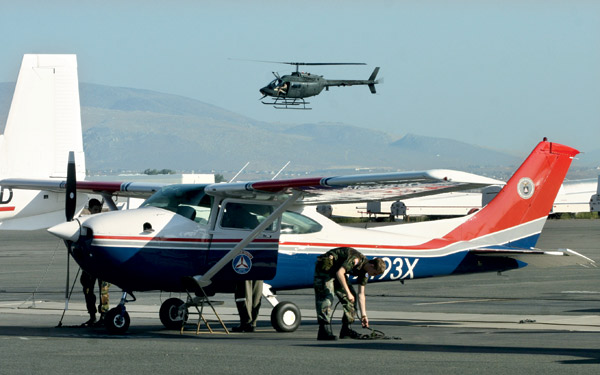
Aircraft searching for Fossett
So where is Steve Fossett? Cynthia Ryan says theories poured in from all over the world. "I'd get calls from little old ladies and they'd have a dream that Steve had walked out of the forest," she says. Keilholtz says the investigation did uncover several credible sightings of Fossett as late as 11 a.m. on September 3rd, some two hours after he took off. A California highway patrolman saw Fossett's plane flying at a low altitude near Mammoth Lakes in midmorning, and a ranch hand reported seeing the plane disappear around a ridge to the west of Ne-vada's Mount Grant—the last confirmed sighting of Fossett.
The searchers have their own ideas about what might have happened after that. "We've had it happen," says Cynthia Ryan, "where somebody went down through some brush trees, or through some ground cover in a steep ravine somewhere, and you can't see up from the wreckage and you can't see down into it." Beyond that, she says, "he could have had some kind of health problem"—say, a heart attack. (Fossett's doctor, Harry B. Knaster, says his patient's overall health was excellent, but acknowledges that he did have Fossett on Lipitor to reduce high cholesterol levels.)
|
RELATED MULTIMEDIA
|
Timothy M. Evinger, the sheriff of Klam-ath County, Oregon, sees little mystery in Fossett's disappearance. "Based on everything I learned during the investigation and search," he says, "I believe that Fossett's plane crashed, that the wreckage is located in a difficult and remote terrain, and that Fossett did not survive."
In the end, the most plausible explanation for what happened may lie in Fossett's own words. Despite his numerous brushes with death and his lifelong pursuit of dangerous achievement, he acknowledged the reality of things beyond his control. "Throughout my career as an extreme sports adventurer," he wrote in Chasing the Wind, "I have come to understand the literal meaning of the phrase, 'the winds of fate.'"
* * *
Our search flight is over. Neither Campbell nor Vanzant expected to find much on the mission—it's winter now, and snow has carpeted some of the region where Fossett would likely be found. And, aside from a brief curiosity about a glint Vanzant spotted, none of us saw any sign—just miles and miles of pines and scrubland. Whether the remains of the famous pilot are lost here forever, as many believe—or, as Cynthia and Ron Ryan speculate, a hiker or a hunter eventually will find them—the outcome is almost certainly in the hands of the fate about which Fossett mused. Either way, the mystery surrounding his final flight likely will stand—as permanent, as puzzling, and as oddly absorbing as his life of chasing records. The mountains, the canyons, the winds aren't telling. From so high above, the landscape lies as mute as a graveyard.
Photograph: Rich Pedroncelli/Associated Press