


"Time out. Time out. Goddamn it, time out!"
The gorilla mascot, all fake fur and fury, flies onto the court in his purple-and-gold Phoenix Suns jersey and pummels his chest. Hard-bodied dancers bump and grind to molar-rattling hip-hop. As the Suns players bound toward their bench in a flurry of high-fives, the balding man in the dark suit just glares.
It is a Sunday night at US Airways Center in Phoenix and the home-team crowd, glum for most of the game, roars with almost three quarters' worth of bottled-up frustration. Until now, the Chicago Bulls had dominated the game-building a 15-point lead on one of the hottest teams in the NBA. The Bulls had seemed poised and scrappy, playing the kind of ball sorely missed since the days of you-know-who. Then Phoenix began draining three-point shots as if they were cups of beer. The Bulls, who minutes earlier had snapped passes around the perimeter, now look like an over-40 rec club that has raided the cooler.
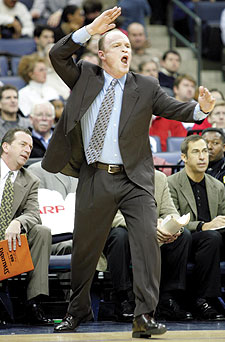
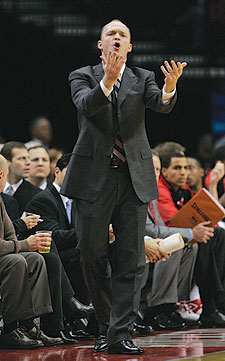
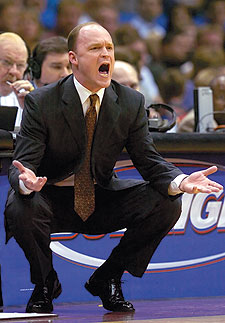
The Bulls' coach, Scott Skiles, has seen enough. Leaping to his feet, he snaps his jacket shut and shoots his cuffs. "Time out!" he screams. His piercing dark brown eyes flash, withering his players as they skulk to the bench. With all deliberate venom, he forms, then spits, the f-word.
To anyone who has watched Skiles coach the Bulls these past three years, his face in such moments limns a familiar portrait-a sneering, jaw-clenching mask inflamed by muscle-knotting fury. Chucky the horror movie doll with a clipboard.
It is the kind of reaction that earned him the reputation-first in college, then as a pro player, and later as coach at Phoenix-as belligerent, thin-skinned, a walking temper tantrum, someone with the short fuse (and idiocy) to take a swing at his Orlando Magic teammate, the seven-foot one-inch Shaquille O'Neal. "He's as joyless and red-assed as always, I assume?" says Brian Schmitz, a beat reporter for the Orlando Sentinel covering the Magic. "How intense is Scott Skiles?" adds the Magic's senior vice president, Pat Williams. "He came out of his mother's womb in a three-point stance."
But his temper aside, Skiles, 43, has always impressed with his passion, his command of the game, and his teaching ability. "Even as a player, he was keeping a little book of different things about the game, plays, scenarios," recalls former Atlanta forward Tom Gugliotta, who played under Skiles in Phoenix. "You won't find a more organized, well-prepared, smarter coach. There are guys who might not like it, but that's because he demands a lot."
Since Skiles took over the Bulls in 2003, he and general manager John Paxson have stocked the team with players who seem to buy into the coach's grinding, old-fashioned, defense-first approach to the game. "I'll put him with anybody in terms of knowing the game," says point guard Chris Duhon, who played at Duke under hoops sage Mike Krzyzewski. Adds point guard Kirk Hinrich, "He's old school. I think that's just what he believes-coming in and giving a hard day's work." Luol Deng, the rising star also out of Duke, says that despite Skiles's notoriously hard practices and demanding attitude, "I like playing for him. He has a way of getting us to play hard every night."
And though his public face rarely appears to budge beyond a range of emotions between dour and distant, on rare occasions-even in the midst of a bad patch such as the one this night in Phoenix-he will let something slip: a smile. Seriously. Chucky does smile.
"How intense is Scott Skiles?" adds the Magic's senior vice president, Pat Williams. "He came out of his mother's womb in a three-point stance."
"A guy asked me on Fox this morning-first question: ‘Does Skiles ever smile?'" says Keith Glass, who has been Skiles's agent and adviser for more than 20 years and includes a chapter about Skiles in his book, Taking Shots. "The answer is, Of course. If you ever remember the movie Cool Hand Luke, Paul Newman would give this little smile. That's what I called Scott's smile-that little Luke smile; when he was beating you, when he was losing to you, he'd give that little smile."
Skiles says his players have seen it. "The Ben Gordons, the Chris Duhons, Luol Dengs, they understand my sense of humor," Skiles says. "They know that sometimes when I appear to be really serious, I'm just very focused." Duhon agrees, sort of: "If we're winning, he loosens up. If we're not winning, he's not so funny." Duhon says Skiles can even be patient-to a point. "At first he'll tell you about a mistake in a calm manner, with a calm demeanor," Duhon says. "But if you keep making the same mistakes-let's just say you don't want to be on the other side of that confrontation."
Duhon thinks that Skiles keeps a distance to avoid blurring the line between coach and players. "I think he wants to establish respect," Duhon says. "He's so young as a coach. That's his main goal-not to cross that line." Chicago Tribune reporter K. C. Johnson, who covers the Bulls, doesn't buy into the stereotype of Skiles as overbearing hothead. "Scott's a badass," Johnson says, "and I think he kind of gets off on that. But I don't say that in a negative way. He's a badass because his whole career has been backing up what he believes in and holding those around him accountable. That trait is rare in any profession these days, much less professional sports."
Skiles's approach has earned some not-so-kind words from former players, including Tyson Chandler, the young forward who at one time was considered a cornerstone of the Bulls' post-Jordan rebuilding plan. Skiles "is not a good person," Chandler said in March before his first game back at the United Center after being traded to the Hornets. "That's obvious in the way he treats his players."
Perhaps Skiles's biggest test as the Bulls' coach came last November when he clashed with the newly acquired $60-million Ben Wallace over whether Wallace could wear a headband. The Bulls' rules forbade it. Not only did Wallace defy Skiles; he showed up wearing a band of bold red. "That was a blatant act of insubordination," Johnson says. "It was clearly a case of two strong-willed guys doing a stare-down."
Skiles held Wallace out of the game until the center removed the headband. But just before the start of the second half, Wallace put it on again. Again, Skiles took him out.
What struck Johnson about the incident, however, was Skiles's restraint. Asked after the game whether he was upset at Wallace, Skiles told reporters, "No. I don't know why. I'm just not." Whether he really felt that way-and a postgame, closed-door, raised-voice team meeting suggests he did not-Wallace no longer wears the headband. Which reminds Johnson of a comment Skiles made during the 2003 season: "I've never lost a battle of wills in my life. And I don't plan on doing it now."
Since the Wallace incident, the Bulls have gone on to a decent, if unspectacular, season. In many respects, the team reflects the coach-tough, intense, meticulously prepared, and a little short. There's no doubt that Skiles has returned the Bulls to respectability from their post-Jordan wallow. The team managed only 19 wins after Skiles took over for Bill Cartwright in November 2003, but has made the playoffs the last two seasons. Still, there are grumbles. Despite Skiles's "old-school" approach, the team is still given to lapses in fundamentals-failing to box out for rebounds, handling the ball poorly, botching offensive plays. Even more troubling to fans, the team has failed to advance beyond the first round in its two playoff appearances under Skiles.
Few fans expect the Bulls to recapture the dominance and star power of the Michael Jordan years. The six championships that Jordan, Scottie Pippen, Phil Jackson, and others brought the city are a once-in-a-lifetime lightning strike. But that doesn't mean that Paxson, who was part of that dynasty as a player, will settle for less than another championship. "[The Jordan legacy] puts a demand on what fans expect," Paxson acknowledges. "There's no getting around that-and I understand that better than anybody." Which raises a question that has only grown more insistent as past glories have faded: Is "good" the best Skiles can do in a city starved for a return to great?
After the time-out, down goes another Suns jump shot, and up like a Chucky-in-the-box pops Skiles. He flings his arms up; his face lifts to the rafters as if to ask the gods of Better Basketball, "Why have you forsaken me?"
Skiles sees the look starting to come into his players' eyes-the thousand-yard stare. He cups his hands around his mouth and shouts encouragement. He claps. He cajoles the refs. In and out go the players, tearing off their sweats as they report to the scorer's table. "C'mon!" he yells, giving a toreador's wave as his Bulls rush back down the court. "Push it, push it, push it!" And Deng responds. He slashes to the basket and rises for a layup. Good! Skiles pistons his fist like a hammer blow.
"People have gotten this idea over the years that I'm this authority figure, that I'm some kind of crazy taskmaster," Skiles says in the low, intense, slightly menacing tone that would confirm the general fear for many. And you're not? "Well, I'm not mad at anybody," he says, sounding slightly mad. "That's just my face when I'm thinking about what the hell we need to do. I'm not going to bite anybody's head off." No? "No," he says, laughing. "I have a strong personality. It's part of who I am. It's not intentional."
Glass argues that Skiles's sour puss is a function of his brainpower. "When you're very intelligent you don't walk around like a goofball," the agent says. "You're not a happy idiot."
Of his demeanor, Skiles says, "People who know me really well laugh at it, but if you don't know me that well I understand that I can come across as a little bit . . . unreachable or whatever."
"Unreachable" is an apt word. In the three-plus years since Paxson introduced Skiles as the man to succeed the ineffectual Bill Cartwright, Skiles has given virtually no interviews of the sort that might dispel-or at least soften-the caricature of him as surly and unapproachable. Skiles consented to talk with me for this story only after it became clear that I had talked to a number of people familiar with his career, including critics.
When he does make himself available before and after games, as all NBA coaches are required to do, he is rarely asked-nor would he likely comment-about much beyond what kind of night Ben Wallace had or why Kirk Hinrich isn't shooting better. And so, the ritual is the same: Skiles, clad in a sober, dark suit, strides before the cameras, his jaw set, his head tilted slightly down. His dark eyes, alert, slightly beady, occasionally meet those of the reporters, but not often. Instead, it seems, he addresses the ground, his voice low and measured, intense and barbed with a rural Indiana twang.
So if he hates attention so much, why would he seek to coach in the NBA? Why not Podunk College, where he could teach far from the bright lights and bling of the pros? Simple, he says. "You're coaching the best players in the world at the highest level and you have an opportunity to creatively manipulate the game. Not every game. But you have more timeouts; you can do things like move the ball to half court. I'm not down on the college game. I know I could do very well in college. But the NBA was where I wanted to be."
The persona has been the same since he starred as a point guard at Plymouth High School in north-central Indiana, then later at Michigan State University, where he was perceived as cocky, overly emotional, preachy, and smug-perceptions not helped by three arrests in college, one for marijuana possession and two for driving under the influence. His swaggering reputation continued during his time as an NBA player and later as a head coach for Phoenix, where he was brought in to instill discipline in a team that had grown lax. Despite a 50-win season, Skiles was asked to move on after rumors that several veteran players were sniping about his methods. He was too hard, they complained. They were grown men. They didn't need a dad scolding them as if they were learning the game on a driveway rim over the garage. "There was some resentment," says Tom Gugliotta. "What Skiles ran into was that a lot of players were already set in their ways."
Retreating to his Indiana home near Bloomington, he was without basketball for the first time in his life, faced with an uncertain future, in the state where his destiny, and his fierce persona, were fixed as surely as the plastic basketball hoop in his playpen.
Plymouth, Indiana, some two hours from Chicago, 25 miles south of South Bend, is the kind of small Midwestern town Sinclair Lewis wrote about in Main Street-a 10,000-resident amalgam of family-owned shops and parks, with a bowling alley, a 136-year-old courthouse, a blueberry festival, and a drive-in theatre. Weekend nights revolve around "The Rock"-the gleaming, 4,000-seat gym at Plymouth High School.
This is a place where the number of season ticket holders (about 1,500) is greater than the total enrollment of the school (1,042). "Basketball is big," says Plymouth High athletic director Roy Benge. "It's the focal point of Friday and Saturday nights here. It pays the bills."
"Scotty" Skiles spent his grammar-school years in nearby Walkerton, an even smaller town, where he rooted for the Chicago Bulls on a fuzzy television set. "I'd turn the rabbit ears and I could watch Jerry Sloan and Norm Van Lier," he recalls. "I loved the Bulls." His father had big plans for his son and they didn't include the boy living out his life in an Indiana backwater working 12-hour days in a factory-the old man's story. Rick Skiles had been an athlete, a high-school basketball player. And from the day his son was born he set out to make the boy into what he had not become: a star. Starting with a basketball hoop in the two-year-old's playpen, the father pushed Scott mercilessly in sports-a fact both father and son acknowledge. "I knew when I was seven years old and I was in Little League that if I struck out, on the way home there was going to be some consequences," Scott recalls. "Not getting beat up or anything like that, but there was going to be some pretty firm discussion about it."
On the basketball court, the father literally pushed his young son. "We'd play in the driveway and I'd knock him down and tell him, ‘This is how it's going to be when you get up there,'" Rick Skiles told the Chicago Tribune's Melissa Isaacson in 2003, shortly after his son was hired to coach the Bulls. (The father, who suffered a stroke more than two years ago, no longer grants interviews.) "No matter what he had done, I'd criticize him and never build him up. He may have scored 35 points but had six turnovers, and I'd ask him about the turnovers. I regret that now, that I pushed him that hard."
Scott recalls the parents of fellow players fretting to his mother, a nurse's aide: "They'd say, ‘Do you know what Rick's doing to your son down at practice?'" Scott Skiles says. "He would be hitting grounders to me five times as hard as he would other kids and if I missed I'd have to run laps." Yoked to such expectations, Skiles developed into a brilliant young athlete and a living expression of his father's unforgiving obsession. "I was a pretty sore loser," he admits. "If things went wrong out there, I would get very emotional. I'd throw my hat," glove, bat-whatever piece of equipment was handy.
Today, Skiles defends his father. "Yeah, there were some tough moments," he says. "As a child that small, it bothered me a little bit, but probably not like it should have. I knew that my dad was working 8, 10, 12 hours a day and that he would still come home and hit me grounders until it was dark. My father was a factory worker who gave of his time in a way that I don't think that many people do. I just think he pushed because he thought I could take it and thought I was good. And I wanted to be good just as badly as he wanted me to." (His parents divorced about 15 years ago; his mother still lives in Cape Coral, Florida, where she moved while Skiles was playing for Orlando.)
"What I learned from [my father] was that I was not going to be allowed to blame other people for things that happened," he says. "Things are so sissified now. If I mentioned something that a teammate did, [my father] would say, ‘Go look in the mirror and see whose fault it is.'"
Other boys in the area began to hear of the young prodigy-and his healthy ego. "Even at that age he had a certain swagger to him," recalls Phil Wendel, who would later share the backcourt with Skiles on the Plymouth High team. What made him so special? "He just played so hard," says Wendel. "He had this intense drive. It was always there. I'm sure his dad had a big impact on that."
When Scott was 11, and already a budding star in basketball, baseball, and football, the father packed up the family-including Scott's sister, Brenda, a fine athlete in her own right-and moved them to Plymouth. The town was scarcely bigger than Walkerton, but it had a deserved reputation as a basketball hotbed. Jack Edison, a 2005 inductee into the Indiana Basketball Hall of Fame who still coaches the high-school varsity team, says Skiles, "was strong, was tough, and, boy, did he hate to lose."
Skiles says his father's tough love served him well in at least one respect. "What I learned from him was that I was not going to be allowed to blame other people for things that happened," he says. "Things are so sissified now. If I mentioned something that a teammate did, [my father] would say, ‘Go look in the mirror and see whose fault it is.'"
Still, Skiles demanded a lot of his teammates-barking at them when they blew plays, telling them where to stand, positioning their feet. "I remember one time he drilled me in the side of the head with the ball, and I was about ready to kill him," says Larry Johns, another high-school teammate. "But when I looked at him, the expression on his face was like, ‘Hey, look, you were open. If you're open, I'm going to pass you the ball.'"
Even some college players were taking notice of Skiles, including a star player at Notre Dame named John Paxson. "When he strutted out there, he just had a confidence you didn't often see in high school," Paxson recalls.
So what was it like to play with Skiles back then? "Painful," says Pete Rockaway, also a high-school teammate. "Practices were brutal. Scott was such a basketball genius that it would become very frustrating to him when other players would make mistakes. It was like trying to explain math to a three-year-old, and we were the three-year-olds. But we knew he was just trying to make us better. And how can you complain? We won the state championship."
 The Bulls, down five at the start of the fourth quarter, have seen this movie before-blowing a big lead, then losing in a heartbreaker. Tonight, however, they keep playing hard as the game wears on. Passes snap again. Ben Gordon nails a jumper. Hinrich adds a jumper of his own and pops a three. The Bulls unleash a 7-0 run and roar ahead.
The state championship game that made Skiles's career springs right out of the movie Hoosiers. "The state championship in high-school basketball in Indiana was the ultimate dream," says Wendel. "It was like the Super Bowl, the World Series, and the Final Four all wrapped into one." Skiles had been the state's leading scorer that season. But now they were playing Gary Roosevelt, a much larger school and a heavy favorite.
Skiles started slowly, but in the second half dominated. At the buzzer, he hit a 22-foot shot to send the game into overtime, then scored several more points to secure a 75-74 double-overtime victory for Plymouth. The school became the smallest in Indiana since Milan High in 1954-on which Hoosiers was based-to win the state championship. But though hundreds of Plymouth's townspeople lined the streets and thousands packed into the gym to honor the team, Skiles up to that point had attracted only mild interest among big-name schools.
Purdue had made overtures, but one of coach Gene Keady's assistants had inexplicably sent a letter inviting Skiles to look at other schools (an incensed Keady fired the scout, Skiles says); Digger Phelps, then head coach at Notre Dame, showed faint interest. The god of Indiana basketball at the time, Bobby Knight, inquired, then let it drop.
Jud Heathcote, head coach at Michigan State University, had never heard of Skiles before the day a booster called to say Heathcote ought to be recruiting him. "We got these calls all the time," recalls Heathcote, now retired. "But I call the coach at Plymouth and he sends me this fuzzy eight-millimeter film. Well, the thing was so dark it was like the Keystone Kops. I couldn't see the numbers of the players."
When Heathcote went to see Skiles play in the state championship tournament, he stared in disbelief at the player. "I look at this guy with kind of spread out feet, and what looks like kind of a pot stomach. He's almost an albino, he's so white-and I say, ‘That's Scott Skiles?'" But he had a presence out there, a presence that said he's running the show."
After the state championship tournament, the recruiters finally called. "Now the whole world's recruiting him," Heathcote recalls. "But you gotta know Scott-he's a funny guy. He says, ‘Hey, if they didn't want me then, they ain't gonna get me now.' And they didn't."
"I look at this guy with kind of spread out feet, and what looks like kind of a pot stomach," says Jud Heathcote, head coach at Michigan State University. "He's almost an albino, he's so white-and I say, ‘That's Scott Skiles?'" But he had a presence out there, a presence that said he's running the show."
Heathcote did, and Skiles went on to become a first-team All-American and a Big Ten Conference MVP, breaking two of Magic Johnson's Michigan State records. He played with the same cocky, brash, annoying intensity and court savvy that would eventually earn him notoriety as, well, a kind of a jerk. He woofed. He pumped his fists. He berated players. "I think in his senior year he thought he was Elvis," says Rockaway, who today owns a vending business and still sees Skiles often.
"‘Cocky' is a good word [to describe him], but ‘confident' is better," says Heathcote. "Scott always had that great confidence when he had the basketball in his hands. He just knew he could do something positive."
Skiles's most famous basketball moment in college-perhaps in his career-came in a game against Georgetown, when he whipped a no-look, wrap-around-the-body pass to a streaking teammate. "Even to this day, I'll be in an airport and someone will come up to me and that's the first thing they'll bring up," he says. "I had made that pass, and similar passes to that, all my life, all the way back to junior high, but I had never done it on national TV before."
Off the court, his most famous moments made other kinds of headlines. Between August 1984 and November 1985, he was arrested three times-the first, when police discovered cocaine paraphernalia and marijuana in Skiles's car. He initially claimed his roommate had put the drugs in his bag. Later, after a felony cocaine charge was dropped, Skiles pleaded guilty to marijuana possession. Three weeks after that, Skiles was hit with a charge of driving while intoxicated. He pleaded guilty to impaired driving, paid $300 in fines, and landed in jail for three days. Then, just two and a half weeks before the start of his senior basketball season, Skiles was nailed again for driving while intoxicated. He wound up being sentenced to 15 days in jail-to be served after his senior year.
Heathcote came under enormous pressure to suspend Skiles, possibly for his entire senior season. If he did it, Skiles's career was likely over. Skiles himself told Sports Illustrated at the time, "If I had been coach I would have kicked the guy off the team. No questions asked."
While not downplaying the seriousness of the three arrests, Heathcote defended Skiles-and continues to do so. Because of his brashness, "he was a sitting duck for the media," Heathcote says. "They tried to make him out as an ax murderer." The truth, Heathcote insists, was far less sinister. "The athletic director said to suspend him for one game, which I did. But I never lost confidence in him." Today, Heathcote names Skiles and Magic Johnson as the best players he's ever coached.
Next to his March 1996 divorce from his high-school sweetheart and an accompanying custody battle, Skiles recalls the period as the most painful of his life. But he refuses to deflect the blame. "I did what I did," he says. "I paid for it and I deserved it. But it was also an opportunity for me to mature and understand things better. I wasn't doing anything that a lot of other college kids weren't doing. But the fact is, I was a person who was sort of sailing through life, so to speak." As usual, Rick Skiles brooked no self-pity from his son and Scott Skiles didn't shy from coming clean. "At that point, you're busted," he says. "There's no running from it."
During his senior year, opposing fans never let him forget his crimes. They taunted him; one spectator hoisted a sign saying Mothers Against Scott Skiles. At a game at Iowa, according to a 1986 Sports Illustrated article, a vendor hawked programs by saying, "One dollar and fifty cents and you get a list of every offense by Scott Skiles. Cocaine! Marijuana! Drunk driving! It took 12 pages, but we did it!"
The jeering only seemed to motivate him. "I could get very emotional and still play," Skiles tells me. "People thought they could get under my skin, but that's the wrong approach to take. I can appear to be very emotional but my mind is calm."
Seven minutes, 35 seconds left. The score in Phoenix is tied 92-92. Skiles has the combination of players he is looking for on the court. And for a moment, the team is more than merely good. It's great. Ben Wallace gets a tip-in. Luol Deng streaks around Phoenix defenders for a jumper. Hinrich drains a three-pointer. The Bulls coach leaps to his feet.
Skiles says he knew two things back when he was a boy ducking elbows from his father: that he would one day play in the NBA and that one day he would coach there. As with most aspects of his life, he had to overcome skepticism about his lack of size and speed. He did. The 22nd player chosen in the 1986 draft, he played ten seasons-including stints with Milwaukee, Orlando, Washington, Indiana, and Philadelphia. He still holds the single-game assist record, 30, set on December 30, 1990. He ranks among the all-time top five free-throw shooters with a success rate of .889. And in 1990-91, he won the league's Most Improved Player Award. "He's probably the Magic's favorite all-time player," says Magic senior vice president Pat Williams. "When he was here he was diving, banging, crashing, sticking his jaw into everything. He competed ferociously and the fans loved him for it."
To teammates and opponents, however, he could be grating. His postgame tirades as a player for the Magic were legendary. "Oh, God, he was the worst, horrible," says Schmitz, the Orlando Sentinel reporter. "When they lost he would come into the locker room just raging. He would throw shoes, tear off his jersey-stuff was flying everywhere. And they were an expansion team, so they were getting their asses kicked every night."
On the court, Skiles had an equal penchant for tantrums, including the time at practice when he went after Shaquille O'Neal. "He was wrapped around Shaq's waist and Shaq was wailing away. It became like a rugby scrum," recalls David Steele, the Magic's television play-by-play announcer. Skiles fought teammates (he was knocked down by Indiana teammate John Long in a December 1988 fight) and opposing players (a Milwaukee Bucks player knocked him down in a fight that drew Skiles a $3,000 fine). Skiles's reputation got so bad that in December 1988 Sam Smith of the Tribune dubbed him the "point-guard-who-would-be-a-boxer."
While in Orlando, Skiles also experienced what he has called the most difficult time in his life-a very public divorce and custody battle over his children. They're the kinds of deeply personal moments Skiles is loath to discuss, but he unburdened himself to Schmitz in a 1993 article. "I take great pride in being a father," Skiles said. "Now all of a sudden I'm in this huge home by myself, and it's difficult because all [my children's] toys and stuff are still there. It's the hardest thing I've ever had to deal with." Later in the article he added, "Look, I don't want it to be a pity party for Scott Skiles. I don't want anybody to feel sorry for me. These things happen to people who aren't basketball players and in the limelight."
When his skills-and his body-wore down, Skiles landed with a team in Greece, where he was promoted to player-coach after suffering an injury. "It was a lot different over there," he recalls. "They take their basketball very seriously. You have flares going off in the building. There are fights. There's riot cops, seats being pulled out and thrown on the court, people throwing stones at the bus. If you can keep your head there and coach, you can coach anywhere."
Danny Ainge, coach of the Phoenix Suns at the time, agreed. In 1997, he hired Skiles as an assistant. When the team faltered, Ainge stepped down, and in 1999, at age 35, Skiles became the youngest coach in the NBA.
His tough approach worked, at least initially. "He was a good fit to try to tighten the reins a little," says Gugliotta. "His style was a 180-degree difference from Danny." The Suns compiled a 40-22 record after Skiles took over from Ainge and a 51-31 record in Skiles's first full season as head coach. The next year, when the team struggled, however, grumbling began. "I think coming into Phoenix was difficult, because the [pressure on Skiles] was to be a hard-ass, and he naturally is a tough coach," says Schmitz. Adds Gugliotta, "Maybe at that time he amped it up even more than he was used to because of management's desire to change the atmosphere."
Players began to complain that Skiles rubbed them the wrong way. When point guard Jason Kidd, a fan favorite, left in a controversial trade, the grousing grew loud-and public. "I had a great relationship with Jason," Skiles says. "But when he got traded somehow it came out that I was behind it." Skiles insists that was not the case. He says he was in on many of the conversations about the move, and was open to a trade, but did not push for Kidd's exit. "The bottom line is, I was a 37-year-old coach," says Skiles. (Today, he remains one of the NBA's youngest coaches.) "I told [the Colangelo family, who owned the Suns], ‘Hey, guys, I just started this head coaching thing. I'm not sure I'm qualified to make these kind of personnel moves yet.' If I was guilty of anything, it was not going to bat hard enough when I knew it was going down for Jason." The damage, however, was done. "Jason said a couple of things; then all of a sudden all of the veteran players hate Scott," Skiles says.
Shawn Marion, the last remaining Suns player who played for Skiles, and one of the veterans who were rumored to be unhappy, says he harbors no hard feelings. "[Danny] Ainge was a little more laid back. Scott was a little more in your face. He just wanted you to go out and play hard." But, asked if he would play for Skiles again, a smile spreads across Marion's face. "Um," he says.
Not long after the Kidd trade, Bryan Colangelo, the general manager at the time, called Skiles in for a meeting. As Skiles recalls, "He said, ‘Do you think you can get this thing turned around?' And I said, ‘No. This is a dysfunctional team.' In a matter of a couple of hours we made a settlement and kind of mutually agreed to go separate ways."
 Skiles returned home to Indiana. "That was an important time for me," he says now. "It was important for me to learn that I could live without basketball. I had never done that before. I learned that I didn't have withdrawal. I followed the league, but I found I could be happy without it." He was able to spend time with his three children-two sons and a daughter. (Skiles remarried in 2004.)
Perhaps most important, he realized there was more to life than a leather ball and the give-and-go-a psychological victory for a man who was exposed to little else from the time he was old enough to walk. "I know now I'm not a lifer at this," he says. "I'm not going to do this into my 60s or 70s. I love the game; I love to coach. I love being around the guys and the camaraderie. But I have other things I love." Friends and followers of the game say they have seen the change. "I think the time out of the league humbled him a little bit," says K. C. Johnson. "He's recently married; he's a doting father." Ex-teammate Wendel adds, "He's definitely grown. He deals with people better now. The teaching is still there, but he seems to be comfortable with himself."
Lifer or not, when John Paxson called, Skiles leaped at the opportunity. "I knew it was not a great team, and that it would take a lot to get things turned around," says Skiles. "But in talking to John, I knew we shared a similar philosophy-work hard, be on time, be productive, learn to work with other people, self-sacrifice for the good of the group-and I knew it was worth going in and trying." He bought a home in Highland Park and set out to remake the team's attitude and style of play.
The reality of what he was up against shocked him. "When I first got here, this was the worst situation I've ever seen as far as guys being out of shape and guys having virtually no work ethic and being unprofessional," he says. "Everything was kind of a big silly joke. It was very odd. I'd never seen anything like it and I've been around the league for a long time."
Skiles knew that his reputation preceded him. Paxson himself acknowledges as much. "I knew there were all these things out there that were said about him-that he couldn't get along with players, that he's not this, he's not that," says Paxson. "That didn't concern me as much as getting our house in order."
Today, Johnson calls Skiles "the perfect hire. I think he's very good at preaching accountability and when he came in, the franchise was lacking in that regard-probably a little bit worse than in most situations." As was widely reported after his first practice, Skiles wrote words like "lazy" and "selfish" on one side of a greaseboard and "hard-nosed" and "disciplinarian" on the other, then wiped the board clean.
But the coach did not soften his approach to the game. Duhon shakes his head when he recalls the inaugural practice under the imposing new coach. "Oh, my God," he says. "I didn't think I was going to make it. I think a lot of it is he wants to test your mental toughness. He wants to see if you can play while you're tired." Nor did Skiles curb his sharp tongue. Asked what center Eddy Curry could do to be a better rebounder, Skiles responded, "Jump."
The Bulls' two young big men, Curry and Tyson Chandler, didn't last long under Skiles. As a result, the honeymoon with at least one columnist was short-lived. "This whole Skiles thing isn't working out," wrote Chicago Sun-Times columnist Greg Couch in March 2004. "Nothing is necessarily wrong with yelling, browbeating or berating, as long as someone is listening."
"When I first got here, this was the worst situation I've ever seen as far as guys being out of shape and guys having virtually no work ethic and being unprofessional," he says.
Skiles insists there was no sinister plan to get rid of the two players. "We moved Tyson to get Ben Wallace," he says. "That was just a money thing." Chandler's sharp words for Skiles in March, however, suggest there's more to the story, even though Chandler backed off his comments almost immediately. Meanwhile, both Skiles and Paxson have admitted that the pressure for Chandler to succeed here probably doomed his chances as a Bull. Both Skiles and Paxson have admitted that they had trouble getting their message of hard work and accountability through to Chandler. "Whether Tyson thought Scott was too hard on him [I don't know]," Paxson says. "I guess I would make the case that Scott's motive was to help Chandler become the best player he could be. Whether it was the right tactic for that player, who knows? It's not a perfect science."
Still, insists Skiles, "we never had any conversations where we said, ‘Hey, we hate this guy; we've gotta get him out of here.' We thought the exact opposite. If we're going to move these guys we better be prepared for them to do well because they're good players."
And they are doing well-Chandler with the New Orleans/Oklahoma City Hornets, and Curry with the New York Knicks. Skiles says he's happy for them. "We liked those guys. It just wasn't working here right then. You don't want to just beat your head against a wall, telling yourself over and over, It's going to work-we've gotta just give them more time. At some point you have to say, We've gotta mix things up."
For the Bulls, Curry's absence has left a particularly big hole. Both Paxson and Skiles have said they need a solid big man, someone who can calm the players down and run the offense. But this year's trading deadline came and went with no deal. On one hand, the lack of action is seen as an endorsement of Deng's potential, since he likely would have been part of any trade. But fans griped. With every two- or three-game losing streak, they have wondered whether Skiles is too smart for his own good. And they continue to raise the big question-whether he can lift the team beyond mediocrity. After a rough patch in late February, Skiles faced headlines such as the one in the February 28th Tribune: "Anything left in the tank? High-energy style, schedule take toll on smallish Bulls."
But Skiles feels the team is on the right path, and his players-at least for now-defend his approach. "I think any team at any point in the season is susceptible to the schedule [wearing on them]," says Hinrich. "Everybody has to fight through it." Observers like Johnson agree. "The question about Scott is not whether he's too much of a hard-ass," says Johnson. "He's won in Phoenix, he's won here, taking two teams to the playoffs. The question is, can he get the team to the next level?" Johnson's verdict is yes. "I think," he says.
Paxson shies from such predictions. But he does say he is pleased with the job Skiles has done-so far. "Right now, I like the coach we have," Paxson says. "I like what Scott does. I like how we play the game, for the most part. I look at it this way: We all want to win a championship. My job depends on results, too. Let's keep trying to improve and get better as an organization and see where it takes us."
The Bulls have forced two straight turnovers. Suddenly, they're on an 18-4 run. The faces of the hometown fans fall. Gorilla, the mascot, stays in the tunnel, caged under the stands. The Phoenix players trudge off the court at the buzzer. Chicago has handed the Suns their first double-digit defeat of the season. "Roadkill, baby!" a Bulls player shouts on the way into the locker room.
Nearby, Skiles steps before the cameras for his postgame press conference. It's a big win-perhaps the biggest of the season so far, but you wouldn't know it by looking at his face. His expression still reads grim and slightly forbidding. Yes, it was a good win. But there's another game tomorrow. Then it happens: the slightest lift of the lips, the small curl at the corners of the mouth. It's a fleeting moment, a Cool Hand Luke twinkle. That's it, Skiles says. Press conference over. The balding bulldog in the dark suit turns on his heel and vanishes into the visitors' locker room. With him goes the smile, if that's what it was, the moment having faded fast as a final horn.