

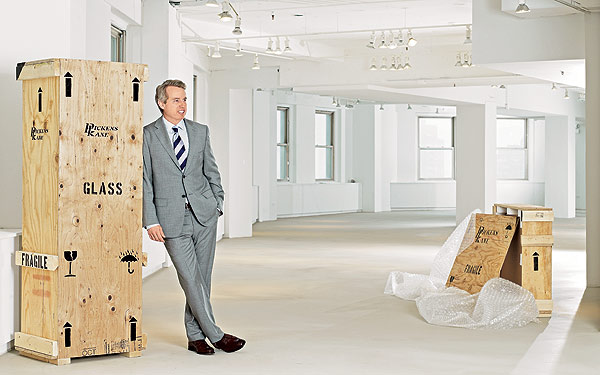
“If you can embrace new ideas, you can embrace your future,” says Christopher Kennedy, shown in the Mart’s space for this year’s Art Chicago exhibition
In late February, racewalking through the 200,000 square feet of the Merchandise Mart’s 12th floor, Christopher Kennedy doesn’t see the current construction mess: the mudding of dry wall, the hanging of ceiling lights, the rolling of paint. Instead, he has a vision—a best-of-class contemporary art show, a see-and-be-seen event with more than 40,000 visitors that ticks along as smoothly as a classic Swiss watch.
On this day, though, the entire space is a hardhat environment, and with a nod to safety, Kennedy, the president of the Mart, carries one in his hand. He gestures with it as he points out how the rooms under construction will turn into galleries that will flow into one another and yet maintain their own level of intimacy. He waves it toward the art-friendly lighting and the moldings in this massive building of show rooms and trade shows. In Kennedy’s world—which is a civic and historic one (he is the son of the late Robert Kennedy, the New York senator turned presidential candidate who was assassinated in 1968)—no detail is too small to be noticed, no plan too large to be considered. That is one reason why Artropolis—an art fair and series of cultural events from April 25th through the 28th that will feature five exhibitions of antique, modern, and contemporary work and more than 2,000 artists—is so important to Kennedy.
“Buying art shouldn’t be hard work,” he is fond of saying. “It should be fun and social and entertaining.” But beyond that, he believes, there is a matter of civic pride and destiny. In 2006, Art Chicago—the centerpiece of Artropolis—almost went into public cardiac arrest when its then owner ran out of cash. Four days before the opening night in Grant Park, the tents were half completed and the unions were refusing to work any longer without pay. A front-page headline in the Chicago Sun-Times proclaimed: “Art Show Fiasco.”
“There were trucks circling the park, wondering if they should unload the art or not,” recalls Howard Tullman, a Chicago entrepreneur and art collector. “It was going to be a horrible black eye for the city, but, thank God, Chris stepped in and saved the day by moving the show to the Mart.”
“It was like he pulled a rabbit out of a magician’s hat,” says Rhona Hoffman, the owner of a contemporary art gallery in the city.
Building on that rescue, last year’s art fair—now owned by the Merchandise Mart Properties Inc. (MMPI) and newly named Artropolis, an umbrella term that encompasses Art Chicago and four satellite exhibitions—drew 42,000 art professionals and consumers, double the number of people who attended the 2006 event. MMPI speculates that last year’s guests spent more than $8 million in the city, which was a boon to local and state tax revenues. This year, the plans for Artropolis are bigger and the organizational details have been tweaked. “Anyone attending this year will know immediately that this is a world-class event,” says Kennedy.
The meshing of culture and business is an important goal for Kennedy, 44, who calls himself “a 20-year transplant” to Chicago. Yet he has developed an unerring sense of the city’s history and spirit. He talks about how it is the city of Frank Lloyd Wright and Ludwig Mies van der Rohe, a city not just of big shoulders but also of big dreams. “A city that embraces contemporary art is a place that embraces new ideas,” says Kennedy. “And if you can embrace new ideas, you can embrace your future.”
* * *
Photograph: Andreas Larsson
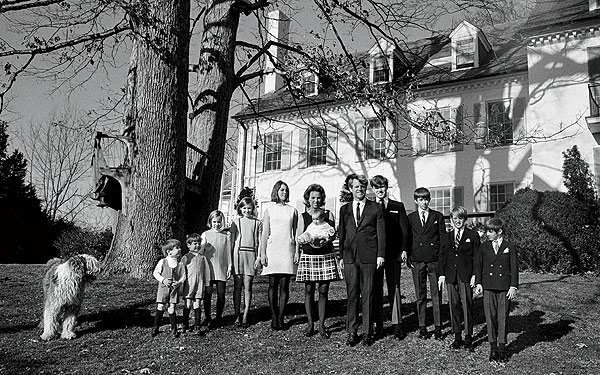
Ties that bind: Senator Robert F. Kennedy with his wife, Ethel, and their children in 1967 at their home in Maryland. From left: Max, Christopher, Kerry, Courtney, Kathleen, baby Douglas, Joe, Robert Jr., David, and Michael. Rory was born after the senator’s death.
|
|
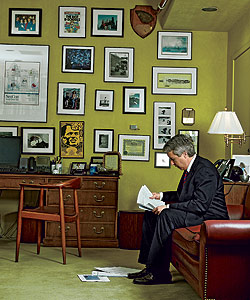
In his office at the Mart, Kennedy, wearing a button-down shirt and an Hermès tie, has a relaxed, engaging manner. The sad downward slope of the famous Kennedy eyes is countered by his quick grin and a rolling laugh. The room is filled with family memorabilia: on the wall, posters from movies made by his youngest sister, Rory; on tables, photographs of his four children; by his desk, the framed 1968
Time magazine cover of his father as a pop superhero; and under the glass top of the conference table, a snapshot of his Bernese mountain dog and a long-haired miniature dachshund. “Oh, my brother Bobby gave my kids that dachshund when I wasn’t around,” he says with a laugh. “I was so pissed. Then we had to get a cat so the dog had someone to play with.”
Chris is the eighth of the 11 children of Ethel and Robert Kennedy. Growing up in a country house in McLean, Virginia, Kennedy says his early exposure to art was confined to “traditional paintings, like those by Edouard Cortès—you know, the kind of artwork you would find in a traditional colonial house.” When Kennedy was in high school, he worked on the presidential campaign of his uncle Edward Kennedy. “Many contemporary artists gave artwork to help fund the campaign,” he says. “And I realized that contemporary art touched me deeply.” While attending Boston College, he met Sheila Berner, a fellow student, from Winnetka. That is how he became the only Kennedy living in the Midwest. “I fell in love and I followed her.” At first, Kennedy worked for Archer Daniels Midland in downstate Decatur, commuting back for the weekends. “What can I tell you,” he says with a laugh. “Before I moved here, Sheila told me Decatur was a suburb of Chicago.” Berner was a lawyer at Sidley Austin; she left the firm to raise their four children.
He and Berner married in 1987; they and their four children—three daughters and a son, ages 9 to 17—live in a northern suburb. The eclectic art in their 100-year-old Queen Anne house includes a Jamie Wyeth portrait of Andy Warhol, work by Damian Elwes, drawings by the Irish artist Jack Yeats, and outsider art by Liz Mumford of Cape Cod. The Kennedys are also antiques enthusiasts. What spare time Chris has is spent attending his kids’ sporting events, cross-country skiing with the family, or biking by himself down the lakefront. He is, after all, a Kennedy. But he is staying out of one family passion: politics.
Although Kennedy and his wife have hosted fundraising parties at their home for Senator Barack Obama in the past, he declines to endorse any Democratic Party candidate—even though his mother, his uncle Teddy, and his cousin Caroline have endorsed Obama, and his brother Robert Jr. and sisters Kathleen and Kerry have endorsed Senator Hillary Clinton. “They are either politicians by profession or high-profile public figures, so I think it’s appropriate for them to do that,” he says. “But it’s unfair for someone like me to dabble in it. I tell them, You stay out of my business and I’ll stay out of yours.”
Kennedy started working at the Merchandise Mart, a family-owned business, in 1987. Commissioned by Marshall Field & Company to be a consolidated warehouse for wholesale goods and trade, the Mart opened in 1930. With four million square feet of floor space, it was the largest building in the world at the time. The architecture firm Graham, Anderson, Probst & White, along with the designer Alfred Shaw, used art deco detailing to break up the massive structure. In 1945, Field’s sold the building to Joseph P. Kennedy, the former ambassador to Great Britain and the father of John F. Kennedy, the future president of the United States. In 1998, the Kennedy family sold MMPI to Vornado Realty for about $630 million in cash and a stake in Vornado.
Starting as a research analyst, Chris worked his way up, developing a reputation for both detail-crunching and wide-sweeping vision. In 2000, he was named the president of MMPI, which now includes not only the Chicago Mart and the Apparel Center but also the Washington Design Center and the Federal Center in the District of Columbia; the Architects & Designers Building in New York; the Boston Design Center; the L.A. Mart in California; and several North Carolina properties, including the National Furniture Mart in High Point. Which means, Kennedy admits, he is in “show business”—as in show-room managing and trade-show producing. So expanding to include the art exposition seems to Kennedy a natural progression.
“It was distressing to witness the decline of Art Chicago over the years,” he says. “The target audiences for Art Chicago—both high-end collectors and the design and décor community—overlap with the Mart’s. Chicago is also a city associated with great architecture and great arts. We certainly didn’t want to see the city turn its back on the art community. The idea that Chicago is a city that works still resonates here.”
* * *
Photography: (Image 1) Steve Schapiro/Corbis Online; (Image 2) Courtesy of Sheila Berner Kennedy and Christopher Kennedy
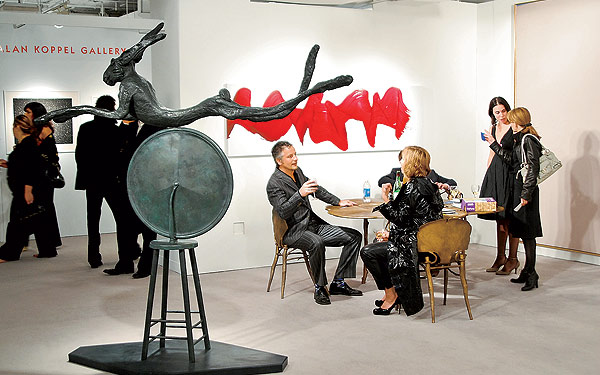
The show under way at the Mart in 2007, with a sculpture by Barry Flanagan in the foreground
The original art fair, called the Chicago International Art Exposition, was the creation of John Wilson, a print dealer and publisher who gathered a team of commercial entrepreneurs under the name The Lakeside Group to produce trade shows. It was held at Navy Pier in 1980, and it helped legitimize a new form of art retailing, in which consumers would buy quality work at a show rather than through galleries or auction houses. During the first two years of Art Expo, The Lakeside Group incurred losses of $127,000 and $80,000. (Revenue comes from booth rentals and ticket sales.) But by its third year, Art Expo was making money. On its tenth anniversary, The New York Times called it “one of the best and biggest art fairs in the world.”
But when Navy Pier started renovating its space in 1989, Art Expo lost its home. Chaos ensued; the contemporary art market tanked, and by 1994 two of Wilson’s top lieutenants, Thomas Blackman and Mark Lyman, had split from the group. (Wilson now lives in Lakeside, Michigan, where he runs a small art-prints gallery.) Lyman spun off to create SOFA (the Sculpture Objects & Functional Art show), an exhibition held in Chicago in November. Blackman, in turn, produced Art 1993 Chicago (later just Art Chicago), a contemporary art show and a direct competitor of Art Expo’s.
What became known as the Art War Years in Chicago ensued. Businessmen from Palm Beach and Cleveland also launched art shows here on the same days as Art Chicago and Art Expo. Instead of one large definitive show, in 1993 there were multiple fractured ones—and none with a defining niche. Costs for the exhibitions rose, and prices for the artwork were driven down.
Blackman’s Art Chicago outlasted the other fairs. But by 1995 it was competing with quality international shows that had been influenced by the Chicago Art Expo model: Art Cologne in Germany; the FIAC in Paris; and the Armory Show in New York City, as well as the long-standing Art Basel in Switzerland, which began in 1970. All the shows became genuine forces in the art world, but the Art Basel show had a singular organizing principle. “It was launched by a public-private partnership whose mission was to create tourism for Basel,” says Kennedy. “They saw the production of an art show as a tool for economic development.” In 2002, a regional version of the Swiss show opened in Miami. The result: Chicago was no longer a dominant contemporary art market; the quality work was going elsewhere. “Art Chicago was hip once, then it wasn’t,” wrote the Chicago Reader last year.
By 2006, Blackman was facing a severe money crunch (the costs of trade shows are usually incurred before the event begins and the fees come in). Three days before the opening of Art Chicago, then being held in Grant Park, the tents had no floors and no lights. “I was spending 20 hours a day racking my brain about how to pull the show off,” Blackman says.
“Blackman was phoning me, asking for a quarter of a million dollars so the show could go on,” says Howard Tullman. “He had pissed off the unions, so they wouldn’t finish the job. Gallery owners were flying into the city, and these half-finished tents were pitched next to mounds of fertilizer for the flower show in Grant Park. It was going to be the worst thing you could imagine for the city’s reputation.”
When Blackman phoned with an SOS request, Kennedy agreed to host the art fair at the Mart, which was also showcasing the Chicago Antiques Fair that same weekend. Mart dock employees worked 27 hours moving in the art exhibitors; MMPI carpenters clocked 35 straight hours setting up the show. The Mart’s marketing and communications group sent out 40,000 e-mails to prospective visitors and printed 15,000 show directories. “Within 24 hours, there was a complete turnaround from total failure to salvation,” says Rhona Hoffman.
Before the 2006 Art Chicago closed, Blackman had transferred the ownership of the show to MMPI. In a speech at the City Club in March 2007, Kennedy called Blackman “a visionary [whose] depth of understanding of the art market is almost limitless. . . . [But] without deep pockets and lacking a large infrastructure, Blackman suffered the vagaries of the marketplace.” The transfer deal included some nifty structuring—Blackman gave MMPI his trademarks, mailing lists, and rights to ticket sales; he was still responsible for debts incurred under his management. And the agreement also gave Blackman a consulting job at the Mart, albeit one that ultimately prohibited him from assuming any high public profile in the 2007 MMPI art fair. “Tom had wonderful institutional knowledge and historical context,” Kennedy says. “And he was a great mentor to the younger staff there.” Blackman left the job in mid-May 2007. “I was told my services were no longer needed,” he says.
Today Blackman is consulting with the organizers of smaller fairs in San Francisco and Los Angeles, as well as staging parts of Art Basel Miami Beach. “The Mart has a tremendous amount of resources,” says Blackman, “and there are great possibilities for what they have in mind.”
* * *
Photograph: Merchandise Mart Properties Inc.
|
|
It wasn’t enough to have rescued Art Chicago; the next challenge Kennedy faced, he says, was “the rebranding and the rebuilding of the show.” The near self-immolation in 2006 had both dealers and collectors initially fleeing from the idea of a 2007 Art Chicago. With the help of Mark Falanga, a Mart senior vice president, and Tony Karman, Art Chicago’s director of sales and development at the time, Kennedy set out to raise the caliber of the show. First, he courted the Art Dealers Association of Chicago (CADA) with a series of energetic meetings and slick PowerPoint presentations. CADA members were sent out into the international art world as recruiting ambassadors for the new fair. The 2007 Art Chicago was considered a success. “For years, this was one of the best art fairs in the world,” says Roy Boyd, a gallery owner and the former president of CADA. “Now with the help of the Merchandise Mart, this fair is approaching that apex again.”
Heather Hubbs, the director of the New Art Dealer Alliance in New York, agrees. “The climate for any art fair is not super favorable right now,” she says. “But the people at Art Chicago are working very hard, and of course the Kennedy family has money and connections to ensure that it is a smoothly run fair and that the collectors attend it. People are very excited about it now.”
This year, 181 galleries will exhibit at Art Chicago, a 37 percent increase in the number of dealers from last year. Premier dealers new to the fair or lured back after long absences include the Leo Castelli Gallery and the Greenberg Van Doren Gallery from New York and the Timothy Taylor Gallery from London. Also returning after an absence of several years is the prominent Chicago dealer Donald Young. “We see the effort that is going into this show,” says Emily Letourneau, the director of the Donald Young Gallery. “And we’re happy to be a part of such a strong enterprise.”
Continuing his theme of “best of class,” Kennedy and his team have studied the art shows in Basel, London, New York, and Madrid. “We can tell you, ‘Well, they do great food here, but their VIP packages are better there,'” he says. The best ideas were culled and incorporated into Art Chicago (MMPI also recently bought the Armory Show in New York, Volta NY and Volta Basel, and the Toronto International Art Fair), with a special emphasis on VIP perks, including cocktail parties in the homes of Chicago collectors and architecture tours with Helmut Jahn and Stanley Tigerman. “Chicago doesn’t have a showoff culture,” says Kennedy. “You don’t see Rolls-Royces here; you don’t see people buying things here to show off. That is a great atmosphere in which to buy contemporary art. Because you’re not buying the froth of the crowd.
“Chicago was always the perfect place for a contemporary art fair,” he says. “What it lacked was a presentation that was commensurate with the work being shown.”
Photograph: Andreas Larsson