

|
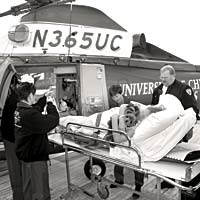
Photo: University of Chicago HospitalsAeromedical Network (UCAN) |
 |

The man wouldn’t stop screaming. Considering that a 500-pound beam of hot steel had fallen on his leg and about three-fourths of the leg was gone, he had every right to express his discomfort. The shreds of hanging skin and muscle looked like hamburger, burned so badly you could see the cracked femur underneath. His pulse was dangerously fast. He was on an Indiana steel mill floor, miles from the nearest hospital, and if his bleeding couldn’t be slowed, he was a goner.
A flight nurse in a maroon jump suit gave him a shot of morphine. A medical resident, dressed in a maroon shirt and khaki pants, undid the patient’s leather belt and wrapped it around his upper leg to use as a tourniquet. But the belt slipped off; it was too big. Another scream. Another ten milligrams of morphine.
The resident saw a paramedic standing nearby. “What’s the biggest needle you’ve got?” he asked.
The paramedic stared. “Fourteen-gauge. Why?”
“Give it to me.”
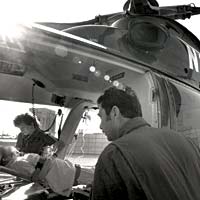
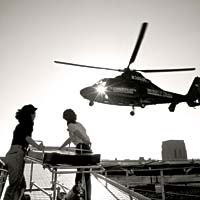
The paramedic handed it over, and the resident jabbed the needle into the belt to poke a hole. He slipped it high on the man’s leg and tightened. Perfect. The folks in maroon hustled the patient out and onto the helicopter. Soon the rotors began slicing through the air, faster, faster, until they were only a blur, and the helicopter started to climb. Then someone hit fast-forward and it darted into the Indiana sky and was gone.
Inside, zooming 200 feet over the lakeshore at 180 miles per hour, the pilot was flying with one hand. Behind him the resident and the nurse pumped the factory worker with fluids, and before long, the flow of blood slowed. The flight to Loyola University Medical Center in Maywood lasted roughly eight minutes; shortly after landing on the rooftop, the man was rushed to the ER, where doctors operated on his leg. He lived. Would an ambulance have saved him? “He could have bled to death on the way to the hospital,” the resident said matter-of-factly.
The guys in maroon are employees of the University of Chicago Aeromedical Network (UCAN). For the past 22 years, UCAN has operated out of the University of Chicago Hospitals complex, performing rescues and hospital-to-hospital transports with a safety record that has been the envy of many in the field.
But UCAN is also a leader in a field that has become controversial in the past decade or so. Since 1995, the number of emergency helicopters in the United States has doubled to more than 600, and the increased competition has coincided with an increase in helicopter accidents. Eighteen people died in crashes involving emergency helicopters in 2004-the most ever in one year-prompting The New York Times and The Wall Street Journal to report on helicopter safety, and the Federal Aviation
Administration to launch an air safety inspection. Though the number of emergency helicopters continues to rise, a recent study by Michael L. Slack, an aviation lawyer and former NASA engineer, showed that fewer than 5 percent of helicopter transports were medically necessary-the result, perhaps, of so many programs competing for flights and profits. It seems the definition of an emergency isn’t what it used to be.
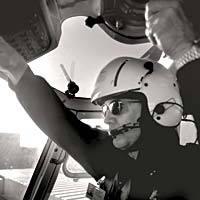
“We’re getting to the point where the growth is excessive,” said Ira Blumen, UCAN’s program and medical director, in June of this year. At the time, UCAN had made more than 14,000 flights spanning 22 years without an accident. Widely known in the field as the author of an influential 2002 paper on helicopter safety, Blumen has spent 18 years building UCAN into one of the country’s top aeromedical programs. Twice a year, he sends his four pilots to FlightSafety International, an aviation training company, where they undergo motion simulator training and decision-making tests. He allows his pilots to say no to flights whenever they want. In October 2004, at the Air Medical Transport Conference in Cincinnati, Blumen won an award for contributions to aviation. He is obsessive about safety. “Anyone in the industry would tell you the same thing,” says Pat Petersen, executive director of the Salt Lake City–based Air Medical Physician Association. “UCAN is an exceptional program.”
Then, this past July 14th, with UCAN’s usual $4.5-million Eurocopter Dauphin AS 365 N1 helicopter in Texas for mechanical repair, its replacement vehicle was taking off from the rooftop of Porter Hospital in Valparaiso, Indiana-with an intubated intensive-care patient on board. Without warning, the craft lurched into a brick structure on the roof and fell about five feet. The helicopter landed on its right side, its tail hanging off the helipad. The cause of the crash remains unknown; a National Transportation Safety Board (NTSB) investigation is ongoing. None of the four people on board, including the patient, was hurt in the crash. The pilot was a Vietnam veteran with a perfect safety record; before his six years at UCAN, he had flown for Bank of America for 18 years without incident.
Most crashes don’t end this way. On January 28, 2003, Michael Russell, an army veteran with 12,000 flight hours to his name, was alone in the Agusta A109C he flew for Air Angels, an independent medical transport service based in West Chicago. Russell told air traffic control he planned to land at the DuPage Airport heliplex. Soon after, the controller saw a “flash of light” to the south of the airport, at which point he lost communications with the aircraft. Russell, 52, who had survived being shot down in Vietnam, had plummeted into a cornfield. He died instantly. The “dark night, low ceiling, and reduced visibility” all factored into Russell’s crash, according to an NTSB report, but the craft apparently had not malfunctioned. In the end, the report cited pilot error.
Both accidents spoke volumes. In the helicopter rescue field, not even one of the most vigilant programs in the country-nor the most seasoned of flight veterans-is immune to the dangers.
|
Photo: University of Chicago HospitalsAeromedical Network (UCAN) |
 |
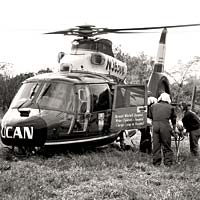
On January 3, 1944, with a snowstorm punishing the Atlantic coast, the USS Turner, a navy destroyer anchored off Sandy Hook, New Jersey, exploded with such force that the blast was felt 15 miles away. All told, 138 crew members died. The survivors were taken to a hospital in Sandy Hook where large amounts of plasma were needed to save them-but the blizzard was making ground travel difficult and airplane travel impossible.
The previous month, Frank Erickson, a Coast Guard lieutenant, had started the world’s first helicopter school, about ten miles away in Brooklyn. When the Coast Guard called to ask if he could pick up plasma in Manhattan and fly it to Sandy Hook, Erickson jumped into his Sikorsky R-4. Ignoring gusting winds, swirling snow, and almost zero visibility, he flew from Brooklyn to Battery Park, attached two cases of plasma to the Sikorsky’s floats, and continued on to Sandy Hook. The flight saved many crew members’ lives. “Weather conditions were such that this flight could not have been made in any other type of aircraft,” Erickson boasted later. “But for a helicopter, it was simple.” It was the first recorded emergency flight by a rotary-wing aircraft.
From the beginning, the helicopter had its critics. Compared with the average fixed-wing aircraft, it was expensive and slow; it couldn’t carry much; it had limited range. But Erickson’s flight proved that helicopters had one thing planes didn’t: maneuverability. A helicopter can hover; it can reverse; it takes off and lands vertically, travels anywhere, and lands anywhere with a clearing of roughly 100 by 100 feet.
In the Korean War, around 20,000 wounded Americans were taken by helicopter to field hospitals, which significantly cut down the casualty rate-and revolutionized the way wars were fought. During the Vietnam War, U.S. military helicopters transported nearly one million people.
In the early 1970s, Denver’s St. Anthony Hospitals developed the first civilian hospital–based helicopter rescue program in the United States. Other urban hospitals introduced helicopter emergency medical services programs of their own, giving them quick access to rural areas. In 1983, the University of Chicago Hospitals became the 51st U.S. facility to do so-and the first in the Chicago area.
Ira Blumen was an emergency medicine resident working at Lutheran General in Park Ridge when he saw his future on the helipad. “There were two helicopters there at the moment,” he recalls. “One lifted off, and I just thought, Wow, this is cool.” He landed a job at MedStar, the helicopter team at St. Mary of Nazareth Hospital Center in Chicago, where he worked until that program ceased operations in 1987.
Later that year, Blumen took the head position at the University of Chicago Hospitals’ helicopter program. He immediately noticed that other areas of the hospital had barely heard of UCAN; those who had were not using it. So he met with department heads and explained that UCAN could take over the whole emergency transfer process-the paperwork, the legwork, the phone calls-and would transport the patient themselves. It all sounded too good to be true for time-crunched doctors; many asked what it would cost them. The answer was: nothing. Patients or insurance companies generally pay the cost of air transport.
Blumen worked nonstop-nights, weekends, holidays-to get UCAN’s name out in the hospital community. He even slept on a couch in his office, prompting the crew to joke that he should get his mail forwarded there. The number of flights began creeping up, and by 1992, UCAN had amassed 5,000 consecutive accident-free helicopter missions. In the mid-nineties, ER, NBC’s Chicago-based medical drama, came calling, and UCAN rented out its helicopter and crew to film complicated scenes. When George Clooney’s character snapped, “Call Ira Blumen; tell him to get his damn chopper over here in a hurry!,” 30 million people heard the line. When the wife of a flight program manager in Pittsburgh asked for Blumen’s autograph, he realized that UCAN had landed.
|
Photo: University of Chicago HospitalsAeromedical Network (UCAN) |
| Ira Blumen-here in a photo taken for an emergency medicine textbook-was immortalized by a mention on ER. |
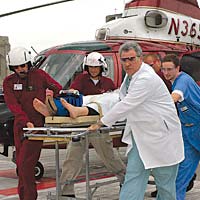
In the 1980s, hospital-based helicopter programs didn’t make a profit; the publicity and new patients they brought in were enough. Those days are over. Now UCAN is expected to make ends meet. The reason for the shift is increased competition from a new kind of helicopter program: the independent, for-profit provider that must recoup investment costs. “Our advantage over hospital-based programs is that this is all we do,” says Michael Dermont, president and CEO of Air Angels, which he calls a “community-based” program. “The U. of C. provides a lot of services, but 100 percent of our resources, our time, our energy, is dedicated to emergency services.” Headquartered in West Chicago, the company has one helicopter in Bolingbrook and one in South Bend, Indiana, which enables it to provide service across the region.
The number of such programs has risen in recent years, transforming helicopter rescue into a big business. UCAN’s days of having fun with the helicopter-like Santa Claus’s annual landing on the helipad to greet young patients with presents-are few and far between; it’s too expensive now. The operating costs have dramatically increased, and so has the bill for a ride. (A 60-mile ambulance transport costs about $2,000; a helicopter ride can run a patient three times that amount or more.) Competition is fierce. A recent New York Times story recounted an incident in which an independent company that had listened on its emergency scanner for accidents raced to a scene before its rivals. In the Chicago area, UCAN shares the skies with Air Angels, a company called Flight For Life, and Loyola University; two more helicopters are based in Rockford, two in Peoria, one in Champaign, and two in Indianapolis. In other words, it’s getting crowded up there.
A chorus of doubters in the health care field argue that urban helicopters aren’t any more effective than ambulances. One of their leaders is Clayton Shatney, associate director of trauma at Santa Clara Valley Medical Center in San Jose, California, and clinical associate professor of surgery at Stanford University. In 2002, Shatney published a study on helicopter transport in The Journal of Trauma Injury, Infection, and Critical Care that was damning. Three years later, he hasn’t toned down one bit. “For the vast majority of urban trauma patients, helicopter transport is unjustified,” Shatney says. “In urban areas like Chicago-with an abundance of trauma centers and all kinds of traffic-it’s basically a wash between lives saved and potential lives lost.”
Part of the perception that helicopters are an improvement over ambulances stems from misleading data, says Shatney. “When the helicopter folks talk about how quick they are in getting to the scene, they’re only talking about flight time,” he says. “What about the 8 to 12 minutes it takes to get to the helipad? Or the time it takes to find somewhere to land? When you add it all up, ambulances are just as fast-and much less expensive. But the ground [ambulance] folks are so scared, they don’t bother to look at the numbers.”
If the spread of helicopter programs is, in fact, a triumph of public relations over practicality, Air Evac Lifeteam is a good case study. The fast-growing Missouri-based indie, with 58 rural locations in the United States, sells $50 annual “memberships” that allow customers to call for transport with no out-of-pocket costs. To draw clients, Air Evac has tried everything from distributing literature outside Wal-Mart to making sales calls at assisted-living homes, and instead of calling 911, some members call Air Evac. “Some of the areas we serve do not have a 911 center,” says Julie Heavrin, Air Evac’s public-relations manager. “In some cases it takes more than two hours [by ambulance] to get to a trauma center.” (Only 2 percent of Air Evac’s calls come from members, but the company could not exist without its membership program.) Air Evac, which transported more than 100 people in the Gulf Coast to safety following Hurricane Katrina, has added eight to ten new outposts a year in recent years. “If you would have asked me in the nineties if an independent company could survive, I would have said no,” says Blumen. “But things have changed.”
|
Photo: University of Chicago HospitalsAeromedical Network (UCAN) |
 |
Another thing that has changed: the perception of pilots as cowboys in the sky, a notion that Hollywood has helped perpetuate. The image of Robert Duvall blaring “Ride of the Valkyries” from his helicopter in Apocalypse Now seems ridiculously outdated in this era of by-the-book safety. Simply put, today’s pilots do not pull stunts. “These are professionals who do not take risks,” says Blumen. “They want to get back to their families safely like the rest of us.”
But the emergency helicopter field still attracts an offbeat crew of adrenaline junkies: ex-firefighters and military men, pediatric intensive-care-unit veterans, emergency room nurses, former emergency medical technicians. One of UCAN’s communications specialists has a part-time job removing corneas from the recently dead; a former employee worked for Aftermath, a company that tidies up after crime scenes. Blumen’s crew are undoubtedly smart and fearless, but they’re average-looking: beer bellies, droopy mustaches, bum knees. One nurse, called “Ned Flanders” by colleagues because he looks like the character from The Simpsons, is colorblind, and hence incapable of seeing blood. Fred Ligman, UCAN’s lead pilot, is among the most gifted helicopter pilots in Chicago-he was the one at the stick during a key sequence of The Blues Brothers, where a helicopter flies among the city’s skyscrapers-but he’s just like the rest of us on the ground, where he drives an ’84 Dodge Caravan and still mows his parents’ lawn.
Ligman and the rest of the UCAN crew spend hours in the office waiting for action. “There’s a lot of downtime,” says Blumen. “It’s like a fire department; the only thing missing is the exercise equipment.” And as in a fire department, the storytelling is legendary. The crew’s macabre tales involve things like infants born with their intestines on the outside, or alcoholics who get sliced in half on train tracks. Jane Kirkley, a UCAN flight nurse for 22 years, talks about the time she transported a child molester who sliced off his own penis. “They re-attached it, but it didn’t take,” she says. “He couldn’t leave it alone.” Kirkley is the first to admit how crass it all sounds, turning other people’s misfortunes into comedy, but gallows humor is one way to cope with the realities of the job. In the helicopter, she is as compassionate as anyone.
After the helicopter accident in July, the storytelling stopped. In fact, the whole program shut down for nine days. During that time, UCAN took a look at its safety practices. It also held a briefing on the accident, inviting crew members, emergency residents, public-relations folks, people from the legal, safety, and security departments-anyone who was eligible to fly with UCAN-to discuss what had happened. Ligman, drawing on a chalkboard, showed that the accident most likely was caused by the loss of tail rotor functionality. Essentially the aircraft started to topple because the rotor wasn’t doing what it was supposed to do.
When the program was up and running again, some of the crew members hesitated to fly in another replacement helicopter, though all eventually agreed. Blumen refuses to assign blame for the accident. “I can’t say it was the fault of the aircraft,” he says; he’ll wait for the official NTSB report to draw a conclusion. It could be a while. It can take more than a year for the Washington, D.C.–based agency to release its detailed accident reports. Meanwhile, UCAN is waiting for its original helicopter to come back from its maintenance in Texas. When it returns, likely this month, the team will notice some technological improvements: a ground proximity warning device that links a database with the craft’s GPS location; a traffic avoidance system that reads transponder codes of other aircraft; a satellite telephone; and an automated satellite tracking system. “We have never stood pat,” says Blumen. “We’re always looking at new initiatives when it comes to safety.”
Are the additions a guarantee that UCAN won’t have another accident, with worse consequences? Obviously not. Pat Petersen of the Air Medical Physician Association recalls a program in Utah that went more than 20 years without any accidents-then had two fatal crashes within months of each other. “I don’t think that accidents happen because people are careless,” she says. “Accidents are accidents.”