

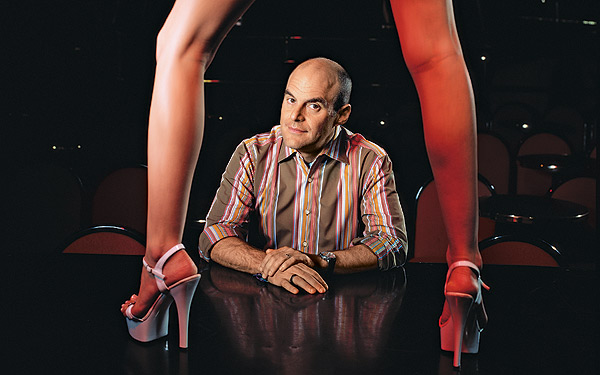
Peter Sagal is having a rock-star moment.
"Well, eat your heart out, Pitchfork Festival!" exclaims the host of Wait Wait . . . Don't Tell Me! The gathering of approximately 10,000 people cheer and hoot for Sagal, who looks tiny standing under the Pritzker Pavilion's massive gray steel curves and protruding blocks of orange wood. They have come to Millennium Park for a special taping of National Public Radio's weekly news-based quiz show on a comfortably cool Thursday evening in mid-July, a few days after the popular alternative-rock festival catered to an entirely different kind of crowd.
"We know our demographic, and we appreciate you giving up your place in line for Harry Potter," Sagal tells the throng filling the lawn.
The free event has drawn the largest audience ever to watch the show—it's usually taped in front of just 500 fans in the basement auditorium of the Chase Tower—and Sagal's guest tonight is U.S. district attorney Patrick Fitzgerald, whose office has just won a high-profile conviction in the trial of media baron Conrad Black.
Fitzgerald slouches, center stage, in a dark suit and tie, looking like a boy awaiting certain punishment. Sagal and Carl Kasell, the 28-year veteran announcer of NPR's news program Morning Edition who moonlights as the scorekeeper on Wait Wait, stand at lecterns to Fitzgerald's right. Along a table to his left sit the show's trio of panelists, drawn from a rotating crew of a dozen regulars—this week it's humorist Roy Blount Jr., Washington Post gossip columnist Roxanne Roberts, and novelist Adam Felber.
Fitzgerald routinely declines requests for interviews, so his appearance tonight is a coup for the show's producers (turns out he's a fan). His rare public appearance has drawn camera crews from the local news stations and CNN, and NPR's longtime legal affairs reporter Nina Totenberg chides Fitzgerald in a prerecorded bit played for the audience. "I sat through the Scooter Libby trial," she says to him, referring to Fitzgerald's successful prosecution of I. Lewis "Scooter" Libby Jr., Dick Cheney's former chief of staff. "Now you're giving an interview to these jerks!" Big laughs.
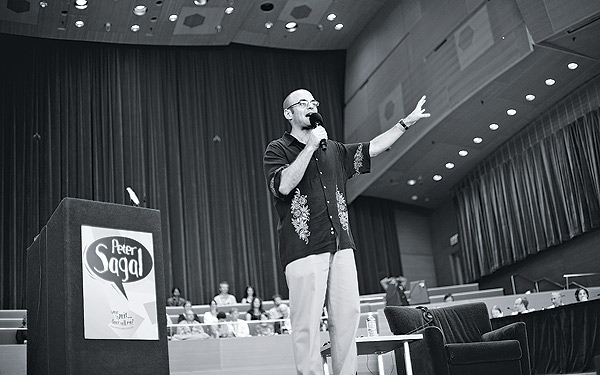
Fitzgerald is one of 2.3 million listeners tuning in to Wait Wait each week, making it NPR's third-ranked entertainment program, behind Car Talk and A Prairie Home Companion. (Here, the show—put together at the WBEZ offices on Navy Pier and taped live on Thursday evenings—airs on WBEZ, 91.5 FM, at 10 a.m. Saturdays, and repeats 9 a.m. Sundays.) Approaching its tenth anniversary, the hourlong show has captivated news junkies across the country with its lighthearted approach to current events; the program is divided into seven quiz segments, including one in which Kasell reads fill-in-the-blank limericks based on the week's top stories. The show has also turned Sagal into a star, albeit one who can still go unrecognized on the street.
"I am well known among a small niche of the general public," reflects Sagal, 42, during a conversation a few days before the Millennium Park taping. "The rest of the world has never heard of me, but the people who know me are funny and smart and well read and interesting."
He's eating breakfast at a corner booth in a Humboldt Park restaurant, dressed in a dark green cycling jersey and bike shorts, blue saddlebags lying at his side. Sagal sometimes pedals his way from his home in Oak Park to his cubicle at WBEZ, where his bike joins the dozens of others locked outside the station's entrance. If Sagal displays certain stereotypical traits of public radio-ness, much of his growing fame is due to the impish comic relief he provides to NPR. (After dutifully announcing a lead-in to the weekend news at the beginning of each show's taping, he likes to crack up the studio crowd by holding his nose and nasally announcing the familiar refrain "From NPR news in Washington . . .")
Now, that same combination of smarts and class clownishness also fills his first book, The Book of Vice: Very Naughty Things (and How to Do Them), to be published in October by HarperCollins. Much as he does on Wait Wait, Sagal drolly skewers human misbehavior as he reports on the making of a porn video, visits a CPA to the rich and famous, shoots craps, and partakes of a lavish multicourse dinner at Alinea only to leave hungry. While he cringes at certain behavior, Sagal largely avoids making judgments (although he does take a few swipes at President Bush and at William Bennett, author of The Book of Virtues). "More than we want to admit, many of us might want to dabble in such experiences," he says. "I wish I had the balls to play high-stakes poker. I wish I had enough self-regard that I could enjoy a swingers' club. I wish I could travel the world and eat these things. But it all seems silly and self-indulgent to me."
These forays in Babylon are a far cry from Sagal's nondescript middle-class upbringing in Berkeley Heights, New Jersey. His father, Matthew, was a telecommunications executive and his mother, Reeva, a schoolteacher turned stay-at-home mom. In high school, Sagal, the middle of three sons, gravitated to theatre. "I was a typical theatre dork, brainy, someone who found actual interaction problematic," he says. He went to Harvard, where he majored in English and wrote and directed student theatre productions. After graduating magna cum laude in 1987, Sagal moved to Los Angeles, where he worked as the literary manager for the now-defunct Los Angeles Theater Center, reading a mountain of plays before turning to writing them himself.
A playwriting fellowship in 1992 took him to Minneapolis, where a friend suggested casting a pretty blond actress named Beth Albrecht in a staged reading of one of his plays. "I thought, This guy is so funny and smart," she remembers. "I immediately had a crush on him, and because my friend had been talking me up, he immediately had a crush on me." Although the high expectations led to a disastrous first date—"We both were trying too hard to impress each other," Albrecht says—they married in 1994.
Fate may have played a hand. In one of the occasional humor columns he has recently written for The New York Times Sunday Magazine, Sagal recounts how, shortly after Albrecht rejected his suggestion that they live together, one of her housemates inadvertently set their furniture on fire; Albrecht moved in with Sagal that night. "With that example, I have taken a more accepting, passive approach to achieving my desires in life," he concludes in his essay. "If somebody refuses a request, or if things don't work out the way I had desired, I don't argue. I sit back, and I wait for something to explode."
While in Minneapolis, Sagal was hired to ghostwrite the autobiography of a 1970s porn-film director named Gail Palmer, only to discover that she was merely a front for her pornographer boyfriend. He went ahead with the project but created a smarter, more self-aware version of Palmer who reflects thoughtfully on her life in the memoir. Palmer refused to let it be published, but Sagal revisits the episode in his own book and says that the exposure to the porn industry laid the groundwork for Vice. During his Minneapolis stint, Sagal also wrote a play titled Denial, which found its way into the hands of the Hollywood producer Lawrence Bender (Reservoir Dogs, An Inconvenient Truth); Bender later hired Sagal to write a screenplay that eventually became 2004's Dirty Dancing: Havana Nights.
Sagal moved from fellowship to fellowship until 1995, when he and Albrecht moved to New York to try to piece together a living in the theatre; he wrote, she acted. Two years later, the couple moved to Brooklyn, Albrecht became pregnant with their first child, and Sagal was asked to audition for a spot as a panelist on a new public radio humor show. "We didn't want traditional performers," recalls Wait Wait's creator, Doug Berman, who also came up with NPR's Car Talk. "We wanted people who had something to say and had a funny take on things."
Sagal became one of the show's original group of four panelists and shortly afterward once again benefited from something exploding: When Wait Wait debuted early in 1998, its host was Dan Coffey, a comedian best known for his radio character Dr. Science, but it soon became apparent he was a poor fit. "He's a talented guy, but it turned out we wanted someone who had more news savvy," Berman says. By the time the producers decided to look for a new host, the show was committed to WBEZ because it was the network radio station with adequate production facilities nearest to Coffey's home in Iowa City. Coffey lasted only until the end of April, but during those few months Sagal established himself as the panelist best able to take the reins. "You could hear him thinking," Berman says. "He was able to bring out the best in other people around him as well as share his own ideas." Midway through a nine-week tryout, Sagal was hired. He moved to Chicago with Albrecht and their newborn daughter in May 1998, eventually settling in Oak Park, where the family has grown to include two more girls.
The Wait Waitstaff occupies a tiny warren of cubicles in the WBEZ offices, housed in a squat building in the middle of Navy Pier. During the course of a typical week, Sagal and the four producers who work with him coordinate guests' appearances and develop quiz questions based on the week's news. Thursday is the culmination of their efforts: In the afternoon, the staff reads through the script in preparation for that evening's taping; Kasell flies in from Washington, D.C.; Berman, who works out of the WBUR office in Boston, listens in on speakerphone.
One recent Thursday, the staffers gathered around a conference table and took notes as Sagal speed-read through his parts, tugging compulsively at his eyebrows—the thickest hair on his close-cropped head. There were a few moments of bogging down in the minutiae that seem to attend any staff meeting as the group fine-tuned the script to hone jokes and emphasize their newsiness. One digression, for example, found them debating the right adjective to convey the Toyota Prius's reputation for poor horsepower in response to the news that Al Gore III got ticketed for going more than 100 miles per hour in his ("Granola-powered" eventually won out).
Sagal says the show's switch in 2005 to taping in front of an audience has spurred its growth; listenership is up by a third in the past two years, according to Arbitron, the radio-ratings service. Originally, the panelists on Wait Wait called in from studios near their respective homes, but now they fly in from across the country. Even though Wait Wait consists entirely of people sitting around talking, the tapings regularly sell out at $20 a ticket. "Part of the fascination of radio is how intimate it is," says Roxanne Roberts, a longtime Wait Wait panelist and a good friend of Sagal's. "People hear your voice, they hear you laugh, they hear you talk about yourself and your life, and they feel they have some sense of you. They're dying to see you in person and to find out to what extent you match up with the fantasy they have of you."
For years, Sagal has been warming up the crowd by telling them that NPR's demographic research has determined that "most of our audience—not you, I can tell—was socially unsuccessful in high school." He retired the line after the Millennium Park taping, but it served him well. "We're public radio dorks, all of us, including me," he says. "We identify as that and we're proud of that. We've learned that the audience loves being teased about it and loves being identified as part of the cult."
The guy who wrote a metabiography of an ersatz porn director seems to fit right in with an audience that cares more about Lewis Libby than Lindsay Lohan. Sagal also has an ex-nerd's tendency to overcompensate for being unathletic as a child: An off-and-on runner since he was 15, he dealt with turning 40 by running the Chicago Marathon, and last year he ran the Boston Marathon as well. (We will leave it for someone else to decide whether his taste for slightly loud clothing or the fecklessness he describes in his Times essays, including getting stuck on a neighbor's roof, and another time being conned out of $40 by a woman pleading car trouble, is also characteristic of the NPR crowd.)
In fact, anyone who doesn't keep up with current events of the nontabloid variety may not get the humor in Wait Wait. The program's features include a segment called "Not My Job," in which guests ranging from Supreme Court justice Stephen Breyer to KISS guitarist Gene Simmons answer questions about an unfamiliar subject area. Patrick Fitzgerald, for example, was asked about scooters the Segway scooter, Scooter the Muppet, and former New York Yankees player Phil "Scooter" Rizzuto. In another segment, called "Who's Carl This Time?" Kasell adopts silly voices and the occasional bad accent as he quotes the week's prominent newsmakers. Each show ends with a lightning round, as the three guest panelists compete to answer the most fill-in-the-blank questions; at Millennium Park, Felber went eight for eight to win the week's show, and Roberts high-fived him as if he'd just hit a walk-off grand slam. Through it all, Sagal keeps the quips flying as he banters with the show's panelists and listeners calling in to the program. The week prior to the Millennium Park show, one bit involved the news that Arizona senator and foundering presidential candidate John McCain was going to stop wearing "gay sweaters."
"I had no idea that a sweater had a sexual orientation," remarked panelist Kyrie O'Connor, the deputy managing editor of the Houston Chronicle.
"Apparently it's not their choice; it's how they're made," Sagal ad-libbed, earning the evening's biggest laugh and two thumbs-up from comedian Paul Provenza.
"One of the problems I had adjusting to the new gig is that a playwright has absolute control," Sagal says. "Radio shouldn't be that. The show gets its glory through improvisation. At the same time, I'm nervous enough and enough of a control freak that I go into the show with as many jokes, ideas, riffs as I can." His colleagues credit Sagal with consistently coming up with clever ideas to keep the show fresh and funny, such as Fitzgerald's thank-you gift (in a mocking reference to President Bush's recent commutation of Libby's prison sentence, the show presented Fitzgerald with a kick scooter engraved with the dedication: "This one will stay where you put it"). But that drive has a downside.
"He has a deep angst in him, a deep sense of worry," Albrecht says. "He worries that he's not attractive enough and he's hot, hot, hot! He worries about not being successful enough. He worries about not being a good enough dad. He worries about not having enough friends."
"I don't think he sits back and enjoys his success as much as I want him to do," Roberts adds. "Smart men are always unsatisfied. They're very ambitious and they always expect more of themselves. The inevitable question is, What next?"
Sagal says he wishes he could do more writing. When he first started hosting Wait Wait, he planned to do some writing on the side but found it impossible to squeeze in (he took extended breaks from the show to finish his book). But after seeing Denial and one of his one-act plays performed in New York earlier this year, Sagal says he feels a renewed appetite for his old creative pursuits. "There have been a couple times in my life where I've been able to do remarkable things creatively, not by the lights of the world, but by my own lights," he says. "Every now and then I get to do that on the radio show when something goes incredibly well. If I could wish for anything, it would be a life in which I could devote myself a lot more to going after that again."