

|
Photo: Paul Natkin |
|
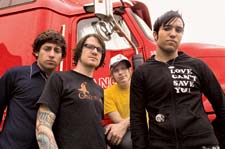
Meet Fall Out Boy: (from left) Joe Trohman, Andy Hurley, Patrick Stump, and Pete Wentz |
Patrick Stump and Pete Wentz are standing on one side of the wire mesh fence behind the stage where their band, Fall Out Boy, has just finished performing a concert for a crowd of thousands of Chicago-area teenagers. Now scores of those kids, most of them girls, are on the other side of the fence trying to get autographs. They hand shirts and hats over the top and pass ticket stubs through the mesh, while the musicians scribble signatures at a wrist-wracking pace.
“Will you say hello to my girlfriend?” a boy asks, passing his cell phone to Wentz.
The bass player doesn’t miss a beat. “Was your day cool even though you weren’t here?” Wentz demands into the phone, still furiously signing autographs.
“Will you sign my pants?” a girl asks Stump.
“Absolutely,” he replies, sticking his pen through the fence to scribble on her leg. (“What a waste of a pair of pants,” he’d remarked earlier of the frequent request; he says he draws the line at signing butts and breasts.)
“They’re some of the nicest guys,” observes Ashley Winkiel, a 15-year-old fan from Lombard and veteran of multiple Fall Out Boy shows, as she stands off to the side. “They’re so genuine and they’ll do anything for a fan.”
The fans and the signatures keep coming for more than 15 minutes until the band’s skin-headed security guard, Charlie Mark, drags Stump and Wentz back to their tour bus. Even then, a few girls give chase, doing an end run around the bus to head them off at its entrance, where Mark shoos them away.
|
Photo: Paul Natkin |
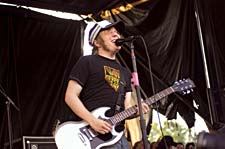
Fall Out Boy didn’t used to put up barriers and security guards to keep away fans. The band-21-year-old Winnetka guitarist Joe Trohman, Glenview singer/guitarist Stump, 21, Wilmette bassist and backup vocalist Wentz, 26, and drummer/Milwaukee suburbanite Andy Hurley, 25-spent four years building an audience with a combination of personal attention and empathy, relentless touring, and online accessibility. In the past few months, they’ve gone from having a devoted grassroots following to being bona fide rock stars.
“So many people want to reach out to them,” says John Janick, the president and a cofounder of Fueled by Ramen records, the independent Florida label that released Fall Out Boy’s first CD, Take This to Your Grave, in 2003. In early May, Island Records released From Under the Cork Tree, Fall Out Boy’s sophomore CD and major label début. Fans bought more than 60,000 copies in the following week, enough to land the record in the number nine slot on the sales chart compiled by Billboard, the music industry’s leading trade magazine. The CDs sales reached the gold record mark-half a million copies-in late July, and by the end of August was approaching platinum status, with almost one million CDs sold.
Fall Out Boy spent most of the summer on the Warped Tour-a multiple-act, multiple-stage summer punk rock festival that has helped raise bands such as No Doubt and Blink 182 to superstardom-playing 48 shows in less than two months, including a hometown concert at the Tweeter Center in Tinley Park in late July.
Standing on the side of the stage before that show, Richard Trohman, a cardiologist at Rush University Medical Center, looks out at the sea of teenagers who are waiting for his son’s band to perform. “I find it hard to believe,” he says of the band’s success. “It’s exciting, and I’m very proud, but it’s surreal. You never dream it’ll really come true. You don’t dare.”
Growing up in the affluent suburbs, the sons of professionals, isn’t your typical pedigree for punk rock musicians, but for Fall Out Boy’s members, music was a refuge from the conventionality and cliquishness of their environment. “We were the kind of nerds who get ignored in high school,” says Stump. “While everyone else was going to parties, we were doing bands.”
Wentz attended North Shore Country Day School (where his mom, Dale, works as an administrator) and New Trier High School. He and Hurley played in a hard-core band called Arma Angelus while they were in college-Wentz came within a semester of earning a political science degree from DePaul, and Hurley was a dean’s list double major in anthropology and history at the University of Wisconsin–Milwaukee. They formed Fall Out Boy in 2001 with Trohman-a New Trier junior who’d known Wentz since they were kids-and Stump, a Glenbrook South High School student that Trohman met at a bookstore.
Taking their name from a Simpsons character at the suggestion of a kid at their first show-a decision they now regret-Fall Out Boy began to build a music scene around the band, playing house parties and booking gigs in any place that would have them. They played a south suburban coffee shop and a dive country bar in Schaumburg, and started selling out a Knights of Columbus Hall in Arlington Heights. “There were so many random places,” Stump remembers. “Every weekend we’d play some other suburb to the same amount of different people in some totally unlikely place.”
“They took the grassroots punk rock steps. If there’s an unwritten manual, they followed it pretty closely, and good things happened for them,” observes Joe Shanahan, the owner of Metro, the Chicago rock club, where Fall Out Boy gradually rose from the opening act on a four-band Sunday night bill to headlining a sold-out year-end concert last December.
|
Photo: Paul Natkin |
At first, the band had a tougher time establishing themselves nationally. Most of the shows on the first tour were canceled. On later tours they played to audiences of two and one, and even the sound engineer abandoned them one night in Nebraska. They slept on the floors of fans’ apartments and crossed Arizona in the summer of 2003 with the heat on in their broken-down van to cool the engine. “It melted the molding on the windows so that it would rain inside the van,” Wentz recalls.
The Internet provided an easier way to reach fans. Before they had a major label behind them, Fall Out Boy made their songs available on the music Web site purevolume.com (to date, their songs have been played on the site more than five million times). They also became a presence on myspace.com, an Internet meeting place, interacting with fans in chat rooms and keeping online journals. “We realized that there was this group of ears and voices that weren’t being catered to,” Wentz explains. “This Internet counterculture definitely appeals to them and allows them to hear music and be part of communities that they wouldn’t be through TV and radio.”
Judging by the crowds at Fall Out Boy’s Warped Tour show in Chicago and in Cincinnati the day before, their fans are mainly girls between the ages of 15 and 20, drawn by Stump’s pleading voice and the band’s quirkily good looks. (There also were plenty of boys at the shows, showering the stage with T-shirts and forming enormous mosh pits, both at Wentz’s urging.)
Something deeper also fuels the fans’ response to Fall Out Boy’s songs, which the band members write together. The music’s ascending melodies, mammoth guitar hooks, and manic structure-Fall Out Boy’s songs rise and fall and shift tempos like roller coasters-are a natural complement to oversize teenage emotions, when every twist and turn in life feels momentous. Similarly, the lyrics Stump assembles from Wentz’s notebooks mix heart-on-sleeve yearning and cleverly sarcastic humor into a potent evocation of teen life. “You can really relate to what they say. It’s the anthems of your life and your day,” Ashley Winkiel says.
“It’s shocking, every time you interact with someone who says, ‘Your songs changed my life’ or ‘got me through this period,'” says Wentz, who has an undeniable way with an epigram. “I’d burn the city down to show you the light” (from “Sophomore Slump or Comeback of the Year”) is a pretty good example of the emotional scale Fall Out Boy operates on. They can flash a tongue-in-cheek wit, too: “The ribbon on my wrist says Do not open before Christmas” (from “Our Lawyer Made Us Change the Name of This Song So We Wouldn’t Get Sued.”)
|
Photo: Paul Natkin |
With a combination of emotional intimacy and hyperactive energy, the band brings out the wilder side of quiet, shy kids like Leigha, a freckled, moon-faced, soft-spoken Cincinnati 16-year-old with curly reddish-brown hair. She’s never been to a rock concert-her father, whom she describes as strict, won’t allow it-so she and her 15-year-old sister told him they were going to the mall but sneaked off to see Fall Out Boy. They’re perched against a railing, part of a long row of kids that stretches along the ground and up a stairway overlooking the stage that’s been erected in a corner of Cincinnati’s Riverbend Music Center. (The Warped Tour scatters make-shift stages across parking lots and food courts of outdoor stadiums. With the cramped array of merchandise booths and the scruffy performance areas, the festival typically resembles a cross between a third-world bazaar and a summer music camp.) “I’m madly in love,” Leigha declares. “They’re real hot and they sing great. I love the way they spin.”
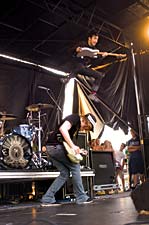
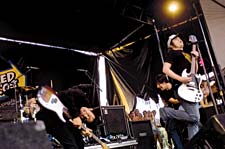
Fall Out Boy’s shows involve a great deal of spinning. While Hurley, stripped to the waist, tattoos emblazoned on his chest and arms, powers the songs with thunderous drumming, Stump, Trohman, and Wentz whirl and jump around the stage without missing a note. Meanwhile, waves of bodysurfing kids tumble over the crowd barricade into the waiting arms of security guards. Many of the surfers snap a quick up-close photo once they land on their feet before being nudged to the exits.
At the end of each show, Wentz tries to bring the crowd and the band together in a moment of communion. “For the next three minutes, let’s pretend the world outside doesn’t exist. Let’s live this fucking moment,” he urges before Fall Out Boy launches into “Saturday.” Shedding his instrument, Wentz takes a microphone and clambers up the crowd barricade. While Charlie Mark, back to the wall, wraps his tattooed arms around the bassist’s legs to keep the fans from pulling him under, Wentz reaches the mike out to the singing crowd and clutches fans’ hands.
|
Photo: Paul Natkin |
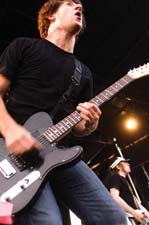
After the Cincinnati show, Trohman, dank with sweat, wanders off to take his first shower in three days (there’re no showers on the bus, so bathing requires a special trip to each venue’s administrative offices, and often the band members don’t bother: “You get used to not showering,” Wentz says). He first stops to sign an autograph for Leigha, who threw up halfway through her first rock concert and is resting dejectedly on a patch of lawn behind the stage.
The rest of the band exit to their tour bus and its cranked-up cooling system. Wentz pours himself a bowl of frosted cereal, a staple of the Fall Out Boy diet, and deals with a lack of spoons by using an unopened Slim Jim package to scoop up his food. “You are surviving in the wild. That’s awesome,” Stump tells him.
Life in a rock band often features long periods of tedium between bursts of adrenaline-charged action, and this afternoon is no exception. The band sits around watching MTV. “I hate MTV,” Hurley complains to Stump. “I like Discovery and the History Channel.” No one changes the station.
Stump’s girlfriend has been visiting with the band for a few days, and the pair retreat to the tiny lounge in the back of the bus. Hurley takes a walk. As José Canseco and Bronson Pinchot compete with a team of developmentally disabled bowlers on The Surreal Life, Wentz lies on the couch punching the keys of his cell phone.
The members of Fall Out Boy spend an inordinate amount of time on the bus text messaging people. It’s another way to communicate with fans-Fall Out Boy could become the definitive band of Generation Text.
“Maintaining relationships is impossible,” laments Wentz, who’s been vexed by the uncertain status of his relationship with a female friend in Chicago. “No, starting them is impossible. Maintaining them is hard. Bands are the ultimate relationship killer.”
More and more, the band has become all-consuming. The day of the Warped Tour’s Chicago show, their first chance to see hometown friends and family in weeks, begins with an autograph session, followed by a two-hour interview for a magazine (not this one), photo shoots for two other magazines (including this one), two radio station interviews, and a promotional appearance at one of the festival vendor booths.
|
Photo: Paul Natkin |
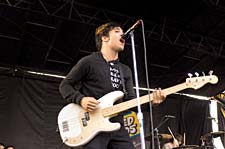
Except for Joe Trohman, who has a Chicago apartment, the members of Fall Out Boy still live with their parents during the few days out of the year when they’re not on tour (the band played more than 200 shows last year and is on pace to do about the same in 2005). Their families are feeling the effects of the band’s success. As the Trohmans and Wentzes hang out on the bus before the show, the conversations revolve around long-lost relatives suddenly calling up looking for concert tickets, co-workers wanting autographed CDs-“What am I, the free merch supplier?” Dr. Trohman asks-and fan mail piling up in the Wentz household and phone calls at 2 a.m. “Our stock answer is, Peter doesn’t take calls at this number,” Dale Wentz says.
Richard Trohman’s spectacles, gray hair, and bushy mustache give him the look of an archetypal kindly doctor, and he has the touchy-feely demeanor to match. He stops Wentz, who has been bounding in and out of the vehicle, to ask how he’s doing-“Lots of drama,” Wentz reports-and gives him a reassuring hug. He and his wife, Catherine, also both hug their son backstage just before he goes off to perform, looking like parents about to leave their kid at college for the first time.