

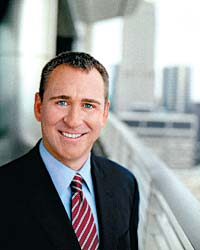
 level of urgency," Griffin says of his ambition to turn Citadel into a global investment powerhouse. Photo: Paul Elledge
If you haven't yet heard about the local financial whiz Kenneth C. Griffin or his company, chances are you're not alone. Although Griffin and his Citadel Investment Group L.L.C., a hedge fund, are known within the rarefied universe of big money, they have remained mostly a mystery to the outside world.
That is beginning to change. Started by Griffin in 1990, Citadel now commands nearly $12 billion in assets, making it one of the world's largest hedge funds. Inside the company's headquarters at 131 South Dearborn Street, about 1,000 people labor long and hard to find unusual investments that yield large returns for clients and fat fees for Citadel. Aside from making gobs of cash, Griffin's goal is to turn Citadel into something increasingly rare in Chicago-an elite global financial powerhouse.
Yet Griffin's high aspirations contrast with his decidedly low professional profile-so low, in fact, he has gained a reputation as something of a recluse, even within Chicago's tight-knit corporate community, where everyone seems to know everyone else.
Griffin's penchant for secrecy is also ingrained in Citadel's culture-it's not a place where employees are encouraged to kibitz, move freely from floor to floor, or informally share information with one another. "They are on the cutting edge of proprietary trading and money management and are very careful to protect their secrets and keep their edge," says Joseph Nicholas, chief executive officer of HFR Asset Management, a rival Chicago hedge fund. For his part, Griffin, 37, makes no apologies for his firm's tightlipped ways, noting that the hedge fund business is highly competitive and that Citadel does not tip its hand to anyone. The more valuable a company's business methods are, the less it is "in favor of transparency," Griffin says.
Personally, however, Griffin, who made $240 million last year, according to Forbes, is inching into the spotlight as he and his wife, Anne Dias Griffin-who also runs a hedge fund-are becoming one of the area's rising power couples. Increasingly, they are taking the lead on charitable and philanthropic endeavors by dedicating their time and making large personal donations, mainly in support of high culture and education. The couple underwrote a Chicago Symphony Orchestra performance at Millennium Park scheduled for September 25th, and they're aggressively backing the University of Chicago's Center for Urban School Improvement, a program that seeks to develop an inner-city charter high school.
The Griffins are also serious art collectors. Kenneth Griffin's most attention-generating acquisition-said to be for $60.5 million-is his purchase of Paul Cézanne's Curtain, Jug and Fruit Bowl, which is on loan to the Art Institute of Chicago. (Griffin bought the painting in 1999 but declines to comment on the price. If accurate, the reported amount would be the highest ever paid for a Cézanne.)
"Over the years, I'm going to give a substantial amount of my net worth away," promises Griffin, who was ranked 363rd in Forbes's 2004 list of the 400 richest Americans, with wealth estimated at $825 million. But he is quick to point out that to support such largess his company must thrive and grow into a world-class investment vehicle.
Simply put, a hedge fund like Citadel is like a mutual fund, albeit for the very wealthy, usually only institutions and individuals who can ante up more than $1 million. Hedge fund operators tend to take on greater risk and seek higher rewards than the typical asset manager. They "hedge" their bets by quickly moving in and out of investment products-everything from stocks and bonds to currencies and crude oil-at best tallying up impressive returns along the way.
The growth in hedge funds has been spectacular: there are about 7,500 funds controlling nearly $1 trillion now, compared with 1,945 of them in 1994 holding $186 billion in assets, according to industry data. Hedge fund investors include the rich, college endowment funds, large institutional investors, and even other hedge funds.
Raised in Boca Raton, Griffin began successfully dabbling in trading bonds from his dorm room in the late 1980s while attending Harvard University (with an investment grubstake of $265,000 from his family and friends). Upon graduation, Griffin, the son of a building supplies executive, moved to Chicago to work for an investment house. But he was there only briefly before he started Citadel in November 1990 with $4.6 million from investors.
Since Citadel's inception, its annual investor return is 26 percent, after Citadel takes out its management fees, according to Bloomberg Markets magazine. Thus, a $100,000 investment made when the firm started would be worth $2.6 million now. (Citadel will not comment on its performance.) Last year, Bloomberg says, Citadel's rate of return was 11.6 percent after fees, considered a good performance for a fund as large as Citadel. The magazine says that Citadel takes 20 percent of the profits; Citadel contends its fee structure is in line with that of other hedge fund operators.
To say the privately owned Citadel plays it close to the vest is an understatement. Its Web site is spare and uninviting, sharing few specifics about the company; corporate signage on the outside of its 37-story office tower is modest at best. The same reserve permeates Citadel's corporate offices, whose walls are white and bare, reflecting none of Griffin's passion for vibrant Impressionist hues. Employees pass pleasantries in the halls and elevators, but tend to steer clear of asking mundane, shop-related questions like "What are you working on now?" Within the Citadel culture, such conversations are supposed to occur on the basis of what the CIA might call "a need to know."
Workdays lasting 12 to 14 hours-even for temporary employees-are the norm. The upper floors of the building, where Citadel's traders work, enjoy a panoramic view of Lake Michigan and the Loop. But with millions of dollars at risk at any given time, there's no window gazing. Traders sit at workstations intently eyeing data flashing on banks of small computer screens before them. They are expected to execute financial transactions in split seconds or risk losing their price advantage.
And when some Citadel workers talk about the weather, chances are it's more than mere conversation. The hedge fund employs a small team of meteorologists who work out of a computerized weather center-a space where even WGN-TV's meteorologist Tom Skilling would feel at home. That's unusual for a hedge fund, but it allows Citadel's traders to stay abreast of global weather patterns, which can affect the prices of commodities contracts.
Citadel's investment professionals are continually on the hunt for breakthrough ideas and computer applications from which the hedge fund can profit. Scattered throughout the offices are large white erasable boards, used by staffers to write computer code, map out business models, or just hash out problems. Citadel employs at least 70 Ph.D.'s in mathematics, physics, and other scientific or technical disciplines; they devise the mathematical formulas that drive the company's trading strategies.
It's a pretty good bet most people would not know what any of Citadel's white-board equations and jottings meant. But that doesn't stop a public-relations person from telling this reporter that anything seen on a white board during a tour of the headquarters is strictly off the record.
Despite all this cloak-and-dagger, Griffin is quick to respond to questions. Over the course of two interviews (one in person, the other by phone), his only "no comment" surfaces when he is asked to verify that he pulled down a $240-million salary last year and to comment on whether it is too much, considering the current shareholder and political backlash aimed at excessive pay packages for CEOs of publicly traded companies.
But Griffin doesn't back off from characterizations of Citadel's intense work environment. Nor does he shy away from the "What have you done for me lately?" management ethos that keeps Citadel's top executives and staff from becoming complacent. On the contrary: Griffin says his employees are competing with the East Coast's roughest and toughest rivals, and he doesn't want Chicago's less hectic pace and lifestyle to dull their competitive drive. "We're not going to get there by counting past accomplishments," Griffin says. "There's a level of urgency."
To move ahead, Griffin is focusing on some parallel missions. First, he's dead serious that in the years ahead, Citadel must break out of the hedge fund crowd to become an international "merchant bank," which can quickly pump capital into an assortment of investments, including stocks, commodities, companies, developing countries, and anything else that promises hefty returns. It will look for opportunities in areas that may frighten other investors and funds, Griffin says, noting that Citadel leaped into the churning energy commodities market right after the Enron debacle (hiring a number of former Enron traders) and is doing all right.
Another example of going places other investors avoid: he's looking for investment opportunities in Russia, despite concerns about widespread political and corporate corruption. Directing his remarks to Russia's prime minister, Mikhail Fradkov, at an investment conference in June, Griffin said: "The economic and political course pursued by the Russian authorities opens up fantastic possibilities for investing capital."
To take full advantage, Citadel-which also has offices in New York, San Francisco, London, and Tokyo-will need to get much larger, and that means attracting a deeper and wider pool of capital. Some financial industry observers say Griffin is looking to pump up his hedge fund into a $100-billion enterprise-a number he dismisses as "hyperbole." There is no target amount be-cause it's not about "how much money is raised, but what's earned," Griffin says. (Another way of attracting money is by turning Citadel into a publicly traded company, but that's a remote possibility, Griffin asserts.)
Still, no matter Citadel's ultimate size, it intends to add to its Chicago presence. It will be bolstering the ranks of its 1,000-person staff, bulking up on well-paid traders, technicians, computer code writers, and whatever support staff is necessary to make the place hum. "It's not just 1,000 jobs created in the last 15 years-it's unlimited careers," he says.
In continuing to grow, Citadel will expand the need for legal, accounting, and other corporate services the Chicago market can muster. Not a bad deal for the area, especially considering that Citadel perhaps already has made a greater impact on the community than, say, Boeing Co., which in 2001 was wooed by the city and state with an estimated $50-million grab bag of subsidies over nearly 20 years to move 400 headquarters jobs here from Seattle.
In addition, Griffin's expansion would help keep Chicago competitive within consolidating global financial markets. Already, stock exchanges are marrying, and many experts predict more consolidation, including mergers that could involve those stalwarts of the local futures scene: the Chicago Board of Trade, the Chicago Board Options Exchange, the Chicago Mercantile Exchange, and the regional Chicago Stock Exchange.
Citadel's big plans sound pretty good, provided they work. That's not a certainty, especially in the risk-heavy world of hedge funds, which some critics claim are secretive and virtually unregulated entities. Besides drowning its investors, a sinking hedge fund, if allowed to go unchecked, could seriously damage financial markets and the economy. It nearly happened in 1998 with the collapse of Long-Term Capital Management, a hedge fund that was thrown a life preserver in the form of a U.S. government–led bailout. A couple more of those and the consequences would be dire, say market experts and economists.
Recently, Standard & Poor's, the financial ratings agency, set off a warning flare. In a new report on hedge funds, it said big losses could hurt institutional investors (such as pension and college endowment funds), forcing banks and other lenders to pull back credit and slow the economy to a crawl.
"Hedge funds are still the Wild West of the financial services industry," says Andrew Stoltmann, a Chicago-based securities attorney who specializes in shareholders' rights issues. "It's just a matter of time before something blows up."
Griffin disagrees. He sees dealing with volatility as part of a hedge fund manager's calling, and he contends that there are ample regulatory safeguards now to blunt excesses. Griffin points out that any hedge fund's dealings with a bank or financial institution, or any investment in nearly any kind of company or any country, is evaluated by some regulatory entity, domestic or international. "To call [the hedge fund business] unregulated is fanciful," he says. To keep regulators at bay, Citadel is supporting the effort by the national hedge fund trade group to beat back any new regulations. So far, the effort has been a success.
While reticent about his business affairs, Griffin is becoming more open about his and his wife's growing involvement in the city's cultural, civic, and social scenes. Once he gets going, Griffin becomes a charged civic booster, talking about the beauty and cultural allure of Chicago. He notes that while he was courting his wife, who lived in New York, they frequented the Art Institute and the Chicago Symphony (the two were married in 2003 and had a garden reception at Versailles). "Not saying I had to recruit her to Chicago," he says. "But [the cultural amenities] didn't hurt."
Both have developed reputations as art lovers. On top of the purchase of the Cézanne ("a magnificent work," Griffin exclaims), he has also acquired an Edgar Degas sculpture, Little Dancer, Aged Fourteen, Original in Wax. Both works are on display at the Art Institute, though the Griffin name is not. Each piece is listed as being on "anonymous loan." And Griffin plans to keep collecting. "In the years to come, there will be other works of interest to my wife and me," he says.
In recent years, Kenneth Griffin has joined the boards of the Art Institute and the Museum of Contemporary Art. Spokes-persons for those institutions declined to talk about Griffin, citing policies of confidentiality for board members. Some fellow board members-who asked that their names not be used-said Griffin was still a relative unknown but was gaining respect as an astute and serious collector, not just another deep pocket to tap.
When not buying or discussing art, Griffin is plowing money and time into improving public education. He is a board member of the Chicago Public Education Fund, a venture capital fund that backs educational initiatives. (A spokesman for that group also declined to discuss Griffin.) Meanwhile, Anne Griffin is a recent addition to the board of Children's Memorial Hospital. (Mrs. Griffin did not return calls seeking an interview.)
It is uncertain just how much money the Griffins are pledging to give these days. The latest Illinois Charitable Organization Annual Report lists disbursements in 2003 by the Citadel Group Foundation-the hedge fund's charitable entity-totaling just $107,555 to a handful of child-oriented charities. But last year that foundation reportedly invested $1 million as part of a $15-million effort by the Chicago Public Education Fund to improve the quality of principals in the school system. Looking at a copy of the Citadel Group Foundation's 2003 state report, Griffin notes that it is just one philanthropic vehicle and is not the Griffins' "primary means of giving."
Socially, the couple are making a splash as well. A high-ranking fellow member of the local business community says the Griffins are attending more parties and events than ever before, a claim that prompts Kenneth Griffin to drop his guard just a little to note: "My wife and I always say that time spent with our friends comes first."