|
Wheaton
From the vast Danada forest preserve on its south edge to the 130-acre Lincoln Marsh Natural Area on the north, Wheaton, the healthiest of Chicago's largest suburbs, has lots of open space. That makes pursuing health easy, says Wally Kubon, a retired state employee who moved to town 11 years ago. "You see a lot of seniors out walking on the Prairie Path and other places," Kubon says.
|
TOP 10
Towns for Women's Health*
Oakbrook Terrace
Oak Brook
Olympia Fields
Park Ridge
Barrington
Palos Heights
Maywood
Flossmoor
Bloomingdale
Lake Forest
*Based on the number of physicians per capita practicing obstetrics, gynecology, and related fields.
Source: Medical Marketing Service
|
The path is one of an impressive array of recreational outlets maintained by the Wheaton Park District, which has been recognized with three gold medals from the National Recreation and Park Association for the quality of its facilities. Fostering good health is "a vital role for us," says Ray Morrill, the director of recreation and special facilities for the park district. "We have the ability to reach everyone at every age."
Like most Chicago suburbs its size, Wheaton has a thriving downtown business district and assorted shopping centers throughout town. But it also has a very low rate of property crime, something that is typically higher in a town with an active retail base. "That's our church-on-every-corner history," says Elizabeth Dee, who has lived in Wheaton for all of her 37 years. "There is still that neighborhood feeling all over town."
Joliet
With casinos, a racetrack (the Chicagoland Speedway), and a growing population, Joliet has a lot to handle. But other, less visible challenges lurk here, too, particularly from the enormous concentration of heavy industry in the area. Joliet owns the dubious distinction of having the highest poundage of toxic releases of any town in the Greater Chicago area, as well as high crime rates and significant occurrences of cancer and low birth weight-which explains why the city had the lowest health score among Chicago suburbs with 50,000 residents or more.
Although officials in this growing Will County city can't entirely eliminate these problems, they are working with a consortium of industry representatives to find solutions. "The two oil refineries in Will County-one not far from Joliet-spent millions of dollars to come into compliance with low-sulfur gasoline production rules in 2003, and they will do that again to meet the low-sulfur diesel rules in 2007," says Jerry Caamano, executive director of the Joliet-based Three Rivers Manufacturers' Association. Joliet-area industries, he says, "have made significant capital investments to meet new ozone rules," which will go into effect by 2010 with the goal of lowering overall emissions.
To address the area's high crime rates, Dave Gerdes, the town's police chief, sends about 200 of his 285 police officers home with squad cars at night, which "puts a visual presence in every neighborhood." And he notes that, over the past several years, Joliet's city council has come up with the money to hire additional police officers. According to Gerdes, the department now has 2.17 officers per thousand citizens, and in 2004, he says, crime figures were down by half compared with rates a decade earlier.
The local public health care system will get a boost this fall when the Will County Health Department unveils a 15,000-square-foot addition to an already sizable primary care facility on Joliet's southeast side. And this year the county facility will offer low-cost prenatal care to mothers of about 1,100 Joliet newborns.
Finally, city hall is pursuing a $42-million program that, by 2007, would purge the water supply of radium, a naturally occurring radioactive element that poses some threat to health. That would be good news to area residents, whose water system racked up 29 violations on the chart, second only to Ford Heights, with 38.
View the complete ratings for towns with 50,000 plus population
|
Best and Worst – 25,000-49,999 Population
|
|
|
Photo: Andreas Larsson
|
|
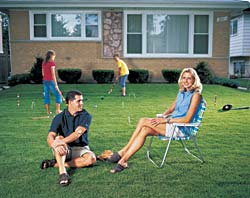
"There's a huge emphasis on health and fitness here," say Robbie and Kim deMarigny of Park Ridge, pictured here with their daughter Rachel, 10, and son Caleb, 8.
|
Park Ridge
It's a sweltering day, so the deMarigny family have the baseball diamond at Park Ridge's Hinkley Park to themselves. "This is such a good town, with a park about every five blocks, and they're sticklers for their trees," says the dad, Robbie, a local pastor, while his wife, Kim, hits balls to their two kids, Rachel and Caleb. "There's a huge emphasis on health and fitness here."
One of the major champions of health in Park Ridge is Advocate Lutheran General Hospital, which staffs and supplies an in-school health clinic at Maine East High School-with financial assistance from a local community fund established by Park Ridge residents. The 2,200-student Maine East draws from the wealthy epicenter of the town, but also from the surrounding unincorporated Maine Township, where affordable housing lures new immigrants. As a result, 67 percent of students at Maine East come from homes where English is not the primary language and where many consider health insurance a luxury.
Situated on the ground floor of the high school, the bright and clean clinic features three exam rooms, a lab, a conference room, and a reception area. "These kids really need this kind of help," says Tom Higgins, director of community relations at Lutheran General. "If you're sick, you're not going to learn."
Working with the Park Ridge Rotary Club, Lutheran General is also launching a groundbreaking health literacy campaign, one that should help ensure that crucial health dispatches-like instructions
for prescription drugs and hospital discharges-are communicated in sufficient detail to marginally literate and illiterate patients. With the program under way at Advocate hospitals, the Rotary Club is taking the campaign to other interested hospitals in the Chicago region.
Harvey
Cancer took the lives of two of Eraina Dunn's co-workers, and her mother has battled the disease as well. And gang violence was the likely cause behind the death of her 15-year-old son. Dunn believes the scourge of disease and violence is the consequence of Harvey's three decades of industrial decline.
"People around here once had viable, good-paying jobs, but they have had to take less and lower their expectations of life," she says in her paper-stuffed office at the Human Action Community Organization. "Industry moving out of Harvey left us desperate for jobs and revenue, so we've been willing to take whatever we can get. We've had to trade health for jobs."
|
11,499
Acres of public open space in Chicago
Source: City of Chicago
|
When a major employer-a company that reprocesses metal-bearing hazardous waste to neutralize it for transport-was up for permit renewal last year, "nobody showed up at the hearings to say, ‘Get out,'" Dunn says. "People wanted to show we appreciate their business, even though we don't know how our health is being affected."
A high incidence of cancer-1,055 cases in five years-is particularly troublesome in this town with a large African American population. Here, and throughout the United States, black women die at a higher rate from breast cancer than women of other races, and black men have the highest likelihood of getting prostate cancer, says Dr. Mark Kozloff, medical director of the cancer care program at Ingalls Memorial Hospital in Harvey. In the late 1990s, Ingalls Memorial launched a series of outreach and screening programs designed to reduce the rates of death by cancer in Harvey and other southern suburbs. This year, it is expanding the program's scope beyond breast and prostate cancer to reduced-price screenings for colorectal cancer.
View the complete ratings for towns with 25,000 – 49,999 population
|
Best and Worst – 15,000-24,999 Population
|
|
Hinsdale
"You know, taxes are really high here," says Carol Fitzgerald, a 20-year resident who routinely walks the nine blocks between her house and Hinsdale's stylish downtown. "You figure for the taxes you pay, you should get the best there is to offer."
|
14.9%
(and climbing)
The percentage of uninsured persons under age 65 in the Chicago metropolitan region
Source: Gilead Outreach & Referral Center
|
Residents do get what they pay for in this lovely, historic community-the healthiest (but not the wealthiest) of our mid-sized suburbs. Hinsdale has little local industry, but lots of safe streets, tall trees, public parks, and doctors-19 for every 1,000 residents. Concerned about the effects of cancer on their community, a group of Hinsdale residents joined forces in 1990 to start Wellness House, a free cancer support and education center. The nonprofit serves western Cook and all of DuPage County; however, the donor list reads like a who's who of Hinsdale. Local banks, community foundations, and businesses contribute, as does the Hinsdale Junior Woman's Club, whose 230 members have donated $190,000 (through 2006) and pledged volunteer help. The grant funds, in part, a support group for kids whose families are battling cancer.
"These children are coping with a lot," says one staffer, "as are all families facing the disease." That is one reason why a big part of the center's mission is dealing with cancer's "ripple effect": 40 percent of people who use Wellness House services have a friend or relative fighting cancer, though they themselves do not have it.
Bellwood
Miscreants, take note. If you cross into Bellwood, you may unwittingly step into a law enforcement version of the TV show Candid Camera. Earlier this year, officials in the town-which, with its high rate of violent and property crime, earned the lowest score among mid-sized suburbs-began installing surveillance cameras in the community. While only a few cameras are in place, the plan is to make every public street visible to remote monitors by 2007.
|
TOP 10
Towns with Conservation Acreage*
Hoffman Estates
Lyons
Countryside
River Forest
River Grove
Bartlett
Lake Villa
Island Lake
Schiller Park
La Grange Park
|
*Based on the percentage of town acreage dedicated to conservation.
Source: Northeastern Illinois Planning Commission
|
"When you put the camera in one place, you just move crime to another part of town," says Wilson Pierce, who, until this past August, was the village's police chief and safety director. "Our system will be throughout the village, so hopefully people get the message that if you want to commit crimes in Bellwood, we will see you and we will catch you."
According to Pierce, half the town's crimes are committed by nonresidents who travel along the Eisenhower Expressway and other nearby high-traffic corridors. Placing cameras along entry roads like Mannheim and Washington is tantamount to laying out big "UNwelcome" mats.
Mayor Frank Pasquale and others are eyeing additional initiatives. Later this year the town will open three community service centers to handle domestic violence and other crimes, and it is buying up buildings to house government employees, re-establishing paramedic service after a 30-year absence, and pushing to extend the CTA's Blue Line through Bellwood to Mannheim Road. "We're a town in transition," says Bell-wood's comptroller, Roy F. McCampbell.
View the complete ratings for towns with 15,000 – 24,999 population
|
Best and Worst – 10,000-14,999 Population
|
|
Winnetka
"People think that in Winnetka I'm treating all socialites," says Bob Fulanovich, a chiropractor who moved his practice from Evanston to Winnetka several years ago. "But my female patients here are basically jocks. They're running and biking-and they translate that out to their kids. I treat more people who are overactive than who are underactive."
|
TOP 10
Towns for Mental Health Services*
Oakbrook Terrace
Northfield
Oak Brook
Riverside
Bannockburn
Palos Heights
Hinsdale
Highland Park
Barrington
Northbrook
*Based on the number of psychiatrists per capita.
Source: Medical Marketing Service
|
In Winnetka, the healthiest of our second-smallest towns, people work out in their home gyms, polish their game at the spectacular A. C. Nielsen Tennis Center (a park district facility), and do sprints and stretches on Maple Street Beach with Pam Phillips, a local trainer. "Most of the adults in Winnetka are serious about integrating exercise into their lifestyle," says Phillips, who has been coaching them for 26 years, most recently out of Winnetka's Community House, a gathering place for art classes, club meetings, and other public events. "They are serious about fitness as the balance against stress."
Children in Winnetka have the expected array of soccer, swimming, and baseball teams, but they also have access to programs like Adventures in Learning, which, on a recent summer day, had David Flahive, a junior high science teacher at Carleton W. Washburne School, coaching six kids in tennis at the Nielsen. "The parents support health," Flahive said, "and they don't need it to be competitive. They want their kids to find their own lifelong sport-and they want us to make it fun."
Markham
Four of every ten adults in Markham die before the age of 65, the worst rate of premature death among local towns of similar size-and one of the worst in the entire six-county region. State representative William Davis, whose 30th District includes Markham and other south suburbs, is sure he knows why: "No jobs means no benefits means no access to good health care."
Unemployment is endemic in Markham and some surrounding towns, Davis explains. "Many people have to rely on emergency rooms for their primary care," he says. "They can't go to a primary care physician to treat problems and get the medications that might help, so they end up charity cases at the hospitals when it gets bad." Davis also notes that the Cook County and Illinois health departments are overseeing an aggressive effort to combat the rampant juvenile asthma that erodes the quality of life here and elsewhere.
A protégé of U.S. representative Jesse Jackson Jr., Davis believes the best way to improve the health of his constituents is to bring in a massive job generator, one that, in turn, means health benefits for his constituents. Like Jackson, he thinks the proposed Peotone airport may offer a solution. Supporters say it would create more than 200,000 jobs in the southern suburbs.
View the complete ratings for towns with 10,000 – 14,999 population
|
Best and Worst – Under 10,000 Population
|
|
|
Photo: Andreas Larsson
|
|
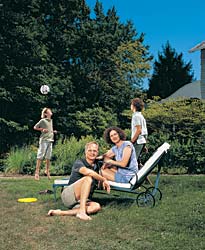
Glencoe residents Susan and Steven Varick, with their children Daniel, 11, left, and Benjamin, 14.
|
Glencoe
Glencoe kids who bike, blade, or skateboard know they are likely to be pulled over by a police officer-and that's just fine by them. In this North Shore town, the healthiest of Chicago's smallest suburbs, officers can issue a gift certificate for a free soda to any child on wheels who is spotted wearing all the requisite safety equipment.
"We have a close, two-way relationship with the people in town," says Mikel Milks, Glencoe's director of public safety, whose department oversees Glencoe's police, fire, and EMT personnel. It also supports an e-mail alert network for residents. When one Glencoe neighborhood experienced a rash of burglaries recently, the town's safety department sent out e-mails to notify the public. "It extended our reach because it gave us many more eyes in that neighborhood than the one patrol car that passes through every eight hours," Milks says.
In March 2003, Glencoe topped Chicago's ratings of the best places to live among the area's most expensive suburbs, and now it tallies the score for the healthiest among the region's smallest suburbs. But the town's desirability is taking a toll on its old housing stock. Teardowns have been rampant for a decade, and the big new homes that fill out the once-spacious lots are uprooting the community's sizable old trees. "I wish our regulations for saving trees were a lot stronger," says Susan Varick, a 21-year resident of the town. "This town is not going to look the same or feel the same when you keep putting in these big houses with backyards the size of my rug."
Broadview
In the mornings, Robert Autrey notices the smell first. "There's a real foul smell, a toxic smell like factories," says the 18-year resident of Broadview, the town that rates as least healthy among our smallest suburbs. "You get a lot of headaches and sinus things on the days it smells worst. When I go out of town I don't have any problem; then I come home and I'm coughing stuff up."
|
42.4%
The percentage of Chicago adults who exercise regularly
Source: Centers for Disease Control Behavioral Risk Factor Surveillance System
|
Broadview is an industrial town, with its major factories strung along 25th Street for more than a mile. For 25 years, Broadview's village president, Henry Vicenik, and other officials have been struggling to reduce the impact of this heavy industry on the town. "We're going from heavy industry to something much lighter," Vicenik says, citing as a prime example the industrial plant right next door to the municipal building. Until the late 1980s, the structure housed a high-polluting aluminum door and window maker; now it is the headquarters of a food products company that makes barbecue and other sauces. Elsewhere in town, a onetime International Harvester plant is now a friendlier big-box retail center.
"Back in the 1950s, when Broadview was building up, the attitude was, ‘Oh, just dump those chemicals in the stream out back,'" says Vicenik, an engineer by training. "Now we know we were misusing Mother Earth, and it's time to change that." Vicenik has gathered up state grants and other public money to remediate brownfields-former homes of dry cleaners, gas stations, and other ground polluters-so that they can be used again. He says that at least $250,000 has been spent so far, and he has an application in with the U.S. EPA for another $500,000 grant.
Local industry keeps residential property taxes at about three-fifths what they would be otherwise-but the town is left balancing the need to enhance air and water quality with that of protecting vital jobs and a tax base. "It's what you do," Vicenik says. "You take an aggressive attitude."
That sounds good to Autrey, though he wonders if change will happen in his lifetime. "I'm 59," he says. "The generations coming up will benefit more."
View the complete ratings for towns with 10,000 and under population
|
|
|
|
|