

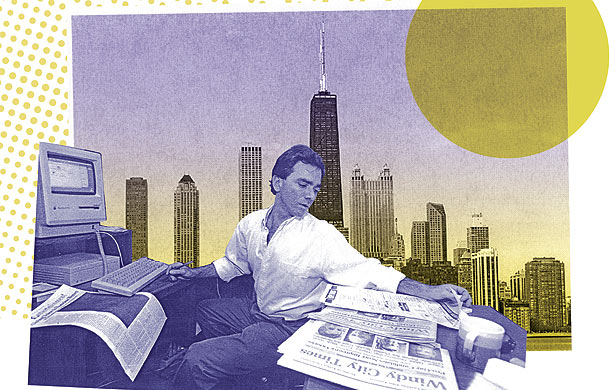
Last May, as they prepared to sprinkle Jeff McCourt’s ashes around the tombstones of his mother and grandmother in an upstate New York cemetery, his siblings—brothers Paul and Dan and sister Dianne—spontaneously broke into what they remembered as one of Jeff’s favorite songs from childhood. The song was Downtown, the old Petula Clark single from the 1960s that begins with the lines “When you’re alone and life is making you lonely / You can always go downtown.”
“The ‘lonely’ part just seemed kind of appropriate,” says Dan, who, at 41, was McCourt’s youngest sibling and, by most accounts, his favorite. Indeed, “lonely” is a word that crops up frequently when people discuss Jeff McCourt. He is also often called brilliant, erratic, infuriating, and visionary.
McCourt was the founder and publisher of Windy City Times, one of the most successful and influential gay newspapers in the country. Starting in the fall of 1985, the paper began a 15-year run during which it was instrumental in transforming the way that business and political leaders in Chicago regarded the gay community. With McCourt at the helm, the paper also be-came a major force in the battle for gay civil rights. Those efforts culminated in the 1988 passage of Chicago’s Human Rights Ordinance, which outlawed discrimination based on, among other factors, sex, gender identity, and sexual orientation.
Over the years, Windy City—which continues under different ownership and management—has won numerous journalism awards for the excellence of its coverage of everything from local elections to national issues such as the cancellation of a Robert Mapplethorpe photography show at the Corcoran Gallery of Art in Washington, D.C., in 1989 and the outcry in 1998 over the gay-bashing murder of the Wyoming college student Matthew Shepard.
But by the time McCourt died this spring from complications of HIV at age 51, after spending his last years in a dreary downtown nursing home, he had been largely forgotten by a community that had moved on to other issues and that, in any case, had always regarded him with a certain degree of ambivalence.
He was just too, well, out there, with his theatrical voice and mannerisms, the epic tantrums and wild mood swings, the emotional neediness, the drugs, the porn-star boyfriends. Last year, in an inexplicable twist, he was denied membership in the Chicago Gay and Lesbian Hall of Fame.
* * *
Photoillustration: Wes Duvall
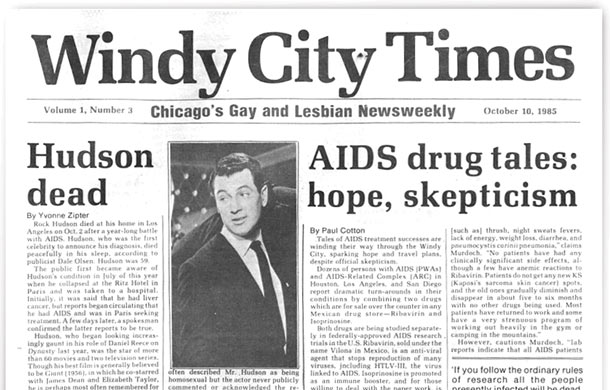
An October 1985 issue reported on the actor Rock Hudson, who admitted shortly before he died that he had AIDS.
“I wonder if Jeff was one of the last of the spectacularly self-destructive gay men,” says Mark Schoofs, the paper’s editor in the late 1980s who went on to work for The Village Voice in New York, where he won a Pulitzer Prize for his coverage of the AIDS epidemic in Africa. Now living in Los Angeles, Schoofs is a staff reporter for The Wall Street Journal.“He was definitely a gay publishing visionary,” Schoofs says. “The gay community was coming into its own in those years, and Jeff was one of the people who recognized that gays were part of mainstream America. He understood that gays were like Jews and blacks and Puerto Ricans and Irish people—another tile in the mosaic of America. He was incredibly flawed to the extent that he himself could not be part of that mainstream. But he was one of the people who made it happen.”
So much has changed in the intervening 20 years that it is difficult to reconstruct what the gay world was like in the 1980s. Back then, the issues that most people associate with gay rights today—marriage and adoption, joint partner benefits, and joining the military—were barely conceivable, let alone debatable. Despite the birth of the gay-liberation movement in the 1960s and 1970s, the gay community was still very much underground and went largely unnoticed by the larger culture. The few existing gay publications tended to be either sex sheets or what were commonly known as bar rags—basically going-out guides that might occasionally squeeze in a story or two on the latest police raid or gay-bashing incident.
McCourt got his start freelancing for one such publication, GayLife, a weekly tabloid owned by the gay businessman Chuck Renslow and edited by Albert Williams. Later Williams was briefly the editor of Windy City Times before moving on to the job he has held for most of the past 20 years: theatre critic of the Chicago Reader.“Chuck thought of GayLife as a charitable thing he was doing for the community,” says Williams. “He didn’t believe a gay paper could ever make money.”
Politically, the gay community was missing in action. In Tony Kushner’s Pulitzer Prize–winning play Angels in America—which McCourt loved and later produced in Chicago—the Roy Cohn character delivers a speech that perfectly sums up the position of the gay community in those years.
Homosexuals, Cohn says, are people who “in fifteen years of trying cannot get a pissant antidiscrimination bill through City Council. Homosexuals are men who know nobody and who nobody knows. Who have zero clout.” Cohn is speaking about New York, but the same conditions applied in Chicago, where, in fact, a gay-rights bill had been languishing in the city council for more than a decade.
“We weren’t taken seriously,” says Rick Garcia, an early gay activist who is currently the head of Equality Illinois, a civil-rights group. “The attitude among activists was to not rock the boat.”
* * *
Photograph: Courtesy of Windy City Times
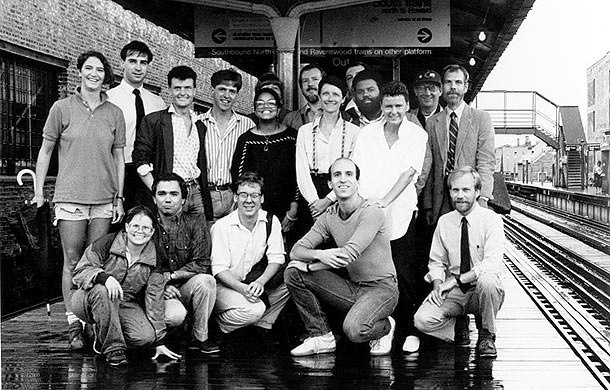
A 1986 Windy City Times staff photo, above: (front row, from left) Tracy Baim, Jeff McCourt, Larry Shell, Benjamin Dreyer, William Burks, (back row) M. J. Murphy, Chris Stryker, Hugh Johnson, Steve Alter, Shani, Jorjet Harper, Lawrence Bommer, Yvonne Zipter, Albert Williams, Chris Cothran, Jill Burgin, Jon-Henri Damski, and Mel Wilson.
Enter McCourt, who arrived on the scene in late 1982 when he attended a GayLife holiday party. At that time, McCourt—who had moved to Chicago from his native New York in the mid-1970s to attend Loyola University—was a trader on the Chicago Board Options Exchange. “He was precocious in regard to how successful he was by that age,” says Williams.
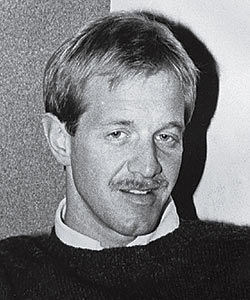 Robert Bearden, McCourt’s only long-term romantic partner, died in 1987. |
The party changed his life in two important ways. The first is that he met Robert Bearden, GayLife’s handsome blond ad-sales manager, who became the only long-term romantic partner he would ever have. The second is that he asked Williams if he could start contributing theatre reviews to GayLife. “He said he went to the theatre and knew a lot, and it turned out he did know a lot,” says Williams. “He came from New York and had seen a lot of Broadway shows.”
Pseudonyms were common in gay publications in those days, and McCourt was no exception. The name he chose was Mimi O’Shea, a combination of Mimi Sheraton and Tessie O’Shea, figures that today are fairly obscure. Sheraton was the acerbic restaurant critic of The New York Times in the 1980s, while O’Shea was a raucous British comedienne and character actress from the period of McCourt’s childhood, the kind of performer who often turned up on The Ed Sullivan Show to balance out the classical music acts. The two together implied a mix of high and low—Dorothy Parker–style bitchery combined with low-comedy camping that was highly characteristic of McCourt’s excitable personality.
By most accounts, McCourt was a so-so writer. He made up for his occasional grammatical difficulties, however, with the strength of his no-uncertain-terms opinions. His review of an evidently less than stellar dinner-theatre production of Evita is vintage McCourt. The show, he wrote, was “the most overrated musical of the past decade, a pompous piece of propaganda for People magazine readers of the ’80s, a vulgar, pointless show that plays like a disjointed series of Reuters news flashes, with a witless score by Andrew Lloyd Webber and Tim Rice and a thematic point of view that runs the gamut (as Dorothy Parker once said) from A to B.”
Theatre remained a touchstone for McCourt—he would go on to produce several shows in the early 1990s and also try his hand at writing plays—but gradually his interest started shifting to the business side of the equation. “Jeff was getting very turned on by the community and by politics,” says Williams. “He wanted to do more with his life. He started saying, ‘I know Chuck thinks the paper can never make money, but I think he’s wrong. I think this kind of a paper could make money if it was marketed right.’”
McCourt was also looking for a way to incorporate Bearden—whom he began living with shortly after they met—into his professional life. The laid-back Bearden, who was six years older than McCourt, acted as something of a foil for his by all accounts hyperactive partner. “Bob could keep Jeff in line,” says Williams. “Jeff would go over the top, and Bob would snap him back to reality.”
“They fought a lot,” says Tracy Baim, one of the founding editors of Windy City. “They had a very contentious relationship that was really hard to define. It was like watching a movie sometimes in terms of the dramatic things that were going on between them.”
Photography: (Image 1) M. J. Murphy/Courtesy of Windy City Times; (Image 2) Tracy Baim
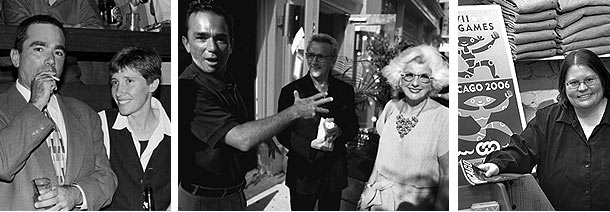
(From left) McCourt with the reporter Lisa Neff at the paper’s 11th anniversary party at the Sidetrack bar in 1996. McCourt with the photographer Victor Skrebneski and the public-relations consultant Margie Korshak in 1998. Tracy Baim, now the publisher of the Windy City Times, bought the paper from McCourt in 2000.
In the summer of 1985, after a failed attempt to buy GayLife, McCourt organized what was basically a mass defection of the management team—himself, Bearden, Baim, and the art director, Drew Badanish—for the purpose of founding Windy City Times. This is essentially what happened to McCourt at the end of his career—only then the positions were reversed.
The paper was founded on a relative shoestring, with McCourt, Bearden, and Badanish each putting up $10,000. The offices were located in McCourt and Bearden’s third-floor walkup apartment on Melrose Street near the lake. “All sorts of things were going on in that apartment,” says Baim. “My office was in the front. We did layout in the kitchen, and the typesetting machine was in the basement because it was too heavy to bring up three flights of stairs.”
The first issue, dated September 26, 1985, was 28 pages and included a slightly breathless publisher’s note in which McCourt forthrightly explained that even though his journalistic credentials were limited, he intended to produce “a newspaper broad in scope, exciting in presentation, and, above all, honest in its political and social motives. Our ultimate goal is to expand the gay sensibility in positive, progressive directions.”
From the beginning, Windy City looked and sounded like an actual newspaper with news and feature stories, columns, an editorial page, and an extensive entertainment section featuring a gossip column written by McCourt under his old pseudonym Mimi O’Shea. The overall tone—in contrast to McCourt’s at times operatic personality—was sober and professional. “It was very much about community empowerment, mainstreaming, and business success,” says Williams.
“Jeff had the force of a visionary,” says Steve Alter, who joined the paper in its early days as an ad salesman and admits to having been dazzled by McCourt. “He was so driven by the goal of creating a great newspaper.”
Looked at today, the first issue seems inadvertently portentous. The front page has three stories, one on Mayor Harold Washington assembling a 15-person committee on gay and lesbian issues—a first for Chicago—and two on a subject that would dominate gay life and politics for the next decade: the AIDS epidemic.
The epidemic crossed an important psychic threshold in the national consciousness that summer when the actor Rock Hudson announced his diagnosis amid a blaze of media coverage. The number of deaths at that point—especially in Chicago—was still relatively small, but predictions were dire for the future. For the most part, those predictions were realized.
For McCourt, the story quickly took on personal dimensions. “Bob started getting sick very quickly,” says Baim. “The first issue was in September, and by Halloween he had caught something that he couldn’t seem to shake.” Over the next year, Bearden—formerly a stabilizing influence in the office—began to spend more and more time in his bedroom at the back of the apartment.
“Bob was in denial a little bit, but that’s all you really could be then,” says Baim. “Nothing could help you.”
Bearden died in January 1987, almost 16 months after the founding of the paper. Days later, McCourt composed his partner’s obituary, which took up half the front page of that week’s paper. Given what friends remember of his emotional state at the time, it is a model of journalistic restraint, carefully noting the facts of Bearden’s life and the circumstances of his death. “He was admitted to the hospital Jan. 24, 1987, after suffering a brain seizure,” McCourt wrote. “He died peacefully in his sleep at approximately 5:30 a.m. Jan. 29, after failing to respond to treatment.” The only personal remark is a one-sentence addendum noting, “His lover, this writer, was at his side at the time of death.”
“I was there when Bob died,” says Williams. “Jeff cried for three hours nonstop. He had carried this load for so long. The two of them had started Windy City Times together. On some level, it was supposed to be their ma-and-pa store. Bob was the love of his life. I don’t think he ever got over him.”
Shortly afterward, the words “In memory of Robert F. Bearden—1950-1987” were inserted at the bottom of the paper’s masthead, where they remained until McCourt’s involvement with Windy City Times ended.
Bearden’s death also raised the question of McCourt’s health. There was no AIDS test then—only a test that revealed the presence of antibodies to the virus in the bloodstream—and doctors were divided about the implications of those antibodies. McCourt, however, never seemed to doubt that he was infected. “I think that fact ran his life after that,” says Dan McCourt. “He had a death sentence hanging over him, and he knew it.”
* * *
Photography: (Image 2) Hal Baim/Courtesy of Windy City Times; (all others) Courtesy of Jasonsmith.com
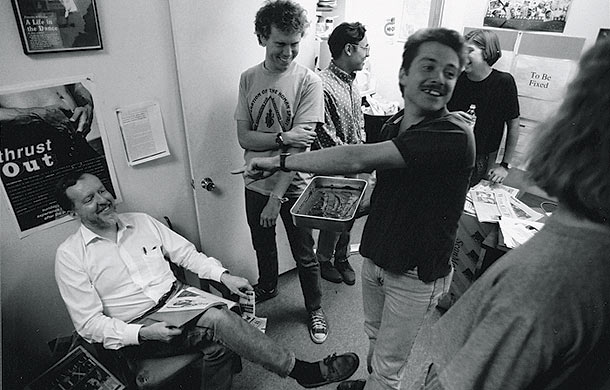
The staff of the Windy City Times celebrates the birthday of theatre critic Lawrence Bommer (seated at left) in the mid-nineties.
The next few years were a time of growth and experimentation, a period when Windy City went from being a better-than-average community paper to a publication that changed the paradigm of gay publishing. “They were very emotional times,” says Kit Duffy, the city’s first official liaison to the gay and lesbian community in the 1980s. “People were writing things that had never appeared before in a gay newspaper and expressing their growing identity as a community, and Jeffrey was in the middle of all that.”
From the beginning, the paper was deeply immersed in politics. Harold Washington’s surprise victories in the 1983 and 1987 mayoral elections had ushered in a major power shift at city hall. “Harold recognized that the gay vote, the African American vote, and the Latino vote together added up to a winning coalition,” says Garcia. “He was the first politician in Chicago to see that, and it changed the political landscape.
“Jeff and the paper had a lot to do with organizing the gay community as a voting bloc,” Garcia continues, “and a big reason was the thoughtfulness and excellence of his endorsements. The whole process energized people and got them to take politics seriously as a way to change things.”
Indeed, the paper received one of its first Peter Lisagor Awards, a competition named for the late Washington bureau chief of The Chicago Daily News, for a groundbreaking series of candidate interviews in the 1989 mayoral election in which it methodically fact-checked the responses of the candidates to a list of questions and carefully noted any discrepancies. The paper was on the whole nonpartisan, though not without an agenda. “The endorsements were always based on which candidate Jeff thought would be best for the gay community,” says Garcia.
The highlight of the paper’s early years was undoubtedly the passage of the Human Rights Ordinance. The bill had been languishing in the city council since 1973, when it finally came up for a vote in the summer of 1986 and was solidly defeated. Within days, a lobbying effort began to reintroduce the bill, with McCourt playing a leading role. “I remember Jeff saying, ‘Here are the desks, here are the phones, here are the typewriters. Whatever you need, do it. Get it done,’” says Garcia. “We called Windy City’s offices Ordinance Central,” says Williams, who was one of a number of activists working on the campaign.
Two weeks before Christmas in 1988, the slightly retooled bill sailed to passage. The subsequent victory party—held that night at Ann Sather on West Belmont Avenue—felt like a watershed moment. Among the dozens of politicos and media figures who felt compelled to make an appearance and offer their congratulations to McCourt and the assembled crowd were the two most powerful politicians in the city: the then mayor, Eugene Sawyer, and the future mayor Richard M. Daley.
* * *
Photography: Courtesy of Jasonsmith.com
Suddenly the people “who know nobody and who nobody knows” were being perceived as an important swing vote well worth courting in future elections. McCourt, as the publisher of what was often referred to as the “paper of record” for the gay community, became the official power broker. “I had calls from so many candidates asking, ‘Do you think I can meet with Jeff McCourt? Do I have a chance of getting an endorsement?’” says Garcia. “George Ryan came. Judy Baar Topinka came. It was important to them.”
The success of the paper was also evident on the business side. “He recognized that we needed to bring in standard publishing ideas,” says Schoofs. “We were one of the first gay papers in the country to have a real-estate issue, a fashion issue. Jeff’s thinking was that if we created these advertising venues, the advertisers would come. He also wanted straight advertisers like car and beer companies. He understood that this is journalism, it’s a business, and it needs to be done right.”
“Jeff always said, ‘My competition is not GayLife. It’s the Reader and the Tribune,’” recalls Williams. Over the years, McCourt would get almost every advertiser he wanted—everyone from Neiman Marcus to IBM.
The paper also benefited from the government deregulation of the telecommunications industry in the late 1980s, which, among other inadvertent side effects, spurred the development of the telephone sex industry—the ubiquitous 900 sex numbers of the era. The back pages of many lifestyle publications—including Windy City Times—were flooded with full-page come-hither ads for those services. “It was like money that dropped out of the sky,” says the ad salesman Steve Alter. “Suddenly what was a $300,000- or $400,000-a-year paper became an $800,000-a-year paper.”
McCourt also enjoyed a good fight. When Tracy Baim left to found her own publication, Outlines, five months after Bob Bearden’s death, she touched off what will probably go down in history as Chicago’s last great newspaper war.
“I don’t know how we survived,” she says. “It was only the worst of times, never the best of times. He played the gender card expertly, telling advertisers I was doing a women’s publication, which wasn’t true, but it still hurt us because, back then, lesbians were not considered an attractive demographic. There were all kinds of dirty tricks relating to ad rates and circulation figures. He was ruthless.”
The increased revenue also allowed McCourt to implement what may have been his most radical innovation of all—hiring first-rate writers and editors and paying them accordingly. “When I started in 1991,” says Louis Weisberg, the paper’s editor for five years in the 1990s, “I was making $30,000 a year, which, when you consider that this was a community paper with a circulation of about 18,000, was a lot.” Over the years, the paper would prove to be the launching pad for a number of people who subsequently went on to have solid careers in journalism and publishing. “He hired very well,” says Baim.
In general, he went with his gut. For instance, Schoofs was a 25-year-old philosophy major from California who had published a few articles in gay newspapers on the West Coast when he contacted McCourt about whether the paper would be interested in running a report from a gay conference Schoofs was planning to attend.
“He called me up and said, ‘Yes, we’d like to run this—and by the way, would you like to apply to be editor of the paper?’ I thought this was completely absurd and told him no. Then I thought about it for a few days and called him back and said let’s talk about it. He flew me out to Chicago and I interviewed and he hired me.”
In addition to the already-noted writers and editors, figures as diverse as Studs Terkel, the novelist Achy Obejas, the columnist Jon-Henri Damski, and the filmmaker Maria Maggenti all contributed to the paper in its heyday. If McCourt had no problem attracting top talent, however, retaining it was another story. Four years seems to have been the limit for most people. Some left for better jobs, but most simply were burned out from dealing with a person who—for all of his intelligence and drive—seemed at times completely oblivious of the impact of his actions on people.
“He was an enfant terrible, an impossible child,” says Alter. “You couldn’t sit with him for any length of time because he didn’t know how to stop talking and pontificating. It was a maddening dynamic. He read people with great sensitivity and accuracy, but he didn’t really have a clue how to connect with them emotionally. It almost seemed like he lacked some kind of gene that way. Everything was organized around his own monumental ego, and it was hard for him to understand that you had a separate existence outside of his sphere. There was an infantilism about it.”
“At the core of him was this insatiable insecurity,” says Schoofs. “Not your garden-variety insecurity about ‘Am I good enough?’ or ‘Am I a lovable human being?’ This was like a beast inside of him that needed to be constantly fed. Any slight perceived lessening of affection that he might feel from you could spark this sort of emotional crisis that would have to be attended to. And then you would have to deal with all the other staff members who were feeling abused. It just felt like an emotionally unhealthy environment, and ultimately I didn’t want to be there.”
* * *
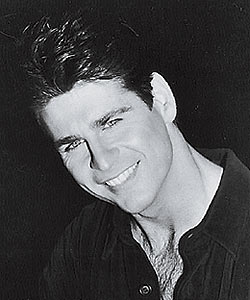 After Bearden’s death, McCourt had a number of brief relationships, most notably with Marc Anthony Donais, a man better known in the gay community as the pornographic film star Ryan Idol. |
All of this was complicated by McCourt’s apparently limitless appetite for cocaine and other illegal substances. “He was so abusive of his body,” says Williams. “He got more and more into drugs, and that made him paranoid. He became very hard to deal with.” His personal life was also in disarray. For most of the 1990s, McCourt lived in a spacious apartment on the second floor of an old mansion on Dover Street in Uptown that included a large living area furnished with leather couches and chairs, a book-lined den, and a veranda where guests would gather during McCourt’s numerous dinner parties. “At his peak,” says Williams, “he had a gorgeous lifestyle.”
The mansion was owned by his attorney, Greg Friedman, who lived downstairs with his wife. “I got to experience a guy who was a bon vivant, who loved to party, loved to entertain, and was constantly on the go,” says Friedman. In general, he remembers a far less conflicted personality than was evident to many of McCourt’s friends in those years. But even he notes that McCourt was “not a guy who was lucky in love.”
In the years after Bearden’s death, McCourt would drift into a number of brief relationships, the most notable of which was with Marc Anthony Donais, a man far better known in the gay community as the pornographic film star Ryan Idol.
“In some kind of fucked-up way, they cared about each other,” says Alter. “They were two highly narcissistic, very on-the-edge types of personalities who were using each other for image, for money, for drugs, for sex.” He adds, “In spite of all that—and I know how strange this sounds—I think there was something real there.”
Donais, who today lives in a small New England town, agrees. They met in the late 1990s, when Donais was in Chicago and attempting to launch a legitimate acting career by starring in a play in Bailiwick Repertory’s annual Pride Series. He and McCourt began a yearlong on-again, off-again relationship that was complicated by the fact that, for most of that time, Donais had a girlfriend. “He was somebody I’ll never forget,” Donais says. “He was really like a best friend, a big brother. He would have me in his office all the time to show off and stuff. And he would be wielding his power, and I identified with that.”
The staff remembers it somewhat differently. “We’d have editorial meetings where Jeff would be sitting there with white powder around his nose, drinking booze out of a bottle with Ryan Idol asleep on the couch,” says Weisberg. “At some point we just knew this wasn’t going to work—that this was no way to run a business.”
The odd thing is that, at least on the surface, the business seemed to be doing fine. The 1998 Pride Issue—traditionally the largest issue of the year—came in at just under 200 pages, a near record at the time for a gay newspaper.
Later that year, McCourt would write “The Politics of Passion,” an editorial on that year’s gubernatorial race that would win a Lisagor Award. It is, in many ways, his valedictory statement, reflecting as it did a lifetime’s experience in the struggle for gay rights. After summing up the generally dismal voting records of both candidates, George Ryan and Glenn Poshard, and refusing to endorse either one—a first for him—he noted the recent brutal murder of the Wyoming college student Matthew Shepard and concluded by encouraging readers to look to the future.
“Historically, we have always made our greatest strides after, not before, setbacks,” he wrote. “The 1986 loss and subsequent 1988 victory in the Chicago city council on a similar bill is a memorable case in point. That period brought out the best anger, the best energy in all of us. Ultimately, it also brought out the best in our friends and political supporters as well. . . . We must remember, however, that no one can ever tie Pride to a fence and beat it out of someone. Nor can anyone legislate it away. It is a word, a feeling, that will never again be consigned to a shadowed closet of indifference.”
Photography: Courtesy of Jasonsmith.com
 McCourt embracing his friend Chris Cox |
Eight months later, the staff of Windy City, fed up after years of drug-fueled erratic behavior, departed en masse to found the Chicago Free Press. McCourt rallied briefly—long enough to launch an expensive lawsuit against his former staffers—but “the déjà vu was painful,” says Williams, referring to the circumstances of Windy City’s founding 15 years earlier. So many of his old friends had fallen away by that point. “It was like watching a train wreck,” says Garcia. “You had someone with enormous gifts and talents who contributed to his profession and community in ways that were unparalleled but who was spinning out of control.”
In the summer of 2000, McCourt called it a day, ultimately selling the paper for the fire-sale price of about $250,000 to his former employee and longtime rival Tracy Baim.
Around then, the HIV he had refused to acknowledge for so many years came roaring back, and he wound up in the emergency room at Northwestern Memorial Hospital, where, according to his brother, he was in and out of a coma for several weeks. Again, he rallied. But by now, dementia had set in. His final years were spent mainly at the Warren Barr Pavilion, a nursing home on the Gold Coast where he was looked after by a companion hired by his family.
Last year, one of his old staffers nominated him for the Gay and Lesbian Hall of Fame, an honorary society administered by the city of Chicago’s Commission on Human Relations. Nothing came of it, however. “Jeff was just too controversial,” says one observer. “Nobody wanted to deal with him.” Six months later, McCourt was dead.
“There’s a part of me that thinks maybe he died in peace,” says Garcia. “Maybe always being surrounded by folks was overwhelming to him. Maybe when you lose everything, including your friends, it’s easier.”
Kit Duffy remembers a conversation she had with McCourt toward the end. “He told me, ‘I have one friend’—meaning the hired companion—‘and I really think that’s all I need now.’”
Photography: Courtesy of Jasonsmith.com