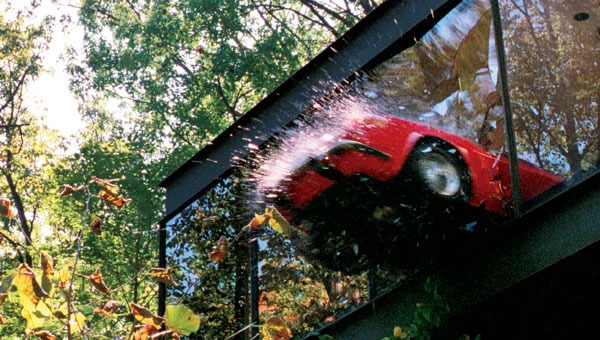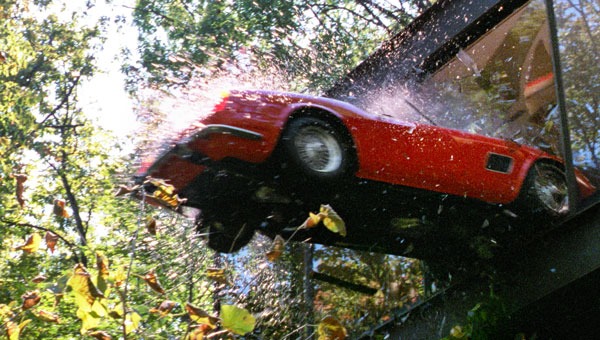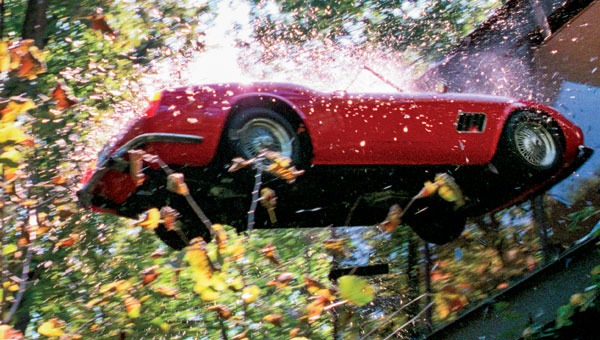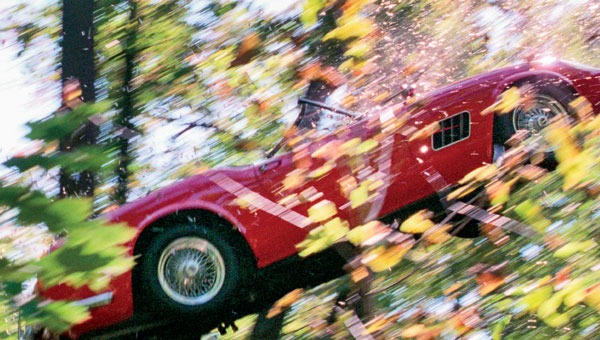


Ferris Bueller’s best friend, Cameron Frye, can be summed up with one sequence, one prop, and one location. The sequence is at the Seurat painting at the Art Institute of Chicago — it’s the first time in the 1986 film Ferris Bueller’s Day Off that we see Cameron (played by Alan Ruck) truly look inside himself and be afraid of what he sees. The prop is his dad’s Ferrari, which comes to symbolize everything that Cameron has been going through with his father. The location is the house at 370 Beech Street in Highland Park. The attention is on its pavilion, a 1974 addition serving as the garage. When we do see the house itself, a mid-century modern structure designed by A. James Speyer, it’s presented as a flat brown backdrop that doesn’t do it justice. It doesn’t need to. The clean lines and spaciousness add to how we perceive Cameron: alone and adrift.
“He puts his foot down, then backs off,” said John Hughes, the film’s director, in his commentary for the 1999 DVD release, describing the way Cameron tortures the engine of his 1982 “piece of shit” Alfa Romeo Alfetta before he heads out to grab Ferris (Matthew Broderick). “I like playing this with the headrest in focus, and him in the background having a tantrum.”
Whenever Cameron is alone, we get the most contemplative shots, done with an intentionality that doesn’t call attention to itself, the same way Speyer’s house, commissioned by textile designer Ben Rose, is intended to integrate with the surrounding forest while also existing as its own space. When Cameron jumps up and down from sheer frustration, he is shown out of focus. For us, the viewers, his tantrum is incidental; the focus remains on the car and the idea of moving forward, which is what Cameron should be focused on as well. It’s a perfect illustration of just how silly impotent rage can look.
Before settling on the Rose House, the crew originally sought a home for Cameron’s family on Lake Michigan. “We were spending all of our location-scouting time trying to find a house on a cliff on the shore of the lake,” says unit production manager Bill Coker, recalling the long days of driving around the North Shore with nine department heads crammed inside a passenger van. At that juncture, he says, the plan was for the car to shoot off into the lake. (Reviewing old scripts, I can’t find any draft that references a lake for this scene, but I can’t rule it out as an idea Hughes might have had at some point.)
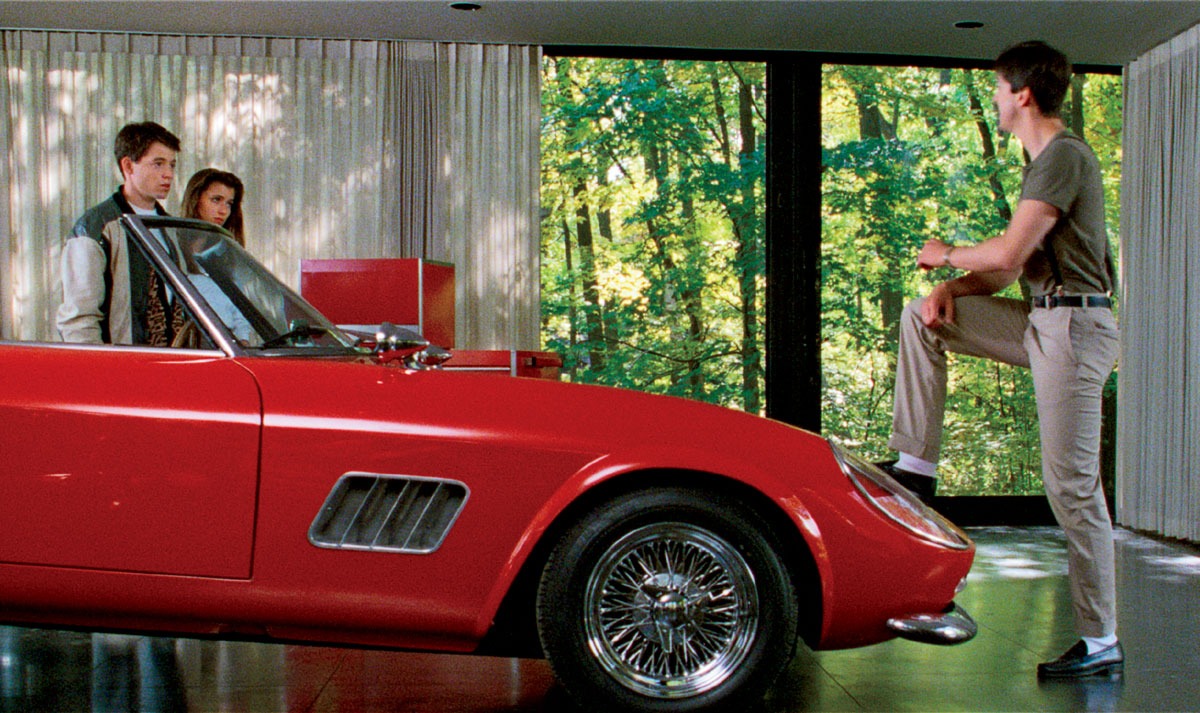
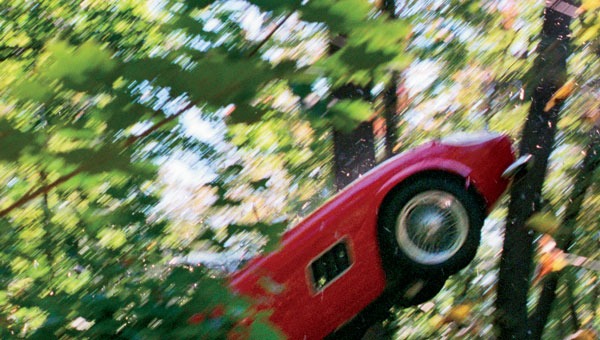
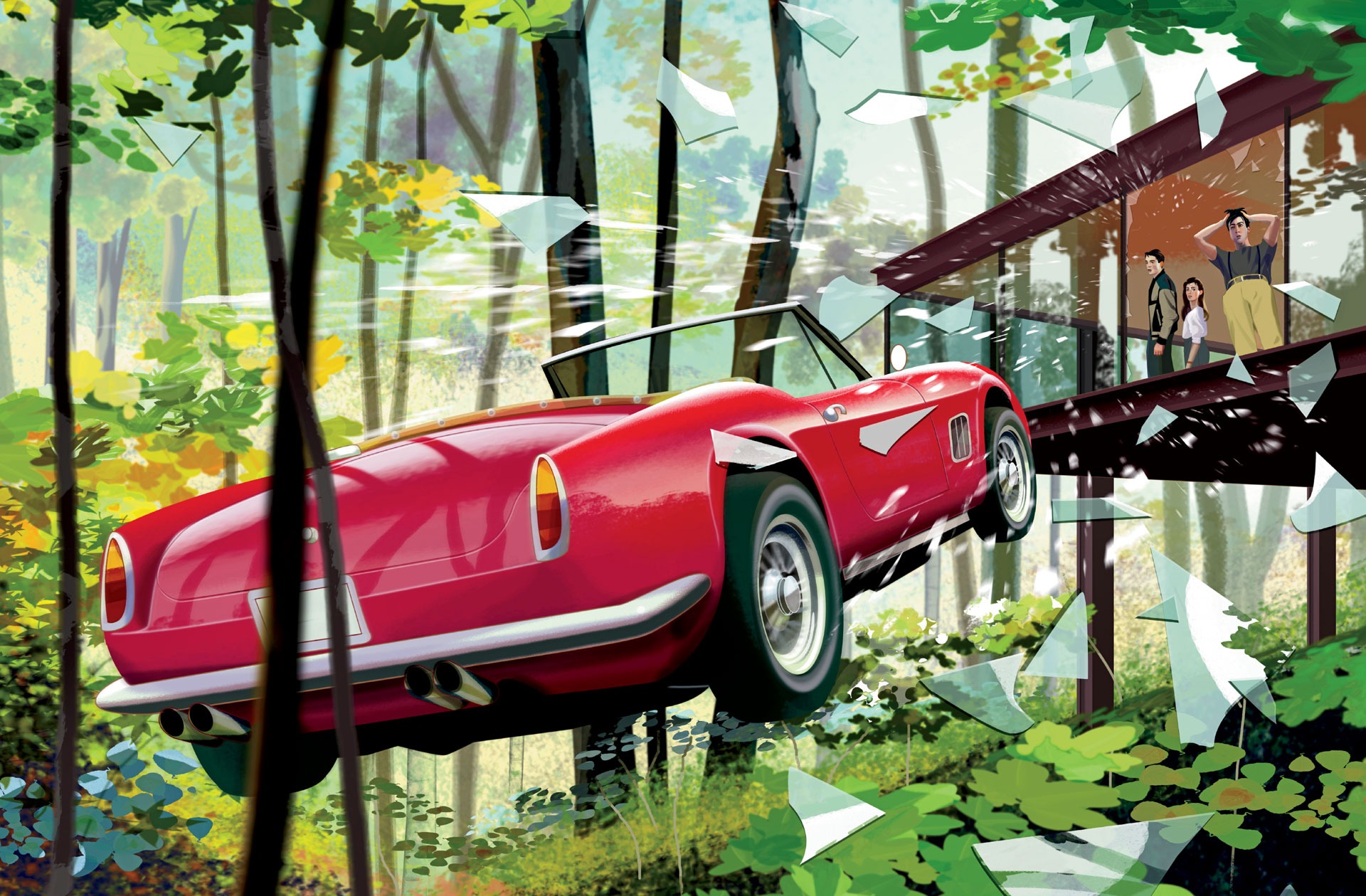
The van was on a bridge in Highland Park when something caught Coker’s eye. “I saw this steel I-beam and glass building almost completely cantilevered off of this cliff and this arroyo, and I said, ‘Wow, look at that building. It’d be crazy if the car went out one of those windows and into that forest.’ ” Hughes, who was in the van, turned around in his seat and told Coker to get the house. Coker then went to location contact Billy Higgins for the owner’s information.
Producer Tom Jacobson remembers it differently. “[Hughes] looks in the woods and says, ‘Whoa, what’s that?’ ” The van stops, and the Rose House reveals itself. “It’s this beautiful glass and steel house. [Hughes says,] ‘That’s really cool, that looks like a Mies van der Rohe.’ ” He was close — Speyer was one of the famous architect’s star pupils. “We look at that back house, and John just completely visualizes the scene,” Jacobson continues. “Visualizes the car going out the window and into the ravine, which is so much better than what he wrote on the page. So this is an example of, like, ‘Oh, there’s something that presents itself to me, and this is what’s going to work.’ ”
The location crew made an appointment to speak with Ben Rose personally to make it clear they would take good care of the house, because by then they were well aware that it was his baby.
By the early ’50s, Rose had found enough commercial success with his printed patterned textiles to prompt a move for his family from Chicago proper to the upper-crust suburb. First, Rose and his wife needed to build their new house, nestled among the trees and abutting a ravine. The modernist sensibility of Speyer was hardly in keeping with the traditional architecture of the area. “It stood out like a sore thumb,” one of their sons, Rob Rose, recalls. “Instead of embracing the design, our neighbors made us persona non grata.” It didn’t help, he says, that they were a family of Democrats, given the local political leanings at the time. The house took a year or so to complete, and in 1953 the family moved in. The residence was a stellar example of modernist design, and Rose recalls tours of it being conducted while the family lived there. It was featured in Architectural Record in 1956.
Rose is fairly certain the house wouldn’t have been noticed by the Ferris Bueller crew if they hadn’t been scouting in the spring. “There wasn’t as much foliage that disguises the pavilion. You can hardly see it [later in the year]. The greenery is wild like that.” The crew would discover this the hard way once the leaves started to turn. “Every day, before we started shooting, we had to paint all these leaves green,” Hughes said on the DVD. “We had to be very careful we didn’t knock them off.”
Persuading the Roses to let the crew shoot in — and drive a car through — their bespoke glass-and-steel home felt to Coker like a hard sell. These people had money, so the idea of a film gunking up their driveway and at least pretending to destroy part of their house wasn’t going to hold much appeal for them. The crew was paying the Roses only $5,000 for the planned three-day shoot.
When Ben Rose asked what part of the house the crew wanted to use primarily, Coker explained that it was the addition behind the main house. “Oh, the pavilion,” Rose said.
“Oh fuck, he’s calling it a pavilion,” Coker thought. He asked Rose to reserve judgment until he gave him the whole spiel. In his DVD commentary, Hughes explained that the biggest hiccup when it came to the Roses was their concern about the pavilion’s glass: “The fear with the building, in breaking one of the window panes, as we would have to do, was that it would affect the structural integrity of the building.” But the scene was integral — or became so in Hughes’s ever-evolving vision. “Very unusual to find a steel-and-glass museum building in the woods over a ravine,” the director continued. “I mean, it was [an] absolutely perfect location. And fortunately, Ned Tanen knew the guy that owned the house.” That’s right: Unbelievable as it may seem, Tanen, the head of the motion pictures division at Paramount Pictures, was acquainted with the owner of the home that had suddenly appeared for the crew like Brigadoon from a thick fog.
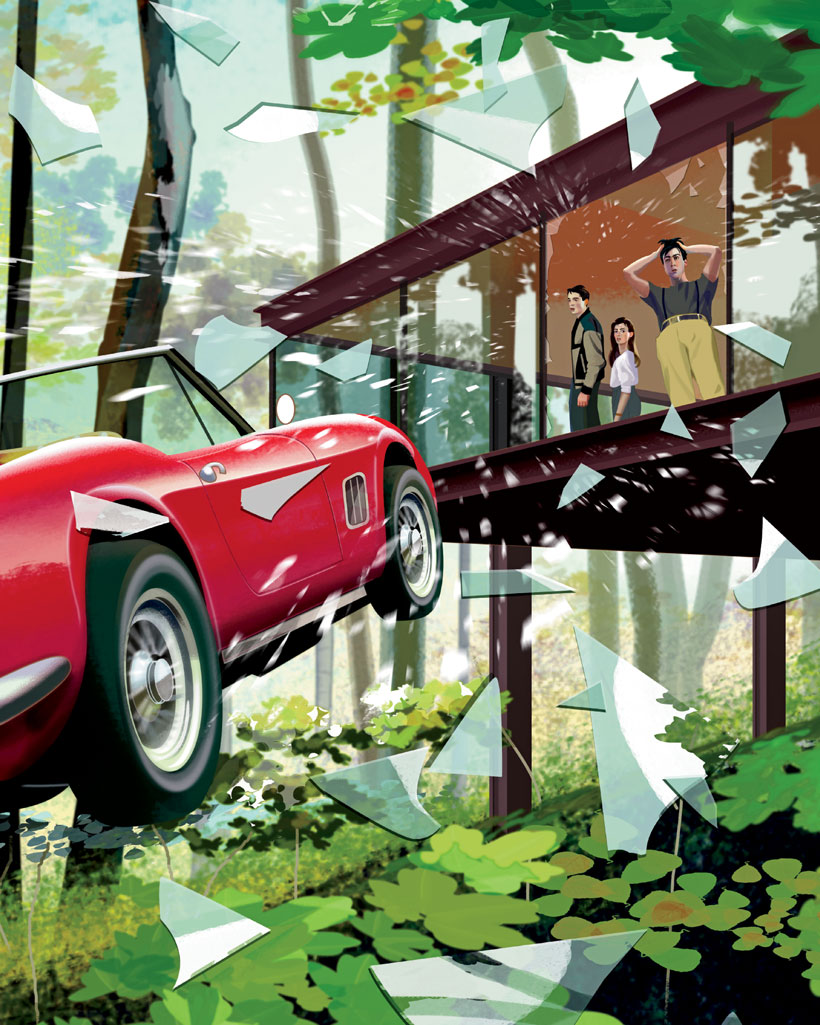
“We want the car to go out through one of the windows that we will make out of movie glass,” Coker explained to Rose. “We just would need to remove one of your windows and secure it and then put it back when we’re done. And we’ve got to get the best people in Chicago that do high-rise building glass and everything.” When Rose inquired as to the kind of car they were planning to shoot out of his window, Coker explained it would be a Ferrari. “Really?” Rose responded. “Come here. I want to show you something.”
“We’re going to get the lecture now,” Coker recalls thinking. “He’s going to tell us all the reasons we can’t.”
Persuading the Roses to let the crew shoot in — and drive a car through — their bespoke glass-and-steel home felt like a hard sell.
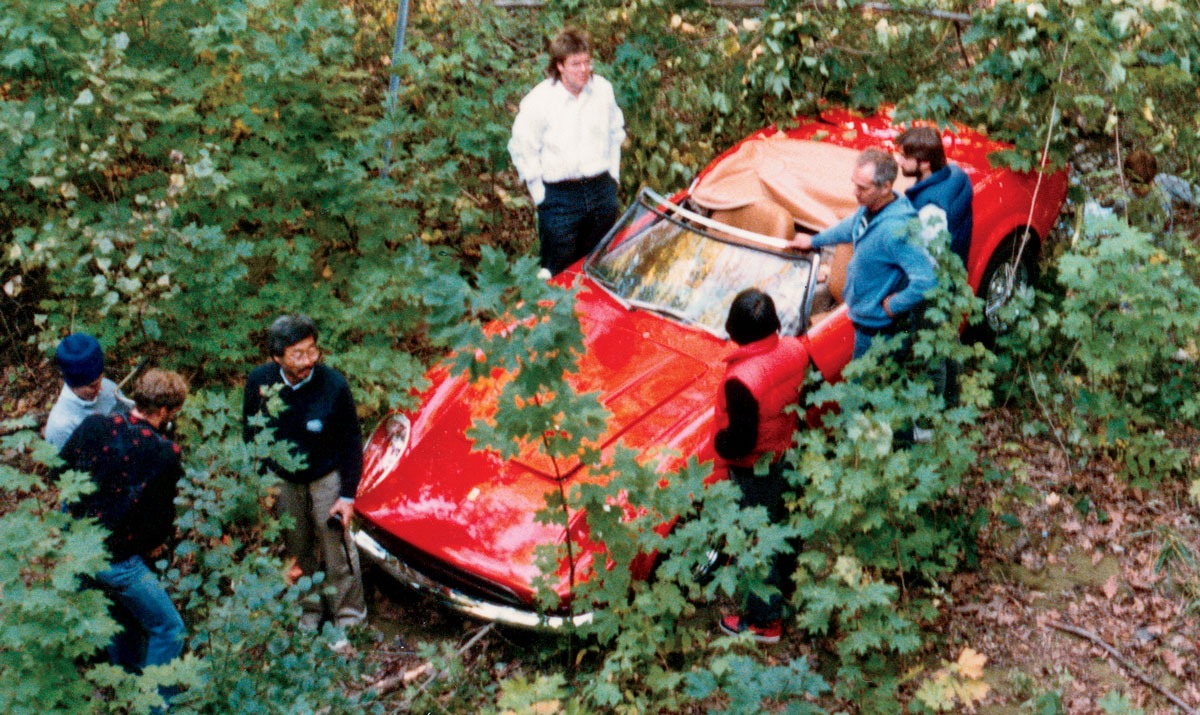
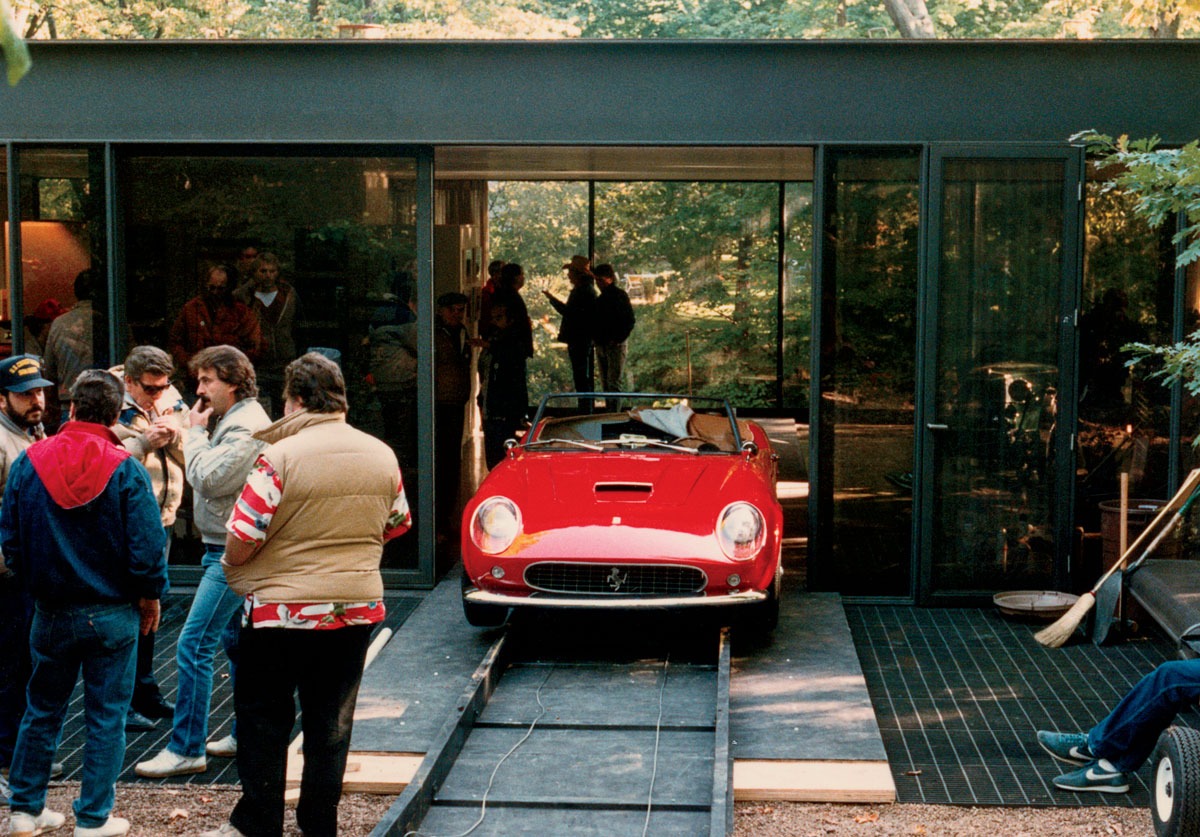
Rose walked the crew out to the pavilion, first giving them a good look at the panoramic view of the plunging ravine below. “You know, that forest out there is primeval,” Coker recalls him saying. “It’s thousands of years old. There’s no modern trees in that at all.” Coker explained to Rose that the car would be a fiberglass shell on a body of steel tubing — no engine, no oil, no gas, nothing to wreck the pristine nature. “As soon as that car hits the ground, we’ll vacuum up every single one of those little fractured pieces of glass that our breakaway window makes,” Coker told Rose. “It’ll look like it never happened.”
Rose then let the crew into the pavilion. “We step inside, past the curtain,” Coker recalls. “[There are] something like six antique Ferrari racecars, one for each decade that Ferrari has been racing, in immaculate condition.” Coker immediately reassured Rose: “We will insure them for whatever amount you say they’re worth,” he told him. “We’ll put guards on them if we have to, because we really want to use this location. It is brilliant, and this could be a lot of fun. What do you think?” Rose’s reaction, as Coker recalls: “He looked at us and he said, ‘You know, I really like that movie Tom Cruise did, where the Porsche went off the pier into the lake. That was pretty cool. Let’s do it.’ ”
Jacobson’s memory of the day is similar. He remembers that he and Hughes spoke with Rose personally, even though securing the house would normally have been the purview of the location manager. Hughes described for Rose the setup for the scene: the kids trying to run the odometer back while the car is up on the jack. Rose laughed at this, fully engaged. Then came the critical moment when Hughes had to tell him about smashing the car through a giant plate of glass. Recalls Jacobson: “The guy goes, ‘Smashes through the window into the ravine?’ Because this is the million-dollar moment, right?” Tension hung in the air. “What type of car?” Rose then asked. Hughes and Jacobson explained they were going to use a mockup of a Ferrari 250 GT California Spyder. “Huh. I used to own one of those.” Simple as that.
Greg Popp, the film’s location assistant, says Rose told him that if the crew had been asking to shoot a commercial at his house, he would have instantly said no. “I don’t need the money,” Popp recalls Rose saying. “But the idea that you’re going to actually put a car through the window into the ravine is so goofy — you only live once. This is irresponsible. I’m going to do it.” Popp also thinks some gifts from Hughes or the production team may have greased the wheels, like the tools seen in the pavilion in the film.
“My parents were immediately delighted,” Rob Rose says of the prospect of shooting a movie at their house. In fact, Bob Rose was a much-easier sell than another party who wanted a say: the architect of the pavilion.
Like Speyer, David Haid had been a student of Ludwig Mies van der Rohe, but he was more focused on the architectural work itself and a purist about his designs. “My parents were very close with Ben,” recalls Melissa Haid, the architect’s daughter. “They both loved the cars, and my dad wanted something to do, and there’s Ben with his big fat wallet, and all the cars. I think he wasn’t above schmoozing the right client for the right thing.”
Haid took issue with the film crew’s plan when he got wind of it — and let them know he wasn’t pleased. “I got a phone call from the architect, like a week later, screaming at me,” Coker remembers. “ ‘What the hell do you think you’re doing? That is an architectural heritage location, and all of those windows have a patina that has been growing since they were installed in the ’50s. If you break or even crack one of those windows and have to replace it, it will not look like the rest of the windows. You will have to replace all 24 of those 8-by-10 windows if you break or crack a single one of them.’ ”
Coker tried to reassure Haid: “OK, we won’t break or crack a single one. And if we do, we’ll replace all of them. Don’t worry about it.” Responded Haid: “You better not break them.”
“So my ass is on the line,” Coker recalls. “Me. Not the producer, not the director. Me.” Replacing all the glass — if it came to that — would cost around $100,000.
Overseeing this aspect of the shoot, as it turned out, would be none other than Haid himself. His daughter thinks that filming at the house wouldn’t have happened without that stipulation. Says Melissa: “I remember him being extra pleased because he was getting paid through the nose for it” — around $1,000 a day. “He wasn’t going to let anybody else [do it]. I’m not even sure he let the Roses do much in the way of maintenance without his approval.” Haid and Hughes had that in common when it came to their art: “Once he did it, it was his forever,” Melissa says of her father’s creations. He would sometimes check in on a bank he designed in Evanston, pointing out his concerns about how “his” building was being treated.
The Chicago Tribune would later report that during filming the pavilion was “smashed and later repaired under Mr. Haid’s supervision.” But his daughter scoffs at the notion that the structure was ever damaged: “Not in a billion years!” Melissa says. “My dad was a most demanding, meticulous sort.”
Haid was on board with the plan of subbing in a pane of movie glass, a facsimile made of sugar; he just wanted to be there to watch over the crew as they prepared the window and did the stunt. “The concern, structurally, was that if they went through one window and didn’t switch out all the other panes of glass, which surrounded the building, that some structural vibration would impact those panes,” explains Melissa. “I’m not 100 percent sure, to be fair, that my dad actually knew that [would happen]. But his approach was ‘Don’t break it.’ ”