


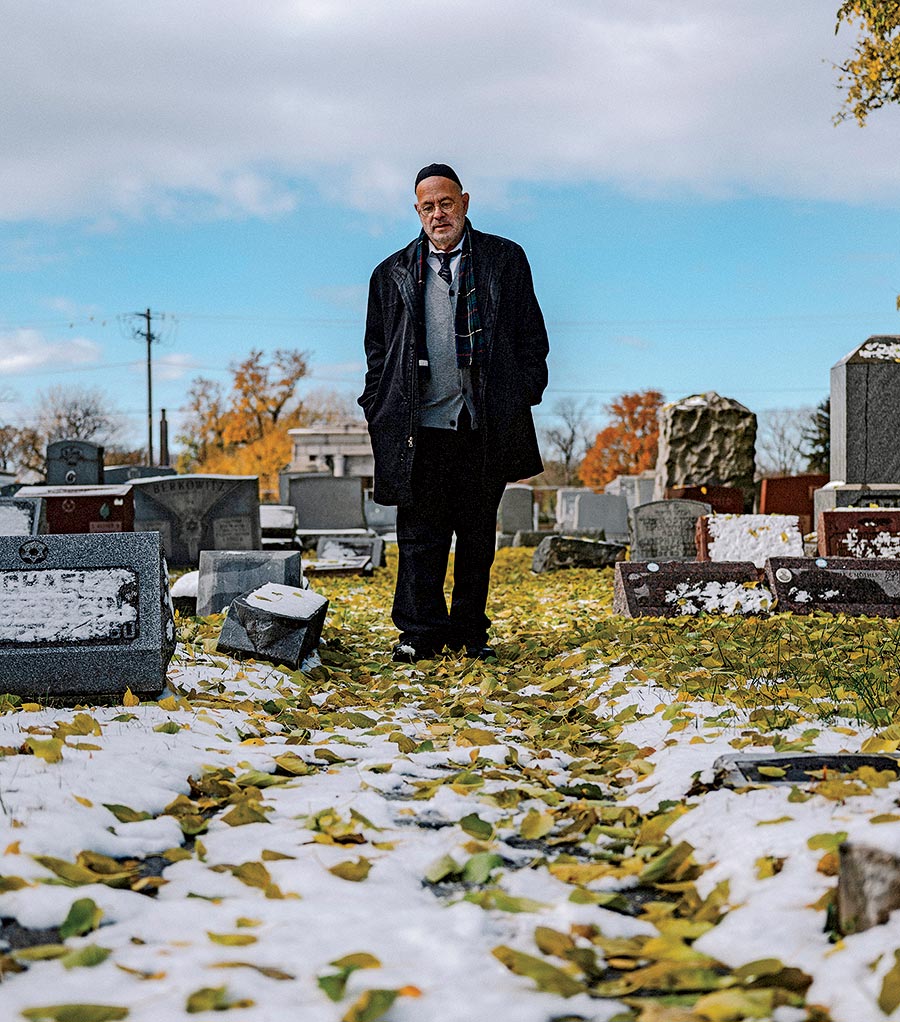
With more than 175,000 graves, Waldheim Cemetery is the largest Jewish burial ground in the Chicago area. Just east of the Des Plaines River in Forest Park, Jewish Waldheim, as it’s commonly called, is actually a collection of many small cemeteries — hundreds of them, with different owners, divided by fences and gates.
Behind two of those gates there are plenty of graves, but few headstones. It is here that many Jews without the means to pay for a cemetery plot and burial are laid to rest, most of them by a man named Shlomo Tenenbaum, the former longtime rabbi at the Ark, a Jewish social services agency in West Rogers Park that helps individuals and families experiencing financial insecurity. Over four decades, Tenenbaum has organized and conducted more than 3,000 funerals for indigent individuals. After the gate 1 area filled up, Tenenbaum started burying the dead behind gate 59. Simcha Frank, a funeral director at Skokie-based Chicago Jewish Funerals, has a name for these special sections: Tenenbaum’s Garden.
My family has known the rabbi for a long time, but I learned about this side of his work only a few years ago. My brother first met him during their teen years, when he was just a kid from Evanston named Sheldon. Later, he became my parents’ neighbor in Peterson Park. After my mother died in 1997, he and his wife, Adina, hosted my father, a Holocaust survivor, every Friday night for Sabbath dinner; these weekly meals continued for 15 years, until my dad moved to assisted living. In 2020, when my father died, Rabbi Tenenbaum was the obvious choice to preside over his funeral.
A few months back, I visited Tenenbaum, 66, at his home. Inside there were Jewish books everywhere — on groaning shelves, in five-foot-high piles on the floor, on top of furniture. And there were more in the basement. Somewhere amid the books, I spotted a violin case. Tenenbaum, who trained as a social worker at Columbia University, is a talented musician. He has an irreverent sense of humor, too. During any given conversation with him, one might hear a learned discourse from a Jewish text — or a reference to the Three Stooges.
Tenenbaum spent his entire career at the Ark, where his official title was director of spiritual enrichment. His ministry was working with the Ark’s most troubled clients — those struggling not just with poverty but also with disabilities, homelessness, entanglements with the law, substance abuse, and mental illness. “Psychiatric patients always sort of trusted me because I didn’t look like a regular mental health guy to them,” Tenenbaum says. But he was being modest. My brother told me the rabbi has the gift of being able to connect with anyone, even the most difficult people.
Over the years, some individuals gave Tenenbaum power of attorney for their health care so that he could advocate for them during medical crises and ensure that their end-of-life wishes were respected. He even encouraged his clients to carry his business card so he would be contacted when they died. Usually, the deaths were from natural causes, but from time to time there were also accidents, suicides, even homicides.
“People a lot of times ask me, ‘Isn’t it depressing?’ But there is something beautiful about it.”
Often, it was up to Tenenbaum to notify the family. Sometimes he’d spend hours tracking a relative down. By law, he needed permission from the next of kin to conduct a burial if he had not been authorized in advance.
Tenenbaum did his first burial in the mid-1980s at the request of an Ark client whose wife had passed away. Then he helped when others at the Ark died, and over time he took to the role. His outlook was shaped by a hearse driver named Wally, who would ride with Tenenbaum from the funeral home to the cemetery. “Working with death, he had this beautiful perspective on life, and he saw beauty all around him,” Tenenbaum recalls. “People a lot of times ask me, ‘Isn’t it depressing?’ I won’t say it’s a bed of roses, but there is something beautiful about it.”
Still, it can be fraught, especially when dealing with estranged family members. That was the situation with one of my own relatives as a consequence of his alcohol and drug use, homelessness, and trouble with the law. For more than a decade, no one heard from him or knew where he was. Then he showed up at the Ark and cleaned up. Eventually, Tenenbaum helped me to reconnect with him.
One summer afternoon, as my relative was starting to get back on his feet, he pedaled to the Ark on a bicycle (his driver’s license had been revoked after a DUI conviction), and we visited for the first time in many years. It was the last time I saw him. In the summer of 2024, he was found dead in his Uptown apartment. Tenenbaum had coincidentally seen him the same day he died and was alarmed by his weight loss. When my relative’s family reached out to me to share the news, I steered them to Tenenbaum.
Even with the most basic casket, the typical retail cost of a Jewish funeral in the Chicago area is about $15,000, including a burial plot. When a family is unable to pay, or when there is no family at all, the Ark has funding from donors designated for such funerals. The Ark works with Chicago Jewish Funerals, which receives a discount from Waldheim for indigent plots and handles the services at cost. The caskets are pine boxes (as they are for many conventional Jewish burials, signifying that everyone is equal in death), and there are no headstones, but David Jacobson, the funeral home’s owner, says he treats all burials the same, sharing Tenenbaum’s philosophy of treating the dead with dignity.
Cremation is considerably less expensive, but Tenenbaum discourages it. From his rabbinical perspective, it is a biblical commandment to bury the dead. Judaism tells us that it is a desecration of the body’s holiness to destroy it through cremation. Perhaps the ultimate altruistic act in Jewish tradition is to bury someone who cannot repay the kindness.
The vast majority of the funerals Tenenbaum has conducted have been for current or former clients at the Ark. But sometimes he’ll bury someone from the county morgue. Rebeca Perrone, manager of indigent and family services for the Cook County medical examiner’s office, explains that unclaimed bodies are typically cremated. But because of Jewish and Muslim prohibitions against that practice, she works with a rabbi and an imam to determine whether any of the unclaimed deceased might have belonged to either of these traditions. If Jewish, they often end up in Tenenbaum’s care.
At the burial, he always gives a proper eulogy, based on whatever he can learn about the deceased, even if the only people present are the funeral director and cemetery workers standing quietly in the background. Tenenbaum is especially proud of one eulogy, which was given on short notice, as he didn’t know the individual and had just a moment to talk to the family. The deceased was a Holocaust survivor who had worked as an electrician. The man, Tenenbaum said, brought light to people’s homes after he had lived through some dark years.
On occasion, Tenenbaum has led memorial services for people who were not Jewish. When Tommy McCracken, a Chicago blues legend, died last January, Tenenbaum was asked by McCracken’s family to officiate. One of McCracken’s sons was Jewish. A number of blues musicians came, and some brought their instruments. After the eulogies and prayers, they walked up front and started playing. Tenenbaum put down his notes, picked up a guitar, and joined in.
This past summer, Tenenbaum was fired by the Ark. He says he had complained about the direction of the organization and about his hours being cut, arguing he couldn’t fulfill his role under the new arrangement; soon thereafter he was dismissed. “We cannot comment on personnel issues,” the Ark told Chicago in a statement. “We are grateful to Rabbi Tenenbaum for his four decades of service to Jewish Chicagoans.”
When I asked Tenenbaum how he was coping with the loss of his job, he told me he has been finding solace in the book of Psalms. In these ancient biblical songs, he comes upon wisdom about disappointment and moving on to something better and higher. The work, though, hasn’t stopped: Since leaving his job, Tenenbaum has raised money through personal connections to conduct several indigent burials. In the end, how one treats others — whether living or departed — is what matters.