


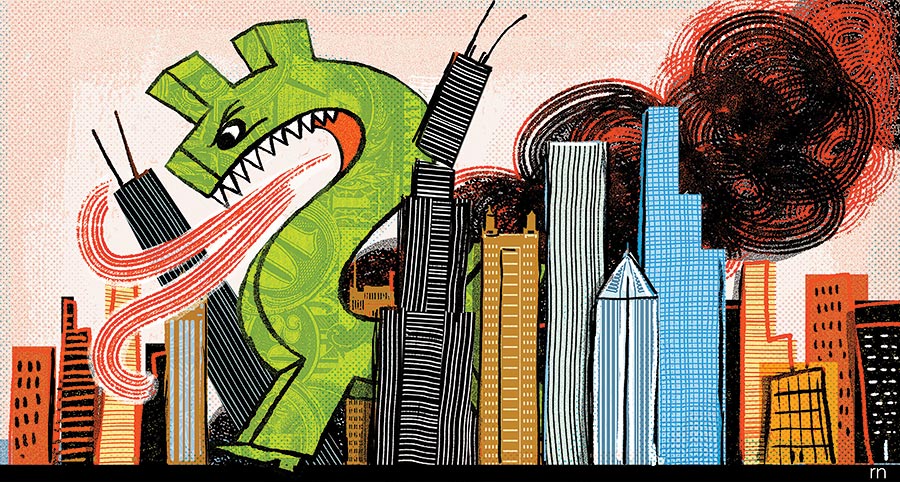
It’s the pensions. It’s the tax code. It’s the TIFs. It’s the Chicago Teachers Union. Every politician has his or her pet explanation for Chicago’s decades-old mounting pile of debt. Which is fair, as about 40 percent of the city’s annual budget goes to paying off some $40 billion in obligations, including hefty pension shortfalls. But how did we get here, and how do we get ourselves out of this mess? Let’s go to class.
CITY OF BIG INFRASTRUCTURE
For Justin Marlowe, director of the Center for Municipal Finance at the University of Chicago, the city’s debt problem all comes down to shrinkage. “Chicago’s infrastructure was built to serve a population that was, at one time, [a third] larger than it is now,” he says. And with those fleeing Chicagoans goes precious tax revenue, which means the city is forced to take on debt to keep potholes filled and trains running (kind of) on time (for the most part). “It creates this long-term structural imbalance, which is what we’ve been living with since about the mid-’70s.”
Not only are we great at taking on debt — we’re also great at figuring out how to not pay it. The city has creatively refinanced portions of its debt time after time. And when it does, it extends its bond maturities (collection dates) way down the road, up to 25 years. While this refinancing move (called a “scoop and toss”) keeps the lights on, it effectively burdens future taxpayers (sorry, kids) with even higher payments.
WORST-CASE SCENARIO
In November, Goldman Sachs put $454 million in Chicago municipal bonds on the market. The bank was left holding $75 million of them. This, I’m told, is bad, as municipal bonds are generally very sellable. Investors, it seems, have grown weary of the city’s debt management tricks, which is perhaps exactly the wake-up call Chicago needs.
The true nightmare comes if we keep neglecting to chip away at our debt. Credit agencies could knock the city for poor governance, dropping our ratings to levels so low that no one is able to lend to us. S&P already lowered its rating of Chicago from BBB+ to BBB in January 2025 and announced a “negative outlook” in November. If the city suffers another couple-notch downgrade, it falls out of investment-grade ratings. That means lots of institutional investors, like mutual funds, wouldn’t be able to buy our bonds, which could leave us broke. Not cool.
WHAT’S NEXT?
“The amount of debt we have and the way we manage debt is symptomatic of a much deeper issue,” Marlowe says. “We haven’t really figured out what kind of city government we really want or need. We’ve just kind of assumed that what we had in the past should continue, even though circumstances have changed a lot.” In other words, Chicago needs to grapple with tough questions it’s been avoiding for decades.
What infrastructure do we actually need? Answering this requires close analysis of each municipal department. It requires putting our city’s brilliant financial minds to work imagining a Chicago built for today, not 1960. And it requires some of our alders to sacrifice resources in their own personal fiefdoms. The difficulties inherent in that will take more than two minutes to explain.