


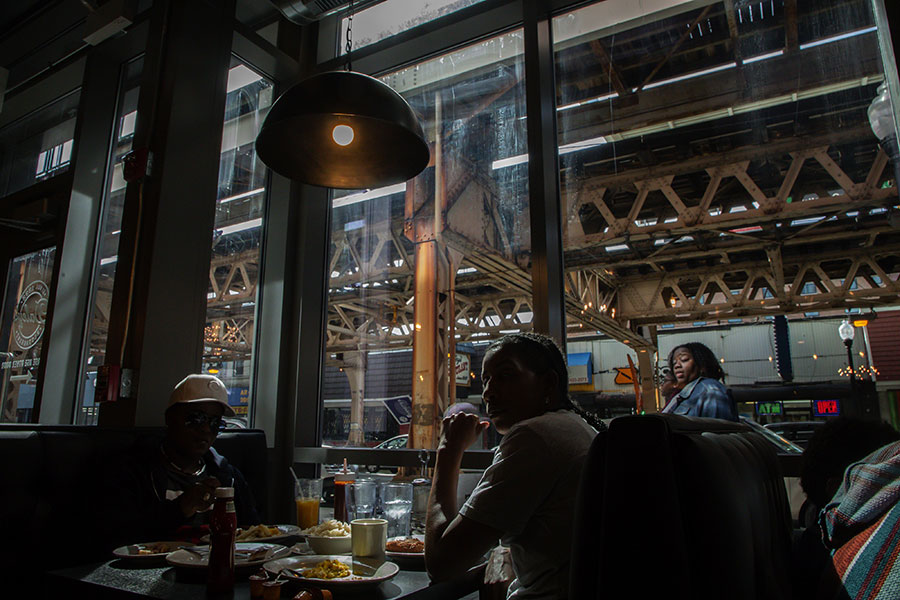
The heyday of the diner is long past, when greasy spoons were open 24 hours a day to serve hungry workers who had just gotten off third shift, or who were just about to go on first. But there are still plenty of diners left on streetcorners and in storefronts, with sugar shakers in every booth, patched-up naugahyde, hand-lettered menus on chalkboards, and proprietors working the grill.
On a recent Wednesday, I visited seven diners, chosen to cover as much of the city as possible. I started at breakfast time on the North Side of the city and ended with a late lunch on 63rd Street and Cottage Grove Avenue, for the sake of finding what remains of this urban/roadside culinary tradition,
My first stop at 7:15 a.m. was Alexander’s Restaurant in Edgewater. The diner sports a worn yellow marquee over the doorway. Inside, you’ll find an applique portrait of Jesus — one that looks like a young George Carlin — and a sign behind the counter warning “No Se Permiten Telefonos Celulares.” I sat on a stool, hid my cell phone in my pocket, and waited for the unfailing diner greeting from the waitress: “Coffee?” I’d bought a copy of the Sun-Times, Chicago’s diner newspaper. It was the prior day’s Sun-Times, but the crossword puzzle would be new to me.
“Yes,” I said, “I’ll just be having coffee today.”
I would be visiting a lot of diners. I couldn’t eat in them all.
Alexander’s daily specials were written on a blackboard in multi-colored chalk. The country side skillet was $19.99, which seemed expensive for a diner. But this is the North Side. The soups of the day were split pea and chicken seashell. I finished my coffee, left a fin for a $3.81 tab, and headed south to the Little Corner Restaurant on Broadway. The Little Corner is actually big for a diner. Its back room, which was closed to the morning crowd of three lonely breakfasters, each sitting alone in a booth, served as a campaign stop in 2023 for Brandon Johnson. The decor consists of framed vintage LPs: Connie Francis, the Turtles, Judy Garland, a Big Band compilation. One of the stools was patched with tape. The breakfast special was eggs benedict for $14.99, which was a little more like it, and there was apple and cherry pie in a refrigerated case — a diner rarity these days.
Why were so few people eating this early (7:45 a.m.)?, I wondered. At the Diner Grill, on Irving Park Road, I didn’t wonder. I was the only customer in the joint, where the seating consists of 13 stools in a narrow room, like a converted rail car. The Diner Grill is open 24 hours, and does big business with late-night drunks, who are inebriated enough to attempt its famous specialty, the Slinger.
“What’s in the Slinger?” I asked the waitress. She brought out a long plate to show me how it’s served.
“Hash browns, hamburgers, two eggs, cheese, onions, and chili on top. You want it?”
“How many calories does that have?”
The waitress shrugged. I made a face. She made a face back.
“No,” I begged off. “Just coffee.”
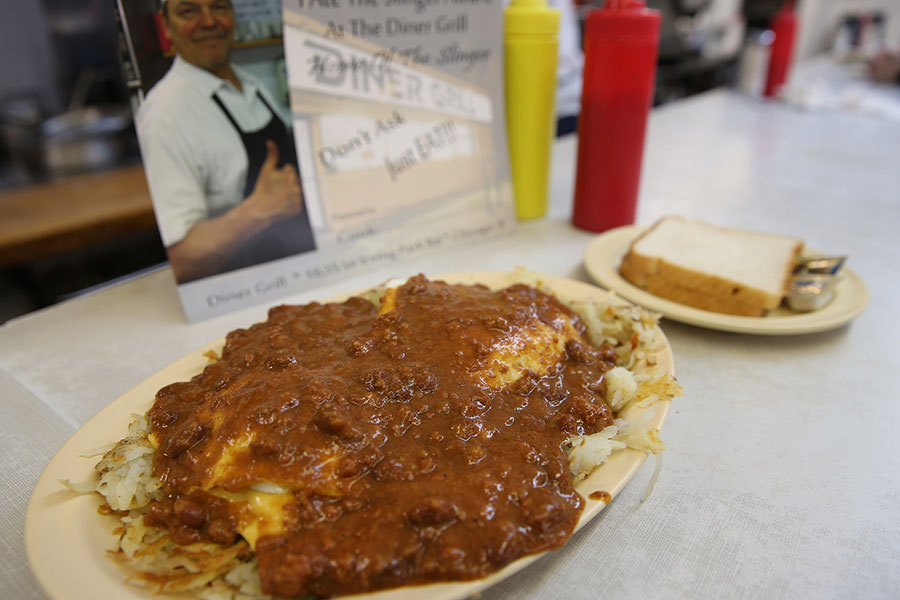
Plenty of people do want the Slinger, though. The wall behind me was papered with Certificates of Completion for the Slinger, bearing the glutton’s name and signed by the waitresses and cooks. And t-shirts are on sale for $15. If you’ve eaten at Diner Grill, you’ve got to brag about it.
By the time I reached S&G Restaurant in Lake View at 9:30 a.m., the breakfast crowds were beginning to pick up. S&G is named for Sam and George, two now-deceased Greek immigrants who led “good lives,” according to head waitress Marie. Almost every time the door opened, she greeted the customer by name, and acknowledged their dining habits.
“Well, hello. Nice to see ya? You gonna grab your spot? Mario. I have to give you your hat.” Marie handed the man a plastic bag. “It’s been driving me crazy. Good thing it’s not too cold today. Elliott, let me give you some decaf. Tina, do you need some water?”
“Everyone is a regular, once they find us,” Marie said. “They like comin’.”
I settled down in a booth to figure out the previous day’s crossword puzzle. Then I examined the menu, which runs several pages and included 29 – 29 – different skillets. There’s a neon sign for Grecian Delight Gyros, in case you couldn’t figure out this place is Greek.
After I finished the puzzle, Marie introduced me to one of her regulars. Every Wednesday at 10 a.m., Sandy (I think that was her name), gathers with several other painters at the S&G.
“We have an art meeting that has been meeting for several years,” she said. “I don’t just get a glass of water, I get a pitcher. I know that sounds strange, but it makes a difference. I like to get the turkey sausage and eggs and toast.”
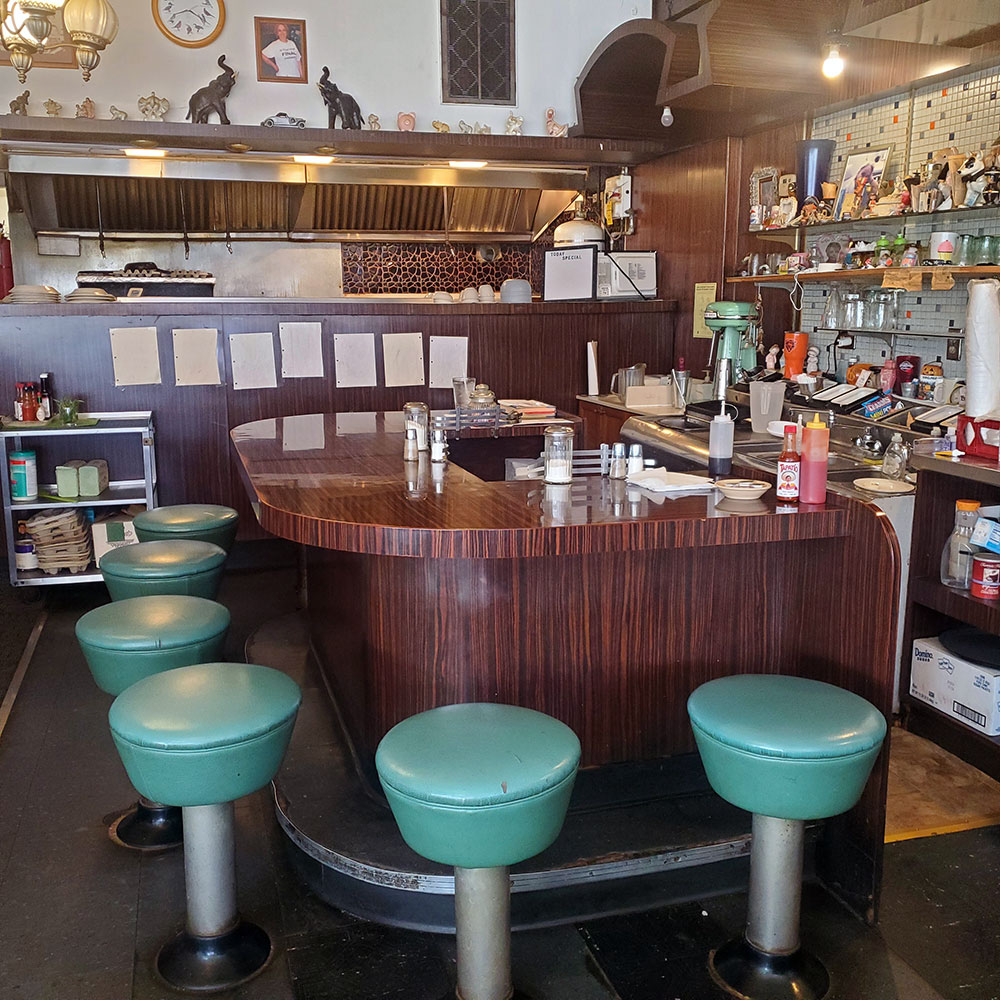
On my way to the Northwest Side, I stopped at a Walgreens for the day’s Sun-Times, with a new crossword puzzle. Then I visited the New Delta Restaurant in Kilbourn Park, which the cracked lettering on the window advertises as the Friendly Delta Restaurant. The New Delta is directly across the street from the single-room occupancy Hotel Elinor, providing a customer base. I discovered the New Delta when I was researching a story about walking the length of Belmont Avenue. Its owner and only employee, Penny Revels, is indeed the friendliest short-order cook I’ve ever met. I had to save the New Delta for later in my trip, because it doesn’t open until 10 in the morning.
“Why do you open so late?” I asked Penny.
“Because I’m the only person who works here,” she said. “I work from 10 to 6.”
At the New Delta, I finally ordered breakfast, because I like Penny’s cooking, and because a Denver omelet with hash browns is only $11.
“It’s not a rich neighborhood,” Penny explained, “and I don’t believe in charging someone 10 times more than it’s worth.”
I skipped the coffee. By then, I needed the bathroom. (“It’s the door on the left. It says ‘Out of Order,’ but it works.”) There were no paper towels, so I used a napkin. After she served me breakfast, Penny ruminated on the disappearance of diners.
“It’s like you don’t see them anymore,” she said. “When we were growing up, they were on every corner. Huddle House, J.B.’s, Demar’s. Everyone would rather go to IHOP and Denny’s, places where you can’t talk.”
Besides me, the only customer at the counter was Miguel, who was sealing envelopes full of advertisements for his accounting business. Miguel comes to the New Delta every day for Penny’s chili.
“A lot of older people used to come in,” Penny said. “A lot of them have passed away, moved. I still get regulars, but not like the old people I knew. I get a younger crowd, but they’re all such good kids. I like ’em.”
Lou Mitchell’s in the West Loop started out as a diner in 1923, and still has its original neon sign, but has matured into a tourist destination. Three years after Lou Mitchell’s opened, Route 66 was dedicated, and the restaurant’s location less than a mile from the starting point made it the first of what became many of the highway’s roadside eateries. Route 66 was decommissioned in 1985, but still maintains its attraction to drivers seeking an all-American road trip. Many of those trips begin with breakfast at Lou Mitchell’s. I once stopped in here before a bike excursion on the first few miles of Route 66, and fortified myself with a bowl of oatmeal. This time, I drank coffee and finished my second crossword of the day.
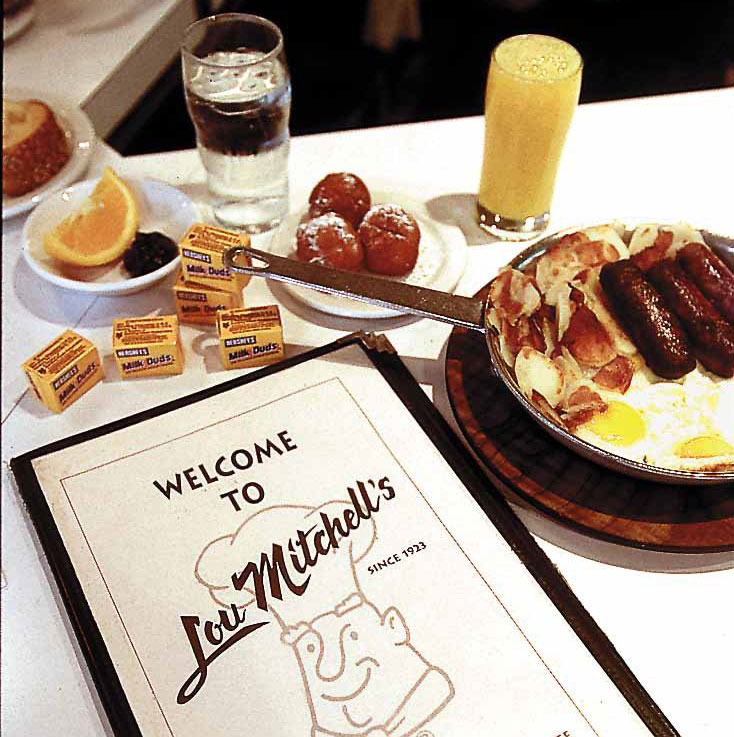
“There’s a lot of groups that come in from Germany and they know it’s Route 66,” said Audrey, the manager. She handed me an Illinois Route 66 Scenic Byway Visitor Guide. Lou Mitchell’s was the first entry in “Land of Classic Dining:” “Lou’s has served up hearty meals, with a side of quirky tradition — milk duds for the ladies and donut holes for the gents.”
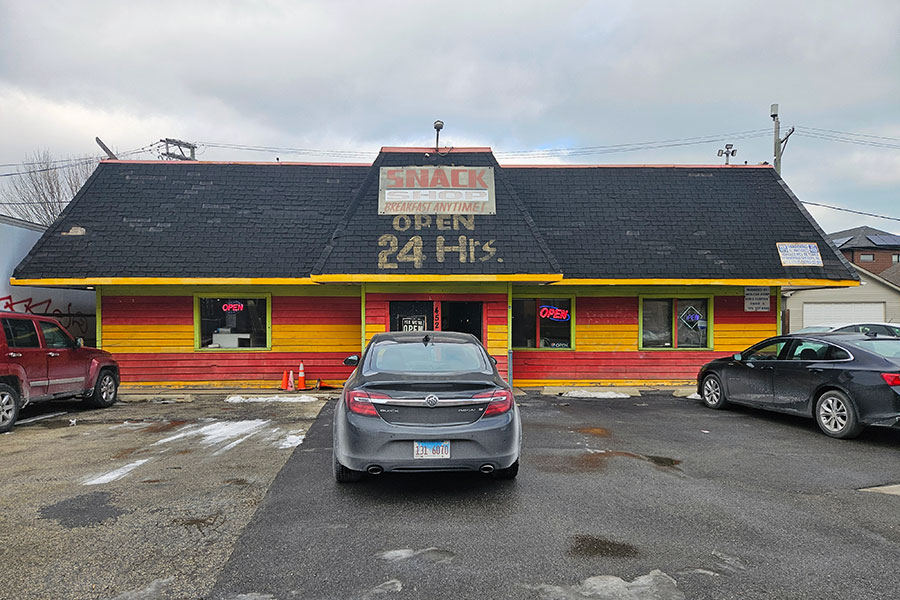
The humblest diner in Chicago has to be the Snack Shop in Bridgeport. It’s a weathered hut that looks like a rural truck stop, with a sign advertising Open 24 Hours. That’s no longer true, because Jose, the only cook, only works from 6 a.m. to 2 p.m. Another sign out front warns, “Trucks One Hour.” (Some drivers tried to sleep in the parking lot.) Inside, a TV behind the counter was playing a cooking show, and Jose was sweating over a takeout order of corned beef hash, eggs, and grits. His daughter, Audrey, worked the cash register.
“It’s a neighborhood place,” Jose told me, during a break from his cooking. “Some people come from far away, because they don’t have a place like this. I cook all the food. I try to put another, but the customers say, ‘You’re not in the kitchen, I’m going.’ I work seven days a week. Closed on holidays.”
One of the customers who comes from far away is Gil, an eightysomething man with a gray beard and a sable brown toupee. He was sipping at the soup of the day, beef barley. Gil lives in the diner desert of Hyde Park.
“It’s an upgrade to go to McDonald’s,” he cracked. “Popeye’s. I got no one to cook at home.”
“You got to get you a wife,” said his booth companion.
“Then I’d have two headaches!”
“This gets me out of the house, ’cause I’m alone,” Gil said. “Get out and get something to eat. It sits off the street. You don’t see it. I’m trying to get the owner to paint it brighter colors.”
Daley’s Restaurant in Woodlawn claims to be the oldest in Chicago, a boast verified in David Anthony Witter’s book Oldest Chicago. Daley’s was founded in 1892 by an Irish laborer named John Daley (no relation to the political family) who wanted to take advantage of the crowds visiting Chicago for the World’s Columbian Exposition.
It’s the fanciest of the diners I visited, oozing South Side urbanity with a brick facade, exposed ducts, chandeliers, and R&B music bouncing out of the speakers (this current, 5,900-square-foot space is across the street from its previous location and opened in 2019). As the population of the Woodlawn neighborhood has changed, Daley’s has become a part of Chicago Black history. There’s a famous photo of Muhammad Ali under the 63rd Street L tracks outside Daley’s, where he often ate. Daley’s also displays photos of Nat King Cole and Harold Washington, who were likely customers.
“I found out about it from my uncle,” said Kiara, a customer on her way to pick up her daughter at King High School. “He was a regular. When I’m on the go, I like the coffee. When we sit down, it’s the chicken and waffles” — the most popular item on the menu.
Me, I ate a BLT with fries. Daley’s may not look like a diner anymore, but that’s diner food just the same.
Diners are not the fanciest restaurants, but they are the friendliest. My own definition of a quality restaurant is one that serves the most amount of food for the least amount of money. No place does that better than a diner. Some of my favorites have closed over the years — Huddle House, Uptown Snack Shop — but there are still enough around that you can eat in a different one every day of the week. The diner may not be ubiquitous anymore, but it’s far from dead.