


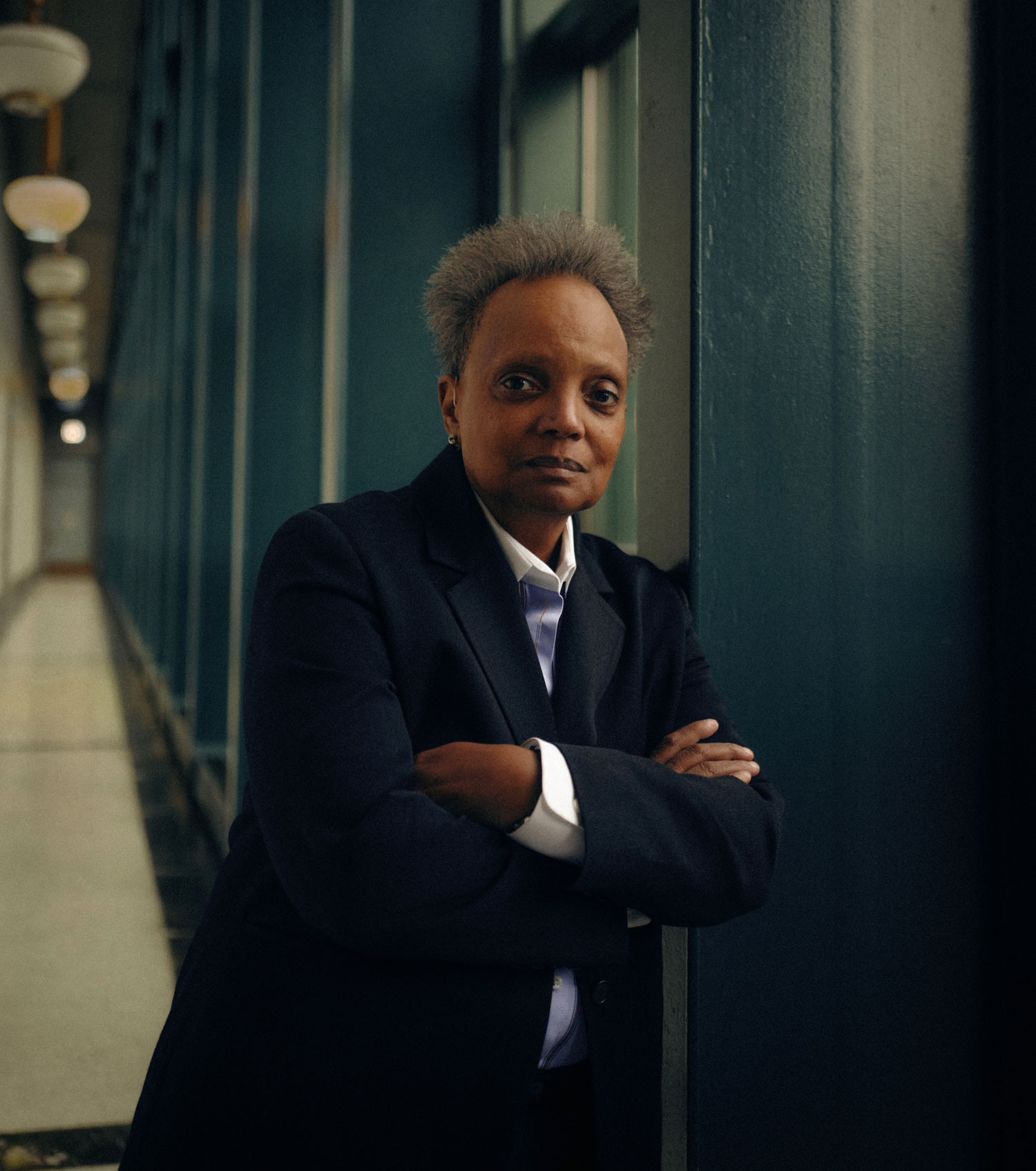
Even though Lori Lightfoot is out of office, the former mayor is not out of public service. “I’m not inclined to sit on the sideline,” she says. Sparked by what she sees as the preeminent social justice issue of our time, she has started the ICE Accountability Project. Its website (reporticenow.com) invites citizens to upload videos and stories of abuses by federal immigration agents so that the documentation can be used to support possible legal action.
This interview was conducted before the fatal shooting of Alex Pretti by a U.S. Border Patrol officer in Minneapolis this weekend.
What made you want to do this?
I watched with great interest what was happening here in September, and as things got rolling along, at Broadview, with agents upon the roof firing [baton rounds] indiscriminately into the crowd of peaceful protesters. It pissed me off. I had a conversation with one of my folks who said, “Well, what would you have done if you were mayor?” I thought a lot about that. I wouldn’t be sitting on my hands. Even as a private citizen, there are things that can be done. What really motivated me was to create transparency, to give people a feeling like they could take some control over what was happening by assembling a body of evidence that was undeniable, that would galvanize people to say, “Hey, local government officials need to do something. We cannot look away.”
Do you think ICE should be abolished, or is there a better way of deporting undocumented immigrants?
Those are really two different questions, right? Given the way that ICE has conducted itself over this last year, if there is a change in administration, it’s going to be very difficult for this agency to exist in its current iteration. And to be clear, we’re not talking about just ICE. To some extent, the worst offenders are the Customs and Border Protection agents. They are simply not trained to conduct law enforcement activities in an urban environment. From what I can see looking at videos of their activities, both in Chicagoland and now in Minneapolis, there seems to be a significant lack of supervision. They’re going out in teams of twos and threes, maybe four. And then when they get a target, there’s a swarm, but there doesn’t seem to be an adult in the room who is making sure that the rights of the people they’re targeting are not violated.
“I am stunned that there hasn’t been seemingly any effort made by the state’s attorney’s office to investigate a homicide in Cook County.”
Do you think the Trump administration is sending these federal agents a message that any use of force is acceptable?
I absolutely do. Take the example of Renee Good. Within minutes, but miles away, [Homeland Security Secretary] Kristi Noem was standing on a platform playing cowgirl, spewing out this statement of how Renee Good was a domestic terrorist, how she was weaponizing her vehicle, and how the agent was totally justified [in fatally shooting her]. What I know from having investigated a lot of police-involved shootings before I became mayor is that the facts always evolve. You’ve got to let the facts settle before you make a definitive statement. They don’t seem to care about any of that. And it sends a message to the agents in the field: We can do whatever we want because the folks in Washington are going to say we’re fine.
Is Renee Good’s killing a turning point in the way the public views ICE operations?
I have been thinking a lot about the analogy with the civil rights movement. I was too young to really remember, but everything I’ve read says that when the national media went south and saw the Bull Connors of the world training dogs and fire hoses on civil rights activists who were peacefully protesting, that shocked the consciousness. I do believe that there is something about the murder of Renee Good that has had that same kind of catalytic effect on people. The silent majority is repulsed by what they’re seeing, appalled that in 2025, 2026, the federal government is turning on its residents in this way.
Why do you think the killing of Silverio Villegas González in Franklin Park didn’t produce nearly as much outrage?
You’re asking me an obvious but difficult question. The truth is, I don’t know the answer, but I do think it has something to do with the fact that he was a Latinx immigrant. People were outraged that this white woman got killed. We can’t separate the possibility that race has made the difference in the way these two things have been covered. They’re really very similar [incidents]. Mr. González had just dropped off his kids at [school]. He’s in his vehicle. Two masked men with weapons are coming up to him and don’t have any insignia on them that suggests they are even remotely related to law enforcement. He may have thought that he was getting carjacked and took off. That traffic stop should be played at law enforcement academies as to how not to do a traffic stop. It was botched from the very beginning.
Should that incident have been investigated by local officials?
No question whatsoever in my mind. I am stunned that there hasn’t been seemingly any effort made by the state’s attorney’s office to investigate a homicide in Cook County. Same with the shooting of Marimar Martinez. That officer clearly should have been charged. All the incendiary stuff — the text messages, the statements captured on the bodycam — that cries out for an investigation. But what we also know is that Ms. Martinez and the estate of Mr. González can absolutely bring civil suits. The U.S. Supreme Court has said as much.
Is that an example of the kind of legal proceedings the evidence you’re collecting could support?
Our goal is, let’s gather the information, let’s have a centralized repository, let’s unmask these agents who are accused of doing the most egregious things. Like the officer in Evanston who, when an individual was on the ground, not resisting arrest, face down, hands behind his back, decided that he wanted to punch him in the head. That’s on video. If those were police officers, we would be way beyond questioning whether something should be done.
Are you going to expand this project beyond Chicago?
We have built it so that it is scalable. We have built it so that it can be replicated. We are in the very early stages of doing some outreach with Minneapolis. Mayors across the country — I notify them to let them know this tool exists.
Do you think this is the biggest social justice issue facing the country right now?
Without a doubt. Because people are being hurt. I saw a video today on my Instagram feed. It was from Minnesota, a young man who was supposedly 17 pulled out of a Target store. He’s saying, “I’m a U.S. citizen. I’m a U.S. citizen.” These masked thugs throw him into the back of a van. They later drop him off, and he’s bleeding profusely. He is hysterically crying. It made me think back to when I was involved in the [Chicago] Police Accountability Task Force. One young Black man we talked to from the South Side — 16, 17 years old — he had been stopped so many times just walking down the street doing nothing. That trauma that that young man was carrying with him from being thrown onto the ground, thrown over the hood of a car, handcuffed behind his back for nothing will stay with him for the rest of his life. When I saw the video of the [Minnesota] kid, I thought, That’s what he’s going to think our government is about. We are doing deep harm to this generation. My daughter’s generation. How can we survive as a democracy if that is the message that we are sending to our youth?