

David Byrne knows exactly what inspired his deep dive into neuroscience. But given that brains are tricky things, he can’t really recall precisely when. “I don’t remember the date. It was at least 10 years ago,” the Rock & Roll Hall of Famer ponders over lunch at Nonnina in River North.
No matter. The important thing is that he read about an experiment conducted by Sweden’s Karolinska Institutet in which people, outfitted with a head-mounted camera display, were tricked into feeling like they were the size of dolls or giants. The results, published in 2011 under the playful title “Being Barbie,” proved that a person’s height shapes their perceptions of the world. “That got me started,” Byrne says, “not just reading about such things but thinking, I want to experience this. It sounds like fun!”
Now 73, the modern-day Renaissance man — musician, visual artist, film director — nurtured his curiosity into a decade-long creative quest. It led him across two continents and, now, to Chicago, where he’s teaming with Goodman Theatre to present Theater of the Mind, a boldly interactive show opening March 11.
His partner in this adventure is Mala Gaonkar, a rock star herself in the world of hedge funds and investment management; she also writes short stories on the side, one of which was shortlisted for a Pushcart Prize. The pair share a passion for neuroscience, as well as each other: They began dating while developing the project and married last year.
Along that journey, they consulted a passel of scholars at various universities, from Stockholm to Urbana-Champaign. “We found it so fascinating — how our mind works, how it doesn’t work,” Byrne recalls. “We wondered: How can we bring this to the public? Given my background, I leaned towards doing it in an art gallery. Mala thought about doing it in a science museum. We ended up with a theater piece.”
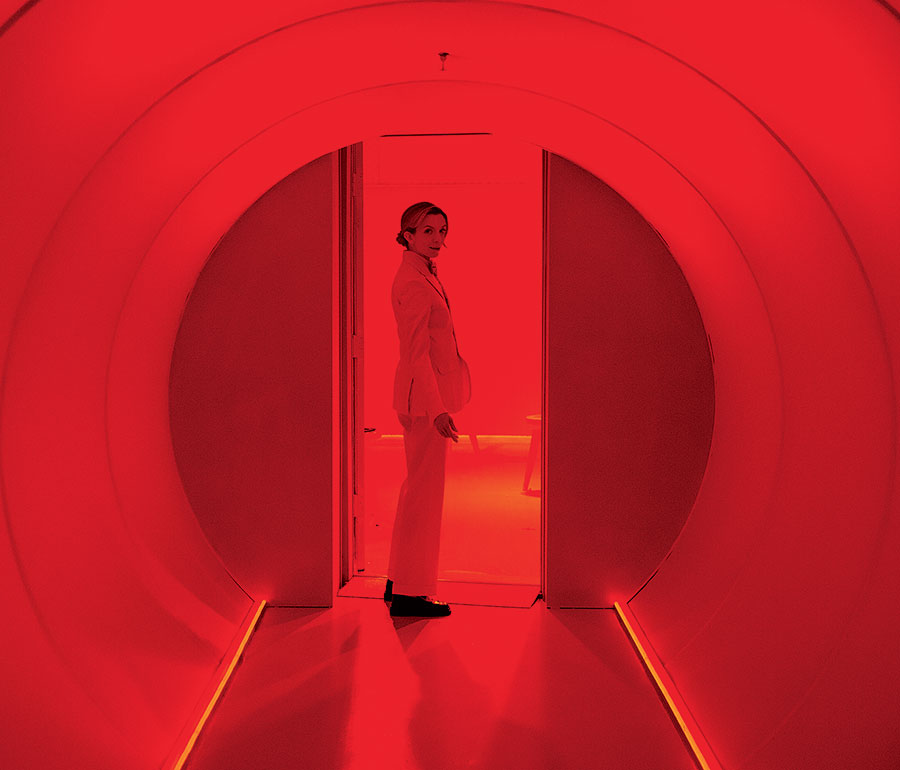
Don’t expect a musical or a concert-theater hybrid, like Byrne’s two Broadway outings earlier this decade. Rather, this is a site-specific show wherein an actor escorts audience members, 16 at a time, through a series of 10 rooms. Each features a chapter of that host character’s life story (told in reverse chronological order) and incorporates a concept that challenges perceptions of reality.
The Mind actors all play the same white-suited host named David. Despite that moniker, the narrative is not a Byrne biography, though it draws loosely on moments from both his and Gaonkar’s lives. They developed the story as a means to introduce various neuroscience concepts. Some rooms feature low-tech effects, like using a disco ball and colored lights to induce an optical illusion, or serving a West African berry that alters how foods taste. Others are more high-tech: In one room, audience members don VR glasses, inducing their own “Being Barbie” experience. “What does it feel like to be a foot and a half tall?” Byrne says. “Well, you’ll find out.”
“We found it so fascinating — how our mind works, how it doesn’t work,” Byrne recalls. “We wondered: How can we bring this to the public?”
Interestingly, despite Byrne’s musical prowess, the creators largely avoided exploring the effects of that medium. “Music hits too many parts of the brain,” explains the former Talking Heads frontman, who won an Oscar for his score to the 1987 epic The Last Emperor. “There’s the cognitive part dealing with words; there’s pattern recognition with rhythm; there’s aural perception with sound. It’s too complicated.” (That said, Byrne did write one new tune for the play. Notes Mind director Andrew Scoville, who grew up in Elmhurst: “The song is a banger.”)
The first iteration of the show, then called Neurosociety, was mounted in the Bay Area in 2016. “That was kind of a test,” Byrne says. “We had a conceit, but we didn’t have a story. It took a lot of rewriting.” The first fully staged version came to fruition in Denver in 2022, fittingly enough in a former cannabis-growing warehouse. For the Chicago run, the Goodman has remodeled 15,000 square feet of a vacant floor in the historic Reid Murdoch Building, the red-brick Chicago landmark on the north bank of the river.
Currently, tickets are on sale through May 31, but Goodman officials, as well as Byrne, would love to see the show inspire enough return visits to warrant an open-ended run. “Our hope is that this becomes a destination,” Byrne enthuses.