Northwestern’s longtime lacrosse coach built an unlikely dynasty in the 2000s — and then the trophies stopped coming. To turn things around, she embraced an unusual strategy: focusing less on winning.
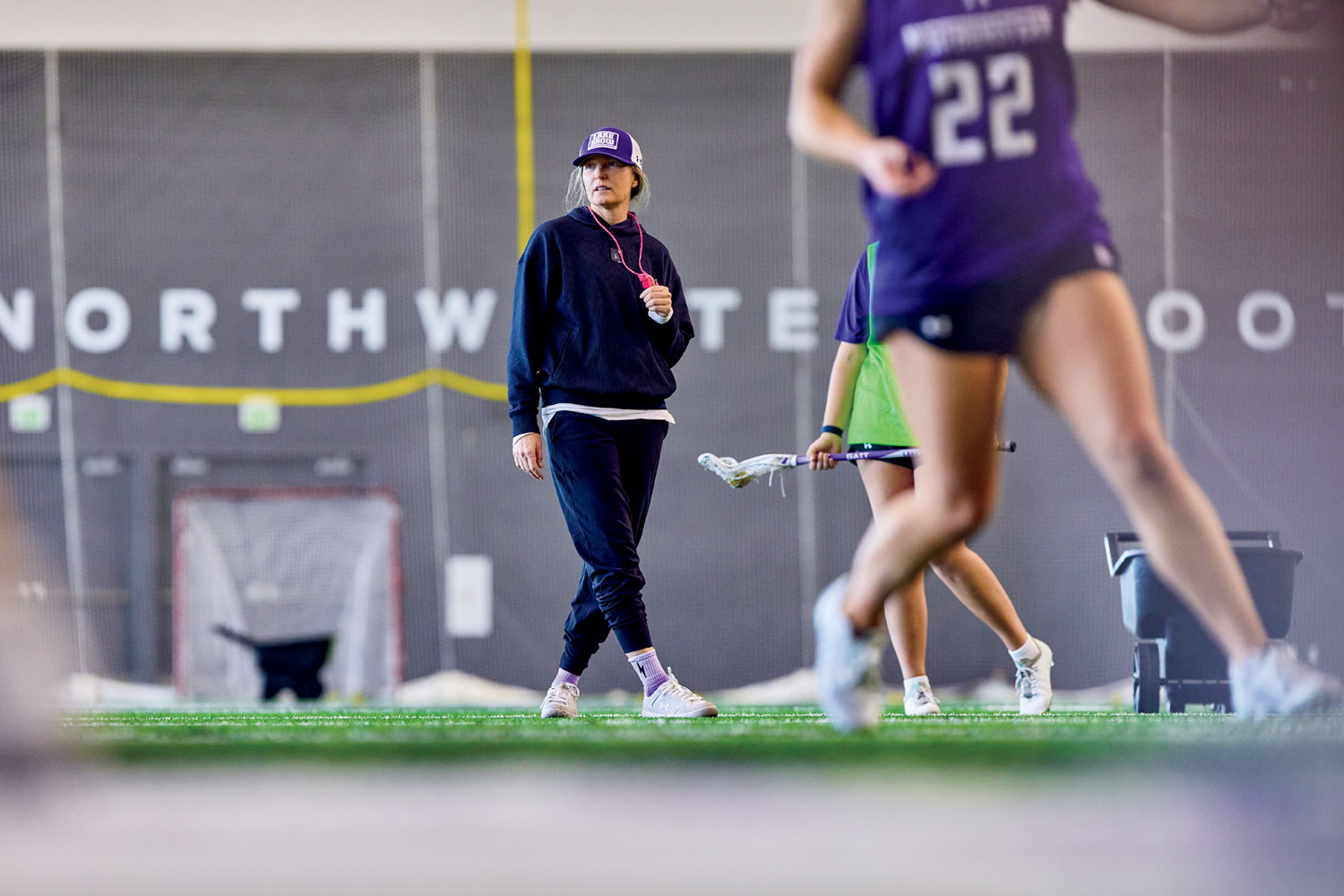
On a frigid Sunday night in February, five days before the start of a new season, the Northwestern women’s lacrosse team gathers not in its glassy, palatial lakefront home at Ryan Fieldhouse but in the refurbished indoor complex, a little more than a mile down the road, where the baseball and softball teams practice. A fencing tournament has displaced the lacrosse players. The setting is quaint, temporary, a tiny bit awkward. The purple-and-white jerseys are anything but.
They say “Northwestern” across the front, which in lacrosse parlance translates to something quite distinct. Over the last two decades, the Wildcats have become the most dominant program in the sport, winning eight NCAA championships and becoming punch-your-ticket regulars at the Final Four each Memorial Day weekend. They are the Midwest outlier that long ago blew up the idea that lacrosse greatness belongs exclusively to its East Coast stronghold.
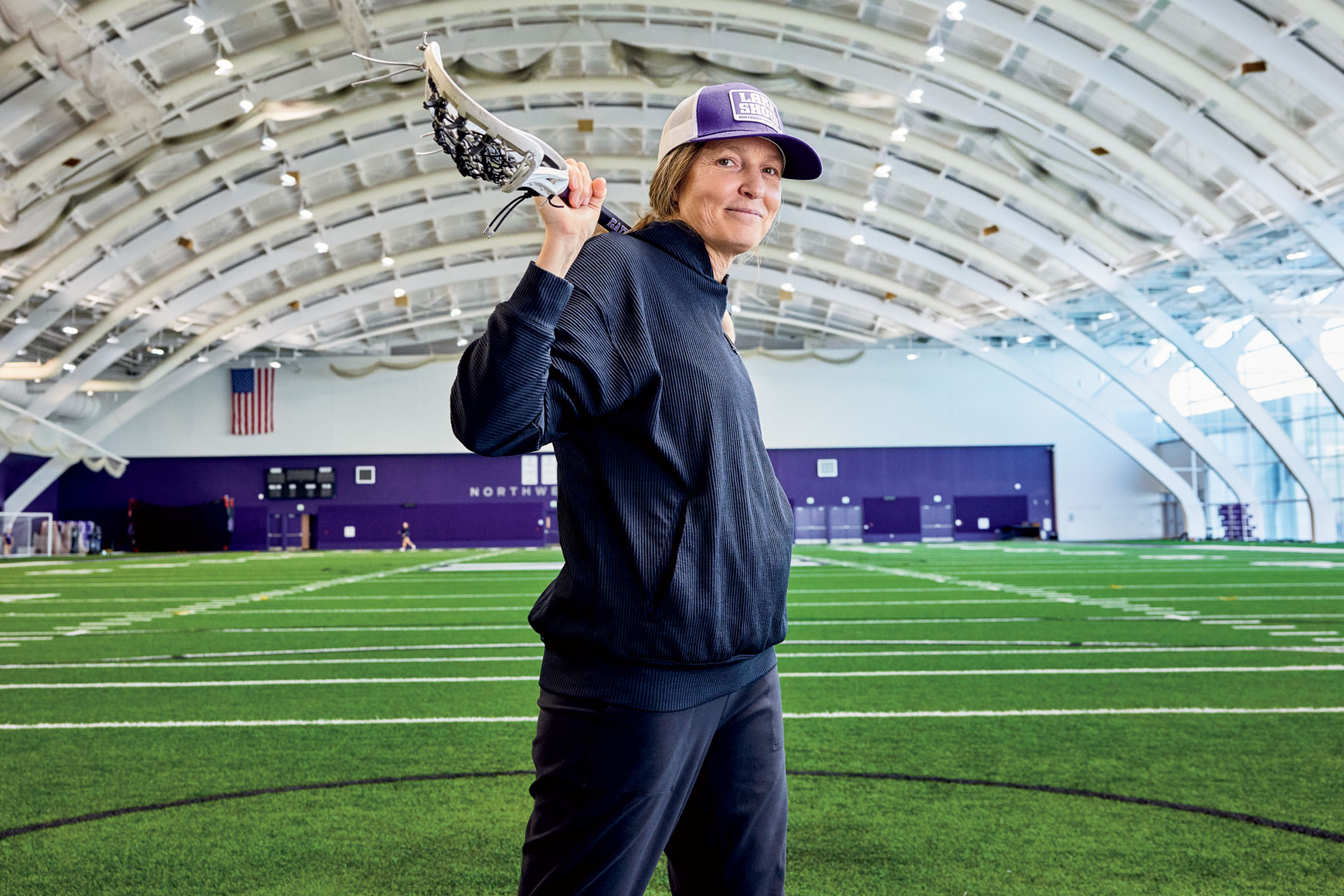
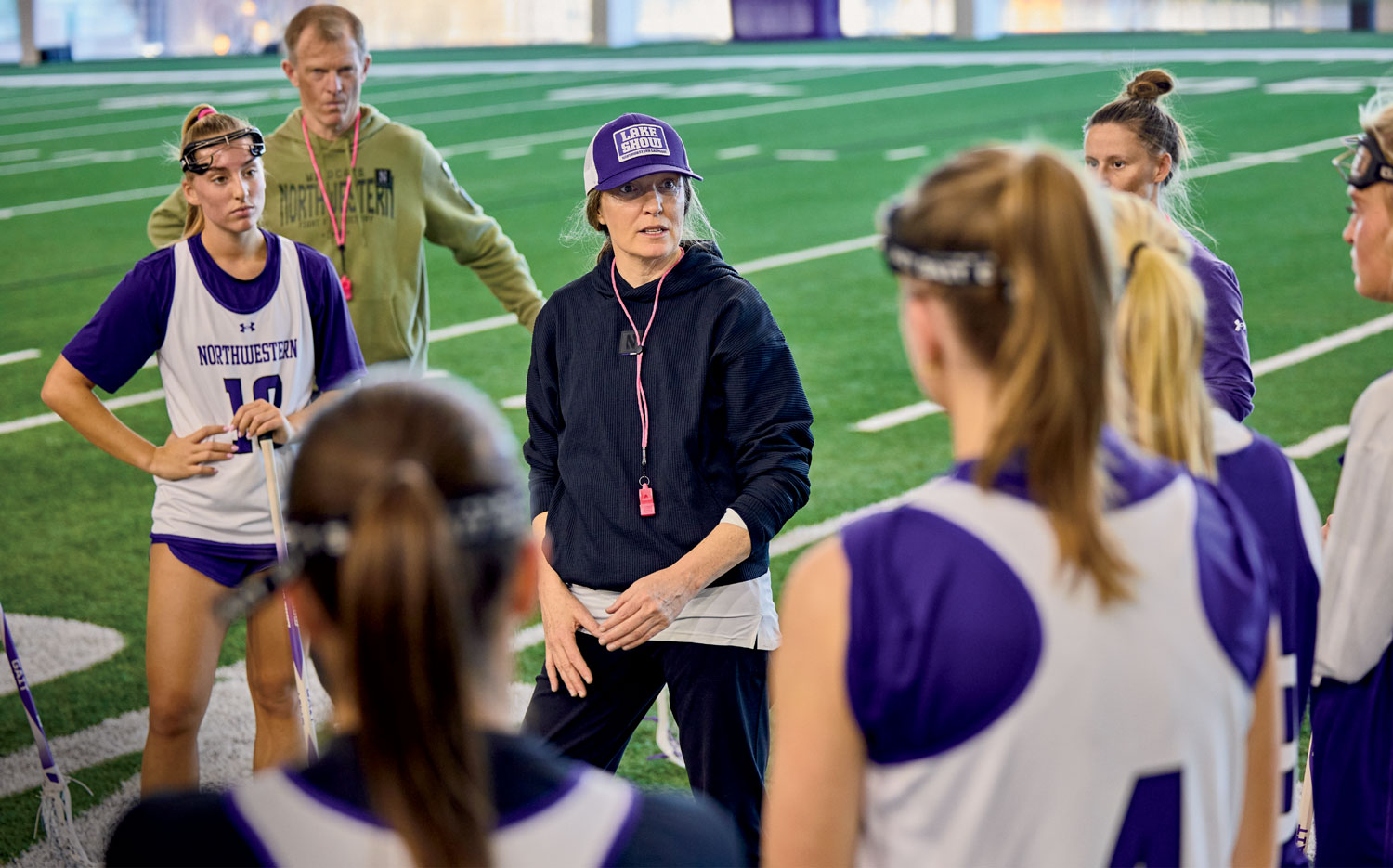
After a spirited two-hour practice on the small field, coach Kelly Amonte Hiller, the woman who built this dynasty, stands in front of her team, arms folded, voice even. The Wildcats are ranked No. 2 headed into the season, Amonte Hiller’s 24th as coach. No. 3 Boston College awaits in the opener, as does the promise of a new season that will culminate in May with the national semifinals and championship being played in Evanston — the first time the Final Four will be held outside the Eastern time zone.
But on this day, the opportunity to win a ninth national title on home turf is still months away. Tonight, Amonte Hiller simply reminds her players of the basics. To eat well. Get rest. Take care of their bodies. Then she pauses.
“And if you hit a roadblock,” she says, “talk to someone.”
She doesn’t spell out what a roadblock might look like. It could be a challenge in the classroom. A problem at home. Or the quieter distraction every team sport athlete knows well: worries about your role.
There’s no edge to Amonte Hiller’s instruction. What might seem trivial is in fact the foundation of how she has built and sustained a lacrosse power in Evanston. By teaching her players not to hide from pressure but to withstand it. And by evolving as a coach, even if the way she’s done that goes against everything she once believed. Bouts of failure will do that to you.
The players disperse, giggling as they head into the winter night. Amonte Hiller and her husband and assistant coach, Scott Hiller, follow. What lingers is a moment, one that had repeated itself again and again that night: Clean or sloppy, after every drill the Northwestern players had tapped each other’s sticks, a cacophony of plastic and mesh. A habit so small it’s easy to overlook. But one that is anything but accidental.
Four days before that Sunday night practice, the 52-year-old coach sits at a round table in the corner of her office inside the expansive Walter Athletics Center on the north end of campus. A standing desk dominates the room. To its left, a small shelf holds keepsakes from decades in coaching. There’s a picture of her father, who died in 2009. Handwritten notes from former athletic director Mark Murphy, a mentor who went on to become president of the Green Bay Packers, and from Olympic silver medalist Kennedy Blades, a wrestler she helped guide through the 2024 Games.
Affixed to the wall behind Amonte Hiller are two framed items: the cover of a Sports Illustrated from 1999 that ranked the 50 greatest sports figures from Massachusetts (Amonte Hiller, a four-time All-American in lacrosse at Maryland, was No. 21) and a Chicago Sun-Times back page highlighting the day she threw out the first pitch at Wrigley Field in 2021.
Otherwise, there are no trophies or medals in this office bragging about Amonte Hiller’s accomplishments. “I’m not a big one for awards,” she says. “I don’t care about that stuff.”
Winning a lacrosse title was an improbable triumph for a school in the Midwest. “Like building a championship ski team in Florida,” says Amonte Hiller’s husband, Scott Hiller.
Twenty-six years ago, when Northwestern asked Amonte Hiller about restarting the women’s varsity lacrosse program, which the university had killed for financial reasons, the then-26-year-old initially wanted no part. At the time, she was an assistant coach for the women’s team at Boston University, and her husband was an assistant coach for the men’s team at Harvard. The couple were building a life in New England, surrounded by family. But Scott implored her to at least take the interview.
She called her brother Tony Amonte, then captain of the Chicago Blackhawks. He vouched for the city. She reached out to her college coach, Cindy Timchal, who had coincidentally led the Wildcats through the 1980s before leaving to win eight titles at Maryland. Timchal told her how much she loved her time at Northwestern. On her visit there, Amonte Hiller hit it off with the school’s leadership. She jogged along the lakeshore on a sun-filled day, admitting to herself it all felt right. Still, she was hesitant. Scott reminded her they could always return home if she didn’t like it. “And I’m still here,” she says. “Never went back.”
Most everything Amonte Hiller says is delivered evenly, typically with little emotion. Nothing rushed, nothing performative. Until the topic changes to her older daughter, Harlee, a freshman wrestler at the University of Iowa. A mention of her brings an ear-to-ear smile. Amonte Hiller admits that on match days she sometimes sneaks a Hawkeyes shirt under her Northwestern gear. “I get a hard time for that around here,” she says. Amonte Hiller pulls out her phone and leans in with a video to share. “Watch this,” she says. Ten days earlier, Harlee pinned the nation’s seventh-ranked wrestler in her weight class. “I love it.”
Sunlight bounces off Lake Michigan below, pouring into the fourth-floor office and spilling across the carpeted floor. From here, you can trace the shoreline south, past the snow-covered lacrosse field beneath her window to the Chicago skyline. Willis Tower rises in the distance. So, too, does the Hancock. It’s a view that offers perspective — a reminder that no single game, season, or setback defines what Amonte Hiller has built. “I truly believe that what you’re given is what you need,” she says.
A RUN FOR THE AGES
Kelly Amonte Hiller’s eight titles and 16 Final Four appearances during her tenure at Northwestern have put her in rarefied company. Only John Wooden (UCLA men’s basketball), Dan Gable (Iowa men’s wrestling), Cael Sanderson (Penn State men’s wrestling), Anson Dorrance (North Carolina women’s soccer), and Geno Auriemma (Connecticut women’s basketball) have built comparable NCAA dynasties.
National championship
Final Four appearance
Nicole Beardsley Montag was a high school sophomore in upstate New York in 2012 when Northwestern won its seventh national championship in eight years. She was in the stands that day at Stony Brook University, watching her first college lacrosse game in person while picturing herself in purple and white, playing for Amonte Hiller.
Amonte Hiller had forged the Northwestern juggernaut the only way she knew how: all in, all the time. In the beginning, it was a complicated blend of unwavering confidence and youthful naïveté. In one of her first team meetings after her hiring, she told her players they were going to win a national championship. They laughed. But in 2005, just the fourth season after the Wildcats returned to the NCAA level, Northwestern won its first national lacrosse title. Proving it was no fluke, the school won six more over the next seven years. It was an improbable triumph for a school in the Midwest. “Like building a championship ski team in Florida,” Scott Hiller says.
By the time the sport adjusted, Northwestern no longer felt like a surprise. It felt like the standard. Beardsley Montag watched it all. But when she arrived in Evanston in the fall of 2014 as a highly touted recruit, something had changed. Under the weight of what had come before them, the Wildcats were struggling to maintain their extraordinary success. “Anything short of a national championship felt like a failure,” said Beardsley Montag, now an assistant coach at Northwestern. “It wasn’t a lack of care. It was a lot of care — just misdirected.” Every practice rep carried that weight. Every mistake felt amplified: I have to score this goal. I have to get that ball. I can’t let my teammates down.
In Beardsley Montag’s first three seasons at Northwestern, the Wildcats lost 27 games — more than in the previous 11 years combined. As the struggles mounted, Amonte Hiller noticed cracks she hadn’t seen before. Her program was caught between what it had been and what it needed to become. For Amonte Hiller, losing exposed something uncomfortable. “I had become hyperfocused on ‘We’re not winning,’ ” she says. “And trying to win, trying to win.”
Until then, her answer to any struggle had been to work harder. It was the formula she had always lived by. Push more. Figure things out. But when it came to fixing her ailing team, pushing harder only added more pressure, and that pressure was making things worse. “There was anxiety around the program — not just for the players, but between Kelly and I about the direction of it all,” Scott says. “We’d already done everything. So what are we doing this for if we’re not enjoying it?”
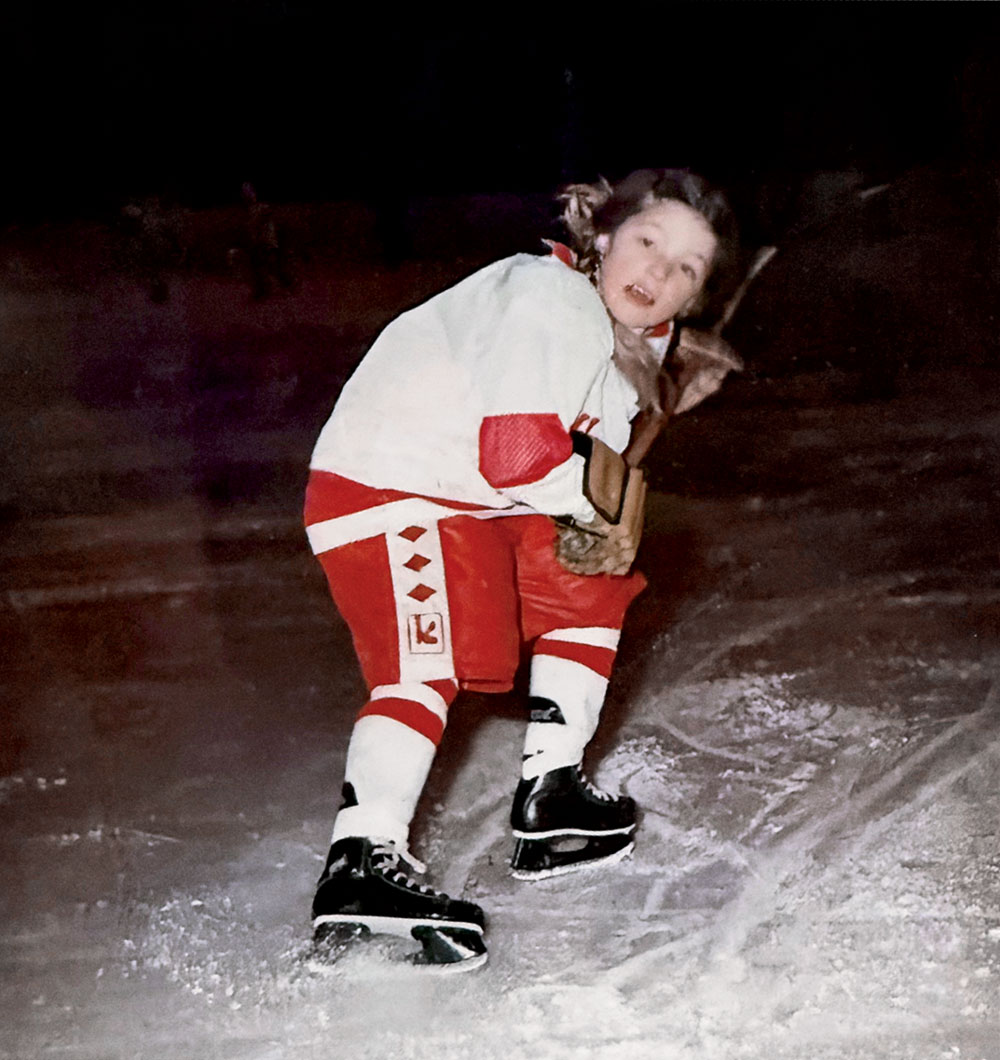
Amonte Hiller playing hockey as a 7-year-old Photo: Courtesy Kelly Amonte Hiller
After a surprising second-round loss to Notre Dame in the 2016 NCAA tournament, the head coach came to a realization she couldn’t ignore: She needed to look within. She did it deliberately and mostly alone, stepping back from lacrosse conversations with Scott in pursuit of clarity. She’d think about what was wrong while strolling along the lakefront. While driving her car. While shopping for groceries. She asked questions she hadn’t asked before: Why did I start this program? Why do I love this game? What do I actually want from all of this?
“It wasn’t just losing games, it was a loss of love,” she says now. “Love for each other. Love for the players. For the sport. I was putting so much pressure on myself. And I think everyone felt that.”
Kelly Amonte Hiller’s instinct to push harder when things wobble didn’t originate at Northwestern. It can be traced to a basketball hoop on the side of her grandfather’s barn in Hingham, a blue-collar Boston suburb. The youngest of four — besides Tony, she has another brother, Rocco, and a sister, Kim — she had to fight for scraps of everything: clothes, food, sports equipment, attention.
When she was 4, her father, Lewis Amonte, abruptly retired from the family excavation business at 37 after triple bypass surgery. The silver lining was more time with his children, but the smaller bank account was a challenge. “We didn’t have any money,” Tony recalls. What they did have was family in the neighborhood: cousins down the street, grandparents next door. Sports was their connection. Both of Kelly’s brothers excelled in hockey. But they didn’t dominate their little sister in everything. “My brothers weren’t really that good at basketball and I was,” she says.
Tony and Rocco responded the way older brothers often do when pickup games don’t go their way: They played physical. “We didn’t do her any favors,” Tony says. “If she was beating us, she was going to take a beating. There was no other way to do it. We were ruthless.” As Kelly recalls it, “I would sprint home and cry to my dad that it wasn’t fair. And he’d be like, ‘You can do it. Get a Band-Aid on and get back out there.’ ”
She watched Tony become a hockey star at Boston University, then skate onto the ice at Madison Square Garden with the New York Rangers (he would go on to play 15 years in the NHL), and decided, she says, “This is what I want for myself.” She chose to play college lacrosse at Maryland, where she developed into one of the game’s all-time greats.
After the Terrapins fell short in the championship game her sophomore year, Amonte Hiller responded by not losing another game in college, leading Maryland to back-to-back undefeated titles. (She also played soccer during lacrosse’s off-season, even earning All-American honors her sophomore season.) “She fought for every moment in every game,” Timchal says.
Tony, once the tormentor of his youngest sibling, sums it up: “She was always relentless.”
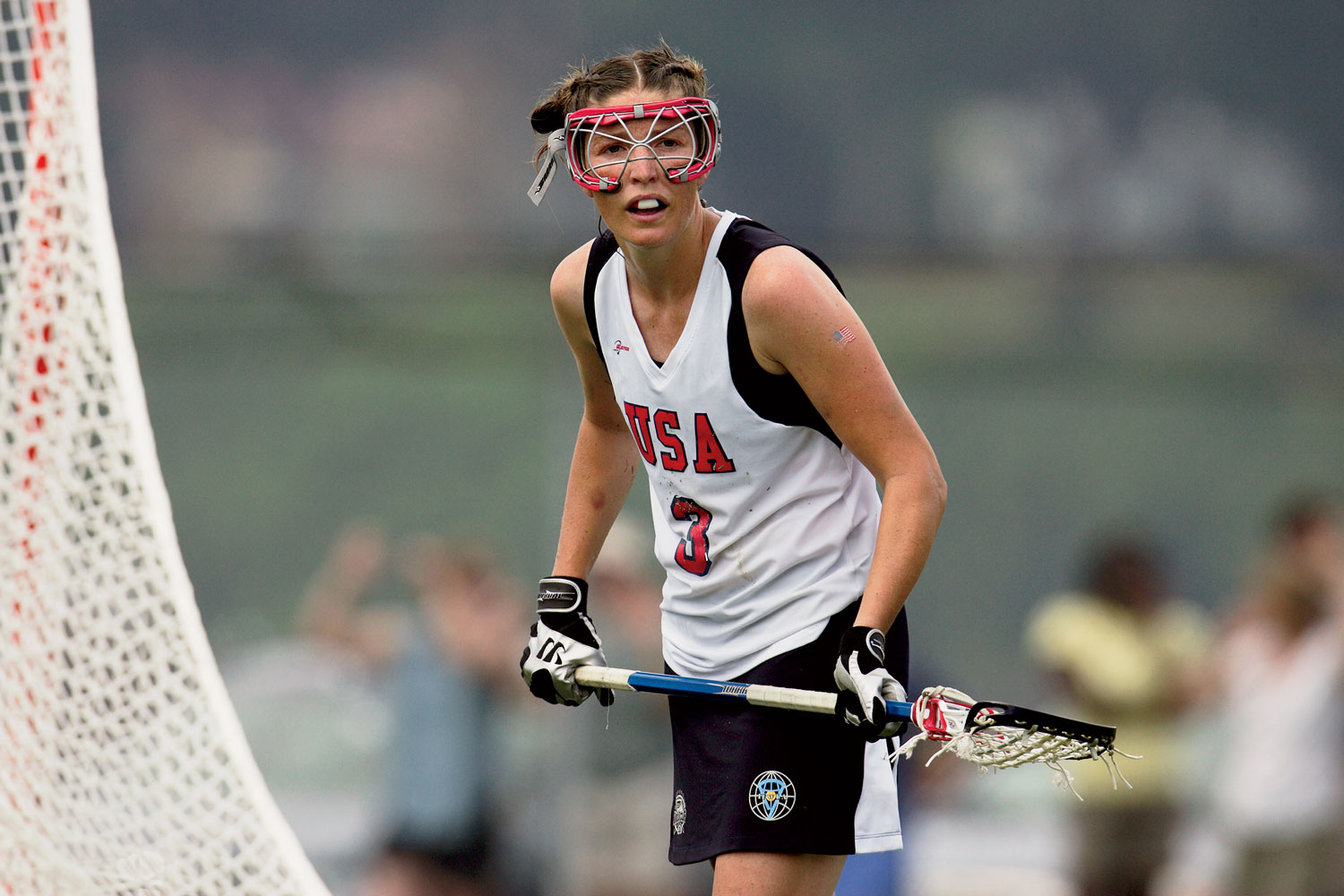
Just weeks after coaching Northwestern to its first national title in 2005, Amonte Hiller represented the U.S. at the World Cup. Photo: Kevin P. Tucker/USA Lacrosse
Which is why, after a second straight second-round defeat for Northwestern in the 2017 NCAA tournament, Amonte Hiller knew something had to change. That summer, as Beardsley Montag was preparing for her senior year, she and a few of her teammates met several times with their coach for some very honest conversations about the program. “Some of it was easy to hear. Some of it was hard,” Beardsley Montag recalls. “Humans aren’t wired to enjoy hard conversations. It’s particularly challenging when there’s a power dynamic. To have trust both ways.”
After months of reflection, Amonte Hiller sat down with her husband to share what she had learned. She came prepared with a written plan. She determined the focus would shift from outcome to process — joy, development, creativity. Winning would remain the goal, but it could no longer be the obsession. Social media had changed how athletes absorbed criticism. All that noise was difficult to ignore, and it was part of the reason Amonte Hiller felt she needed to change. “I had to think about how I wanted to coach,” she recalls. “It was an opportunity to reinvent myself.”
Scott’s response? “I was all in.” He agreed that adjusting their approach to players was critical. “Lacrosse has to be the best part of their day,” he told his wife. “There’s enough pressure. We can’t add on to that.”
Setting aside the importance of winning may sound easy enough when your résumé already lists multiple national titles. But it’s hard to embrace when you’re wired to avoid losing at all costs. So in 2019, the coaches adopted a new mantra: “Get To.” They plastered it on locker room walls and said it in huddle breaks.
“I get to play lacrosse today,” elaborates Beardsley Montag, who by then had graduated and joined the team’s administrative staff. “I get to represent this program. I get to do it with people I care so much about at an institute like Northwestern. So let it rip and go have some fun.”
There were still losses and moments where belief wavered, but something began to take hold. “It’s fun again,” Scott remembers thinking. And when the winning returned, it felt different. More intentional. Northwestern got back to the Final Four in 2019. And other than 2020, when the pandemic cut the season short, the Wildcats have been to the Final Four every season since.
Northwestern’s recalibration produced not only success but trust — trust between players and coaches and among teammates. The new approach faced its first real stress test in 2022, when the team squandered a late eight-goal lead in the national semifinal against top-seeded North Carolina. “The belief that we were trying to build, it just wasn’t strong enough yet,” Amonte Hiller says. “They came back and they came back and we lost the game. But that was such an important step for us. I was so grateful because now the fire was burning.’ ”
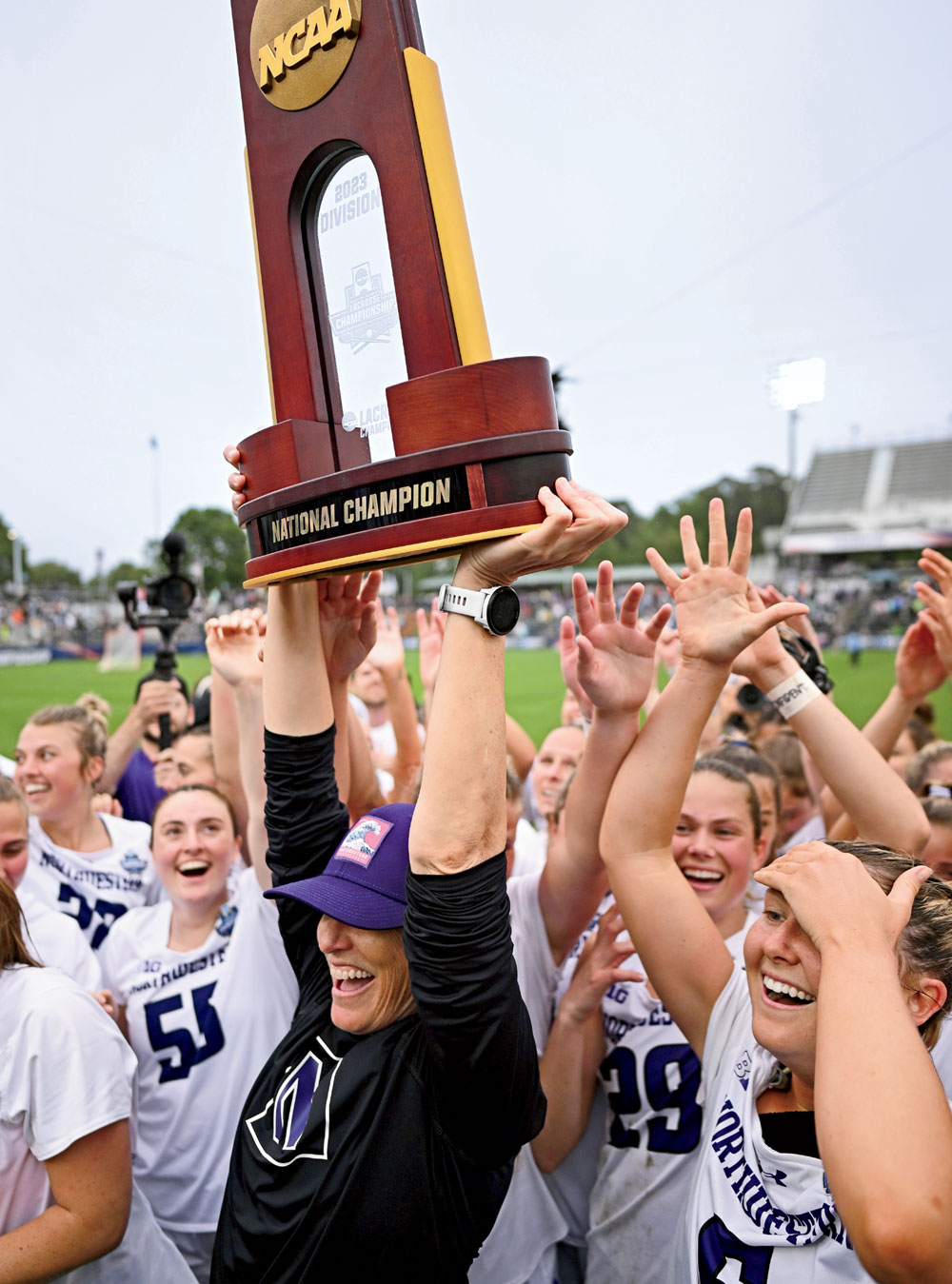
The following season, Northwestern lost its opening match against Syracuse, then ran off 20 victories in a row to return to the national title game for the first time in 11 years. There, the Wildcats dominated Boston College, winning the program’s eighth NCAA title. Included in Northwestern’s starting lineup for all 22 matches that season was a player with a familiar last name: Dylan Amonte, Tony’s daughter. The backyard brawls in Hingham had come full circle.
In each of the two seasons since, Northwestern has come up just short, losing in the national title game. But for Amonte Hiller, winning championships isn’t the end-all anymore: “I love what I do again. I loved it at the beginning, when I was inspiring these girls to believe in themselves. In the middle, we got away from that. Now I feel like I’m doing that again — but at a much higher level.”
In 2023, after an 11-year drought, Northwestern returned to the top with its eighth national title. This season it will try to win another on its home turf. Photo: John Joyner/NCAA Photos/Getty Images
The standard for the Wildcats these days is how they show up and compete. Amonte Hiller says her new outlook has fostered stronger relationships with her players. That includes Madison Taylor, the Wildcats’ latest and arguably greatest star, who last year, as a junior, broke the NCAA Division I single-season goal record, with 109. Says Taylor of her coach: “She pours belief into everyone every single day. She takes a lot of pride in having gratitude, and when that’s at the forefront, it makes you a more positive person and makes the game more fun.”
Amonte Hiller studies the mental side of her sport the way others do film or footwork. It isn’t an afterthought. It’s at the center of everything. She reads books and listens to podcasts by coaches outside lacrosse — among them Phil Jackson and Cael Sanderson, the Penn State wrestling coach who has won 12 NCAA titles. Amonte Hiller has sought advice directly from former longtime New England Patriots coach Bill Belichick, who even attended a game at Northwestern two years ago. For inspiration, she gravitates toward watching wrestling and other individual combat sports, where there’s nowhere to hide and no excuses to make.
Ahead of the 2024 Olympic trials, when Team USA hopeful Kennedy Blades was struggling with lofty expectations, Amonte Hiller, whose daughter and Blades wrestled for the same suburban Addison club, recognized the pattern. That led to weekly Zoom conversations in which Amonte Hiller worked with the 20-year-old on the mental side of performance. She helped Blades focus on her faith and gratitude instead of on living up to the label as wrestling’s next big thing. They continued to talk throughout the trials and the 2024 Paris Games, where Blades won a silver medal. “It was such a cool experience because I was learning too,” Amonte Hiller says. “I was honing my skills.”
The experience reinforced Amonte Hiller’s belief that anything she and her staff could do to take pressure off their athletes would only boost performance. Winning couldn’t be the ultimate goal. It had to be the result of players pushing themselves to reach their individual peak, whatever that might be.
When Northwestern opened this season against Boston College, the team looked every bit the juggernaut it was supposed to be. The offense flowed. The sideline crackled. Taylor carved up one of the best defenses in the country, scoring five goals. It was the kind of win that confirms preseason rankings and fuels highlight reels. In the lacrosse world, the talk began immediately. About talent. About depth. About another title run. The Wildcats returned to Evanston riding that wave.
And then, three nights later, in the home opener against unranked Colorado, everything unraveled. The Buffaloes punched first. And kept punching. Northwestern trailed for most of the night, clawed back, briefly seized the lead — and then let it slip. When the final horn sounded, the scoreboard displayed the shocking outcome: Visitors 10 Home 9. Afterward, holding their black-and-gold Colorado flag, the Buffaloes posed for pictures beneath that scoreboard.
It was Colorado’s highest-ranked win in program history and Northwestern’s first home loss to an unranked team since Amonte Hiller’s first season. For a dynasty with eight championship banners hanging inside Ryan Fieldhouse, it was far more than just a defeat. It was a test. Afterward, Amonte Hiller didn’t search for an excuse. Just as she had 12 days earlier in her office, she spoke in a calm and measured tone. “It’s about competing as hard as you can, wire to wire,” she told reporters. “I’m not sure we did that. That’s a lesson that sometimes you have to learn.”
No theatrics. No public flinch. Just clarity. Privately, she was frustrated, of course. “One hundred percent,” she admits. She knows this group’s potential. She also knows what happens when confidence drifts toward complacency. “If you don’t heed the lessons in advance, there are circumstances that will teach them to you,” she says. “Sport is the ultimate humbler.” Taylor felt it too: “We beat ourselves.”
“She pours belief into everyone every single day,” says star player Madison Taylor. “She takes a lot of pride in having gratitude. It makes you a more positive person and makes the game more fun.”
It would have been easy for a loss like this to push Amonte Hiller to tighten everything. Squeeze harder. Chase correction through control. Earlier in her career, she might have done that. “She would have been angry,” Beardsley Montag says. “ ‘How could we have done this? This is going to ruin the whole season.’ ”
But this time there was no panic. No fracture. Just a quiet reset. The message was not that they were broken. It was that they were exposed. “Once the game’s over, there’s nothing you can do about the result,” Amonte Hiller says. “You have to transition to: Where’s the learning? How can this help us?”
That pivot — shifting the focus from outcome to process — is the difference between the old Amonte Hiller and the new one. She knew she would find a receptive audience at practice the next day because of the setback. What she said and how she said it would matter. The team held its usual postgame debriefing, reviewing the surveys that players complete after each game reflecting on the team’s performance. And Amonte Hiller reminded them of something she says almost daily: that mistakes are feedback to learn from and then move forward. She shared the words of one of her former players, who once described setbacks as “good for the plot.” Says Amonte Hiller: “It’s part of our story now.”
That day at practice, the sticks were still tapping. Clean drill or sloppy drill. Goal or turnover. Plastic and mesh clacking in quick acknowledgment: Thank you for the look. Thank you for the work. Thank you for making me better. The belief remained.
The steadiness from Amonte Hiller and her staff in the wake of that loss was exactly what the team needed, Taylor says: “Sometimes the hard moments bring you closer. We talk all the time about controlling what we can control — our effort, our energy, our mindset. The results will come.”
Amonte Hiller has tried to take the pressure off her players. “Lacrosse has to be the best part of their day,” says her husband (back left).
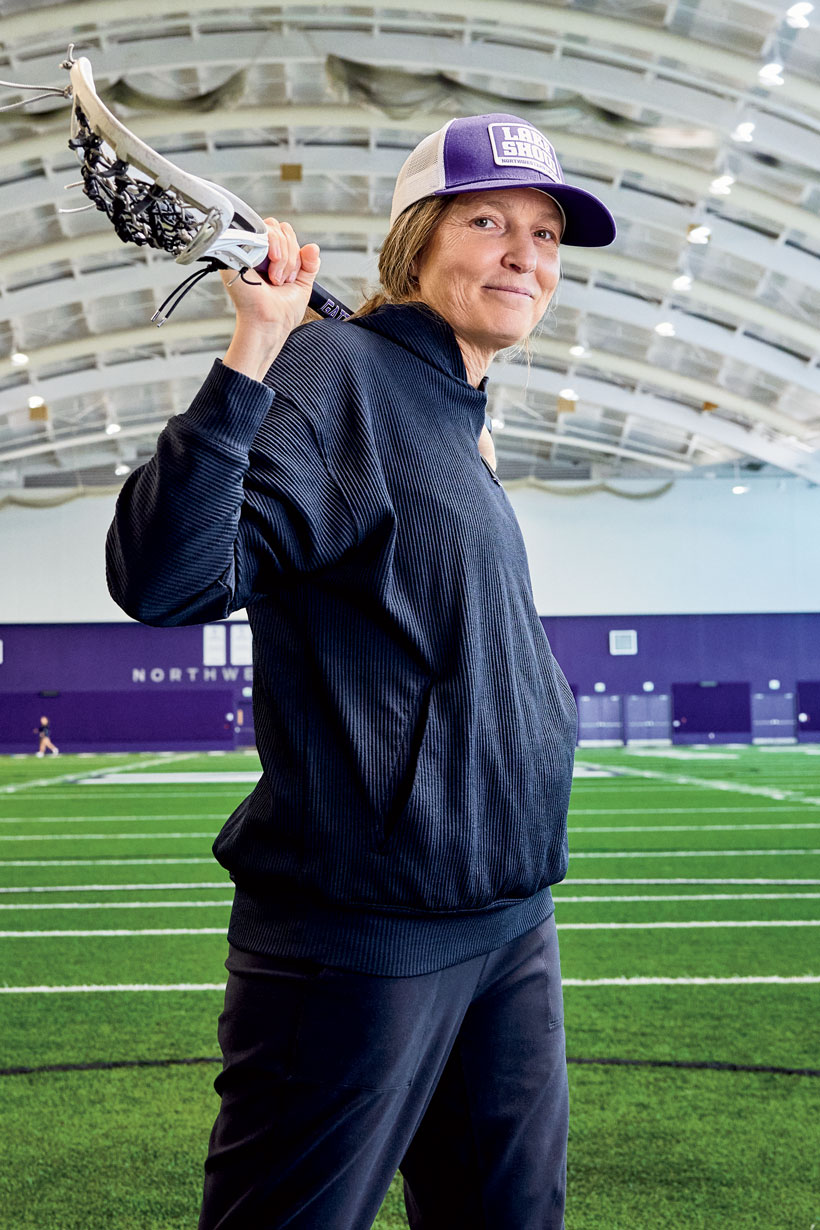
There’s a phrase that now serves as shorthand for everything the Northwestern lacrosse program represents. It’s stitched on parkas and hoodies, stamped on Amonte Hiller’s cap, and emblazoned across the massive flag behind which the Wildcats take the field: “Lake Show.”
A nod to the school’s lakefront setting, it was inspired by the branding of a Canadian lacrosse team Scott once watched. But for Northwestern, it’s more than marketing. It’s an identity. A mindset that instills resilience with gratitude.
“Lacrosse is the vehicle that we use to help women leave here believing they can weather whatever storms come their way,” Beardsley Montag says. “It’s not all going to work out just because you want it to.”
The storms have come. Some in championship games. Some on random February nights. Some when a dynasty stopped feeling joyful and the architect had to look within. What’s different now is not the expectation. It’s the response.
“I love what I do again,” Amonte Hiller says. “I loved it at the beginning, when I was inspiring these girls to believe in themselves. In the middle, we got away from that. Now I feel like I’m doing that again — but at a much higher level.”
After the 2024 national championship loss to Boston College, television cameras searched the Northwestern sideline for images of devastation amid defeat. Instead, they found Wildcats star Izzy Scane smiling. She walked into the postgame press conference with the same grin, prompting a reporter to ask her about it. “I mean, losing sucks,” Scane answered. “But it’s been a really incredible ride. I’m smiling because I love all the people I’ve met through the sport. It’s hard to not smile.”
That smile wasn’t accidental. It was built on the same foundation Taylor sees now — one shaped in the years when winning came easily and reformed in the years when it didn’t. In the uncomfortable conversations. In the recalibration. In the decision to evolve rather than cling to what once worked. “We always say it’s us versus us,” Taylor says.
Later this spring, on Memorial Day weekend, after the snow on Lake Michigan’s shoreline has melted away, the stadium below Amonte Hiller’s office will host the Final Four. Expectations will arrive with it. So will pressure. Amonte Hiller can envision it all. She knows what she can’t control. The bounce. The score. The moment. But she also knows she will do everything she can to prepare her team. “Everyone is going to come at you when you’re in the position that we’re in,” she says. “And you have to be ready.”
Yes, the expectations aren’t going away. But what has changed is how the coach teaches her team to carry them.