


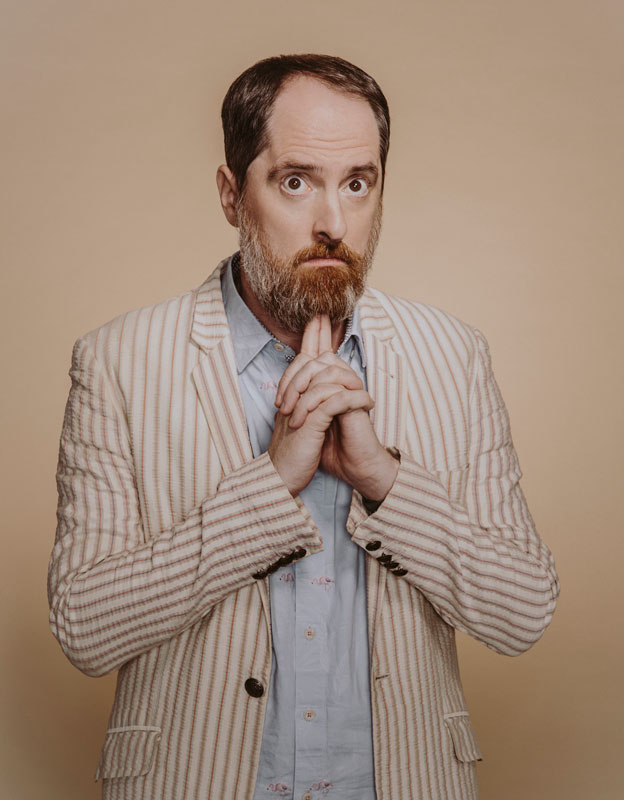
When it comes to marrying laugh-out-loud comedy with authentically earned drama, Brendan Hunt is a practiced bishop. The Chicago-born actor started on local stages in the 1990s, then joined the Boom Chicago comedy ensemble in Amsterdam for five years. Today, he’s most famous for Ted Lasso, the smash hit he co-created and co-stars in, playing the amusingly enigmatic Coach Beard. Before it went on hiatus after its third season (it returns to Apple TV this summer), the show won a slew of Emmys and a Peabody Award for its nuanced depiction of people grappling with life’s traumas. The way to navigate such tricky comedic waters is that “you can’t really pull back from the emotional parts,” Hunt says. In a nod to Charna Halpern, co-founder of iO Theater, he adds, “As the great lord Charna tells us, ‘Truth in comedy is vital.’ We’re still trying to live by that doctrine.”
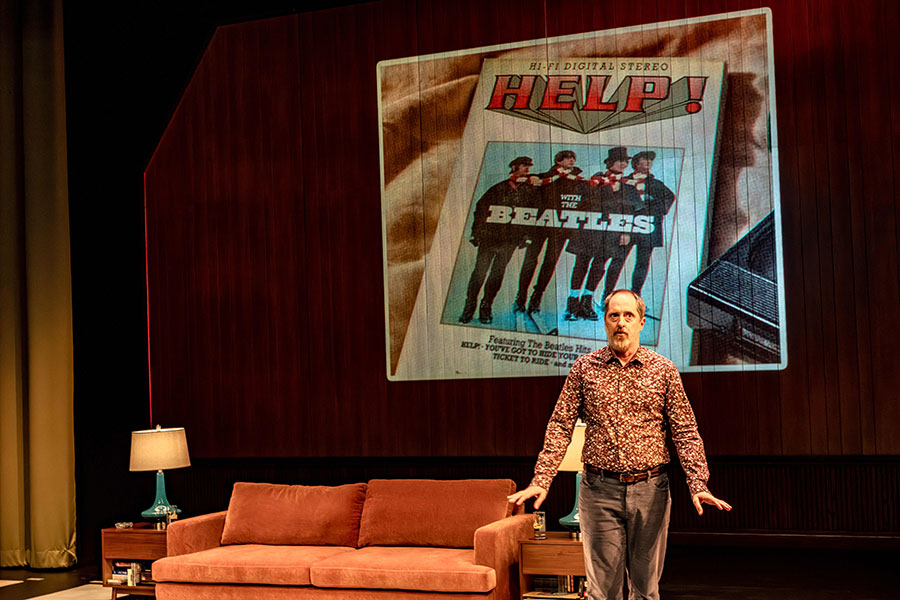
Hunt, 53, is back in Chicago with The Movement You Need, a heartfelt devotional that again balances the comedy and tragedy of life. A one-man show, Hunt’s stage memoir digs into family life with his troubled divorced mother in Rogers Park, Lake View, Gold Coast, and elsewhere in Chicago. Their turbulent relationship was at times soothed by a shared love of The Beatles — thereby inspiring the title, which quotes a lyric from “Hey Jude.” After rattling around in his brain for some years in the wake of his mom’s death, the show began taking shape in 2022. Following several workshop runs, Movement (currently in previews) opens at Steppenwolf this weekend and runs through May 10.
Tell me about your theater and comedy influences growing up. When did the performing bug first bite?
Two field trips had a huge impact on me. In seventh grade, we went to see a production of A Midsummer Night’s Dream at Court Theatre, which absolutely slew me. I didn’t know what it was going to be about; I didn’t know anything about Shakespeare. I would love to rewatch that production — which of course is impossible — to see if it was as good as I remember, because I absolutely loved it. Then, in eighth grade, we took a field trip to see a Second City show, called Jean-Paul Sartre and Ringo. The cast featured, among others, Bonnie Hunt, and I knew her name was Bonnie Hunt by the end of the night because she really stood out. Like, it was a great cast, but Bonnie Hunt was just another level from the beginning.
I know you’ve done earlier versions of The Movement You Need at theaters from Hollywood to Amsterdam to New York. Has it evolved since then, or do you think it’s locked down now?
I try to bring it a step forward every single place I do it. It was Hollywood Fringe first, and then kind of surprisingly, I did it at Boom a week later, so I had to take this jump from 30 seats to 340 seats. I was always noodling back then; it was structured but not scripted. So every show was: OK, that worked; we can expand on that. Or OK, that’s a dud; stop chasing that high of the thing people laughed at once but haven’t laughed at since. At Steppenwolf, this is a proper level-up with a director and designers, and it’s pretty scripted. There’s a little bit of audience interaction — just enough to guarantee that it’ll never be 100 percent the same.
I imagine performing it this time will feel different, given that it’s coming full circle. Do you anticipate some soul retrieval when you unpack all these complicated family stories in the city where it happened?
For sure, unavoidably. Walking the same streets where I walked when these events happened, that’s bonkers. I stress that The Movement You Need is a comedy, but it’s not all pleasant experiences. It takes a lot out of me every time I do it. It’s one thing to do three nights in New York — but eight times a week for three weeks? That’s going to be interesting. For the record, I did it for two nights at iO, a couple years ago. Doing it in front of my sisters for the first time, I tried to prepare them as much as possible, but I also made sure to seat them on an aisle, so if they had to step out, they could do so discreetly. I’ll be doing that for a few more family members this time, too.
But yeah, being here really charges the experience in this unique way — not just because of my friends and family, but because I’m speaking to people who know my language more than anyone else does. This is almost superficial, but it allows me to lean into some Chicago stuff. Like, I don’t know if the word jagoff is going to quite have the same impact if I do the show in New York — but here, it’s a Hallelujah chorus.
Since you grew up Catholic, I’m curious about your reaction when the news about Pope Leo broke last year. I understand you’re a fan of both the Cubs and the Sox — did you hear about the immediate Chicago media frenzy to figure out his baseball proclivity? Initially, Leo was misreported to be a Cubs fan.
I love the little window into the Sox-Cubs rivalry, which — having stood on both sides of it, to some degree — is felt more keenly on the Sox side. The Cubs fans are more like, Yeah, sure, the Sox are fine, and Sox fans are like, Fuck you! So for the brother of the holiest man in the world to feel the need, on the day he gets announced, to come out and say, ‘Let’s clear something up real quick: Sox!’ — it’s the most White Sox thing I’ve ever heard. It’s beautiful.
Any ball games in your near future?
I might be making an appearance at a Cubs game with a microphone in my hand. You outed me as a bicameral baseball fan. To anybody who’s reading that and immediately going, What the hell!, just know two things: One, I’m a North Side child of South Side parents. It’s complicated. Two, I’m literally writing a book about it that will explain the whole thing. Hopefully it comes out next year, but I actually have to finish writing it first.