


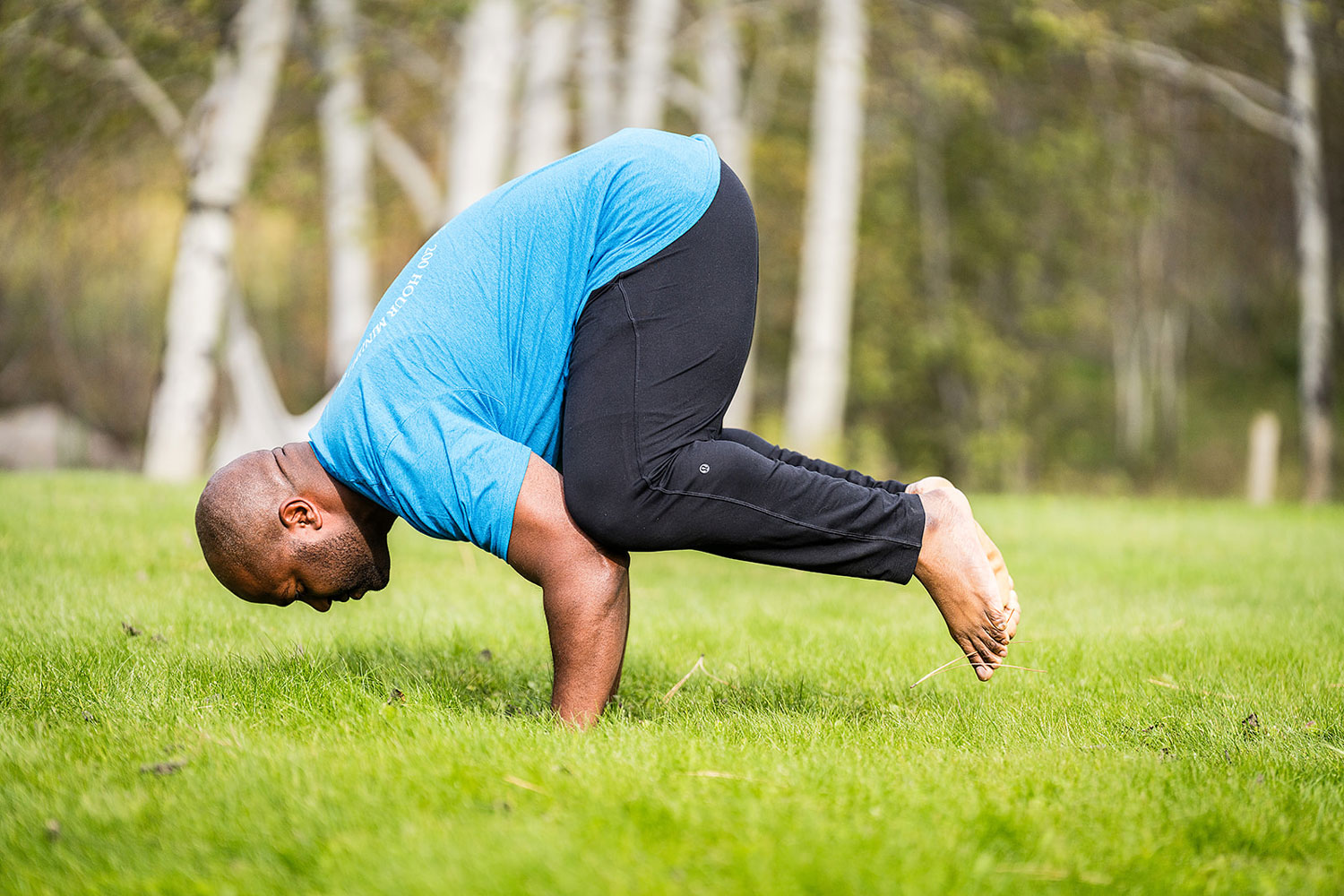
For a burly fellow, Brandon Lyles is awfully flexible.
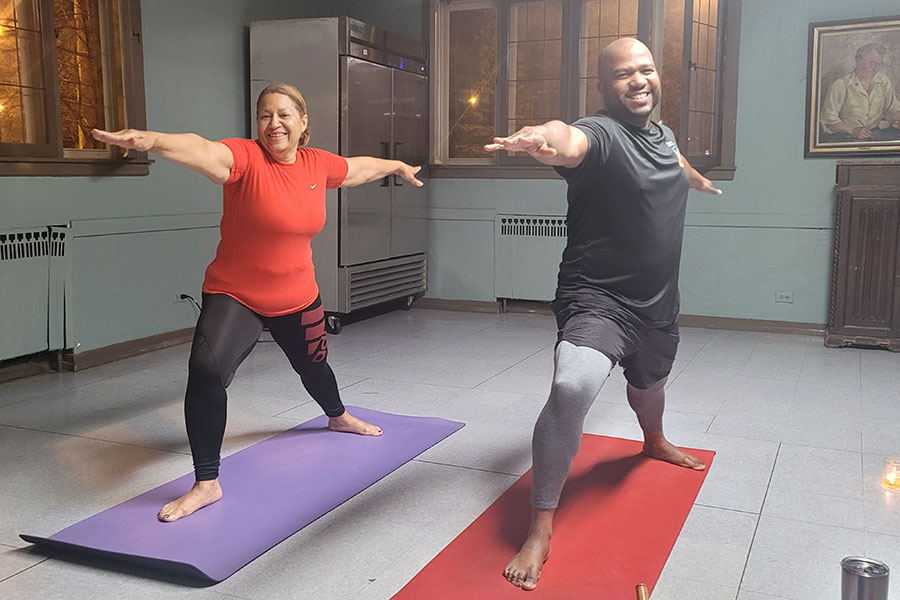
Here he is, leading a yoga class at Ridge Park in Beverly.
“Inhale, reach the arms up high,” he says, lifting his hands toward the ceiling. “As you exhale, reach forward, settling into the first deep stretch of the day, maybe feel a stretch in your hips, back.”
Off to Lyles’s right, a man with a stubble-cut head, a moustache, and glasses is sitting on a mat, mirroring the teacher’s moves. He’s Officer Cesar Guerrero of the Chicago Police Department, unwinding with a yoga class after a stressful day on the streets. This is First Responder Yoga, a class designed specifically for cops, firefighters, and their families.
“Arms overhead, exhale. Arms back by your side. Let your chin go down, then let the head slowly circle.”
When he’s finished, Lyles asks his students to give themselves “a quick moment of gratitude that we made it out to our own mats despite everything happening around us for a little self care.”
As he rolls up his mat, Guerrero talks about how yoga helps him deal with his police work.
“It’s easier to deal with calls on the job, and overall responses,” he says. “My wife actually pushed me to come here. She saw it on the police department website.”
Across the room is Mary McKamey, who has been retired from the police force for 16 years. In her day, there was no yoga for cops, but she understands now how it would have made her job easier.
“It teaches you how to de-escalate,” McKamey says. “You’re taught the skill and to do it mentally. You still might be retaining stress, and yoga teaches you to release it.”
The beefy world of policing seems incongruous to the gentle practice of yoga, but Lyles has experience teaching tough guys to relax. As a former soldier and current Army reservist, he introduced the practice to his unit when he was stationed at Fort Bliss, Texas. There’s a similarity, he believes, between the need for mental health and suicide prevention in soldiers and first responders.
When Lyles was serving on active duty, “at first I didn’t want to teach it. I wanted to keep it separate. On the military side, it seemed kind of taboo.”
Then a sergeant Lyles worked with committed suicide, and he began to see how yoga might have benefited his mental health, and that of his other fellow soldiers.
“That was a big shift for me,” he says. “Before that, I was a little reluctant. It can be stigmatized.”
After that, Lyles began teaching yoga at Fort Bliss. When he returned to Chicago, and was hired by the park district, he connected with Meghan O’Boyle, another yoga instructor whose father was a police officer and whose husband was a firefighter. Together, they started First Responder Yoga in 2019, scheduling classes on the Northwest and Southwest sides, which have heavy populations of police and firefighters. Lyles and O’Boyle often visit station houses and firehouses, where it’s useful to have a military veteran demonstrating yoga.
“Yoga is seen as female, and we’re trying to get more male participants,” O’Boyle says. “They see me and they’re like, ‘Of course she teaches yoga.’ He has been able to break down that stigma: ‘He’s a guy just like us.’ ”
Indeed, besides Guerrero, all the members of Lyles’s yoga class the day I visit are women. The city’s fire commissioner, Annette Nance-Holt, is a regular participant in First Responder Yoga. Still, Lyles believes that yoga can – and should – break through to the macho world of policing.
“I think they need to incorporate it in the training,” he says. “You’ve got to let go of stress, and if you have an outlet like this, you’ve got a place to let it go.”