


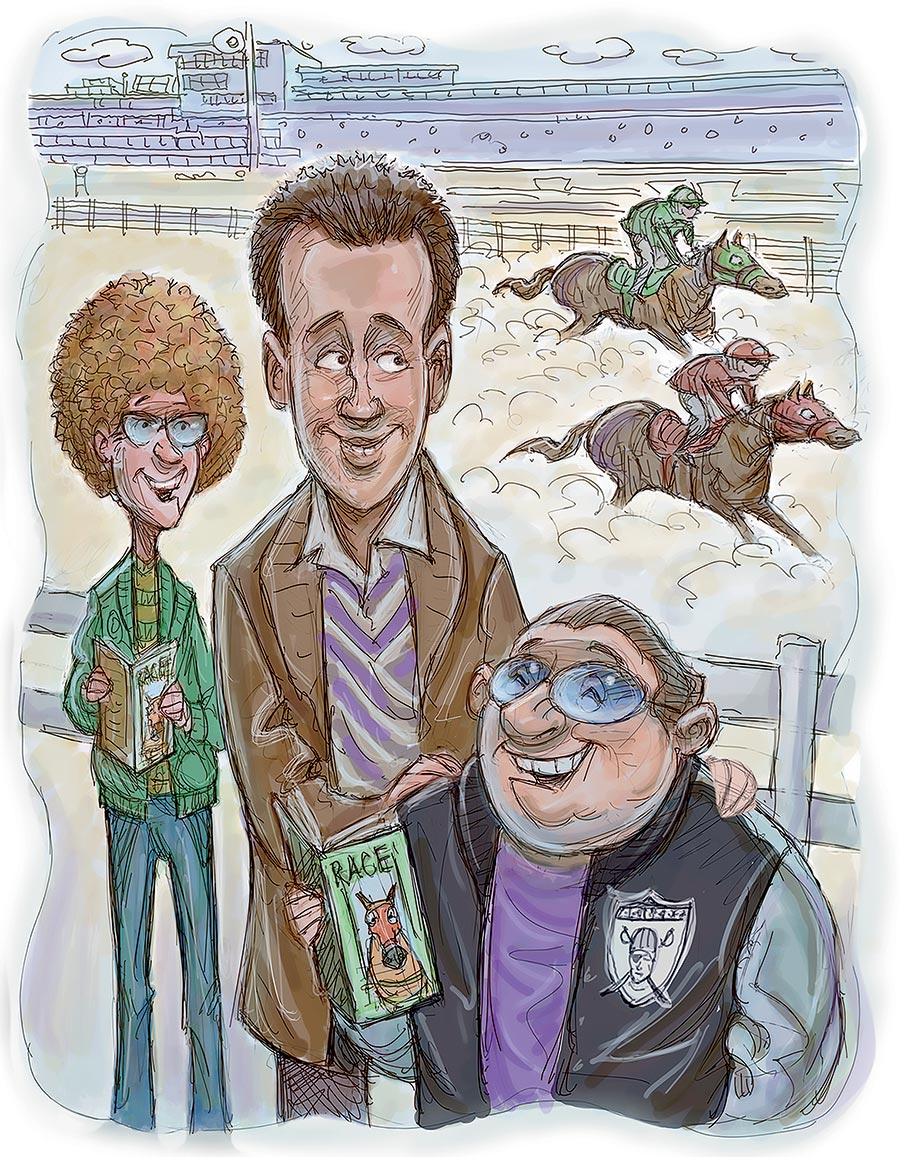
The first time I went to Arlington Park, in the summer of 1996, the worst thing that can happen to a novice horseplayer happened to me: I won $150. Thus began a decade-long mania for horseracing. Three tracks — Arlington, Hawthorne Race Course, and Sportsman’s Park — ran almost year-round, and I was at one or the other almost every day. It’s a far cry from where we are now: Hawthorne, the last remaining track in the Chicago area, has declared bankruptcy, putting in doubt the future of racing here.
But in those days, there was plenty of action to support a gambling jones. It’s not the money I lost that I miss — that can always be replaced — it’s all the strange characters I met along the way, a gambling subculture that has disappeared from Chicago. An acquaintance of mine called my fellow horseplayers “fringe-dwelling individuals, like a cross between statisticians and winos.” They were my friends, though, which may mean I was closer to that description than I want to admit.
Let me tell you a few things about horseplayers. Horseplayers will bet $200 on a race but won’t spend $20 on a pair of pants. Their wardrobes of windbreakers and T-shirts are racetrack giveaways. They scorn lifestyle choices that would interfere with their gambling: jobs, marriage, family, homeownership, the responsibility of maintaining an automobile.
No one fit this description better than my first racetrack mentor, Johnny G. We met in the grandstand at Sportsman’s Park. Johnny was 30-ish, a short, pudgy guy with thinning red hair and the tough-looking face of an extra from On the Waterfront. He wore a dingy Raiders jacket, a weathered purple T-shirt, and jeans as baggy as a rhino’s skin. Propped on the table in front of him was an enormous blue backpack, a frayed nylon collegiate model so tumescent it looked like a tortoiseshell. This was before all racing results were on the internet, so Johnny had cut out all the charts for the past five years and carried them wherever he went.
“I’ve been making my living out here for eight years,” he told me as he worked his scissors over a copy of the Daily Racing Form, the horseplayer’s New York Times. “I hit the twin trifecta at Hawthorne for $24,000 last year. That’s the only thing that’s keeping me going. I don’t make a lot of money at this. A lot of times I starve.”
Johnny lived with his father in Burbank, but he was in the black, so I followed him around. Though intelligent, he was uneducated — except when it came to horseracing. He taught me how to judge a horse’s appearance, a key edge, because it doesn’t appear in the Form, which most betters rely on.
I wasn’t just at the track to learn how to gamble, though. I saw it as a literary project. I told myself if I wanted to be a writer, I had to have something to write about. And write about this I did. My first story for the Chicago Reader was about my tutelage with Johnny. My first book was Horseplayers: Life at the Track. A publisher gave me an advance that served as seed money for a year of gambling.
It was while I was researching Horseplayers that I met the Professor, the one respectable character at the track. He got the nickname because he was a teacher at Harper College who quit to become a professional gambler. He treated the races as an academic discipline. He calculated his own speed figures, a statistic that determines which horse was the fastest in its previous race. His work paid off when he hit a twin trifecta — a bet that requires you to pick the top three horses, in order, in two successive races — for $81,000. He brought the money home and told his wife, “Pay off the mortgage.” A burly man who was built like a desk sergeant, the Professor always wore a tie to the track, and he supplemented his winnings by selling his speed figures and teaching handicapping seminars. “I’m better off financially than I would have been if I’d stayed in teaching,” he told me.
Snow made a few dollars by running errands for a blind man who sat outside the track. The man couldn’t place his own bets, so Snow did it for him. Horseplayers work together that way.
That wasn’t the story of Creighton R. Schoenfeldt, whose nickname was Creighton R. Schoenfeldt. The most cantankerous horseplayer in Chicago, known for writing querulous letters to track management, Creighton had gambled away his life savings, supposedly to the tune of $230,000. He lived with his wife, Mary, an ex-nun 17 years his senior, in a one-bedroom apartment in Lincoln Square. “What would a house do Mary and me?” he said to me. “It’s just the two of us.”
Every year on their wedding anniversary, Creighton took his wife to the off-track betting parlor, bought her lunch, and gave her a share of his winnings — if there were any. The thing was, Mary was a better handicapper than Creighton, even though she’d rather go to Mass than the racetrack. One Sunday, after church, Creighton brought Mary to a handicapping contest. She filled out her entry, then sat down with a book of crossword puzzles and a devotional to pass the 25 minutes between races. She bet $2 to show on each of her selections and recorded all her wagers on a square of notepaper. Every time she won a bet, she drew a smiley face next to it. The contest covered six races. Mary picked five winners, splitting a $2,250 prize with two others.
At first, Creighton was apoplectic. “She could have gone for the whole thing in a playoff!” he shouted. “She would have had an advantage because she’d have me helping her.”
At the very bottom of the horseplaying totem pole were the stoopers — scavengers who picked up discarded tickets, hoping someone had accidentally thrown away a winner. I befriended a stooper nicknamed Snow (which I suspect was a reference to a cocaine habit), who occasionally found a ticket worth enough to cover a $2 bet. When he didn’t, I’d give him $2. It was a gapper, a gift from a winning horseplayer to a loser. Snow had once worked in a steel mill but now lived with his sister, who provided him a bed because he’d paid her way through nursing school. Snow always carried a CTA card so that he wouldn’t gamble away his bus fare. He made a few dollars by running errands for a blind man who sat outside the track entrance with a tin cup, crying, “Please help the blind!” in a high-pitched voice. The man couldn’t place his own bets, so Snow did it for him. Horseplayers work together that way.
Bob the Brain was a kid from Skokie who dropped out of college in the early ’70s to join the revolution and ended up at the track instead — “as a rejection of mainstream society,” he pointed out. He’d once been a successful gambler, earning $30,000 to $60,000 a year and avoiding outside employment, but then the Form started publishing speed figures, eliminating his edge. By the time I met him, he spent an entire race meet wearing glasses with one stem. His other nicknames were Bob the Plumber, for his untucked shirts and sagging pants, and Art Garfunkel, for his wild, kinky russet hair.
“If Bob ever gets a big bankroll again, he’ll be one of the best players out here,” said his friend David the Owl. The problem was, Bob never had a big bankroll. He drove a cab to pay for the room he rented at a friend’s apartment and save up for a new stake. Finally, though, Bob made a big score. He won a handicapping contest at Hawthorne, beating a former national champion. First prize was $5,000, on top of the $3,000 he won betting. “It’s not near the kind of money I need to do what I want to do,” he said. “I’m not going to increase my bets a lot. But it’s a nice way to give myself a boost after a horrible year.”
But Bob the Brain was content. As he once told me, “Compared to most people in history, I live like a lord. I’ve got heat, running water, indoor plumbing.”
And he got to go to the track. For a horseplayer, that was enough. It wasn’t enough for me, though. I stopped betting seriously when I learned that I could win if I went to the track every day, but I couldn’t win enough to make it worth going to the track every day. And the characters I’d met, colorful as they were, had no lives outside racing. As my interest declined, so did horseracing in Chicago. Sportsman’s closed in 2002. Arlington in 2021. And now Hawthorne is in financial trouble. I couldn’t write a book about horseplayers today — there aren’t enough left. It’s a vanished world, but for a glorious moment, it was ours.