


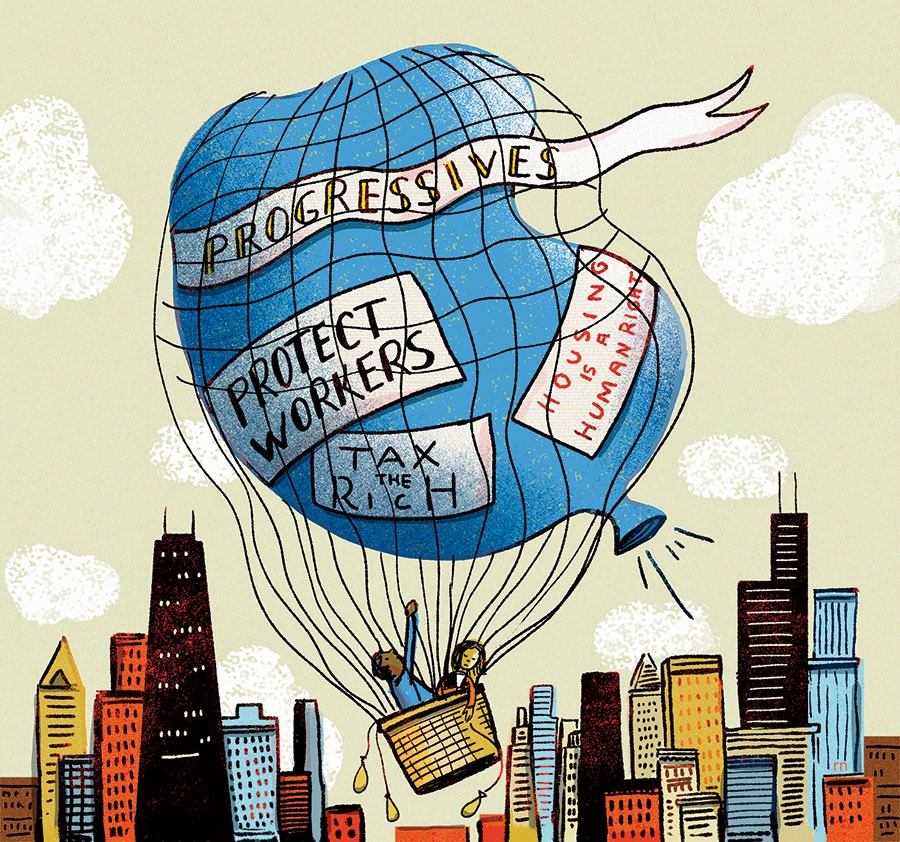
It wasn’t all that long ago that progressives had the momentum on the City Council. With a like-minded mayor in office and a record number of democratic socialists as alders, they passed ordinances that aimed to reshape Chicago according to their vision. Workers were granted guaranteed paid leave. Residents near the Obama Presidential Center were given protections so they wouldn’t be displaced by gentrification. And the progressives’ signature ordinance? One Fair Wage. Championed by the mayor and passed in 2023, it raised the minimum salary for tipped workers from less than $10 an hour to the standard wage (currently $16.60), giving restaurants five years to scale up their pay.
Fast-forward to this March. That same City Council voted to scuttle the wage plan and freeze the scale-up at $12.62 an hour, citing concerns from the industry. Mayor Brandon Johnson vetoed that move and still had enough votes on the council to prevent an override, but it’s telling that 30 of the 50 alders wanted to nix the plan that, just three years earlier, 36 voted for. This is what things have come to for progressives in Chicago. They are no longer in control of the agenda. Instead, they’re playing defense, trying to protect what they already gained.
So how did we get here? The City Council’s Progressive Reform Caucus still has 19 members — the same as in 2023. But many of the other alders who once voted with it have joined forces in the so-called Common Sense Caucus, united in putting a check on the mayor’s power, most notably by rejecting his last budget and writing their own. That block has helped relegate progressives to their traditional role as an outspoken minority.
Alderperson Maria Hadden, cochair of the Progressive Reform Caucus, concedes that there have been defeats lately, but she chalks the shift up to the nature of promoting leading-edge legislation: “Progressives through history, the very nature of it is to work against the tide of complacency, address systemic issues, and present proposals to move us forward. In some ways, progressive ideas are always on the offensive, and there’s going to be backlash to that. People have a hard time with change, and that’s just the general dynamics of political movements.”
That might be true, but it doesn’t explain why progressive alders like Jeanette Taylor and Andre Vasquez, both democratic socialists and members of the progressive caucus, have broken with the mayor’s agenda in high-profile ways. Taylor voted to freeze the wage scale-up this spring out of concern for restaurants in her ward. Vasquez helped uphold the mayor’s veto on that ordinance, but he has publicly criticized Johnson on many other fronts: for pushing out Chicago Public Schools CEO Pedro Martinez, instituting stay limits on migrant shelters, and proposing a property tax increase to cover budget shortfalls.
Vasquez, the caucus’s other cochair, says the mayor’s team hasn’t helped the cause any with its insular approach and its intransigent stances. “The administration really failed at building relationships or listening to alders they didn’t view as part of their inner circle at the beginning and throughout the term,” Vasquez told Chicago. “Some of us would only get information when votes were needed, and I would be contacted less so once I was publicly calling out disagreements related to how the migrant mission was handled.”
Could additional progressive measures still be passed by the City Council? “Not in this term,” says Alderperson Andre Vasquez, referring to the mayor’s remaining time in office, “because he bungled it that bad.”
Vasquez thinks the Johnson administration turned off potential allies by dismissing concerns voiced about the Bring Chicago Home plan, which the mayor campaigned on and which would have funded efforts to combat homelessness with an increased tax on big-ticket property sales. “It appeared as though anyone asking questions about Bring Chicago Home was viewed as someone who innately didn’t care about solving homelessness,” Vasquez says.
It isn’t just the City Council bucking the progressive movement. Chicagoans rejected the Bring Chicago Home referendum in 2024, the first major blow to Johnson’s agenda. This spring, legislators in Springfield were considering bills to strip the city of the power to regulate tipped wages at all, as well as to tax sports betting and institute a corporate head tax, the centerpiece of Johnson’s failed 2026 budget proposal. And a measure to put an amendment on the ballot to impose a 3 percent tax on incomes of more than $1 million — a cherished progressive goal — didn’t get enough support to advance out of the Illinois House. (Johnson’s response: “Why isn’t Springfield working harder to support working people?”)
Despite all the setbacks, Johnson still has ambitious plans for the 10 months left in his current term. He wants to see another increase in the standard minimum wage and the building of 100,000 units of housing, both of which are unlikely to happen anytime soon. He’s also proposing the Reverend Jesse L. Jackson Sr. Fair Access to Democracy Ordinance, which would prevent federal immigration agents from operating within 200 feet of polling places. Progressive council members, meanwhile, are back to pushing small-bore initiatives: a workplace protection requiring employers to have a plan in place for when the temperatures get dangerously high, and zoning rules making it more difficult to put polluting industries in poor neighborhoods.
Could additional progressive measures still be passed by the City Council? “Not in this term,” Vasquez says, referring to Johnson’s remaining time in office, “because he bungled it that bad.”
Vasquez sees the future of progressivism in Chicago not as a political movement but as a grassroots one. Last fall, when he held a town hall about strategies for opposing immigration enforcement efforts, 700 people attended. “The fact that that many people showed up is significant,” Vasquez says. “When times get tough, the neighbors do step up.” In other words, Chicago progressivism these days is reflected more in community rapid response teams than in victories on the City Council. The people are taking action when politicians won’t.
The challenge for Johnson, Hadden, and other left-wing politicians will be turning that grassroots energy into electoral — and legislative — wins. “They’re not going to go away,” a former alderperson says of Chicago progressives. “They have a strong base. But I think it’s pretty likely they are going to lose the mayor [in the next election], and then it’s back to the old days for them.”