


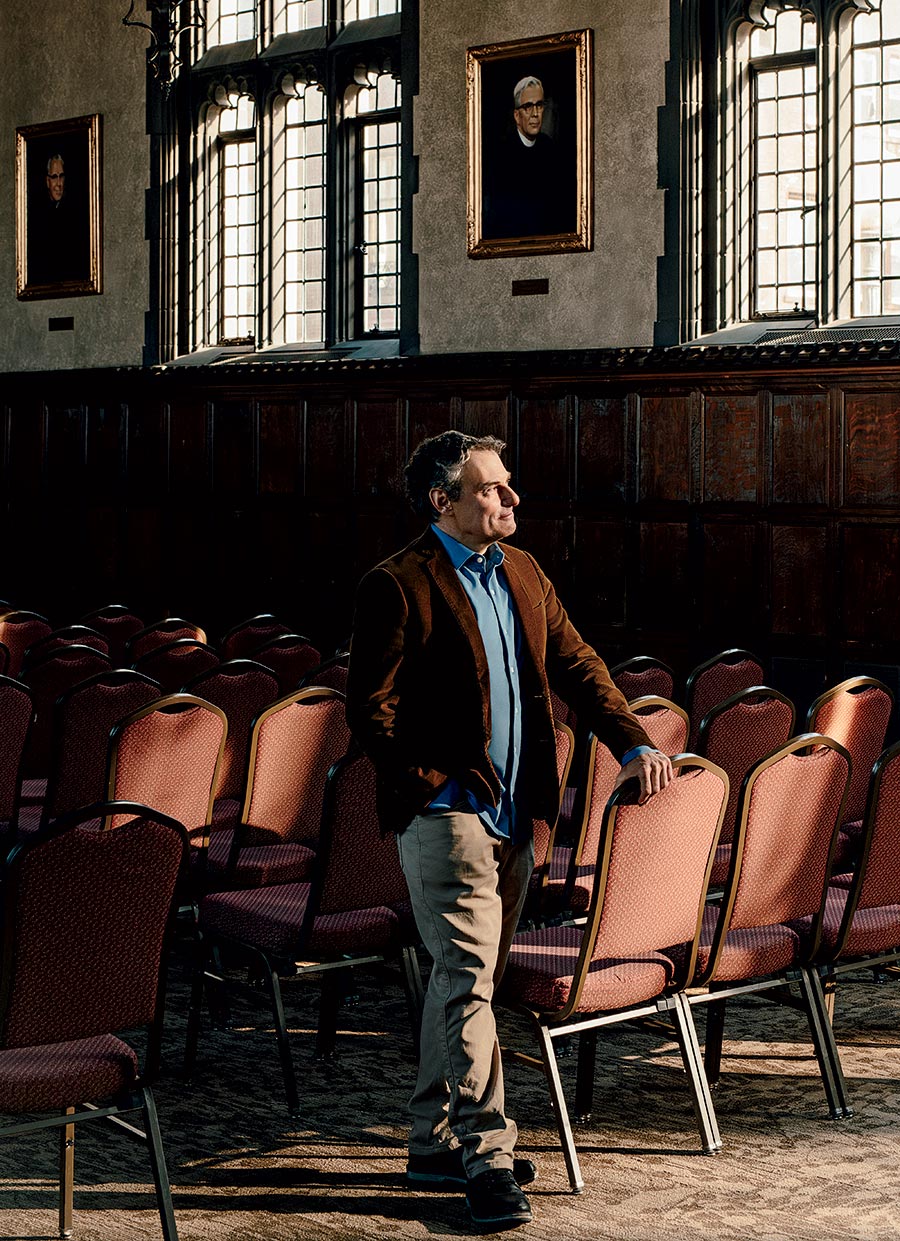
Craig Klugman grew up around death: His father was an estate attorney; his mother, a nurse; his aunt, a hospice nurse. “It was dinner table conversation in our family to talk about these issues,” says the DePaul University professor, a bioethicist and medical anthropologist. But openly discussing death isn’t the norm, at least not in the United States. Klugman is trying to change that. He’s held Death Over Dinner events around the subject, he’s helped people write their living wills, and he got trained as a death doula. He has also brought the topic to the classroom with his Death and Dying course at DePaul, letting students hear from funeral directors and medical examiners. As he tells his pupils, “We talk about death so we learn how to live.”
Why is it important to be comfortable with death?
Death is taboo in American society. Since COVID, we’ve gotten a little more open about it, but essentially it is something we hide. When people look like they’re near death because they’re older or have an illness, we put them in hospice or in a nursing home. In the Victorian era, people died at home. It was very seen. In fact, the reason it’s called a funeral parlor is because funerals were held in the parlor of the house. If we are more comfortable with death, we will communicate about it. This is something that brings us together. It can be a scary thing to think about nonexistence. But by thinking about death, we appreciate the things we have in life.
What were your goals in designing the course?
I wanted a class that explored death and dying in an American context, which is multicultural, multireligious. Yes, the students learn facts and figures and history, but they also have an opportunity to think about their own mortality and the mortality of people around them. It’s kind of a life skills course. We all have to deal with it, right? Whether it be a pet, sibling, parent, friend — somebody’s going to die on you. What I find is that students don’t know what to say. How do you talk to people in mourning? What do you offer to do for them?
“We talk about the beauty of birth — the wonder, the miracle. I think the same way about death. It can be so meaningful.”
What should you say to grieving people?
We tend to shy away from the simple stuff because it feels trite and overused, but it really is the best. Like just saying, “I’m sorry.” Sharing a memory you have of the person can be really nice. A lot of times people will say, “They’re in a better place,” or “They’re no longer suffering.” Not helpful. People will also say, “Just let me know what I can do for you.” What you’re asking is for somebody in the most utter grief moment of their life to now have to figure out a way to make you feel useful. The better approach is to just make the offer: “Hey, I’m going to pick up your kids from school on Monday, Tuesday, and Wednesday,” or “I will arrange the food train.”
So make the casserole?
Make the casserole. Although people can be overwhelmed with food. Make sure you have it in freezable portions, in freezable containers, because nobody can eat through 30 casseroles.
In the 10 years you’ve taught the class, have you seen a change in how people think about death?
I think there’s more hunger for having these conversations. There’s been so much death around the world — not just from the pandemic, but from violence and war and stuff like that — that people are trying to find a way to make meaning out of it. We talk about the beauty of birth — the wonder, the miracle. I think the same way about death. It can be beautiful, it can be mysterious, it can be so meaningful. We used to have ways to mourn and ways to grieve. There were systems. For Italian Catholics, they used to have like five-, seven-, nine-day visitations, where the family would be at the funeral home. Now they do a couple hours in an afternoon, right? As we’ve declined in our religious participation, and as we no longer have the civic organizations we used to, there’s a sense of being alone when death happens, both for the person dying as well as their survivors. By spending the time to think about it, to look at different practices around the world, people get to make their own meaning out of it, which is powerful.
How should we start to normalize discussing death and dying?
If you are a parent and your kids see a death on television, talk to them: “How does that make you feel? What do you think about that?” It turns out we think nobody wants to talk about death, but if you give people the opening, the opportunity, they’re hungry for this. The first day of the class is 32 strangers in this virtual room, and everybody shares. Things like Death Over Dinner evolved to create spaces for people to talk about these issues. So the taboo is there, but it’s more in our own minds.
Does media desensitize us to death?
There is a sense of denial of death, right? This was an actual study done a number of years ago: They looked at, for one year, every medical drama on TV and the number of times people coded and the number of times people died. It turned out like 75 percent of the time, people who were coding would survive. The real number is more like 10 percent. So our media representations are just not realistic. I don’t know that it desensitizes us, but it prevents us from thinking about it very personally. It turns death into a commodity rather than a human experience.
Medical aid in dying was recently legalized in Illinois. How does that addition shift the conversation?
There are some standard fears. One of the big ones usually comes from religion, which is that only God gets to make the decision. The interesting thing is, there’s a concern that humans might make a choice to not do everything possible, preserve every single moment of a spark of life, but there’s no concern about are we intervening in God’s will by putting people on ventilators and ECMO machines and all sorts of stuff. So it becomes a very one-sided conversation there. We in modern medicine and ethics have worked to maximize people having a say in their own health care. And what is more autonomous than allowing people to make choices to avoid a suffering- and pain-filled existence that they don’t want anymore when they have a terminal diagnosis? I think people think of this as an easy out, but it is not an easy thing to do. The process requires you to make oral and written requests. Under Illinois law, the written request has to be witnessed by two people. One of them can’t be close to you. They can’t be involved with your care. They can’t inherit from you. They can’t be married to you. That kind of thing. The process requires dedication. It requires support. You can’t do this on your own.
What are the reports like from states that already permit medical aid in dying?
Most people [who seek it], their reasoning is that they want control. They want to exercise autonomy, and they want to preserve their dignity. They want to avoid the pain and suffering they know is coming. The reports also show a lesser reason: There are some people — not even half, but there are some — who are concerned about taking resources away from their family members. And unfortunately, I think that’s more of a commentary on the state of the United States health insurance system.
What is your ideal death?
Most people in America today want to die in their sleep. In the Middle Ages, this would have been an utter nightmare, because they wanted to stare death in the face and die in action and battle. I want to die doing something I love — maybe I’m at the theater or I’m on a vacation. But just quickly, quietly. I don’t want to fade away. That would be the worst thing for me.