


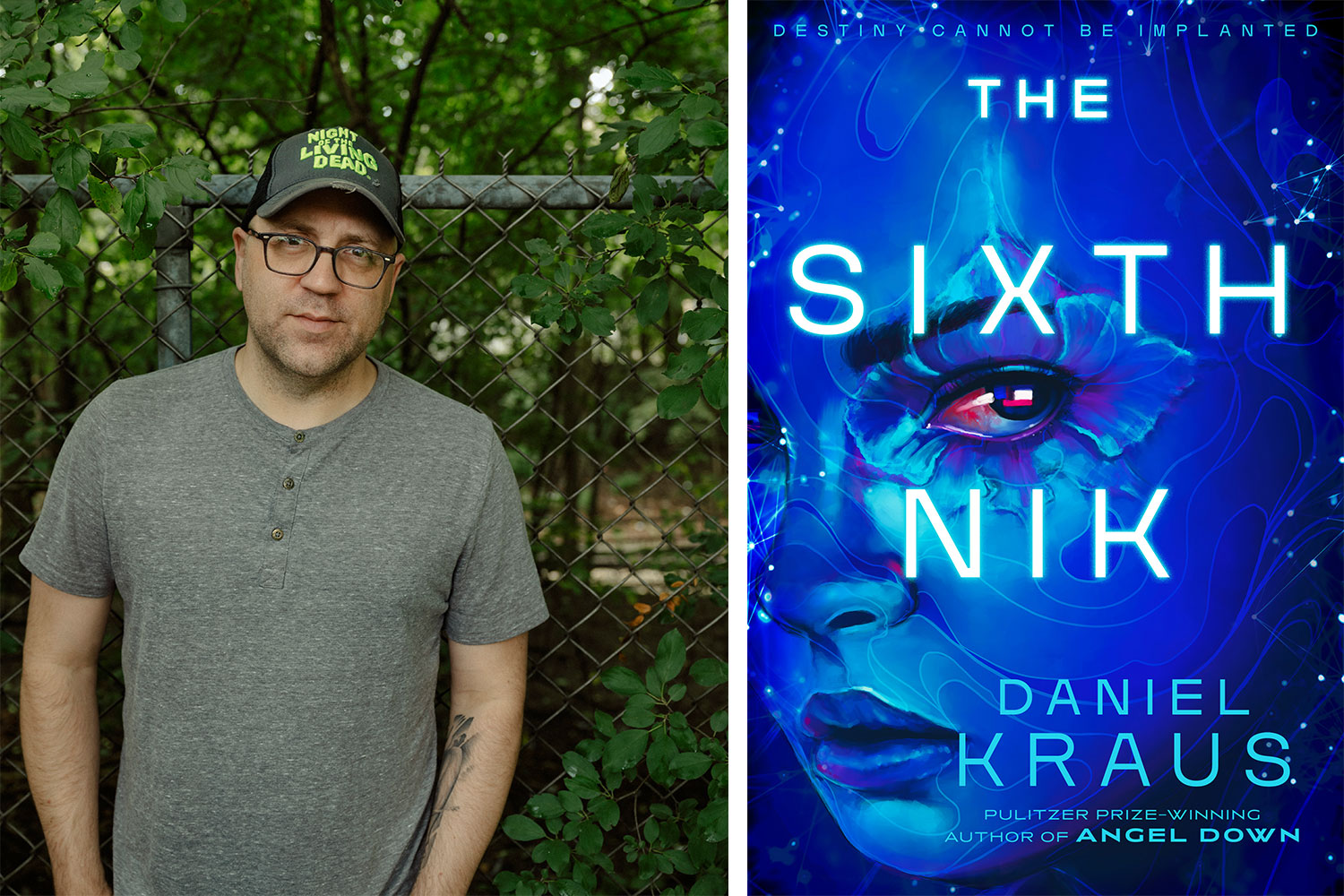
Daniel Kraus didn’t mean to write his first sci-fi horror novel. In fact, the Evanston-based novelist never really knows what genre any given book he writes is going to pursue — and that’s what makes him one of the most exciting writers of his generation. With an oeuvre that keeps his readers on their toes, it’s no surprise that as he’s celebrating a Pulitzer win for his 2025 novel, Angel Down, he’s getting ready to publish his 28th book that, as expected, is nothing like he’s written before.
Set hundreds of years into the future, The Sixth Nik (out June 23) introduces readers to Sisilla, a 9-year-old cultist who was selected at birth, by the Nuna Naavoq, to be the 55th Niffakoq. With her brain embedded and enhanced with six disks, or Niks, Sisilla receives her chore: a monumental problem that Niffakoq are raised to solve before their death at 12. Soon she’s sent into deep space to investigate the mystery planet Fém with a motley crew of characters (including a faceless assassin) on a fleshy, humanlike spaceship. With nuance and deft detail, the novel explores the meaning of individual agency, family, and — ultimately — what (or who) decides who lives and who dies.
We’re chatting a month after you’ve received the Pulitzer Prize for your novel Angel Down. TheSixth Nik, while not the book that immediately followed Angel Down, is coming out after a lot of press about this other book. It’s also incredibly different — a new genre, a new form. How is that feeling?
On the one hand, it’s very normal. I try to make every book as much of a 180 from the previous book as possible, so I skip around to different genres and styles. It’s very normal to frustrate anyone who liked my last book. All I do is frustrate readers. Part of that is a joke, and part of it’s not, because I always do. It’s a really ill-advised way to run a career, and I do lose significant chunks of readers all the time. Of course, I gain some, too, so in the long run it’s working fine, but I always know that a reader of book 29 is not necessarily gonna be the right reader for book 30. I particularly kind of like The Sixth Nick coming out after Angel Down, because it’s so disturbing, and so strange, and I like the idea of challenging readers who were introduced to me through Angel Down with something that may be out of their comfort zone.
I really appreciate how you bounce around with style, and I’m wondering if you pick the genre or if the genre picks you when you sit down to write?
It’s the latter. I don’t have a checklist of genres, but over time, I have managed to check off most of them. Naturally what I do gravitate to is something that’s very different, and often that will lead me to a new genre. Fifty percent of me is interested in a new story, a new plot, and that’s often tied up with genre. And then the other half of me is interested in a new way to tell the story. As much as I’m interested in story, I’m much more interested in language. If I write a book that’s all one sentence, present tense, historical fiction, like Angel Down, I’m going to want to follow that up with first person, past tense sci-fi.
What do you think brought you to sci-fi horror this time around, with this particular story?
Again, it wasn’t like I was thinking, “I need to write a sci-fi epic.” I had an idea that was inspired by the movie Whatever Happened to Baby Jane? and it was going to be a small, almost two-character thing, just like that, and one of the characters was a robot. That’s where I started. It ended up not being that book at all. But there’s a scene right in the middle of the book that is that. So I started trying to reverse engineer everything. I was like, “Okay, who are the characters? How do they get here?” And then it just grew massively in all directions and I was getting excited by these other details more than I was the original idea.
One of the things that immediately pulled me into The Sixth Nik was that world building. It was so specific, so detailed. What did your process look like as you started writing?
Generally I’m setting things in the real world, but just because the world exists, it doesn’t mean you don’t have to rebuild it. There’s still so much research that even goes into stuff that’s grounded in reality because you want to get it right. With this, there was actually some freedom, even though some of the concepts are sort of based in real science. With The Sixth Nik, I was like, “Here are some interesting science ideas that I’m going to use as inspiration for something that doesn’t exist.” And I would do that over and over. I purposely wanted to overwhelm the reader with technicalities and technical jargon. I’ll saturate the prose with a lot of stuff that I know most people aren’t going to understand, but that’s not really the purpose. The purpose is to establish, “I’ve got it. Trust me on this.” If it looks like the author has a handle on this stuff, I think they’re willing to let me take them to places that might be unpleasant or strange.
This book felt perfectly timed in so many ways. It’s set in a world that exists in the future, but I could see the beginnings of that world in the conversations we’re currently having about AI and about laws that control other peoples’ bodies. In The Sixth Nik, people modify their brains with tech, the characters can access a kind of nefarious social media (named the Snarl) with their minds. There are the Niks themselves. Was this novel a look at what could happen? Or where things could go?
By my calculation, the book is about 500 years in the future, and it felt like, if anything, this book is way underselling AI. I think we’d be very lucky to exist in 500 years. The reason I think this book is okay with having AI actually as minimal a presence in the book as it is, is because of the Niffakoq, who have been around to quell all these things that show up. The AI powers in the book are significant, but they’re not what I expect things to be 500 years in the future. It’s all the same reason why the world hasn’t burned up from climate change in the book, because the Niffakoq were there to help with that. So there was a plot mechanism by which I could let the world of 500 years from now be a little more like it is today, and not the hellscape that I actually think it’s going to because the Niffakoq are maintaining some sort of a grounding.
As far as the themes around bodies, the concept for the novel comes first, unhooked to meaning. I’m thinking about a story hook. In my novel Whalefall, a guy gets swallowed by a whale: that’s the hook. The story often will tell me what to do because of physical realities. For The Sixth Nik, if I want this person to be part of this cult who has things in her brain, who would allow that to happen to them? No one, so it has to be somebody who doesn’t have control of their own body yet, like a baby. Once you frame it like that, you start thinking of other things and it all follows very naturally from there.
With a book like The Sixth Nik, which is so obsessive about the things that it’s obsessed with, once I started introducing things about birth, abortio,n and all these other ways of giving life to people or taking it away, my instinct is always to go to 11 on the chart of whatever I’m doing.
Is this related to why you chose to make a child the protagonist? Specifically a 9-year-old girl? As a reader, there were times it felt incredibly uncomfortable, but I was interested in how it fit into our current discourse.
I think there are certainly gonna be people who are going to be like, “Did it have to be a girl so young?” It’s uncomfortable. But it’s uncomfortable in a different way if she’s 16. It’s uncomfortable no matter what you choose. I liked the idea of somebody who’d never had a childhood. She was trained for this from the very beginning. It’s taking these ideas and then just driving them to the hilt, and because it was sci-fi, I felt that I could. There are things in this book I could never do in another book because I’m bound by reality. But here, it felt like I could continually take things to extremes, toward the goal of being super uncomfortable.
Now, what I didn’t expect, and something that might have been the biggest surprise to me in the book, was how, how much fun I had, and how much I started liking some of the characters. Knowing what this book was gonna be about, I thought it would be this really dire, bleak thing — and it is to a certain respect — but, I didn’t expect to like some of these people so much. They’re fun, and they’re funny, and it’s something that sort of happened accidentally, and I’m very happy about it.
Do you think the Nuna Naavoq are good or evil?
I should probably pause here and say that this book has a sequel that comes out next year, but you’re gonna learn more about them in the second book.
This book, though, is relatively clear in that there’s nothing wrong with the Nifolk, of course. They’re just innocent victims in this. The Nuna Naavoq are much more complicated. It’s a society wherein most of the population isn’t directly responsible for what’s happening. But that’s not the question, really. The question is, is it excusable? Is it excusable to have a young girl die rather horribly every 12 years in order to solve a whole bunch of problems? There’s all sorts of far less dramatic versions of this question all around us. There’s the classic example from our youth: was it okay that they rubbed cosmetics into rabbits’ eyes to make sure they’re safe for people? Is it okay that children are building our iPhones? It’s hard to fight every battle at once, but these are the things that we have to think about. And the Niffakoq are just a very visceral way to re-ask these questions.
In the book, Sisilla the Niffakoq asks her crew a series of questions — the Niff Six. Have you asked yourself those six questions?
That’s a great question. I don’t think I have, but I always feel a real affinity with a character named Feng. I feel like if anyone’s answers were close to mine, they probably would’ve been Feng’s.
Do you think that any one of the Niff Six questions is more important than the others?
This is a hard question. I feel like number one is easy. Is suffering an integral part of being human? Yes.
The second question: Can a person be wholly evil? No. The third question: Have you wasted your potential? This is when it kind of starts getting interesting, because now that’s just gonna tell you about the person. The fourth is, do you fear death and why? The fifth question: Will it matter if you are forgotten after your death? And the sixth question is, does the afterlife exist?
I guess maybe another way to state this question is: What would I least like to answer? I think the most awkward one for me to answer would be five. Will it matter if you are forgotten after your death?
Why is that?
I think because I work in the arts and particularly if you don’t have kids, which I don’t, you think about that sometimes. You’re like, “Well, this is what I’m making, this is what I’m leaving behind.” But generally I think that no one is going to remember my books. They might because Angel Down is going to be on a Pulitzer list. But there are lots of books on that list. There’s a few of them I’ve never heard of before.
I think there’s the answer that I want to give and the answer that I really think is the truth. Will it matter if you are forgotten after your death? The answer I want to give is, No, it doesn’t matter. But the more painful answer is, I do want my life to matter.