

Reading between the lines is a handy talent, but sometimes the lines themselves require deciphering. Case in point: Newberry Transcribe, an ongoing project at the Newberry Library. The independent research library on the Near North Side has undertaken a massive crowdsourcing initiative: using volunteers to help transcribe handwritten documents in its holdings to create a more useful digital repository. Sounds straightforward enough, but the process of transforming the chicken scratches of yesteryear into readable text is a challenge, especially for young scholars unpracticed in cursive and shorthand. Documents from a century ago can be as indecipherable as Egyptian hieroglyphics, so it falls to boomers, Gen Xers, and similar elders to serve as living Rosetta stones.
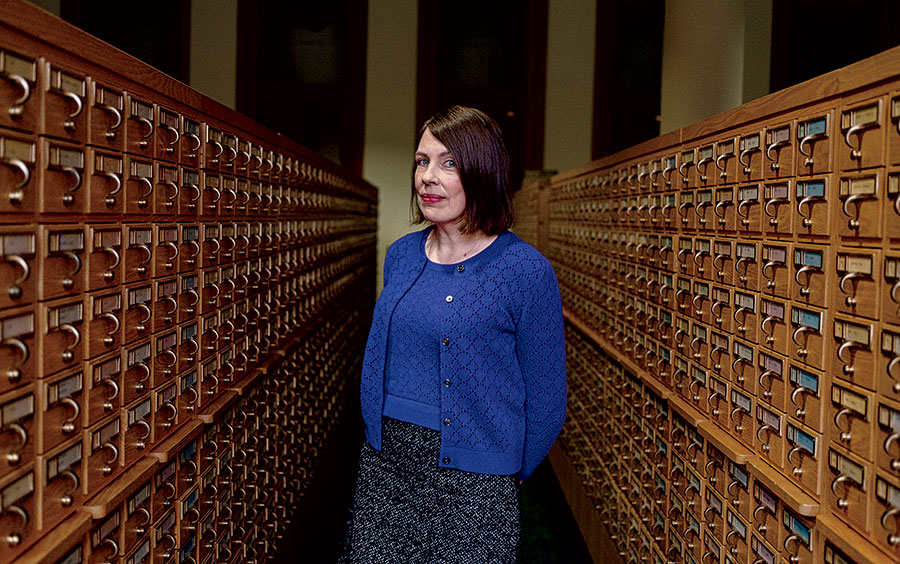
The project is focused on the library’s modern manuscripts and archives collection — over 15,000 linear feet of manuscripts, correspondence, journals, photographs, and other materials. Thousands of pages have been digitally scanned, but the challenge is to make these documents more accessible to scholars and the general public. “Once we started putting handwritten documents online, that opened up access for everyone around the world,” explains Newberry librarian Jen Wolfe, who leads the project. Scans are great, but they aren’t searchable. “The act of using the papers [as images online] was kind of the same as what you would do in person — examining each page, one at a time; each researcher doing the work of deciphering them from scratch.” Better than nothing, but not very efficient.
The Newberry started transcribing manuscripts into searchable text in 2013, during the Civil War’s sesquicentennial, concentrating on letters sent during that four-year conflict. But the project really took off during the pandemic. “People were looking for something meaningful to do, and that’s when we launched our transcription crowdsourcing effort in earnest,” says Alison Hinderliter, the Newberry’s curator of modern manuscripts and archives. The library reached out to the public through its website, newsletter, and mailing lists. “It got a really fantastic response,” Hinderliter says. The project currently has 146 registered volunteers, but thousands of others have come and gone over the years.
At the Newberry, “modern” covers a bigger time period than you might think. The trove of manuscripts includes writings from as early as the 17th century through the present day. These documents are stored in a building next door to the library. Wolfe and Hinderliter show me the merest sliver of the collection, arranging several letters, diaries, photos, and the like in a small meeting room at the Newberry. Some of the more fragile and valuable documents are protected by plastic sheeting, but most can be handled with clean, dry hands — no gloves required. History at my fingertips.
Many of the documents have a Chicago connection, including materials related to luminaries like novelist Sherwood Anderson and a personal hero of mine, screenwriter and director Ben Hecht. (I was asked if I wanted to hold one of Hecht’s Oscars. You damn betcha.) Lesser-known local litterateurs are also represented, like Jack Conroy. “He’s a super interesting guy,” says Hinderliter. “A friend of Nelson Algren, Richard Wright, and Gwendolyn Brooks. He wrote a proletarian novel in the ’30s called The Disinherited before The Grapes of Wrath was published. A very funny and witty letter writer as well.”
I am confronted with a page of script that’s simultaneously cramped and loose. Only every fourth word or so is decipherable.
Just as entertaining are the letters Conroy received, not least from Algren. One — sent from Chichicastenango, Guatemala — features a poem in Algren’s hand on torn, yellowed paper. Here the gritty scribe behind A Walk on the Wild Side and Chicago: City on the Make writes a 14-line stanza beginning with “Bingo Bango Bongo / I’m in Chichicastengo [sic]” and ending with “Best from Nelsonango / To Jackson Conroybango.” Another, employing language best described as both salty and greasy, details Algren’s feelings about Hollywood and Otto Preminger, the director who made the movie version of his The Man With the Golden Arm.
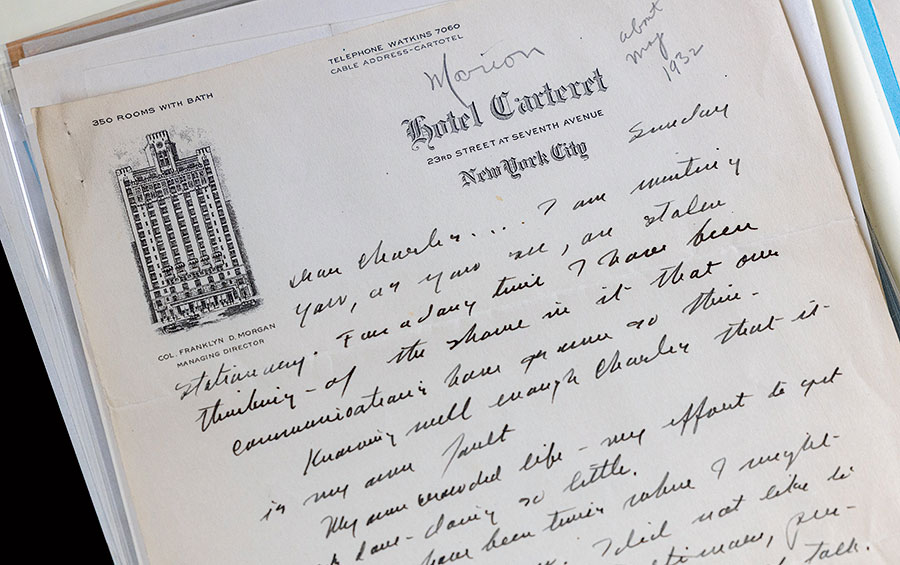
Algren’s correspondences are at least semilegible. The same can’t be said for Sherwood Anderson’s. While his short stories were lucid, his handwriting was not. “Especially with his diaries,” says Wolfe, adding that he was likely writing entries only for himself. That doesn’t excuse the scrawling script appearing in his nondiary writings as well. Shown a letter that Anderson wrote on hotel stationery, I am confronted with a page of script that’s simultaneously cramped and loose, and only every fourth word or so — largely determiners and prepositions like “the” and “of” — is decipherable. I find myself losing the plot in the middle of a single word. Hinderliter directs me to one particular sentence: “He says, ‘I am becoming more and more a communist.’ But it’s not super clear that’s what it says at first glance.” Nor at my second or third glance. Even after I’ve been told what it says, it still looks to my eye more like “This becoming recess and need seance a paramecium-ist.” Sister Rosalyn, my handwriting teacher at St. Damian, would’ve been appalled.
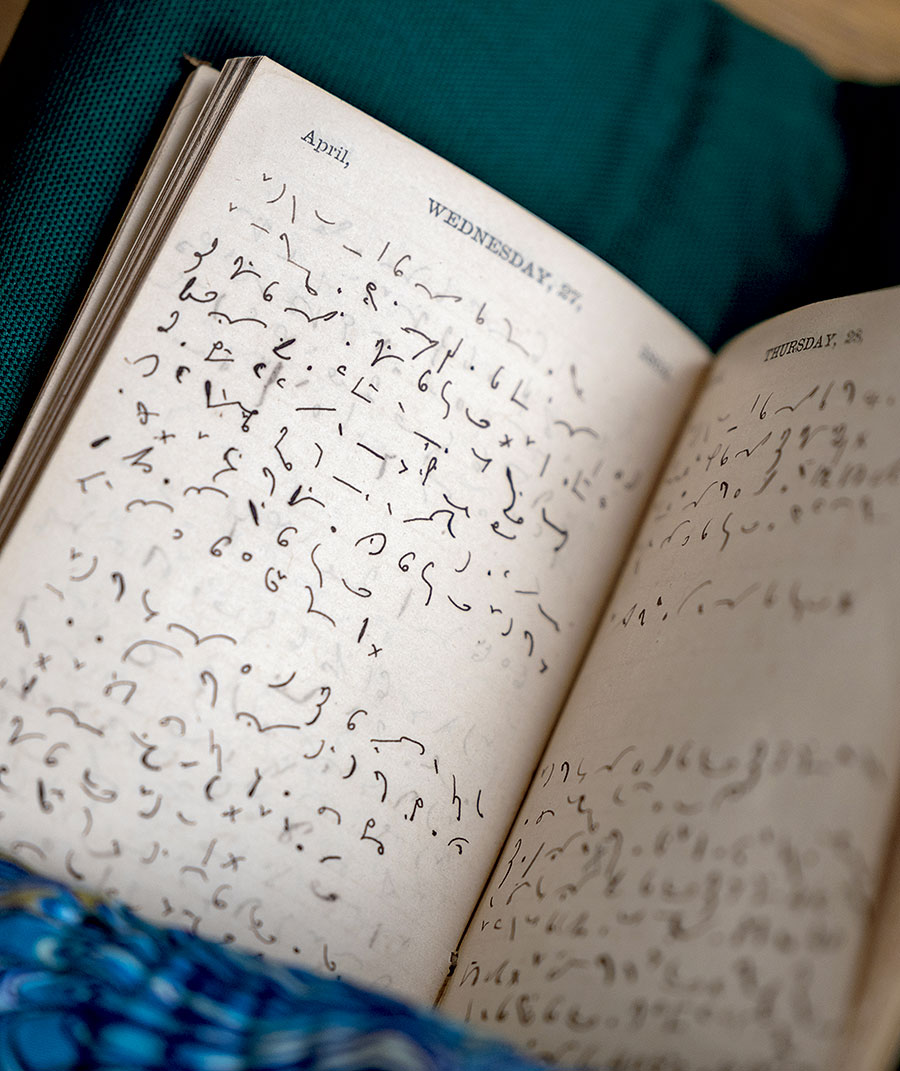
Poor penmanship is vexing, but shorthand is a whole other language. These days, the use of phonetic symbols to take dictation and document proceedings in real time is practically extinct, replaced by voice recording and AI transcribers. It’s rare to find someone trained in shorthand. Compounding matters, there are multiple systems. The Gregg and Pitman ones show up most frequently in Newberry documents.
Gregg, created in 1888, is probably what most people think of when they think of shorthand — if they ever do. Pitman was created earlier, in 1837, and was quite popular in the 19th century. Used by reporters to transcribe the Lincoln-Douglas debates, it turns up often in the Newberry’s collection of Civil War diaries. “Those are just so enticing,” says Wolfe. “It was always frustrating that we had these Pitman Civil War diaries that we could not make heads or tails of. When you look at them, it really looks like aliens wrote it.” Fortuitously, a mother-daughter volunteer team who knew Pitman and Gregg, respectively, stepped up.
For the materials in foreign languages, the library finds translators, but handwriting remains a challenge to read whether it’s in English, Spanish, or even Latin. “We have a book of magical spells from the 1600s, and some of it was in Latin,” says Wolfe. The author of that book, what the library has labeled Newberry MS 5017, was unknown until 2017. That’s when transcriber Renae Satterley, a librarian at Middle Temple in London, recognized 17th-century attorney Robert Ashley’s handwriting from his vita and the notes he made in the margins and on the endpapers of the books in his massive collection. Ashley was no pointy-hatted sorcerer (though a portrait shows he favored flowing, lawyerly robes): While some of the spells purportedly help the caster speak with spirits, they’re mostly geared toward relief from toothaches and other ailments.
In recruiting transcribers, Wolfe and Hinderliter promote the pleasure of reading direct accounts of history’s eyewitnesses. For example, Wolfe points out the library’s collection of firsthand tellings of the Great Chicago Fire, permitting me to peruse Julia Newberry’s private diary. She was the daughter of Walter L. Newberry, a Chicago alderman and later president of the Chicago Board of Education who made his fortune in real estate, railroads, and banking and stipulated in his will the provision of funding for the “free public library” that bears his name.
Julia’s October 13, 1871, entry, rendered in impeccable cursive, is stark, revealing her shock and horror, still palpable more than 150 years later: “I am perfectly bewildered with the rush of events, I don’t know what to write or what to think. Half of Chicago is in ashes it is too awful to believe, so dreadful to think about. And the suspense is so fearful, the reports so vague & no one can get direct information.” Says Wolfe: “Reading about someone who saw it firsthand — it makes it more vivid and accessible.”
Hinderliter has special affection for diaries from attendees of the World’s Columbian Exposition of 1893. Conventionally, most of what we know about the fair is based on PR materials and newspaper accounts, brimming with boosterism. But diaries of attendees put you in the shoes of people who were often seeing the White City for the first time. For instance, Miss Jane Elliott Sever O’Reilly, writing to her mother in July 1893, seemed starstruck: “The first thing we saw upon entering the city was the ‘Ferris Wheel.’ It towered above everything.” Enchanted by the fair’s endless strings of newfangled electric lights, Jane wrote, “It seemed as if we must be in Fairy land.”
Transcribers are free to pick whichever documents they wish to work on. While some hop around, others stick with particular collections. “With family papers, you can watch someone grow up through their letters to other family members,” Wolfe says. Simple children’s correspondences, rendered in giant block letters, evolve over time into neatly handwritten notes sharing news about entering college, getting married, becoming a parent, and other milestones. “And then, eventually, it’s someone else talking about their death.”
Volunteers call up documents through a portal and type them up. Their work is then reviewed by other participants. The volunteers are a mixed bunch: retirees; visiting scholars; students, ranging from high school to postgrad; and a legion of various other types. “It’s a good way to teach working with primary sources — giving newer scholars ownership or agency with the research,” says Wolfe. “There are people who go crazy and just do hundreds of pages, or people who pop in every once in a while. We don’t know a ton about them, because we don’t require any sort of login. We want to make it as accessible as possible and have a low barrier to entry.”
Rebecca Rector is a retired librarian in upstate New York. She had her own business offering genealogy research, but that took a hit when the COVID-forced closure of libraries, courthouses, and other archive locations made such fact-finding nearly impossible. Then she heard about the Newberry project. “I have Midwestern roots — born in Ohio — so I thought this would be interesting. It was, and still is!” Rector tells me by email. “I am familiar with old handwriting, so doing the transcriptions was a great way to spend time during the pandemic.” Rector continues to transcribe not only for the Newberry but also for the National Archives and assorted New York museums.
Newberry transcribers may skew older, but there are younger participants, too. Markens Desir of New Jersey is a volunteer transcriber for the Newberry and the Library of Congress — when he’s not attending high school. Desir, 17, has a special appreciation for the papers of Chicago lawyer and civil rights activist Mark J. Satter. Asked by email what keeps him typing, Desir displays an admirable earnestness: “These transcription campaigns feel like a real world and high-stakes investigation for me. It’s my own little way of creating world-scale impact.”
This is the reality of how history is preserved, one document at a time, a painstaking process of deciphering and transcribing. But the way Wolfe sees it, there’s plenty of fun in it, too — especially if you enjoy a challenge: “If you run out of Wordles, we have an endless supply of word puzzles for you.”