


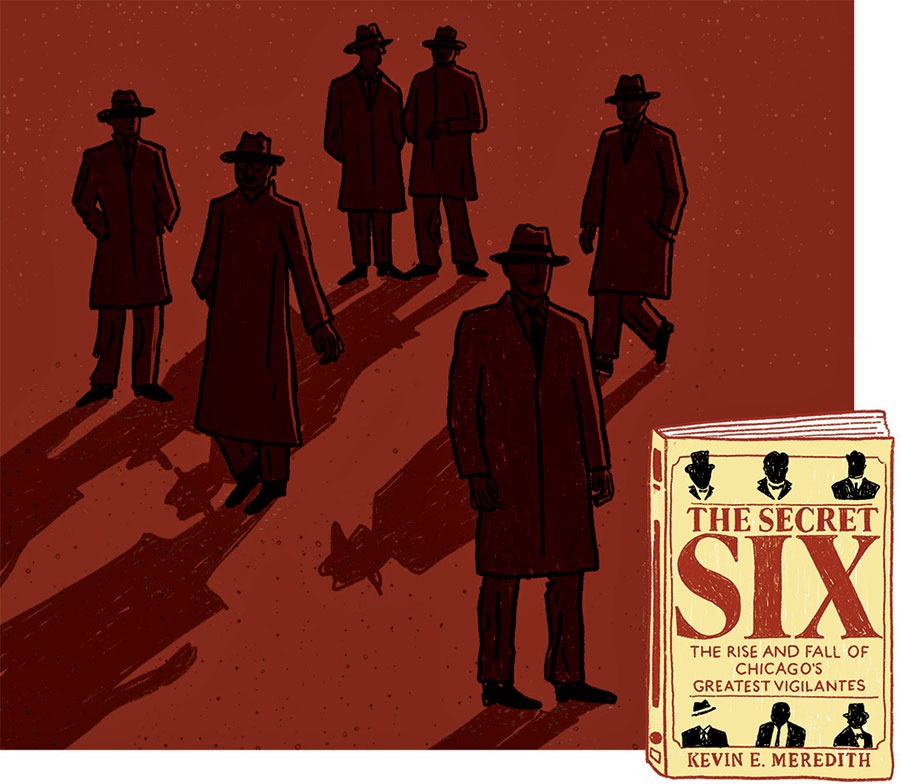
1 Business leaders launched the crime-fighting cabal.
Kevin E. Meredith’s book The Secret Six is titled after this shadowy syndicate that took matters into its own hands. Formed by the Chicago Association of Commerce in 1930, when the city seemed overrun by mobsters, this outfit of freelance lawmen was supposedly controlled by six anonymous “business and civic leaders,” though in reality the number was not fixed. The men conducted their own investigations and even apprehensions but worked in collaboration with the police and state’s attorney. “There was plenty of crime in America’s second largest city, but plenty of money as well, and enough outrage to inspire the flow of those dollars to a private justice crusade,” Meredith writes.
2 These “secret” crime busters were actually publicity hounds.
Meredith found tens of thousands of newspaper stories mentioning the Secret Six, whose boss, Colonel Robert Isham Randolph, often exaggerated its exploits. “Randolph’s boasts grew more outlandish and more detached from reality as time passed,” Meredith writes. But the author does credit the group with helping solve 18 criminal cases. Notably, the Secret Six foiled a 1930 death threat and extortion plot against Oscar Stanton De Priest, who was the only African American serving in Congress at the time.
3 Al Capone and Eliot Ness fell for the hype.
Before Capone went to prison for tax evasion in 1931, he blamed the Secret Six for his downfall, saying, “They’ve licked me.” And when Ness wrote a book about his work as a Prohibition agent, he described the Secret Six “knocking over [Capone’s] breweries, tapping his telephone wires and harassing him in various ways.” Those are exaggerations, according to Meredith: “The Secret Six did not do nearly as much to bring down Al Capone as the legends report, but the vigilantes at least provided a distraction while the federal government did the real work of smashing Capone’s empire and putting him in prison.”
4 Other cities wanted their own version.
Similar vigilante organizations popped up in Kansas City, St. Louis, Elgin, Peoria, Omaha, New York City, and Atlantic City. A group in Toledo, Ohio, reportedly enlisted “reputable citizens willing to use their fists and even weapons if necessary to fight against the outlaw bands.” Amid much praise for these efforts, some critics raised an alarm. “It smacks of a vigilantism that has no place in a civilized society,” The Minneapolis Tribune said about the movement.
5 The Secret Six botched many cases.
It tried to expose corruption in the Chicago Police Department and failed. And in one extortion case, the group wrongly identified William Kuhn, a young investment clerk with a drinking problem, as a suspect, detaining him for several days at the St. Clair Hotel, where he was “mercilessly grilled.” Kuhn later sued members of the Secret Six and won a $30,000 judgment. “The Secret Six had become little different from the gangsters they swore to shut down, destroying an innocent person with impunity,” writes Meredith. In 1933, Mayor Anton Cermak blocked the city’s cops from cooperating with the group, and the Association of Commerce cut off funding. And with that, the Secret Six was history.