Under Larry Snelling’s watch, violent crime is down in Chicago. To understand his approach, you have to understand where he comes from — and the lessons he’s learned.
It isn’t easy to rattle Larry Snelling. Late on an October afternoon, I’m in his corner office at the Chicago Police Department headquarters in Bronzeville. Outside, the city is on edge. Five hundred National Guard troops have just arrived, ready for deployment as part of a federal immigration crackdown. Masked agents have been sweeping through the city, clashing with residents. Four days earlier, a woman was shot by a Border Patrol agent in Brighton Park, less than five miles from CPD headquarters. The police department Snelling leads — the second largest in the country, with nearly 12,000 officers — is caught in the middle, trying to keep the peace in a city that feels ready to explode.
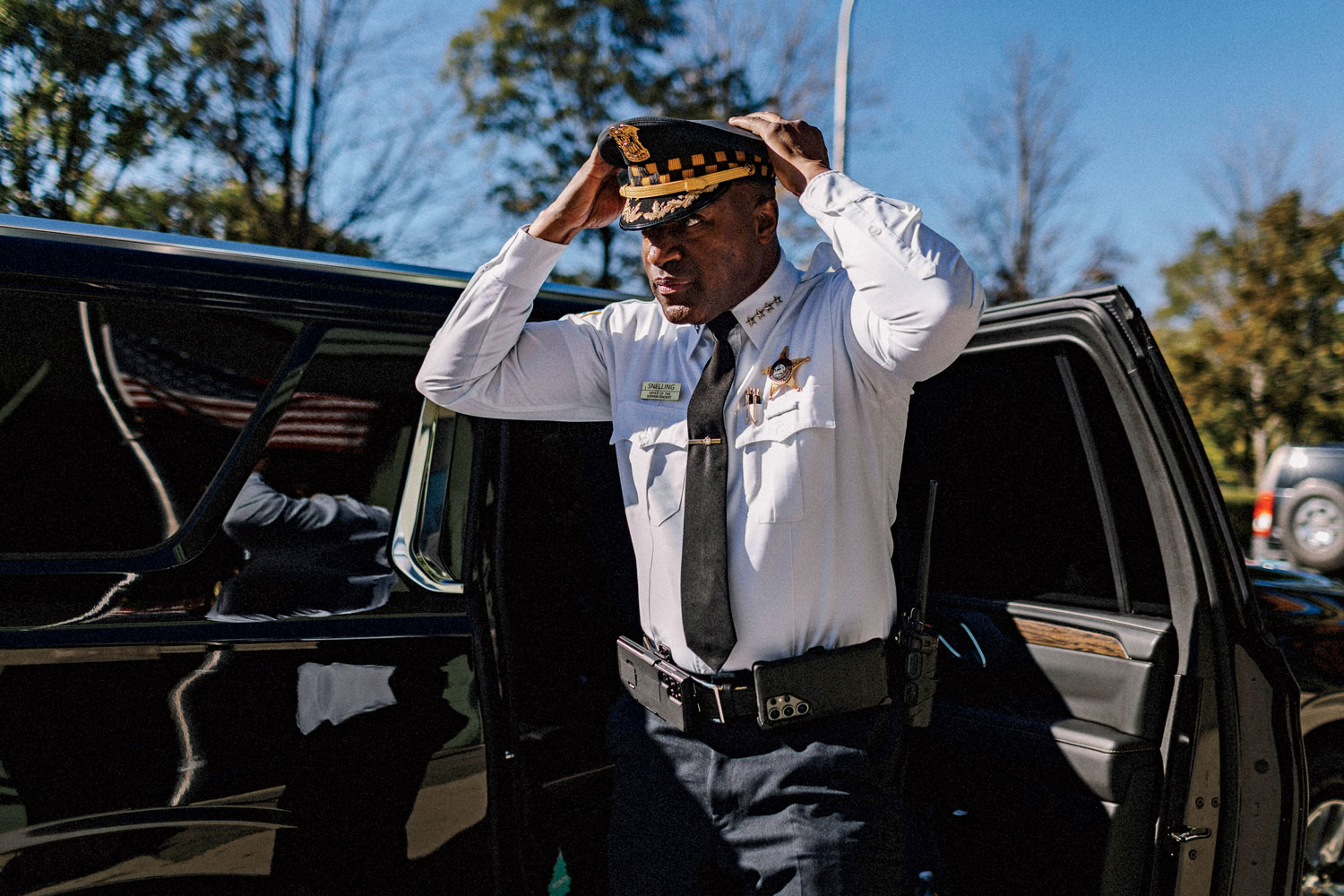
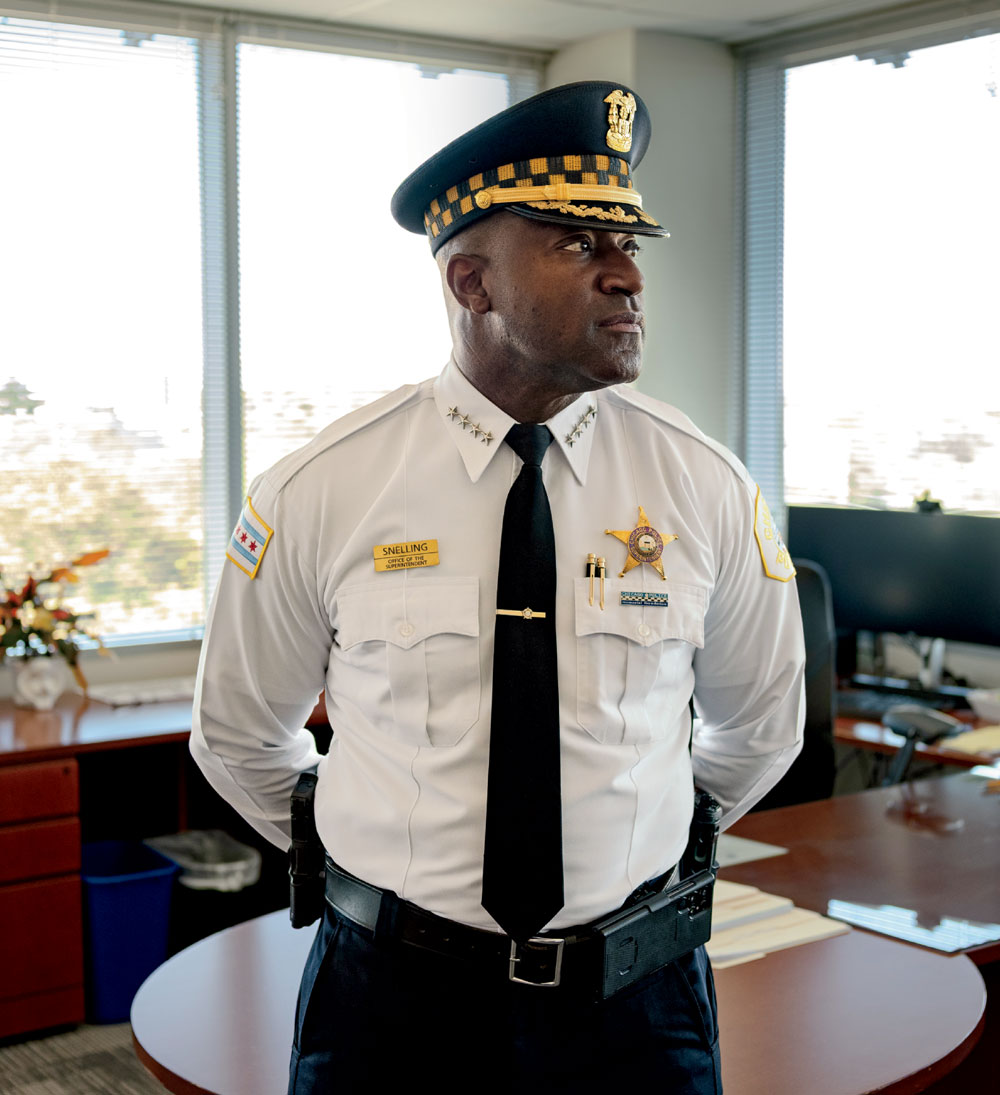
Snelling sits on a low-slung couch near the door to his office, on the fifth floor of the 390,000-square-foot complex. The 56-year-old has broad shoulders and a firm handshake that suit his certification as a CrossFit instructor. Despite all the chaos in the city, Snelling looks calm. When I ask what the last 48 hours have been like, he gives an uncharacteristically sheepish grin. “I never expect that we won’t face challenges,” he says, pressing his hands to his knees. “It’s just new ones every day.”
Snelling prefers to stick to the facts. He doesn’t like conclusions. They’re too subjective, too slippery, too easy. Facts provide clarity. Facts reveal truth. Snelling instructs his officers to fill out their reports with facts, not conclusions. If a report says, “This person had a bat and was aggressive,” that, to Snelling, is a conclusion. “If I said, ‘This person was in possession of a bat, and he was swinging it at people as they walked by,’ those are facts,” he explains, his cadence steady, measured. Conclusions risk inaccuracy. Inaccuracy is where mistakes are made. And Snelling hates mistakes. Just keep to the facts.
Here are some facts: In 2021, there were 805 homicides in Chicago, the highest number in a quarter century. As the haze of the pandemic cleared, that number started to fall. In 2023, the year Snelling was appointed, there were 623. Since then homicides have declined even more sharply. Through the end of November, 390 people had been killed in Chicago in 2025, giving the city a chance at an extraordinary achievement: reaching a new low mark for this century. The current low of 425 homicides was set in both 2013 and 2014. Other measures of violent crime have fallen significantly too since Snelling took over: Through the first half of 2025, carjackings were down 58 percent from the same period in 2023; aggravated assaults, 13 percent; gun-involved assaults, 24 percent.
Plenty of people have their own conclusions about why that is, but the truth is, no one — not in Chicago, and not across the country, where crime rates are also falling — really knows. Maybe it’s due to larger, systemic societal shifts. Maybe we’ve finally achieved a new normal after the tumult of the pandemic. Or maybe here in Chicago it’s something Snelling is doing as superintendent.
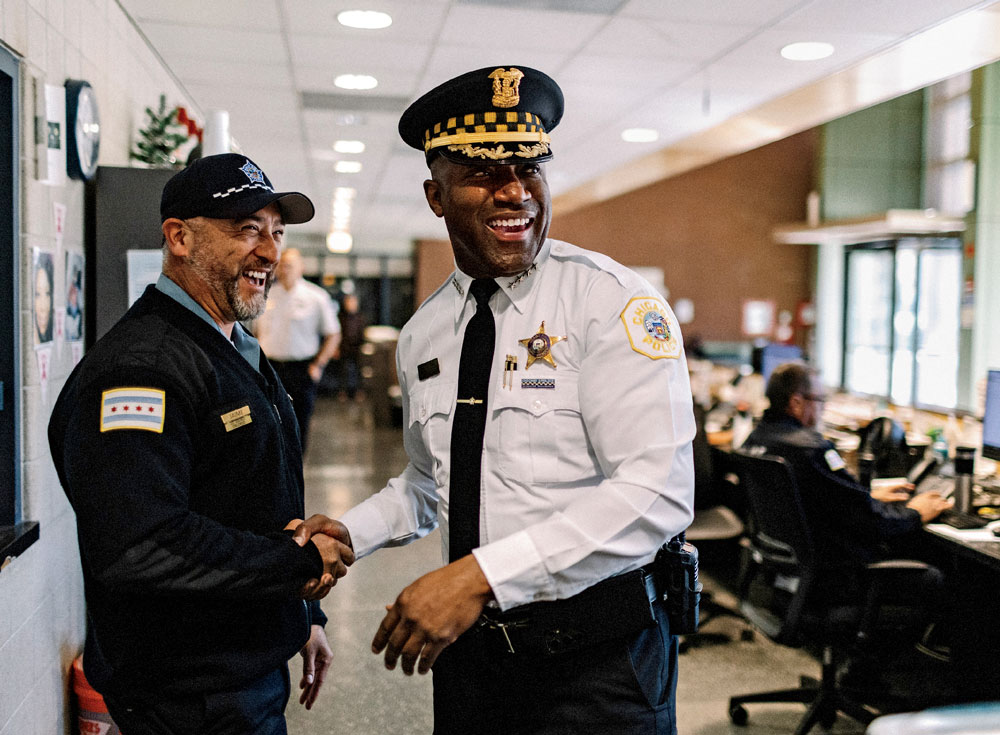
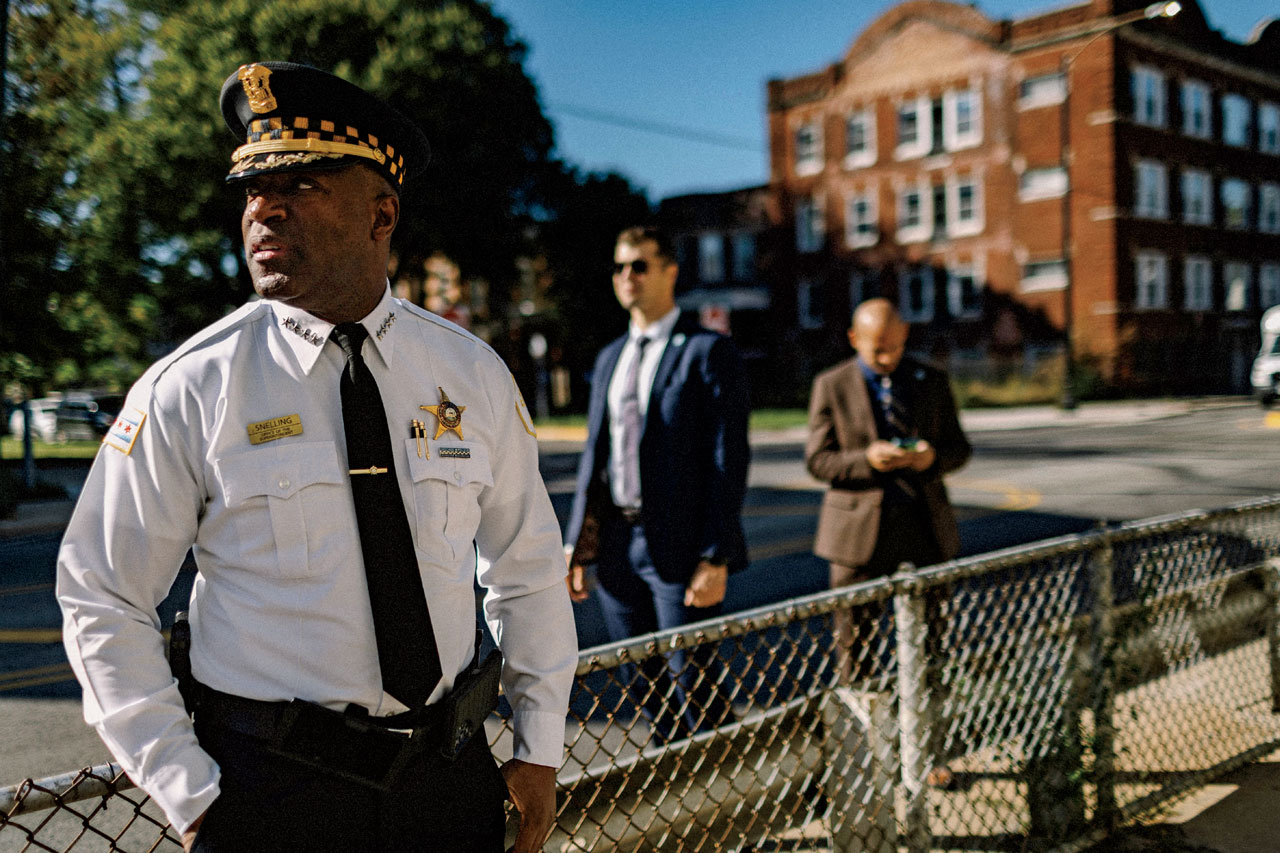
Snelling greets an officer at the 7th District station in Englewood, where the superintendent once served as commander.
That’s a conclusion, so Snelling isn’t interested in engaging with it. But plenty of people around Chicago are eager to credit him. He’s well liked in many circles. It’s not just that the 31-year department veteran is a native Chicagoan, raised in Englewood, unlike two of his recent predecessors, former Dallas Police Chief David Brown and Garry McCarthy, who came from New York City. People — the department’s rank and file, the City Council, even the public — seem to trust Snelling.
When he came into the role, the department was in upheaval. Under Brown, whose tenure coincided with the pandemic, violent crime soared, civil unrest flooded the streets, and complaints related to officer misconduct spiked. Public distrust of the police, still fueled by the 2014 police killing of teenager Laquan McDonald and exacerbated after George Floyd’s death in Minneapolis, had caused department morale to plummet and contributed to a mass exodus of officers. During the 2023 mayoral election, the president of Chicago’s Fraternal Order of Police, John Catanzara, warned that if the ultraprogressive Brandon Johnson won, there would be “blood in the streets” and that up to 1,000 officers would quit. That didn’t happen, but by the time Snelling accepted Johnson’s nomination as superintendent, there were still more than 1,700 officer vacancies.
All of which is to say that Snelling was stepping into a fraught situation. Yet even the mayor’s sharpest critics, those who rarely praise anything Johnson does, have lauded the superintendent’s performance. “The one decision that Johnson got right was hiring Snelling,” says Illinois Comptroller Susana Mendoza, who is widely seen as a mayoral contender in 2027. “He’s the best thing that’s happened to Chicago in some time.” Mendoza nods to Snelling’s hard-line approach to law and order as a reason for the drop in crime. She also cites his relationship with new Cook County State’s Attorney Eileen O’Neill Burke, who campaigned on a similar approach: “Given the dynamic they have to work with in the mayor’s office, I think it’s miraculous what they’ve been able to do together.”
There is, of course, no shortage of reminders that Chicago remains among the nation’s most violent cities, not least two incidents within a week in November that gained national attention: A woman was set on fire on the L, and a few days later, nine teenagers were shot, including a 14-year-old boy who was killed, in the Loop. But even those who advocate for stricter policies tend to pin the violence on politicians and judges — not Snelling.
It’s not just the tough-on-crime crowd praising the superintendent. “It’s pretty clear that Snelling is an upgrade,” says Alderperson Andre Vasquez, one of the City Council’s loudest progressive voices. Comparing Snelling with his predecessors, Vasquez is unsparing: “We were only getting excuses from Brown. We’d never get information.”
But there are other facts — facts that are more troubling. In 2024, CPD officers pointed their guns at people 4,209 times, a 44 percent jump from 2022. (Snelling attributes the rise to more transparent data collection under the federal consent decree that mandated sweeping police reform here in the wake of McDonald’s death.) As of mid-November, there had been 18 police-involved shootings where the target was killed or injured in 2025, already more than in all of 2024, yet still far fewer than the 44 a year the department averaged from 2010 through 2015, according to a Tribune analysis at that time. I ask Snelling if the drop in crime is a function of more aggressive policing.
He objects to the question. The word “aggressive,” he says, is subjective. “Here’s what I would tell you, and I just want to be clear about this,” he continues, his voice steady. “Each police-involved shooting is based on the circumstance that unfolds at that moment. So it doesn’t necessarily have anything to do with an officer approaching something aggressively, right? Because this could be a situation where an officer is flagged down and there’s this person with a weapon. An officer could pull up on the scene and immediately face gunfire and now has to respond. There’s someone who’s violent with a knife or a gun, and now the officer attempts to de-escalate, but there’s a failure in that de-escalation, right?” Snelling sits back. “I wouldn’t use the word ‘aggressive.’ I would like to say that we’re being more efficient and more proficient.”
Whatever your choice of adjectives, the rise in use of force has civil rights activists alarmed. In a September federal court filing, a coalition of reform groups expressed concern about a 75 percent increase in use-of-force incidents here between 2021 and 2024, disproportionately against Blacks and Latinos. Some fear the department is returning to its pre-McDonald tendencies: more opaque and less accountable. Even as Chicago applauds the drop in violent crime under Snelling, a question lingers: Is it coming at a cost?
After Larry Snelling joined the Chicago Police Department in 1992, at the age of 22, his first assignment was to patrol the streets where he grew up. The third of five sons, Snelling had been raised by a single mother in Englewood, which was rife with gangs and violence. As a student at Englewood High School, he was impressed by a school resource officer named Officer Thomas. The man was tough, Snelling recalls — “He made sure you were following the rules and you did exactly what you were supposed to do” — but by making it his business to keep students in line, he let them know that someone was looking out for them. Ultimately, Snelling decided to join the police force because he needed a job and the department was hiring, but Officer Thomas was in his mind when he sent in his application. “That’s an example of what a great police officer could be,” he remembers thinking.
Returning to his old neighborhood as a young officer wasn’t easy. Early in his career, Snelling was called to a house to handle a domestic incident. A woman answered the door, visibly injured. Snelling had the woman stay in one part of the house while he looked for her assailant, calling out his name. When a man stepped out of the bedroom, he looked at Snelling and said, “Larry.” Snelling stopped. They had known each other when they were kids. How many more times working this beat would he arrive at a crime scene and see someone he grew up with?
I ask Snelling whether his shared history with the individuals he arrested in those early days shaped how he saw criminals. He quickly rejects the notion that it made him more empathetic to them. “My empathy has always been for the people who are victimized,” he says. “In the moment where someone is harming someone else, I’m not empathizing with that.”
A year later, there was another call that Snelling remembers for different reasons. Gunshots had been fired in a home, the details of which Snelling glosses over, because that’s not what matters. What he remembers is the moment he walked in and saw a 2-year-old girl with a gunshot wound in her chest. The slow settling of death into his arms as he carried her outside. The tubes down her nose that ran red. How, once he saw all the blood pulled out of her chest, he knew she was gone.
“A lot of times, officers are judged by people who have never done this job,” Snelling says. “They forget that these are human beings who see terrible things on a daily basis.”
The image of the girl dying in his arms stayed with Snelling, but there was something else: The second-guessing. The questioning. Could he have gotten there faster? Could he have done anything differently? It became a refrain in those early years. “The number of homicide scenes I’ve gone to” — Snelling presses his lips, shakes his head — “you’d get to a scene and you’d see a person lying on the ground, every ounce of blood outside their body.”
Snelling now has two grown daughters of his own (and a 1-year-old grandson). Becoming a father changed the way he approached the job: “You think about the crimes you see committed against children, women, girls. When you’re a father, especially to young kids and girls, you want to be a protector.”
Routinely seeing carnage takes a toll on a person, which is something Snelling wants people to understand. “A lot of times, officers are judged by people who have never done this job. They forget that these are human beings who see terrible things on a daily basis.” During those early years of his career, when he arrived home at the end of his shift, Snelling would undress outside his door. It was his way of making sure the job didn’t come inside with him. “What I was wearing that day represented everything I saw and that I dealt with,” he tells me. “Everyone has to have some way of decompressing, a way to work out some of the things that you see.”
Back then, when Snelling was patrolling, officers were told to suck it up. Getting help was seen as a weakness. In 2017, a report from the Department of Justice found that the suicide rate among Chicago police officers was 60 percent higher than the national average for law enforcement officers. Snelling has vowed to change the culture of the department by offering mental health resources and encouraging officers to seek professional help. The department has opened two additional clinics in the last year, and in September, as Snelling advocated for department resources, he told the City Council’s budget committee that there’s been an increase in officers reaching out for help. This didn’t necessarily mean there had been an uptick in mental health struggles, he cautioned. In the past, people just wouldn’t admit that they were having a hard time. “We want to take the stink off the stigma that going to get help is a weakness,” he said.
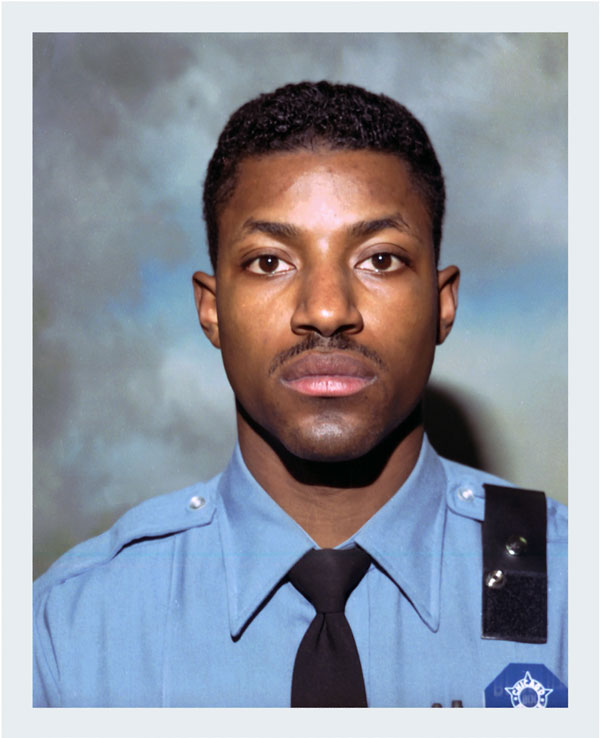
Snelling in 1992 as a Chicago Police Academy recruit Photograph: Courtesy of Chicago Police Department
In Snelling’s office there’s a framed T-shirt, gray and worn, with “Snelling” spelled out in vinyl letters, cracked with age. “CPD Academy, 2 Jan 1992, Class 92-1 E” is written on a poster behind the shirt, the words hanging above its crew neck collar. He points to it at the end of one of our interviews. “My shirt when I was a new recruit,” he says, smiling softly. “It reminds me that we all start somewhere. That everyone makes mistakes.”
Including Snelling. “Coming onto the job, I look at certain decisions that I made, and there have been mistakes — they haven’t been major, but there have been mistakes. I look at those mistakes. Small mistakes going uncorrected could lead to larger mistakes.” Snelling’s voice presses forward, which I’ve come to realize means he’s about to land his point. “I make sure I learn from it. And then we build upon it.”
In 1994, after two years on the job, he was slapped with a misconduct complaint. A man arrested for domestic battery claimed Snelling had hit him while transferring him between stations. Snelling denied striking the man, but the complaint was sustained and he received a two-day suspension. A year later, there was another incident: Snelling was accused of pointing a gun at a driver in Englewood while off duty. During the investigation, he admitted that there had been a “traffic altercation” and that he had a gun in his waistband, but he denied pulling it out. After interviewing witnesses — including the driver, who was an off-duty Cook County sheriff’s officer — investigators sustained the complaint and gave Snelling a five-day suspension.
Snelling’s not one to dwell on the past, but when he does look back on those early years of his career, he’s introspective: “There’s a difference in how you respond to things when you’re a police officer. And those were lessons that had to be learned.”
One complaint in particular from early on would draw scrutiny later, after Snelling was selected for superintendent. In 1997, he and three other officers were accused of coercing a man to bring them a gun, threatening to plant drugs on him if he didn’t. (The CPD has a long history of rewarding officers who get guns off the street with promotions or other commendations.) After an internal sting operation and investigation, the complaint against Snelling was not sustained. The other three officers, however, were placed on short suspensions.
Though Snelling was cleared, the punishment of his fellow officers left an impression. When I ask him about it, he leans forward, his expression firm. “I’m confident enough to sit here and tell you that those were great officers,” he says. “I can tell you, with all certainty, that they were great individuals who went out every day to do hard work.”
Snelling says that the incident had nothing to do with his decision the next year to take a two-year leave of absence to work as a regional security director for AT&T. “I had seen some things on the job where I didn’t want to lock myself into something where this was the only thing I thought I could do,” he explains.
He accomplished what he set out to do, proving to himself that he could be successful at something other than policing. But his heart wasn’t in the work the way it had been when he was an officer, so Snelling rejoined the department in 2000.
When Snelling looks back on those early years of his career, he’s introspective: “There’s a difference in how you respond to things when you’re a police officer. And those were lessons that had to be learned.”
Snelling often thinks back on an incident during his early years as an officer. He had been called to break up some drug dealing on a block in Englewood. He made some arrests, and while his partner loaded people into the wagon, Snelling paused, looking back at one of the houses on the block. He saw the curtains peel back just enough to reveal an elderly woman standing at the window, clasping her hands as if in thanks. “You realize at that point that this woman was a prisoner in her own home,” Snelling says. It was the feeling he got from giving her a sense of safety that made him realize he was no longer a police officer as a matter of circumstance. “I knew that this was something I was going to do the rest of my working days.”
After his leave, Snelling became a trainer at the Chicago Police Academy, where, over nearly 20 years, he served as an instructor for the physical skills section and eventually ran that department. During this time, he became the department’s foremost expert on use of force. He also earned a reputation for being the kind of instructor who’d stay late mentoring students and doling out advice. Often, he’d do extra workouts at the gym with cadets who needed help getting fit.
In quick succession, a series of promotions fast-tracked him through department leadership. He returned to Englewood in 2019 as watch operations lieutenant for the 7th District and soon became its commander. The next year, he was promoted to deputy chief of the Far South Side’s Area 2, and by the time his name was put forth for superintendent, Snelling had risen to the rank of chief of the bureau of counterterrorism. It was an impressive rise.
Jamie Kalven is the founding executive director of the Invisible Institute, a local investigative journalism nonprofit. Kalven, who broke the first major story about the police shooting of Laquan McDonald, has been aware of Snelling since 2018, when the then-sergeant was called by the prosecution as an expert witness in the trial of three officers accused of covering up the McDonald shooting. (They were found not guilty.) On the stand, Snelling was calm and steady during hours of questioning by the prosecution and defense. He was asked why McDonald, who had a knife, should not have been considered an armed assailant when he was shot by Officer Jason Van Dyke, who was convicted of second-degree murder in an earlier trial. “If there was a movement in furtherance toward the officer that you could actually see in the video, then it would rise to the level of deadly force, but I can’t see it in the video,” Snelling testified.
Still, there’s a line from the Department of Justice’s 2017 investigative report on the CPD, spurred by the McDonald shooting, that is worth bearing in mind: The report found that new graduates of the police academy, where Snelling was a key instructor at the time, were “unprepared to police lawfully and effectively.” Later, Snelling redesigned the department’s use of force policy, emphasizing national best practices and constitutional policing.
Snelling’s advancement at the CPD doesn’t surprise Kalven. From what he’s observed, Snelling is unapologetically old school. “Which is attractive in terms of a certain kind of robust leadership,” Kalven says. “To swiftly rise in the department to the ultimate position of leadership, you know how things work. You know where the bodies are buried.”
As Snelling gets ready for work each morning, he thinks about what his message will be for his officers. He strategizes. He looks at his schedule for the day, for the week, for the month. When he comes home, he falls asleep on the couch, reading through documents. He thinks through his plans, adjusts them as needed. He avoids reading news articles, he says. Those work him up, and Snelling doesn’t have time to get worked up over that sort of thing. “If you focus on the facts and continue to do the job the way it’s supposed to be done, you don’t have to worry about [what is written],” he says.
Snelling sums up his approach to crime in three words: “intelligence-driven policing.” What he means is tapping the latest technology, data analysis, and interagency collaboration to investigate and prevent incidents. An illustrative example is the Crime Gun Intelligence Center of Chicago, a partnership of federal, state, and local law enforcement agencies led by the Bureau of Alcohol, Tobacco, Firearms, and Explosives. Established in 2024, the center uses shared databases and resources to trace guns that were used for crimes, quickly analyze ballistics evidence to connect incidents, and identify gun traffickers. “Just working together has been instrumental in helping us get crime down,” Snelling says. (After police captured the man who killed Officer Luis Huesca last April during a carjacking, Snelling declared, “This is intelligence-driven policing at its best.”)
Snelling is also an advocate for management training of his department’s supervisors. In 2023, the University of Chicago Crime Lab began using its findings from the Strategic Decision Support Centers, a data analysis and training initiative with the CPD, to create the Policing Leadership Academy, which trains commanders from departments around the country. Snelling, deputy chief of counterterrorism at the time, was tapped to help develop the program. In early 2024, he worked with the Crime Lab to design a three-day training for CPD leadership, from commanders to the chief of patrol, on how to use data to drive decision making. The Crime Lab points to recent research suggesting that without such tools, police aren’t able to correctly identify the “hottest blocks,” or areas where crime is particularly high — that sometimes they’ll be off by a block or two, or maybe even a few miles.
With Snelling an advocate of using technology to stop and solve crime, it must have stung him when the mayor ended the city’s use of ShotSpotter in 2024. Supporters considered the gunshot detection system a vital tool for helping police respond quickly to incidents. But Johnson had campaigned on removing ShotSpotter, which he insisted had led to the overpolicing of Black and Latino neighborhoods, deriding it as a “walkie-talkie on a stick.”
When I ask Snelling about ShotSpotter, he says debating the significance of its loss is moot. “At the time, did I think ShotSpotter was important? Yeah. As a commander, as an area deputy chief, I know what effect ShotSpotter had.” But he also had known that with the new administration, the technology might get yanked. “And instead of worrying about it going away, I focused more on what we were doing to work around the loss of it. We can’t be looking behind. You’ve got to look ahead.”
Without ShotSpotter, the department has been leaning more on the Strategic Decision Support Centers, which were launched in a few of the city’s most violent neighborhoods in 2017 and are now in all 22 districts, where they provide real-time data analysis. Investigators also rely on area technology centers to quickly process video from a variety of sources, including surveillance cameras and cellphone footage. Still, in November, Snelling told the City Council that the department was looking for a replacement for ShotSpotter.
That Snelling works for a mayor who has been openly skeptical of traditional law enforcement — in 2020, Johnson, as a Cook County commissioner, called defunding the police a “real political goal” — naturally raises questions about their relationship. The FOP’s Catanzara brings up what he calls “the first deputy superintendent fiasco” — that is, Snelling’s appointment of Yolanda Talley as his second-in-command, the first woman named to that post. “He was clearly told that’s who they wanted,” Catanzara says, referring to the mayor’s office. Alderperson Raymond Lopez, a frequent Johnson critic, agrees, claiming that the appointment of Talley, who had been the commander of the 15th District in Austin, brought the Johnson administration some much desired clout with West Side religious leaders.
Catanzara was initially pleased with Snelling’s selection as superintendent but is now skeptical: “The hope was that he was going to be less of a political creature.” He pauses before throwing the jab. “More of a man of his own.” Catanzara says he and Snelling aren’t speaking these days. Their relationship deteriorated after they clashed over Snelling’s handling of Officer Huesca’s funeral. According to Catanzara, Snelling insisted that the mayor be invited against the family’s desires. (Johnson ultimately did not attend.) “I wish he weren’t so delicate to criticism,” Catanzara says.
John Catanzara, the president of Chicago’s Fraternal Order of Police, was initially pleased with Snelling’s selection as superintendent but is now skeptical: “The hope was that he was going to be less of a political creature.”
Snelling denies politics played a role in Talley’s selection. “When it comes to promotion, I’ll never give in to pressure from anybody,” he tells me. “I don’t care who it is.” He says he took his time to fill the role — nearly 18 months, in fact — because he wanted to first get a better understanding of what was needed in the job. “I’ve always been a believer that if you’re going to be at the top of the food chain, you need to understand the moves that are being made.” Nonetheless, Snelling reduced Talley’s role significantly less than five months into her job, and she retired in October.
I ask Snelling if politics ever gets in his way. He shrugs off the question. “Quite often people believe that the mayor is involved in the movement within the Chicago Police Department. He’s not.” It’s the superintendent who calls the shots, he emphasizes, adding that Johnson trusts him. “I tell him that this is what we’re going to do. People on the outside may not understand that. But on the inside, we do.”
In Snelling’s office, there’s a framed photograph. It’s familiar because photos like this one made the rounds on social media in August 2024, right after the Democratic National Convention. It shows him standing in the middle of the street wearing a bulletproof vest, starched white shirtsleeves crossed over his chest. Two officers flank Snelling, their posture loose but focused. Behind them, a line of police in riot gear. It’s dark outside and shadows are cast onto the asphalt from street lamps. Night has fallen and the city is calm.
Snelling was charged with managing security surrounding the convention less than a year into the job. To him, the famously chaotic 1968 Democratic convention here was a result of insufficient training. So that’s where he began his preparation, tapping not just his academy experience but the program he developed for safeguarding the 2012 NATO summit here. As the 2024 convention approached, Snelling met with organizers of the various planned protests. “Come express your First Amendment rights,” he told them. “But don’t come here with violence or vandalism.” Snelling planned details down to how to ensure officers stayed hydrated and fed. When an outer security fence was breached, he was on the scene — in fact, he made sure he was onsite every day. “It can’t be ‘Do as I say, not what I do,’ ” Snelling tells me. The force’s handling of the event was widely praised. This was no repeat of 1968: This time, there were only eight complaints of police misconduct filed during the convention.
Just over a year later, as ICE and Border Patrol agents surged into the city, Snelling faced another significant challenge. In October, tensions were raised by the Brighton Park incident in which a woman was shot and wounded; she was accused of ramming her car into a vehicle belonging to federal agents, but prosecutors dropped the charges. Fox News, citing an internal CPD dispatch, reported that the chief of patrol had told officers not to respond with help for the boxed-in agents.
Soon after, Snelling held a press conference. He had wanted to stay away from politics, but he couldn’t keep silent — not when outsiders were questioning his people. He insisted that his officers were never told to stand down and, in fact, were at the scene. (Body camera footage released in November, though, confirmed that a lieutenant, citing Chief of Patrol Jon Hein, initially ordered officers not to respond, a directive that was ultimately countermanded.) Then, in a calm, no-nonsense delivery, Snelling pointed out something that had gone unsaid by city leaders: that protesters were taking a risk when they made federal agents feel threatened: “You are breaking the law when you do that, and you are putting yourself in danger. You may not like what they’re doing. I can understand that there’s a lot of emotions out there, but that does not mean that you get to commit a crime, especially one that could lead to deadly force.”
With so much anti–federal agent fervor around town, it may not have been what Chicagoans wanted to hear. But it was what they needed to hear.
The room roils with tension. It’s February 2024, less than six months into Snelling’s tenure as superintendent, and he is speaking at the monthly meeting of the Chicago Police Board, an independent civilian body that makes disciplinary decisions in cases of serious police misconduct. Also in attendance are officials from the Civilian Office of Police Accountability, another independent agency, created in 2016 after the McDonald shooting to investigate misconduct complaints.
“What I’d like to talk about is transparency, accountability, and officer wellness,” Snelling says. He’s sitting at a long table directly facing Andrea Kersten, COPA’s chief administrator at the time, and he’s referring to the ways in which COPA conducts its investigations. “It’s affecting officers’ performance, but it’s also affecting the safety of members of the community.”
Snelling is concerned that anti-police bias is playing a role in COPA’s reviews. “What we’re seeing are egregious penalties for extremely minor infractions,” he continues. He also wants COPA to take into account that police are often faced with split-second decisions. “We have officers right now who have been called murderers who were simply trying to protect themselves or protect someone else.” As Snelling speaks, he taps his pen on the table for emphasis. These kinds of allegations hurt officers’ mental health, he points out, and they become afraid to police effectively. Willful misconduct is one thing, but mistakes? Those are unavoidably human.
Then Snelling punches hard: “I hear it all the time: police accountability, police accountability. But who’s overseeing the overseer?”
Kersten’s response is measured. She argues that even honest mistakes can be misconduct. “Just like you walk with officers, we walk with complainants who’ve had a very different experience,” she says. “And we’re not siding with them. But we have to receive their version of events.” After she brings up the tenets of the federal consent decree that require de-escalation, Snelling responds. “De-escalation? You don’t have to explain it to me. I wrote it,” he says, referring to his years as a police trainer.
After watching the exchange, Kalven was initially cautiously optimistic. In his mind, the open exchange offered a sense of new possibility for what police reform could look like. He saw the tension as a means for strengthening the quality of COPA’s investigations. But that’s not what ended up happening. “I think the superintendent ran roughshod over that moment and that possibility,” Kalven says.
The trouble began less than a month later when Dexter Reed, a 26-year-old Black man, was shot and killed by officers in Humboldt Park after a traffic stop. Reed fired first, injuring one officer, but the subsequent hail of gunfire by police — 96 shots in 41 seconds — raised concerns of excessive force. Reed’s family also claimed that racial profiling had been behind the stop.
In the ensuing weeks and months, the hopeful tension Kalven had seen between Kersten and Snelling got strained to a breaking point. On April 12, Snelling made his first public comments about the Reed shooting while meeting with the press about another matter. By then, COPA had announced that a seat belt violation prompted the traffic stop, a finding that Kersten then discussed in an interview with WTTW. At the press conference, Snelling expressed concern that comments about the case had been made before an investigation had been concluded: “Those who are putting that information out there to the media are doing so irresponsibly.”
When a reporter asked the superintendent to clarify his remarks, Snelling shifted his body toward the mic, his eyes narrowed. “If that information came from COPA, then that’s who I’m talking about,” he responded. “Information spreads like wildfire, and here’s the issue — and this is important to me.” He paused. “I’m passionate about this because a police officer was shot.” Snelling looked around the room. “I’ll repeat, a police officer was shot. A man lost his life. This isn’t something that should play out in the court of public opinion.”
Snelling had turned the heat up on Kersten. That fall, two former employees sued the city for wrongful dismissal, saying they were fired after criticizing Kersten’s leadership. One of them claimed she made public comments about the Reed case that were “unsupported by actual evidence” from the investigation. Then last February, facing a vote of no confidence by the Community Commission for Public Safety and Accountability, which oversees COPA, Kersten resigned.
Kalven, for one, thinks the rigor of COPA investigations improved under Kersten’s leadership, and he argues that focusing on the other aspects of her ousting obscures what he sees as the origin: Snelling’s complaints about the way investigations were conducted. He’s worried that Snelling’s growing influence will result in the appointment of a new COPA chief who won’t operate with the same level of independence as Kersten did.
“I don’t know if [Snelling’s] criticism is warranted,” says a former member of COPA. “But what I do believe is that it risked undermining the integrity of the organization as a whole.” If Snelling had real concerns about police bias or improper investigations, this person contends, he should have brought it up with the city’s inspector general.
With Kersten’s departure, LaKenya White was named interim chief administrator of COPA. She has been with the agency since its inception. She also once worked in the CPD’s now-defunct in-house internal review office. In August, the Sun-Times reported that White had withdrawn six previous disciplinary recommendations, including four that called for officers to be fired.
A siren whirs outside the Hyatt Centric in the Loop as someone shuts off the lights and clicks on the projector. Inside a narrow conference room, Snelling faces a collection of round tables pressed against one another, wall to wall, each fully occupied. The room is packed with police leaders from around the country, plus one from Glasgow, who are in Chicago for a week of training with the Policing Leadership Academy.
Snelling comes off relaxed but professional. He shifts his weight onto his heels, cracks a joke. He’s killing some time while awaiting the arrival of a man named Darryl Smith, whom he calls Smitty. Snelling is here to lead a training session with him called Strategically Reducing Violence and Building Trust: A Community Case Study. More specifically, he is here to convince the men and women in the room to find a Smitty of their own.
Snelling gets started without Smitty, telling the story of how they met. In 2020, a year after returning to Englewood as a lieutenant in the 7th District before his elevation to commander, Snelling saw Smitty screaming at a group of politicians on the corner of 63rd and Halsted. Smitty, the president of the community-led Englewood Political Task Force, was sick of people parading into the neighborhood looking for photo ops. Snelling walked up to him. “I went to Englewood High School,” Snelling began. “I grew up right here. I understand you.” Smitty heard that and thought, Well, OK, then I guess we can talk.
Not long after, on August 9, a mile north of where Smitty met Snelling, the police shot a man named Latrell Allen near Moran Park. The air in Englewood was thick with false rumors: that the person who was shot was only 15 (he was was 20), that he was unarmed (he wasn’t), that he had died (he was only wounded). A couple of days later, organizers from Black Lives Matter Chicago pulled together a rally. But many of the protesters weren’t from Englewood, and Smitty couldn’t stand the thought of outsiders coming into his neighborhood to cause trouble. He had heard that the 7th District station had been identified as a target. There was talk of smashing out its windows. Smitty worked for the construction company that had built the station. There was no way he was going to let these outside agitators touch it. So he called Snelling.
Activist Damien Morris has seen, under Snelling’s leadership, a department that’s more receptive to working with community-based violence intervention programs. “It’s a collaborative effort.”
Snelling was already assessing the situation. That morning, he had set up blockades, cutting off traffic two blocks from the station. He had also contacted the BLM Chicago leadership: If they lobbed any bricks or rocks at the building, Snelling told them, his officers wouldn’t hesitate to protect themselves. Then he got Smitty’s call. Smitty had gathered a group of older men from the neighborhood, given them white baseball hats. “Let us go out there and handle the protesters,” he told Snelling. Snelling considered Smitty’s offer and told his officers to hold back. “You’re going to see some old Black dudes out there,” Snelling told them. “And they’re going to be saying a whole bunch of Black dude shit.”
Smitty and his white hats stepped to the protesters when they arrived. There was shouting and some pushing but, by all accounts, no violence. Snelling walked between the groups, making sure nothing got too out of hand, and the police, in riot gear, looked down from the steps of the station ready to intervene if needed. But that wasn’t necessary. As night set in, the protesters dispersed.
“You have to get out of the mindset that it’s all about the police,” Snelling tells the officers in the hotel conference room. “You set your ego aside.” He nods to Smitty, dressed in a gray suit, who is now standing on the other side of the screen, having slipped into the room as Snelling was winding down the story. (They’ll end up telling it again, from Smitty’s perspective.) Smitty smiles his toothy smile. “You realize you are partners,” Snelling continues. “That’s when we started to reach our goals.”
It’s easy to dismiss this as lip service, but I get the sense that Snelling genuinely believes in community partnerships. Damien Morris thinks so too. As the chief program officer of violence prevention at Breakthrough, an East Garfield Park nonprofit, Morris has been instrumental in developing the organization’s response to neighborhood violence. He knows it’s critical to use what he calls a “hyperlocal approach,” hiring men and women from the community who have experience with gun violence, on both sides of the gun. “This is an issue we can’t police our way out of,” Morris tells me.
He’s seen, under Snelling’s leadership, a department that’s more receptive to working with community-based violence intervention programs. The nonprofit Metropolitan Family Services has been involving the CPD in its training sessions for its staff and community groups so that they can all better understand their respective roles. “It’s a collaborative effort,” Morris says. “I think that’s why [the police] are being more effective.”
A week after the Policing Leadership Academy training session, Smitty is driving me around Englewood. We pull into the parking lot of a small corner store on West 66th and Halsted. It’s late afternoon, the time of day when Smitty used to see Snelling walking the street back when he oversaw this area. Often, Smitty would join him, and neighbors, seeing the two men together, would ask what they were doing. “Making sure y’all are safe,” Snelling would say, calling them by name. “How you doing, Miss Jones? How you doing, Miss Brown?”
Smitty shifts his truck into reverse, and as we slowly pull out of the parking lot, we notice a pair of officers seemingly recording three Black teenagers from a patrol car. “I don’t like what they’re doing,” Smitty says, watching the scene through the rearview mirror. “That’s just an interaction you really don’t need. What I don’t like is that things like that don’t get back to Snelling.” He decides he won’t call and bug him about it.
When Snelling was promoted out of Englewood in December 2020, he made sure to introduce Smitty to the new leadership. Since then, Smitty has cooperated closely with two different commanders who have rotated in, but I get the impression that working with Snelling was unique. Smitty tells me that even people who don’t like the police like Snelling. “They know he is trying,” Smitty says. “I’ve heard no one say a bad thing about him.” Snelling does have his detractors, especially outside the department. But even those who are critical acknowledge he’s effective.
I’m reminded of the first time I met Snelling, in the hazy days of August, before our complicated city got even more complicated. After we shook hands, I noticed his boots, not standard issue. Instead of shoelaces, they had a nylon cord. Instead of eyelets and rivets, hooks caught the cord as it zigzagged up both sides to right above his ankles, where a clasp cinched it together. Strikingly utilitarian against the more traditional crispness of Snelling’s uniform: an impeccably pressed white shirt, a thin black tie with a silver tie bar.
There was what was to be expected, and then there was the engine of the operation. Formality propelled forward by focus. Deep treads and a long stride that don’t have time for tying shoelaces. The city is waiting; his officers expect him. Superintendent Snelling has somewhere to be.