


The Route’s Roots
Once upon a time, you could drive from the Loop to Santa Monica on one long street. That was Route 66, established in 1926, part of the first batch of numbered interstate freeways. When intact, the two-lane highway was 2,400 miles long, starting its westward path in Chicago (along Ogden Avenue) and carving through Illinois to St. Louis, then across Missouri, a sliver of Kansas, Oklahoma, the Texas Panhandle, New Mexico, and Arizona before finally landing in California. John Steinbeck dubbed it “the mother road” in The Grapes of Wrath, as it was a major migration route out of the Dust Bowl during the Depression.
Postwar, car culture boomed in America, and suddenly road-tripping was all the rage. Route 66 went from functional to fun. Nat King Cole released “(Get Your Kicks on) Route 66” in 1946, because if you’ve got a voice like that, simply naming locations can sell records. A whole economy of motels, diners, and novelty attractions sprang up along the route, dotting the cross-country path like kitschy neon breadcrumbs. Route 66 wasn’t just a highway; it was a drivable piece of Americana. It wasn’t just a means to a vacation; driving it was a vacation.
Leave it to a guy named Dwight to ruin all the fun. President Eisenhower signed the Federal-Aid Highway Act of 1956, establishing a (more useful, admittedly) grid of cross-country superhighways. The 1926 roads were left underfunded and undermaintained, and Route 66 was finally decommissioned in 1985.
She’s Still Got It
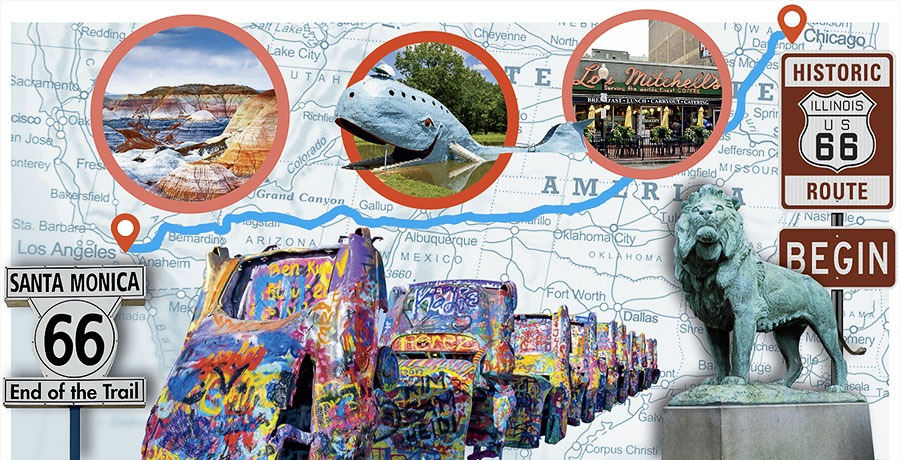
Decommissioning never stopped intrepid road-trippers! You can still drive a cobbled-together version of the old Mother Road today — and have a bizarre blast doing it. Here are just a handful of highlights:
■ Start at the “Begin” sign, right across Michigan Avenue from the front steps of the Art Institute. A meal at Lou Mitchell’s has been a popular sendoff since the route began.
■ Catch a flick at the charmingly retro 66 Drive-In in Carthage, Missouri, which opened during the route’s mid-century heyday. You didn’t want to get out of your car, did you?
■ Thar she blows! The Blue Whale of Catoosa, a giant public art piece (closed for remodeling until spring) in Oklahoma, is one of the route’s most recognizable icons.
■ Cadillac Ranch in Amarillo, Texas, has wowed passersby since 1974. The large-scale art installation features 10 vibrantly painted Caddies, apparently diving nose-first into the earth.
■ Arizona’s stunning topography is a must. The road passes through the Petrified Forest National Park’s Painted Desert, which looks plucked from a Wile E. Coyote cartoon.
■ Dine at the wonderfully kitschy Clifton’s Republic (there’s a fake redwood tree inside) at the original terminus in downtown L.A. Then drive into the sunset to the “End of the Trail” sign at the Santa Monica Pier.
Centennial Celebrations
You don’t have to floor it all the way to California to honor the route’s big 1-0-0. Here are some events closer to home:
■ Route 66 Red Carpet Corridor: As they do each year, 15 Illinois towns, from Joliet to Bloomington, will form a 100-mile “linear museum” of festivals, car shows, craft sales, and more, this time from May 2 to 3.
■ Main Street of America Route 66 Centennial Caravan: Merge in for as much or as little as you’d like with a group of enthusiasts trekking eastbound along the full route June 5 to 24. The Illinois portion is June 23 to 24.
■ Illinois Route 66 Mother Road Festival: Mid-century nostalgia (think vintage vehicles) overtakes downtown Springfield September 25 to 27 for this annual event, which includes live entertainment.