


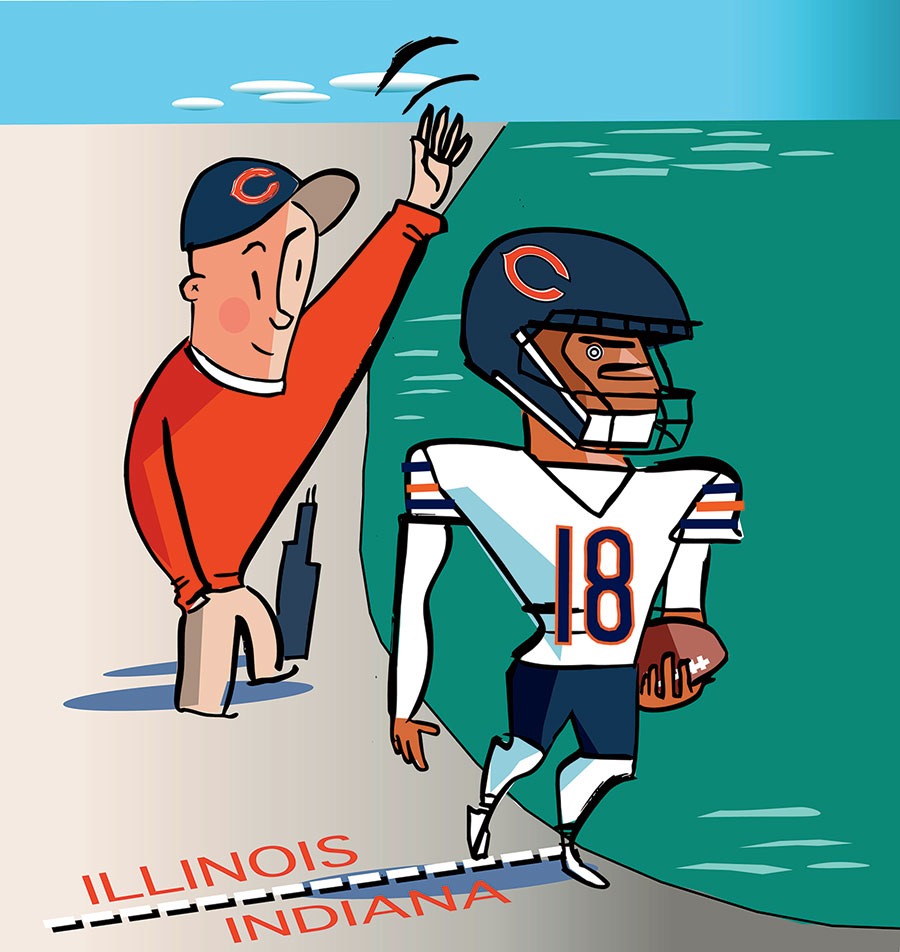
On a windy afternoon in late February, former governor Pat Quinn held a press conference in front of the George Halas statue outside Soldier Field. In a Chicago Bears pullover layered over a Gale Sayers jersey, he promoted a petition he’s circulating to demand that the team not depart for Indiana.
“We’d rather make sure we remain ‘the pride and joy of Illinois,’ ” Quinn said, referring to a line in the team’s fight song, “Bear Down, Chicago Bears.” “Otherwise, the song doesn’t rhyme. Indiana, they stole the Baltimore Colts in the middle of the night with the Allied Van Lines. They’re not gonna pull that again. We gotta take a stand. The Illinois Bears fans deserve a team they’ve been supporting for a century. Don’t let the Bears become the Hammond Hoosiers!”
It was an emotional plea to keep the Bears in this state, where they’ve played since they made their debut in 1919 as the Decatur Staleys. But what Quinn’s appeal didn’t include was a financial argument: that keeping the team here would benefit the state economically. After all, holding on to the Bears would come at such a cost to Illinois taxpayers that (don’t hate us for saying this!) seeing the team step just across the state border and letting Indiana pick up the tab might not be the worst thing that could happen.
Before you crumple up this magazine and spike it like Rome Odunze, consider what Illinois is prepared to do to keep its NFL team: The same day in late February that Indiana finalized a sweet deal to lure the team — one that included $1 billion in public money toward a new stadium (the Bears have been eyeing a potential site near Wolf Lake in Hammond) — the Illinois House Revenue and Finance Committee advanced a so-called megaprojects bill that would allow the team to negotiate an annual payment in lieu of property taxes for the Arlington Heights site it has been considering, saving the Bears money.
The problem with that, say budget watchdogs, is that pro franchises suck up public dollars without returning as much economic value for the community, leaving taxpayers to make up the difference. Even though Illinois has said it won’t contribute to the cost of building the Bears a new stadium, the state seems willing to spend about $855 million to upgrade roads and rail lines around it, as the team has requested. “For me, if I were in Chicago, this would be a no-brainer,” says Adam Hoffer, director of excise tax policy at the Tax Foundation, a nonpartisan nonprofit that is based in Washington, D.C. (and thus presumably not staffed by Bears fans). “Let Indiana subsidize it.”
A study by the Tax Foundation found that local governments around the country spent $33 billion in public subsidies on stadiums between 1970 and 2020. How’d that work out? “The empirical evidence shows repeatedly that stadium subsidies fail to generate new tax revenue and new jobs or attract new businesses,” the study reported. (The Tax Foundation believes that taxes are intended to “raise needed revenue, not to favor or punish specific industries, activities, and products.” So no breaks for your favorite football team, even if it did go 11–6 behind a franchise quarterback.)
“According to the academic literature, there is zero discernible long-run economic benefit of having a stadium,” Hoffer says. Which is why the Tax Foundation encourages local governments to work together to prevent sports teams from extracting maximum public benefits. But the opposite is happening in this interstate battle over the Bears, with Indiana and Illinois, and even Iowa, putting in rival bids, driving up the tax breaks — and ultimately the cost to taxpayers.
What’s the difference if the Bears leave Chicago for Indiana versus going to Arlington Heights? An arbitrary state line. From the Loop, Hammond is even a faster drive.
Brian Costin, deputy state director of Americans for Prosperity Illinois, a conservative tax watchdog, is opposed to the megaprojects bill because it wouldn’t just apply to the Bears. Any new construction, whether a factory or an office tower, that costs at least $100 million and creates at least 100 jobs could trigger such a tax-freeze zone. “All of the risk is on the taxpayers,” Costin says. Once local governments are given the authority to negotiate lower payments, “they are incentivized to screw their taxpayers.”
In the case of a Bears stadium, Costin explains, a small taxing district, such as Community Consolidated School District 15, which operates PK–8 schools near the Arlington Heights site, could use the value of the project to justify an increase in its total tax levy over the next 10 years. And because the Bears wouldn’t be paying property taxes, other taxpayers would have to make up the gap. (Arlington Heights Mayor Jim Tinaglia disputes that residents’ property taxes will increase, telling Chicago, “I am 100 percent certain that no increase in private property taxes has ever been considered or requested for the development of the proposed NFL stadium. However, it would be ignorant to assume that existing properties won’t increase in property value, which could likely raise those individual property taxes accordingly.”)
Consider this, too: Even if the Bears leave for Indiana, Chicago will still benefit from the team’s proximity to the city. Out-of-town fans will undoubtedly stay in downtown hotels to get the full Chicago experience of which a Bears game is a part. (Walk around the Loop before a Notre Dame home game and you’ll see plenty of fans who choose to stay here rather than South Bend.) Who wants to spend the night at the Comfort Inn Hammond I-94?
Sure, there’s a sentimentality argument: Civic pride is on the line. But what’s the difference if the Bears leave Chicago for Indiana versus going to Arlington Heights? An arbitrary state line. Yes, a stadium in the northwest suburbs might work nicely for North Siders and fans in towns out that direction, but let’s face it: For South Siders and south suburbanites, a site in Hammond would be much more convenient. Even from the Loop, it is a faster drive and only a half-hour ride on the South Shore Line.
Let’s not overreact: The Chicago Bears will remain the Chicago Bears even if they move to Indiana. After all, they wouldn’t be the first NFL team to cross state lines while retaining their name: The New York Giants and Jets play in New Jersey, the Washington Commanders in Maryland.
But even if all this makes logical sense, for Illinois politicians, it’s still a tough sell to the public. As the Tax Foundation’s Hoffer concedes, “There is a long-running adage that the quickest way to vote your way out of office is to lose a professional sports team.”