


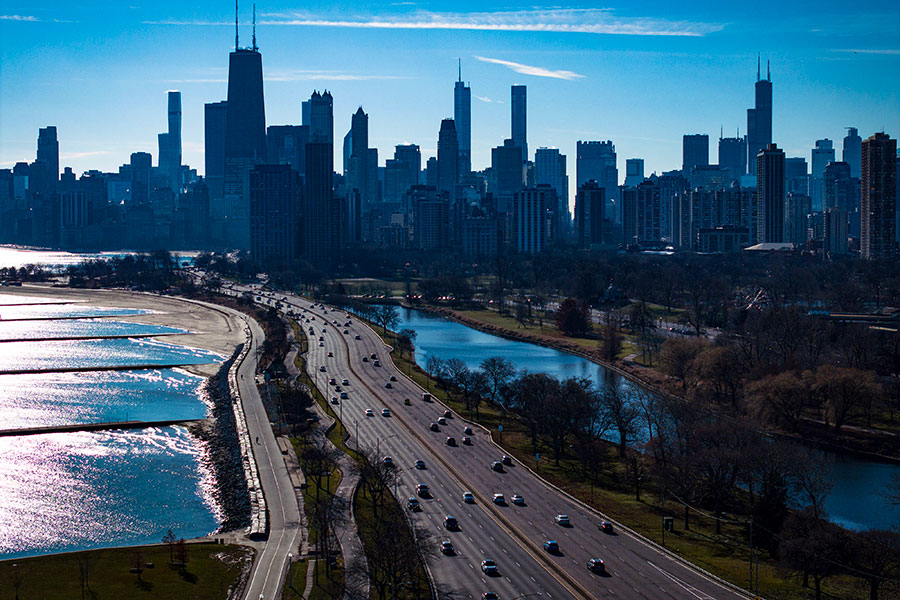
Take a drive down Lincoln Avenue, past the row of seedy motels — the Apache, the O-Mi. Take a left on Foster Avenue, then follow it to DuSable Lake Shore Drive. You probably don’t realize it, but you’re driving on one of America’s longest pre-Interstate highways: U.S. 41, which runs nearly 2,000 miles from Copper Harbor, in the Upper Peninsula of Michigan, to Miami, in the sub-tropics of Florida. They’re two cities that could not have less in common, but they’re the destination points for one of the nation’s great road trips.
Christopher Clott took the entire journey, and wrote a guidebook to the highway, Unearthing Highway 41: An American Journey. Inspired by the Depression-era Works Progress Administration guides to the states, it’s a feast of roadside attractions on one of America’s least celebrated roads, but one that covers a more variegated section of the nation than any other. U.S. 41 was established at the same time as Route 66, which means it will also celebrate its 100th anniversary next year. But unlike that better-known road, U.S. 41 is still an active highway, marked out with 41 signs along its entire route.
“You see a whole swath of the country that people on the coasts don’t,” says Clott, whose fascination with 41 dates back to his boyhood in Northwest Indiana. He later lived 29 years in Beverly, and now resides in Western Springs. Clott traveled frequently while working in the global shipping industry, and got the idea for his guide in the 1990s, when he read a travel book about U.S. 40, the old National Road that became another highway bypassed by interstates.
“Who else celebrates 41?” he asks. “It’s a very unsung road. It’s unsung because it’s still a working road” and not a nostalgic piece of the past. “From my anecdotal conversations, I told people, ‘I’m doing a book on 41.’ They said, ‘Where’s that?’ If you’ve been on Lake Shore Drive, you’ve been on 41.”
At the head of the highway, Copper Harbor celebrates its status as the jumping-off point to 41 with a road sign reading “Miami Fla 1990.” From there, the road passes through Green Bay and Milwaukee before arriving in Illinois. At that point, 41 merges with the Edens Expressway, but Clott stuck to its original route, Sheridan Road. Just as 41 allows a traveler to see the diversity of America, it passes through a diverse slice of Chicagoland. In Lake County, you’ll see Illinois Beach State Park in Zion, the Jack Benny statue in Waukegan, and Naval Station Great Lakes in North Chicago. As the highway passes through the North Shore suburbs, stop at Lake Forest College and Ravinia in Highland Park.
Once 41 passes into Cook County, it winds through Glencoe, home of the Chicago Botanic Garden, then Kenilworth, Wilmette, with the Baha’i Temple, and Morton Grove. It enters Chicago as Lincoln Avenue, just after passing through Lincolnwood. According to Clott’s book, that street’s motels “were built after World War II but prior to the interstate — a time when Highway 41 was still the main road bringing travelers into Chicago.”
On the North Side of Chicago, Clott recommends several sites that are just off 41, including the Green Mill and the Old Town School of Folk Music. Then we hit DuSable Lake Shore Drive, where signs still mark the road as part of 41. You’ll want to leave the Drive to see Wrigley Field, the International Museum of Surgical Science, Millennium Park, and the Art Institute of Chicago. On the South Side, 41 passes by the University of Chicago, the Fountain of Time statue along the Midway Plaisance, and the future site of the Obama Center. After the Drive ends, following 41 gets a little tricky. It runs along Marquette Drive and South Shore Drive, past the South Shore Cultural Center, before picking up the new stretch of DuSable Lake Shore Drive from 79th Street to South Harbor Drive. After that, it returns to surface streets in South Chicago, where you can see Our Lady of Guadalupe Church, the city’s only Mexican parish, and take a short side trip to Calumet Fisheries. On the East Side, 41 is coterminous with Ewing Avenue, which passes by Calumet Park and the Illinois International Port.
“There are parts of Chicago that are relatively unknown, and one of them is the East Side,” Clott says. “Tourists just don’t see it, and there’s so much history there, labor history,” including a memorial to the 10 victims of the 1936 Memorial Day Massacre. “The cool part of the road, in my view, is literally you’re going through a neighborhood.”
After leaving Illinois, near the site of the Illinois-Indiana boundary marker, 41 runs through Indiana, Kentucky, Tennessee, Georgia and Florida. Georgia does a good job of commemorating 41. In the Allman Brothers Band song “Ramblin’ Man,” Dickey Betts sings, “I was born in a Greyhound Bus, rollin’ down Highway 41,” which passes through the band’s hometown of Macon. Florida, however, doesn’t have “a whole lot of interest in 41,” Clott says, probably because the state has changed so much since the highway was established. At the end of the road, near Collins Avenue/A1A, now known as the Jimmy Buffett Memorial Highway, there’s no sign declaring “Copper Harbor 1990.”
Once Clott reached Miami, he’d taken a journey through a country he never would have seen on an interstate highway.
“You see regular people,” he says. “You don’t just see tourists. Even though you’re less than five minutes away from an interstate, you see a different America.”