


West Pullman is a forgotten neighborhood. Of the 243 Metra stations in the Chicago area, West Pullman on the Blue Island branch of the Metra Electric line is the least trafficked. Take a walk north on Halsted Street from the station, and you’ll see a parade of abandonment: a shuttered grill over the entrance of a bar advertising R&B and stepping. A gas station with three empty pumps. At the former MJ’s Cafe (Food for Your Mind, Body and Soul), there’s a “No Trespassing” sign behind the plastic sheeting cover. A sign for a COLLI ION CENTER is all that’s left of a body shop.
Further up the street, the businesses still operating are as basic as they come. Subway. Citi Trends. Family Dollar. A currency exchange. Since its peak in 1980, the Far South Side neighborhood has lost 37 percent of its population. Most houses here sell for between $150,000 and $250,000. The median income is $33,898, less than half the city’s average. (Despite its name, West Pullman has nothing to do with nearby Pullman. It was never a part of George Pullman’s planned community. In fact, it was a place where Pullman’s workers moved to escape his company town.)
Despite its weary appearance, West Pullman is a place where things are growing. The most obvious example is We Sow We Grow, an urban farm on a single vacant lot at 120th Street and Union Avenue, where Shamari and Natasha Nicholes grow tomatoes, cucumbers, peppers, watermelons, cantaloupe, honeydew, zucchini, pumpkins, squash, okra, cauliflower, eggplant, and sweet corn, selling the produce to neighbors. They even have a coop for egg-laying chickens.
“I got started because this was an ugly plot of land,” Nicholes says. “It was covered with grass. There were huge divots. It was a dry cleaners. They tore it out and left the basement. It was a concern.”
Five years ago, Kisha Wilson opened her own soul food restaurant, Kisha’s Kitchen, in a strip mall at 115th and Halsted. A take-out only joint, Kisha’s specializes in heavy platters of catfish, chicken, collard greens, and macaroni and cheese. One meal is big enough to last you a day.
“I’ve been around the West Pullman neighborhood since I was a child,” says Wilson, who attended St. Margaret of Scotland grammar school and Morgan Park High School. “The West Pullman neighborhood is up and coming. A lot of people are elders. They’ve been around for a long time. There are still people that act the fool. The alderman’s doing a great job.”
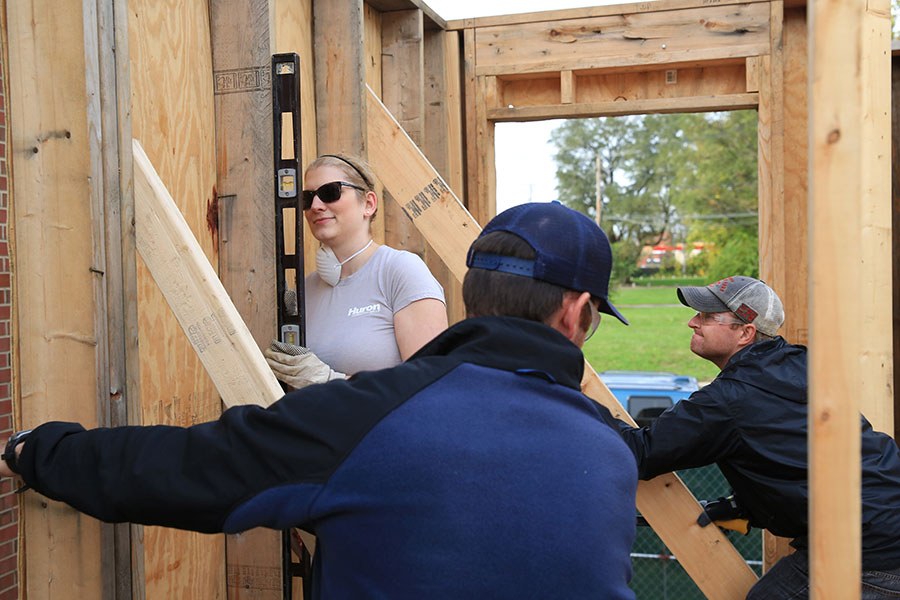
Younger people are moving into the neighborhood, many into houses built by Habitat for Humanity, which has made a special project out of redeveloping West Pullman. Since 2012, Habitat has completed 46 homes there, says Jennifer Parks, executive director of Habitat’s Chicago office. Its first project was a development of 20 homes at 115th and Morgan. Habitat is currently building 20 more homes, which are part of the Pope Leo Village project. (The pope’s hometown of Dolton is just across the Calumet River from West Pullman.) The 1,700-square-foot townhouses will sell for $260,000, which is pricey by West Pullman standards, but cheap for Chicago as a whole.
“We want to see home values continue to rise, and see wealth generated by investing in the neighborhood and having people long term in the community,” says Parks.
Eya Louis is one of Habitat’s West Pullman volunteers. Louis, who lives in the neighborhood, says building homes from scratch is part of West Pullman’s history. Her section, Maple Park, was constructed in the late 1950s and early 1960s by working class African-Americans who were looking for a safe South Side neighborhood to settle in. (At that time, the neighborhood was almost exclusively white; it is now 93 percent Black and 1 percent white, a changeover that occurred in the 1970s.)
Most Habitat homeowners come from outside the community, but they’re welcome by elderly residents eager for new blood.
“It has given us a new wave of community members that have a vested interest in the neighborhood,” Louis says. “The neighbors tend to rally around, and teach them this is what you do in a community.”
So is it worth getting off the train in West Pullman? Well, the neighborhood has a Frank Lloyd Wright house, the Japanese-inspired S.A. Foster House and Stable, which was built in 1900 as a summer home for an attorney. The house sold in 2020 for $140,000. West Pullman may be the best deal in Chicago.