


Sometimes, a man’s name outlives his fame. He may have monuments dedicated to him, cities or towns named after him, schools and parks bearing his name, but his achievements and his writings have faded from modern memory as though composed in invisible ink. Chicago is full of commemorations to men who make passersby say, “Who was that?” Here are a few.
Richard Oglesby
Oglesby, whose Lincoln Park statue has turned green with age, organized the 1860 Illinois Republican Party convention in Decatur, at which the delegates chose Abraham Lincoln as the state’s favorite son. He gave Lincoln the nickname “The Railsplitter” by traveling with Lincoln’s cousin John Hanks to the old family homestead on the Sangamon River, where they found rails that Lincoln had crafted. Oglesby paraded them before the convention, along with signs declaring Lincoln “The Rail Candidate for President in 1860.” Lincoln rewarded Oglesby by naming him a major general during the Civil War, in which he commanded the 8th Illinois Infantry Regiment. Immediately after the war, Oglesby was elected governor, then U.S. Senator. Oglesby Elementary School in Auburn-Gresham also bears his name.
Melville Fuller
A Chicago lawyer who served as chief justice of the United States from 1888 to 1910, Fuller is the namesake of the Fuller Park neighborhood, and has a commemorative bust in the Fuller Park Fieldhouse. Fuller was chief justice when the Supreme Court issued its Plessy v. Ferguson decision, which allowed states to maintain separate but equal public accommodations for Black and white individuals. As a result, his bust ended up on the Commission on Chicago Landmarks list of racist memorials that should be removed. In an irony of history, the Fuller Park neighborhood is now 87 percent Black.
John A. Logan
Logan is the namesake of the Logan Square neighborhood, as well as the subject of a well-known man on horseback statue in Grant Park, which became a rallying point for anti-war protestors during the 1968 Democratic National Convention. As a state legislator, Logan introduced Illinois’s Black Laws, which more or less banned Black folk from the state, and as a Democratic congressman, he favored compromise over civil war. However, Logan served in the Union Army with distinction, rising to major general, and afterward joined the Republican Party. He was a U.S. Senator for 14 years, and James G. Blaine’s running mate in his unsuccessful 1884 run for president.
James G. Blaine
James G. Blaine Elementary School, in Lake View, is one of the city’s highest-rated grammar schools. A U.S. Senator from Maine, he was secretary of state under James Garfield, Chester A. Arthur, and Benjamin Harrison. Blaine was the Republican nominee for president in 1884, losing to Grover Cleveland. Blaine’s historical reputation got a boost this year when he was portrayed by Bradley Whitford in the Netflix miniseries Death by Lighting.
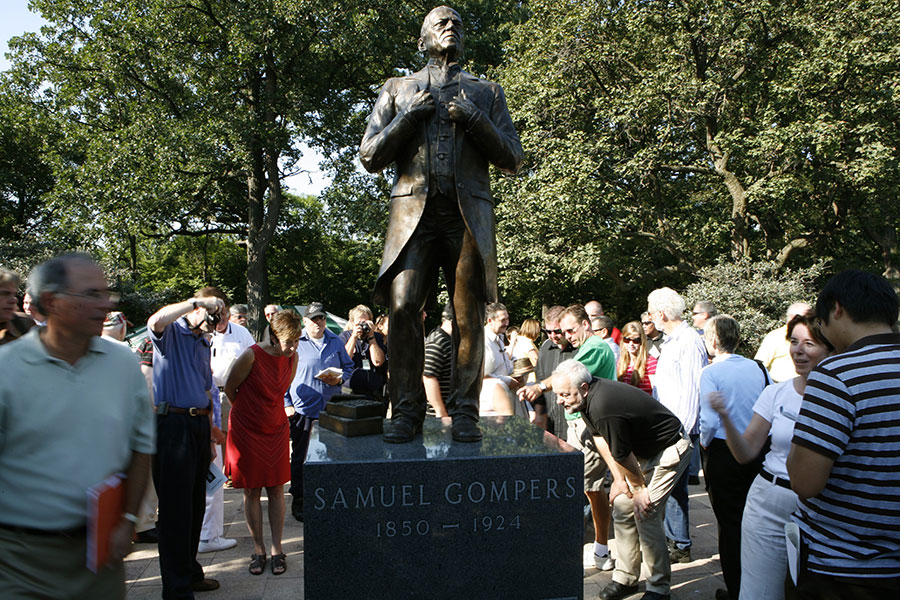
Samuel Gompers
Gompers, who has a statue in the Northwest Side’s Gompers Park, was the founder of the American Federation of Labor, which is now part of the AFL-CIO. During the Panic of 1893, Gompers traveled to Chicago to address 25,000 unemployed laborers, declaring “Why should the wealth of the country be stored in banks and elevators while the idle workman wanders homeless about the streets and the idle loafers who hoard the gold only to spend it on riotous living are rolling about in fine carriages from which they look out on peaceful meetings and call them riots?” An opponent of radicalism and socialism, Gompers favored working within the political system to advance labor’s laws. A strong proponent of the eight-hour workday, his activism led to a law guaranteeing an eight-hour day for railroad workers, and helped set the stage for many of labor’s victories during the New Deal era.
Alexander von Humboldt
An early 19th Century naturalist, biologist and explorer, Humboldt was one of the most famous men of his day. As a young man, he journeyed to South and Central America and the United States, collecting plant specimens and making observations on geology, geography, and weather that became the foundations of climatology, Earth sciences, and ecology. His five-volume work Cosmos: A Sketch of a Physical Description of the Universe, which was based on his early travels, was an international best seller, and its attempt to unify scientific disciplines inspired such contemporaries as Charles Darwin and Walt Whitman. Humboldt is not much read today, but Humboldt Park bears his name, and he is commemorated with a statue there.
Philip D. Armour
When Chicago was the meatpacking capital of the nation, Armour was one of the industry’s magnates, beginning by slaughtering hogs in a plant on the South Branch of the Chicago River, then moving into beef. By 1880, Armour was the city’s largest employer and slaughtered 1.5 million animals a year. He was a pioneer in meat canning and the use of refrigerated railcars, as well as using leftover animal parts for glue and fertilizer. Armour Meats, the company he founded, is still in business today, selling canned and frozen meats in supermarkets. Armour Square, where Rate Field is located, is named for Armour.
Carl Schurz
As a leader of the anti-slavery German community, Schurz was an early supporter of Abraham Lincoln, whom he first met during the 1858 Senate campaign. Schurz made speeches for Lincoln in German, and was rewarded by being named Minister to Spain in 1861. When he returned to the United States, he was commissioned a brigadier general in the Union Army, serving with distinction at Gettysburg. After the war ended, he moved to St. Louis, and in 1868, was elected U.S. Senator from Missouri. President Rutherford B. Hayes named Schurz Secretary of the Interior. Carl Schurz High School, in the Irving Park neighborhood, now bears his name.