


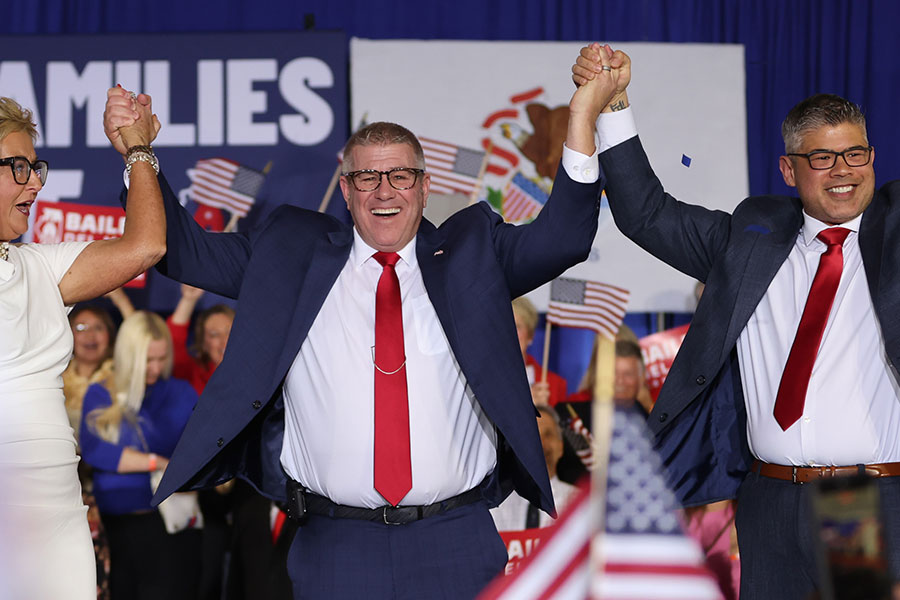
Darren Bailey is turning into the bad penny of Illinois politics, a perennial loser who just keeps coming back for more. In 2022, he lost the governor’s race to JB Pritzker, 55 percent to 42 percent. In 2024, he lost a congressional primary to U.S. Representative Mike Bost. And now he’s running for governor again, in a race that experts give him no chance of winning.
So why do the Republicans keep nominating this guy?
Before we answer that question, we have to understand how the Republican Party electorate has changed in the century. In 2002, Downstate cast 40 percent of the vote in the Republican primaries, while the collar counties cast 35 percent. This year, Downstate cast 58 percent, while the collar counties cast 26 percent. That shift in the party’s center of gravity makes it inevitable that the Republican nominee will reflect Downstate values. And Bailey is Downstate’s guy.
“He’s a conservative Downstate candidate with Downstate values: anti-Chicago, pro-life, anti-gay marriage,” says Kent Redfield, professor emeritus of political science at the University of Illinois-Springfield. “The regional attitude is, Chicago is the enemy.”
Bailey has been trying to make nice with Chicago this election. He and his wife, Cindy, have photographed themselves eating Garrett popcorn, shopping at the American Girl store, and cheering for the Bulls. But he’s still on record as having called Chicago a “hellhole” during the 2022 campaign, which played to regional animosities against the big city.
Bailey’s main opponent in the primary, Ted Dabrowski, concentrated on financial issues in his campaign. That may have been a winning message in 1990, when the Republicans were mainly a suburban party, but it was a losing message among social conservatives. (In 1990, Republican Jim Edgar carried suburban Cook and the collar counties, while his Democratic opponent, Neil Hartigan, won Chicago and Southern Illinois.)
In his 1966 novel The Origin of the Brunists, about a cult that forms around the survivor of a coal mining disaster, Robert Coover captured the two passions that motivated Southern Illinois politics: labor militancy and religious fundamentalism. The labor militancy is gone, now that so many union mines and factories have shut down. The religious fundamentalism is still there, though, and Bailey plays to it, often reading Scripture in video messages to his followers.
“Downstate a long time ago was competitive, because you had manufacturing and mining, and Southern Illinois was Southern Democratic,” Redfield says.
Like all other Southern Democratic areas, though, Downstate eventually turned Republican.
Bailey also benefits from a state of mind called “rural consciousness,” which was defined by University of Wisconsin political science professor Katherine J. Cramer in her book The Politics of Resentment: Rural Consciousness in Wisconsin and the Rise of Scott Walker.
“An identity as a rural person…includes much more than an attachment to place,” Cramer wrote. “It includes a sense that decision makers routinely ignore rural places and fail to give rural communities their fair share of resources as well as a sense that rural folks are fundamentally different from urbanites in terms of lifestyle, values and work ethic. Rural consciousness signals an identification with rural people and rural places and denotes a multifaceted resentment against cities.”
“It’s really the same situation here,” says John Jackson of Southern Illinois University’s Paul Simon Public Policy Institute. “You look at people running for the state legislature from Central Illinois on down, everybody is Republican.”
Rural consciousness may be even more powerful in Illinois than in Wisconsin, because Chicago dominates its rural hinterland far more than Milwaukee.
“That’s a strong appeal, that you’re ignored, left behind, ‘I’m your voice,’ ” says Redfield. “That wins campaigns for the state legislature, but it’s not going to win statewide.”
Bailey may be in a more difficult spot than he was four years ago, because his sources of funding have dried up. In 2022, office supplies magnate Richard Uihlein gave $50 million to his campaign. This time, Uihlein supported Dabrowski.
“He has no money,” says Redfield. “There’s just no outside money. The Republicans are going to be so desperate to hold on to the Senate and congressional seats, no one’s going to spend a nickel on a sacrificial lamb in a blue state.”
Nonetheless, Downstate will have a champion in its long, futile war against Chicago’s overweening political influence over the state.
“There are people who feel it’s important to win the primary and lose the general election,” says Jim Nowlan, a former Republican state representative and frequent contributor to the Tribune editorial page. “It’s obviously a geo-cultural issue. Downstate Republicans tend to be conservative, and Bailey, maybe like Trump a bit, represents old 1950s traditional values that many Downstate Republicans want to return to. Bailey represents traditional Downstate well, while the suburban voter has become much more diverse.”
With all that Downstate support behind him, Nowlan predicts, Bailey will receive “an enthusiastic 42 percent of the vote.”
Just like last time.