

Water Wise Perennials that don’t ask for much. The pros at the Chicago Botanic Garden recommend the following plants for their drought resistance, bug tolerance, and adaptability to different soils. Roll over each flower to read what the pros are saying… |
A. You can grow healthy plants, for one thing, as it’s the unhealthy ones that tend to kick off trouble with chemical fertilizers and other heavy-handed "help." Simply choosing the right plant for your site makes a huge difference. A sun-loving plant in a shady spot is likely to be small and weak and may need extra watering, which is a waste of water. And its lack of robustness will make it more susceptible to pests, which might lead you to start thinking of pesticides.

A Bucktown parkway before (right) and after (below) Ecogardens planted a water garden. |
"Doing good site preparation, amending the soil with compost, planting at the proper depth, and watering properly, you’ll have healthier plants with fewer problems," says Tim Johnson, director of horticulture at the Chicago Botanic Garden. He says that while plants can tolerate some bugs, if there’s a real infestation, gardeners can use insecticidal soap, which has less residue than a regular pesticide and won’t poison the ground water.
The green gardener is highly water-conscious. An alarming 40 to 60 percent of residential water—that is, purified, drinkable water—is used outside, and that’s a waste, says John Eskandari, horticulturalist, arborist, and manager of trees and shrubs at Gethsemane Garden Center (5739 N. Clark St., 773-878-5915; gethsemanegardens.com). One thing homeowners can do to right this wrong is to reconsider the lawn. Eskandari suggests less-thirsty, low-maintenance grasses such as zoysia, buffalo, and No-Mow. Zoysia and buffalo are warm-season grasses that won’t turn green till late May or June, when the temperature is consistently 75 degrees or warmer. But they will thrive in 90-degree weather, when conventional, cool-season grasses turn brown. No-Mow, a loose clumping grass that is often not mowed at all, is a cool-season grass. It is slow to turn brown toward winter and turns green early in spring.
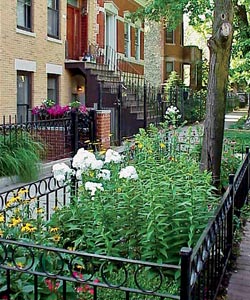 |
Another good move, says Greg Raymond, owner of Ecogardens (1937 N. Winchester Ave., 312-550-5577; ecogardens.com), is to disconnect the downspouts from your gutters to rainbarrels and use the collected "gray water" in the garden. But he’s also a proponent of the rain garden. This is a saucer-shaped depression that you can dig in your yard, or in the parkway between the sidewalk and the street—as little as four inches deep to as much as two feet deep—and fill with plants. Rainwater and the runoff from your roof, driveway, and sidewalks will collect in the rain garden, give your plants a good soak, and then filter slowly into the earth, ridding itself of contaminants by the time it reaches the water table. And all that dirty rainwater will be diverted from entering the storm sewers and flowing out to rivers and the lake.
Both native shrubs and herbaceous perennials are appropriate for rain-garden planting. "The idea is to choose self-reliant plants that can handle the peaks and valleys—short periods of swampy conditions and then drought," says Eskandari. He suggests shrubs such as redtwig dogwood, summer sweet, and black chokeberry, and for plants, turtlehead, beebalm, lobelia, and joe pye weed. For more information on which plants to use and how to build your own rain garden, contact the Rain Garden Network (773-774-5333, raingardennetwork.com).
Photography: Courtesy Chicagoland Grows Inc., Robin Carlson/ Chicago Botanic Garden