

Anyone who follows Chicago blues knows the sound is fading. Despite the parade of interested tourists, storied clubs such as Theresa’s Lounge, 708 Club, Blues Etc., and Turner’s Blues Lounge continue to shutter their doors. The latest blow is the forced relocation of Legends, Buddy Guy’s music mecca, which will be converted into a Columbia College student center (Guy says he plans to reopen elsewhere in the city, but doesn’t yet know where or when). Chicago radio stations have ignored the music for years, and despite the city’s embrace of large-scale dance, theatre, and music events at Millennium Park, there’s little recognition of the early blues pioneers who helped put Chicago on the cultural world map. The city’s free blues fest is underfunded, lacks marquee stars, and is routinely underpromoted; this year, the more appealing option was to wait another weekend and drive 40 miles out to Aurora, where the North Mississippi Allstars and Robert Cray headlined a fest by the Fox.
The final chord, however, has not sounded. The city tourism office recently débuted a 50-minute audio tour, narrated by Guy, that details Chicago blues history; download the tour on the city’s Web site (downloadchicagotours.com) and listen to it on an iPod or MP3 player. On July 28th, Eric Clapton will stage his annual Crossroads Guitar Festival in Chicago for the first time. Guy will be there, and he will be joined by such blues-influenced heavyweights as John Mayer, Steve Winwood, and Sheryl Crow. For his part, Guy says he plans to capitalize on the already sold-out event to raise awareness about an issue that’s hounded him for years: “We need a blues museum in Chicago. What are we waiting for?”
Still, when it comes to promoting, preserving, and even capitalizing on its musical heritage, Chicago falters compared with smaller rivals like Austin, Memphis, and even post-Katrina New Orleans. The broadcasting legend Jack Brickhouse is deservedly memorialized in bronze on Michigan Avenue. But Muddy Waters? Still invisible.
So, what are we waiting for? Maybe a big idea. Here are six ways Chicago can make the blues sing again.
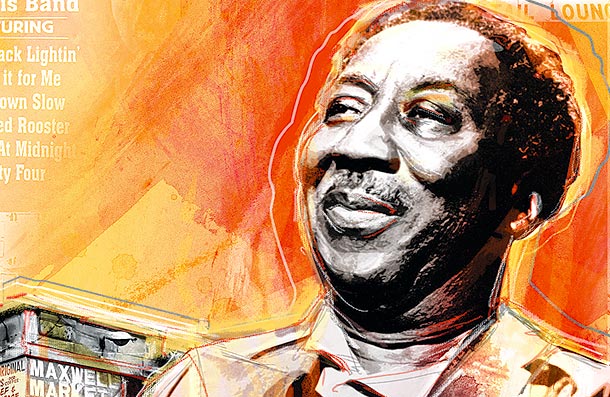
Illustration: Margaret Lee; Photograph: Pictorial Press Ltd/Alamy
1. Turn it on
“You walk into an airport in Detroit and there’s Motown. You go to Memphis and [you hear] Elvis and Sun Records. You go to New Orleans and you have Al Hirt and Louis Armstrong blowing trumpets in the airport,” says Buddy Guy. “You go to Chicago, you ain’t got shit.” O’Hare and Midway could pipe in music from natives like Lil’ Ed and the Blues Imperials or Johnny Drummer (both airports currently play a soundtrack of local jazz) and set up kiosks that offer a dose of blues history. The locals could also take a cue from Austin’s airport administrators and provide regular live concerts (currently, each of Chicago’s airports offers only six concerts a year). What better way for frenzied travelers to de-stress than to watch Eddy “The Chief” Clearwater duck-walk by baggage claim?
2. Hire a music czar
Seattle has one. So does Austin. Even Oklahoma City. Music is an economic boon for any city: in Seattle, it generates $1.2 billion and 9,000 jobs annually. City Hall could follow Seattle’s lead and add a music wing to its film office-or Mayor Daley could create a director of music akin to the “fashion czar” he hired last summer. “We [proved we] were an industry just like manufacturing and biotech. It was legitimized,” says James Keblas, director of Seattle’s film and music office. Keblas was hired in 2005; with just one other full-time staff person and a spending budget of $25,000 a year, he helps facilitate relationships between the city and its clubs, recording studios, record labels, and, ultimately, musicians. He also helps promote the city’s music scene all over the world through remote offices, ensuring that record stores have a Seattle section in their music bins and acting as a liaison for everyone from journalists to international concert promoters. A similar effort could help Chicago use its blues history as a tourist draw, not just relegate it to a poorly funded summer festival. “It’s all about people’s perceptions,” Keblas adds. “I think cities will get over their fear of music and . . . realize it’s a great thing and something to be proud of.”
3. Tune it in
Last January, WBEZ canceled two of its longest-running blues programs-Blues Before Sunrise and Comin’ Home. Except for a few isolated shows on WXRT and infrequent college station airplay, the Chicago airwaves have forgotten the blues. “This is a global treasure right here in the city and a lot of people aren’t aware of it. [Radio] refuses to play it,” says Karen Hanson, author of the recent book Today’s Chicago Blues. More airplay would encourage a younger generation of players to return to the roots of today’s music. “For me, the one criterion for a real bluesman is you grew up listening to blues,” says Steve Cushing, the host of Blues Before Sunrise, which has moved to the College of DuPage’s station, WDCB (90.9 FM). The city could help out by providing incentives (reduced-price advertising space on city buses, key ad placement at city festivals) to stations willing to devote weekly airtime to the blues during peak hours. Maybe even co-opt some bandwidth to create a live, streaming Internet blues station, broadcasting from atop City Hall?
4. Open a world-class blues museum
Buddy Guy’s mission these past few years has been to see a blues museum open in Chicago in his lifetime. (There is a small private museum in Bridgeport run by blues collector Gregg Parker, but it is currently closed.) “I just want it done,” Guy says. “It doesn’t have to be a big thing; I just want it to be Chicago recognizing the guys that made it what it is.” Guy says he already has investors interested (plus superstar friends agreeing to headline benefit concerts); he’s just waiting for city officials to show the same kind of interest they did in bringing corporate giants like Boeing here, courting the Olympics, or promoting the fashion industry. A South Loop location would be ideal, especially if it bordered the Illinois Central tracks, the same route that brought the Southern blues here in the 1930s and ’40s. Considering that the city is home to a Polka Music Hall of Fame, a blues museum doesn’t seem like a stretch.
5. Free Chess Records
Ground zero for Chicago blues history is the Chess Records building at 2120 South Michigan Avenue, where pioneers Muddy Waters, Little Walter, Willie Dixon, Howlin’ Wolf, and even rockers like the Rolling Stones recorded their seminal sides. The Blues Heaven Foundation owns the building, but, although named a Chicago landmark in 1990 and honored with a plaque, it rarely opens its doors. Chess should be as visible as Wrigley Field and as accessible as Sun Records and Motown, both national recording treasures and major tourism sites for their respective hometowns, Memphis and Detroit. Elvis Presley fans still flock to Sun to stand in the same room in which he recorded “That’s All Right”-so crowds would certainly seek out Chess, where, that same year (1954), Muddy Waters declared he was a “Hoochie Coochie Man.”
6. Promote it loud, promote it proud
Visit the Web site for the city’s office of tourism and there is hardly a mention of Chicago blues. “It’s not viewed as a priority,” says Chicago harmonica master Billy Branch. Recent acknowledgments such as a sign in front of Muddy Waters’s house and the 50-minute downloadable blues tour are encouraging, but the city’s tourism office has never launched a full-blown campaign to promote Chicago as a major blues metropolis. Statues, honorary street names, parks, and a wave of historical markers would be a good start. So would a campaign to return live blues back to the street. (Today, live street blues is something you only occasionally hear in places like the parking lot of Wallace’s Catfish Corner at 2800 West Madison Street.) But what better way to get tourists-and locals-out to the neighborhood clubs than a city-sponsored blues trolley? Operational on weekends, the trolley could bring new faces to off-the-beaten-path institutions like Lee’s Unleaded Blues, Rosa’s Blues Lounge, and the New Checkerboard Lounge. Although a few private companies offer these services for hire, the city could park a few trolleys prominently on Michigan Avenue and offer hotels cut rates to get their customers onboard. Not only would revenue flow in all directions, but it would help give respect to a style of music still operating today. “People already tend to think of the blues as old,” says Branch. “So let’s do something to change that and let people know it’s still alive and people are still actively playing it, and playing it well.”
Still Kicking
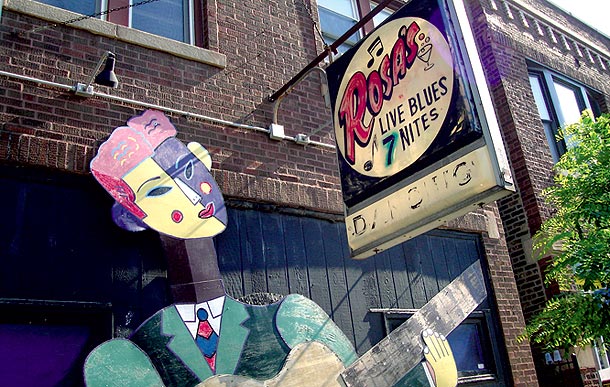
Real blues musicians still jam around Chicago-you just have to know where to find them. Here are ten places to start.
1. Buddy Guy’s Legends >> At press time, the doors were still open for Chicago’s premier room for blues. 754 S. Wabash Ave.
2. Rosa’s Blues Lounge >> Energetic owner Tony Mangiullo makes sure his spot lives up to his boast of “friendliest blues lounge.” 3420 W. Armitage Ave.
3. Lee’s Unleaded Blues >>This snug corner bar emphasizes soul. 7401 S. South Chicago Ave.
4. B.L.U.E.S. >> The North Side’s tourist-heavy alternative to the South Side clubs. 7313 S. Halsted St.
5. Artis’s Lounge >> One reason to go: Billy Branch headlines every Monday. 1249 E. 87th St.
6. 7313 Club >> Thriving South Side juke joint. 1249 E. 87th St.
7. Harlem Avenue Lounge >> This narrow bar toasts blues half the week. 3701 S. Harlem Ave., Berwyn
8. Wallace’s Catfish Corner >> The rare place in the summer to find live street blues. 2800 W. Madison St.
9. Chord On Blues >> The burbs’ classiest blues room. 106 S. 1st Ave., St. Charles
10. The New Checkerboard Lounge >> Legendary club re-staged in Hyde Park. 5201 S. Harper Ave.