

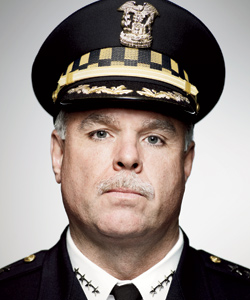
Garry McCarthy was on his victory lap. NATO had ended two days before, it was warm and sunny, and the Chicago police superintendent stood with eight officers on the warning track of U.S. Cellular Field. As personal guests of Jerry Reinsdorf, the Chicago White Sox chairman, the group watched the team take batting practice before a game against the Minnesota Twins, mingling with the players as they wandered in and out of the dugout. But mostly everyone just fawned over McCarthy. A dozen reporters and TV cameras gathered in foul territory for an informal news conference, White Sox Manager Robin Ventura set aside his usual pregame preparations to say hello, and Reinsdorf himself walked onto the field and handed McCarthy a T-shirt with a White Sox logo over the Chicago flag.
The career cop worked the crowd with a swagger, stopping for a series of one-on-one TV interviews, clearly relishing the chance to discuss a subject other than the city’s rising murder numbers. In the seventh inning, Mayor Rahm Emanuel watched from the Sox broadcast booth as McCarthy and his officers—including one who was stabbed in the leg by a NATO protester—were honored on the field. Midceremony, Emanuel rose to his feet and clapped, like a general observing his troops on parade.
On that day in late May, and in the two weeks that followed, the city and those who run it appeared to be under the superintendent’s spell. At a Cook County Board meeting on June 5, commissioners showered McCarthy with praise, comparing him to George Washington and John Wayne. A day later, at a City Council meeting, Alderman Nicholas Sposato offered up the ultimate in hyperbole, likening McCarthy to the warrior in Braveheart.
The salutes kept coming. Officials praised McCarthy’s decision to “lead from the front,” standing with his officers as they tried to keep protesters in line, enduring the same taunts, spit, urine, and physical abuse as the rank and file. They recalled the news conference on the first day of NATO, when McCarthy became emotional as he talked about his officers. “If you think it’s easy to ask people to do what they did, it’s not,” McCarthy said on camera, glancing downward, his voice cracking a bit. “Asking people to put themselves in harm’s way, knowing that they’re going to get assaulted, and to be able to stay there and take it—those guys were amazing.” For a few days, even McCarthy’s harshest public critics, the bloggers behind Second City Cop, were deferential.
Yes, NATO went smoothly, despite all the predictions to the contrary. But given the dire situation outside the meeting’s security perimeter, the postsummit lovefest seemed remarkably tone-deaf. The same weekend as NATO, 22 Chicagoans were shot and 7 were killed, including two boys, ages 12 and 14. (According to a recent chicagomag.com analysis of homicides committed between March and October from 2007 to 2012, the city averaged 4.9 weekend murders during the warmer months.) The shootings happened in Ashburn, Roseland, South Chicago, and West Pullman, neighborhoods most visiting NATO dignitaries didn’t venture near.
The following weekend, while most Chicagoans celebrated Memorial Day, the death toll rose: 43 people were victims of gunfire, and 11 died. One of them was Malcolm Dowdy, 33, a U.S. Coast Guard veteran who was killed as he left a holiday barbecue in South Shore. “People are becoming desensitized to violence. Gunshots ring out. Children keep playing,” said Denise Dixon, whose daughter was engaged to Dowdy. “We need somebody that’s going to take care of the community like they took care of the dignitaries that came here for NATO.”
Fair or not, much of that responsibility falls on the superintendent of the Chicago Police Department, a position that is so intense, political, and high-profile that former chiefs say they never expected to hold on to the job for more than a few years. Enter Garry Francis McCarthy, a hard-charging vet of police departments in New York City and Newark, New Jersey. Emanuel brought him to Chicago in May 2011 on a promise to address the city’s gang problem, make the CPD run more efficiently, and rebuild officer morale.
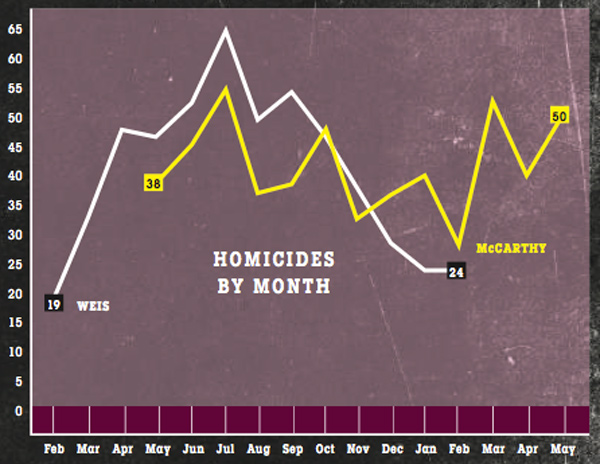
But two months after McCarthy arrived, the murder toll—the stat by which police superintendents are most judged—began to inch upward. And after a brief winter respite, violence surged in March of this year. Through June 17, police reported 240 homicides, a 38 percent increase over the same period in 2011. The situation is particularly worrisome in light of statistics that show the number of murders and shootings starting to level off before McCarthy and Emanuel took over.
Of course, many factors contribute to an uptick in urban violence. But the current crime wave raises questions about the decisions made by McCarthy—an outsider who came here armed with a playbook of policing strategies he learned on the East Coast—and the man who has been his primary supporter, Mayor Emanuel. Why don’t the crime-fighting strategies that worked so effectively in New York and Newark seem to be working here? And if they aren’t working, why isn’t McCarthy changing them? If the violence continues at the same troubling rate, the city will surely demand answers, and McCarthy, who was once compared to George Washington, John Wayne, and Braveheart, could receive a much less flattering title: ex-superintendent.
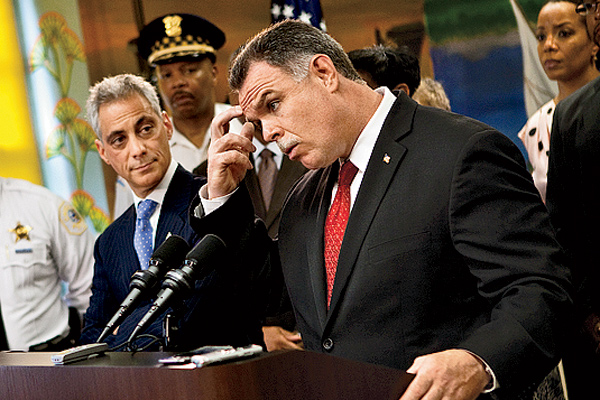
Other than his fondness for business suits, McCarthy, 53, is a cop straight from central casting: tough-guy attitude, stocky build, strong chin, thick neck, small mustache, heavy New York accent. All he ever wanted was to join the police force, and his arrival in Chicago is the latest stop on a meteoric rise that he never expected. “For the last seven years that my mom was alive [she died in 2004], she lived in an apartment downstairs from me,” McCarthy recalls. “So when I came home from work, I’d make a point to stop in. She always asked me, ‘Did you ever think you would go this far?’ And I always said, ‘No.’ ”
McCarthy grew up in an Irish Catholic family in Pelham Bay, a working-class neighborhood in the Bronx. His father, James, was a detective with the New York Police Department and a hero to Garry, his youngest son, who recalls that his father told him to “do better” and not follow in his footsteps. But McCarthy, who attended Catholic grammar and high schools and played football and baseball at the State University of New York at Albany, signed up for the NYPD in July 1981, two months after he graduated from college.
James McCarthy had a heart condition and died two years after his son joined the force. Inheriting his father’s police shield, McCarthy quickly distinguished himself as a beat cop. Other officers were soon talking about the young patrolman who had a knack for making arrests that mattered, busting people who were armed and dangerous. “They started saying that my initials didn’t stand for Garry McCarthy,” he recalls. “They stood for Gun Magnet.”
McCarthy made sergeant at the unusually young age of 26. He kept going, becoming a captain after only 11 years on the job. “At that point, I thought that was the end of my career because I wasn’t hooked up,” he says, referring to his lack of clout among law enforcement higher-ups. “And then, as fate would have it, Bill Bratton came along.”
Bratton had been the top cop in Boston, and his crime-fighting strategies as commissioner of the NYPD in the mid-1990s made him a legend in police circles. As McCarthy explains: “He kind of changed the way we did things so that they had less to do with seniority and more to do with achievement.”
McCarthy is referring to Bratton’s use of the CompStat system, which collects data about everything from curfew violations to murders and then spits out reports that show how each district is performing. These numbers allow the police chief to hold officers and their superiors accountable for results, or lack of them, mainly through frequent no-holds-barred meetings with the command staff. “I got to show my wares at CompStat,” says McCarthy, who earned his bosses’ attention by detailing his successes. “And, quite frankly, I did very well.”
He says that much of his policing philosophy grew out of Bratton’s approach, which worked so well that the city’s subsequent police chiefs rode it to historic drops in crime. Simply put, Bratton did three things: First, he implemented CompStat. Second, he acted on the “broken windows” theory; that is, he instructed cops to crack down on minor offenses—curfew violations, loud music, graffiti, public intoxication, and so on—because any bad deed could lead to more serious criminal behavior. Third, he collapsed the layers of bureaucracy, eliminating middle managers and emphasizing the job of the beat cop. “It has to do with accountability,” explains McCarthy. “If [officers] don’t have a beat, if they’re not accountable for anything, all they’re doing is going from job to job.”
Bratton’s three-part approach was so successful in New York—the murder rate was cut in half during his roughly two-year tenure—that it became a national model, adopted in cities across the country. McCarthy, who had a front-row seat, paid attention, rising up the chain of command after Bratton moved on.
By 2000, he was deputy commissioner of operations, presiding over the CompStat meetings and guiding crime strategy for the entire department. In 2005, New York saw its fewest number of murders, 539, in four decades.
The following year, Cory Booker, the mayor of Newark and a rising star in his own right, took notice. He offered McCarthy the job of top cop and the opportunity to help transform his downtrodden city from a place of “fear and crime,” where the murder rate was six times that of New York City, into one of “possibility and hope.”
The buzz surrounding McCarthy’s move was not unlike what happens in the sports world when a superstar coach agrees to lead a perennially losing team. “His entire professional career has stood for excellence,” Booker said in announcing the hire. The mayor then defended the choice after reporters dug up two alcohol-related incidents from McCarthy’s past: a 1983 off-hours quarrel in which he had gestured toward his gun and a 2005 arrest for angrily protesting a parking violation on behalf of one of his two daughters, now ages 23 and 25.
McCarthy promptly implemented the same crime-fighting strategy that had worked so well in New York. From 2006 to 2009, Newark saw a 12 percent drop in overall crime and a dramatic 40 percent drop in shootings (see sidebar on next page). Despite his successes, the headstrong chief clashed with police union leaders and city council members, who described their relationship with him as rocky. “We hope he does excellent in Chicago and never comes back here,” a police union vice president, Walter Melvin, told the Chicago Sun-Times in 2011.
Meanwhile, in Chicago, Rahm Emanuel was making crime—and his selection of a new police chief—a central issue in his mayoral campaign. One thing was all but certain: If he won, he would ax Jody Weis, the police chief at the time. Weis, a former FBI agent, was the first outsider to lead the department in decades and had performed well under difficult circumstances. After a rocky start, he had kept crime in check, despite the grousing about his G-man background and some questionable administrative decisions. The latter made him a lightning rod for criticism and earned him a no-confidence vote from a faction of the police union.
Emanuel pledged to bring calm to the department by picking a cop’s cop, someone who shared his belief in getting back to beat patrolling and who could make the department more efficient in an era of cost cutting. He also promised to put 1,000 more officers on the streets, yanking some from out behind desks and hiring others.
Rahm found his guy, helped along by a glowing recommendation from Bill Bratton. McCarthy recalls that he and Emanuel “hit it off” at a meeting in April 2011. He was named Chicago’s police chief a little less than a month later, on May 2.
“From day one, we had a shared vision about how to do things,” says McCarthy, who, like the mayor, can be alternately gruff and charming in conversation. The new superintendent moved into an apartment near Millennium Park, where he has been living alone.
Just a few weeks on the job, Emanuel and McCarthy announced the first step in fulfilling the mayor’s campaign pledge: the dismantling of the city’s specialized police units, a process initiated by the interim police chief, Terry Hillard, and continued by McCarthy. The two units McCarthy reassigned, the Mobile Strike Force and the Targeted Response Unit, had been directed to bust up gangs, but Emanuel needed the extra manpower to keep his campaign promise. The 500 officers in those units were assigned beats in various districts. Their expertise hasn’t gone to waste, McCarthy argues; it has just been redirected.
The changes kept coming. In June 2011, he began applying the CompStat system. Then, in March, in what was billed as an effort to streamline the department and save $10 to $12 million, McCarthy announced a consolidation plan that reduced the city’s police districts from 25 to 22. He commissioned a citywide gang audit, or survey, to help officers better understand the ever-changing gang boundaries and affiliations. He introduced a new computer system that delivers gang intelligence to beat officers. And he initiated gang “call-ins”—basically, meetings between police and gang members, mostly those on parole, to try to scare them straight.
Finally, McCarthy touted a “wraparound” strategy designed to better connect residents in crime-ridden neighborhoods with social services, such as job placement, domestic violence counseling, camps for kids, and the like. “I have this big-picture idea about the next phase of community policing in this world,” he says. “I think I’ve got it. That’s what we’re implementing now.”
McCarthy is nothing if not confident.
In April, McCarthy’s particular brand of law enforcement was on full display in Lawndale. For a few months, police had been doing undercover surveillance on a suspected drug market run by the gang New Breeds near the corner of 19th and Troy Streets. On April 19, officers closed in, arresting nine members and seizing drugs, a gun, cash, and two stolen cars.
The day after the bust, McCarthy stood on the corner dressed in his dark blue uniform and spoke to reporters. Behind him, dozens of city workers in their reflective vests were mowing the vacant lots, trimming trees, washing away graffiti, and picking up trash.
Sure, it might have been a bit of theatre for the reporters’ benefit—but it was also, McCarthy insists, a reflection of the fact that he wants to improve these neighborhoods in ways that go beyond simply making arrests. “This is a different strategy that we’re using to target our street gangs and target the cash flow by which they function,” McCarthy said.
From that point on, police officers were going to “maintain beat integrity,” McCarthy explained, and make themselves highly visible on the beleaguered block, parking a squad car on the corner around the clock and constantly patrolling certain streets until they believed the drug dealers were gone permanently. “What we’re looking for is lasting results,” he told the reporters. “We’re not willing to just make some arrests and walk away.”
The next speaker was Maria Pena, the commander of the Ogden District (10th) and the officer ultimately responsible for following through on what McCarthy had just described. Pena said that there would be a community meeting the next Tuesday evening where officers and residents could discuss ways to unite and keep the gangbanging and drug dealing at bay.
The reporters seemed unimpressed. All they saw was a garbage-free block. “Aren’t you just giving the dealers a nicer street corner to deal drugs?” one asked.
McCarthy responded: “What we’ve done traditionally in law enforcement is arrest narcotics dealers and then walk away. So now we [eliminate] the market. We’re not leaving until the demand is crushed and the community can step up and hold on to this corner.”
Eliminating the market for drugs might be a tall order. But when it comes to police presence, McCarthy kept his word. At presstime, a squad car remained stationed around 19th and Troy. As one car finished its shift, another would take its place. Gone are the days when neighbors would see drug users walking up the block or hear gang members calling out “baldhead,” warning one another whenever a cop was nearby. It was quiet. Even the thumbnail-size bags of crack that once littered the sidewalk had mostly vanished.
“If the cops didn’t do this, it would go right back to the way it was,” says Robert Werner, a health care administrator who has lived on the block with his wife and three children for eight years. Werner says that in May he saw something he’d never seen there before: Balloons tied to a front porch. A child was having a birthday party.
Still, Werner and his neighbors wonder how long the constant police presence will last. They watch the news. They hear about city budget cuts, the police department’s manpower issues, and, most of all, the violence. The Ogden District led the city in homicides—24—as of mid-June. But while other officers raced from call to call, the patrol car on their block hardly moved. It was there during the NATO weekend, when many officers were reassigned downtown. It was even there the weekend of June 9, when 16 people were shot in the district. Cops sped from crime scene to crime scene, but the car stayed put around 19th and Troy.
When McCarthy sat down on Monday, June 11, for an interview at the Erie Café in River North—trailed by his news affairs director and his younger daughter, Kimberly, who is spending her college summer break in Chicago—he seemed to be in a state of crisis control. The weekend had been rough citywide: 53 Chicagoans were shot, and 9 were killed.
It was just after 6 p.m., and the superintendent looked tired. Rubbing his eyes and ordering a Bud Light, he said that he had spent the early morning going from TV station to TV station, urging people to take the long view and consider that gangs and violence are deeply entrenched in the city. “It didn’t start overnight, and it’s not going to be repaired overnight,” he said on NBC’s morning show. In interview after interview, he insisted that overall crime numbers are down from last year and second-quarter shootings are 8 percent lower than the same period in 2011.
The numbers depend on how you slice them, of course, and few are better than McCarthy at spinning statistics to prove a point or argue against another—a skill honed during his days running CompStat for the NYPD. “When every category of crime is going in the right direction except for one,” McCarthy says, referring to homicides, “does that mean the numbers are up?”
Well, yes. The spike in headline-grabbing violence began one weekend in March, when 49 people were shot and 10 were killed, including a six-year-old girl from Little Village caught in gang crossfire while playing on her front porch in broad daylight. Afterward, a furious Emanuel called the level of violence in Chicago “unacceptable.”
That’s when McCarthy announced a gang audit to help police better understand what they are up against. But the bad news has only continued, with bloodshed spiking on warm weekends.
In the aftermath, there has been outrage, promises to take action, and more shootings. The day after our interview, McCarthy announced his Violence Reduction Overtime Initiative, a new plan to pay officers overtime to work extra hours in troubled areas. He followed this with a made-for-media “roll call” on Saturday, June 16, in which he instructed officers to get out of their cars and be aggressive.
By the end of that weekend, 35 people had been shot and 7 killed.
Chicago isn’t New York. Or Newark. Experts estimate that our gang population ranges anywhere from 70,000 to 125,000; according to the CPD, gangs commit three-quarters of the city’s homicides. “Gang violence in Chicago is something that’s totally different from what I experienced in New York and Newark,” says McCarthy, “where we had low-level bands of thugs who called themselves Bloods or Crips but were narcotics dealers.”
McCarthy’s citywide gang audit, completed in May, shows that Chicago now has 59 active street gangs with 625 factions. That’s up from 500 factions and 68 gangs in 2003. This continued fracturing of the local gangs, McCarthy believes, is the reason for the rash of recent violence.
The splintering stems from a lack of leadership; many of the highest-ranking chiefs are in prison or dead. “We took the generals out, and we now have the gangs being run by sergeants,” explains Leo Schmitz, the commander of the Englewood District (7th). “Instead of having an area, now they have blocks.” This means increased rivalry—and, as a result, more shootings.
Schmitz describes an adversary who is younger, more reckless, and more likely to pull a trigger. “Young people are making very quick decisions,” he says, “and most of the time they are the wrong ones.”
The audit information has become the foundation for McCarthy’s plan to combat gangs, informing a new computer system that puts updated intelligence in the hands of beat officers. Additional tactics include a new ballistics unit to aid in building criminal cases, the call-ins between gang members and officers, and the shutting down of liquor stores that double as hangouts. “This is not a new problem,” McCarthy said at a May 29 news conference, discussing his gang strategy. “What it is, is a new solution that we’re applying to it.”
One thing that McCarthy can’t do, however, is rely on units that specialize in fighting gangs—the teams that Hillard began disbanding as interim superintendent. McCarthy hasn’t moved to reinstate them, arguing that the officers’ expertise is better used in the districts. That’s one reason his gang strategy has failed to rouse support among the rank and file, whose job it is to proactively police the beats in the way their boss demands.
Police chiefs dating back to Phil Cline, who served from 2003 to 2007, relied on such specialized units. Under Cline and, later, Jody Weis, the units’ officers were chosen from among the department’s best and received special training. The work was dangerous and extremely stressful. “The beat officer is the backbone of the department,” says a former high-ranking police official. “Nobody is disagreeing with that. But a backbone needs to be supported by muscle. Those guys were the muscle.”
Those units operated in a militaristic way, not unlike Army Special Forces. While beat cops can spend entire shifts answering the millions of 911 calls the department receives each year, the specialized units would, for example, saturate a block after a shooting in an effort to prevent retaliation or patrol a neighborhood that had seen a series of sexual assaults.
Several former specialized-unit officers interviewed for this story recall the way gang members knew them by their unit number, say, a 42 or 44 on their cars. “They feared us,” one says. “I’m not trying to be arrogant. It’s just that when you’d pull somebody over, you’d see them looking. They’d see the unit number and put their hands on their car.”
For some communities, aggressive cops, known as “jump out boys,” represented the worst of the department. Revelations in 2006 that some officers robbed and kidnapped residents, and the accusations a year later that one officer plotted to murder another, bolstered that point of view.
McCarthy believes that specialization is the enemy of community policing—an idea that took root long before he came to Chicago. “With specialization, those guys have zero connection to the community,” he says. “They offend a lot of people because not everybody is a perp.”
Even so, it’s hard to argue with the effectiveness of specialized units. Consider what happened when Cline began using them to target gangs, guns, and drugs in certain neighborhoods on the South and West Sides. Chicago went from being the murder capital of the nation in 2003, with 601 people killed, to 453 the next year (see "Murder Capital of America?"). That was the first time since the 1960s that fewer than 500 murders had been recorded.
Homicides remained under the 500 mark until 2008. The previous fall, in the wake of ongoing scandal involving the rogue officers, Dana Starks, the interim superintendent between Cline and Weis, shelved the specialized units. Homicides began to rise. After Weis took the job, he convinced Mayor Daley in September 2008 to reinstate the units, promising that, as chief, he’d implement better training and more accountability.
According to Weis, the city’s sub-500 murder totals in 2009, 2010, and 2011 were a direct result of that decision. “Sometimes the answer is staring you right in the face,” he says.
“Everyone loves the idea of the beat cop,” adds a South Side officer who worked in a specialized unit and didn’t want to be named because he is not authorized to talk to reporters. “You’re Officer Friendly; you’re walking around, whistling, twirling your baton. I get it. It’s a great story. But that’s not where we are right now in society. We’ve got some neighborhoods that are hell on earth. Officer Friendly can only be as friendly as the neighborhood allows.”
In the city’s most violent districts, police officers say, they may be assigned half a dozen jobs or more—covering everything from traffic accidents to assaults—at the start of a shift. Their watches are spent racing from call to call, while anything that requires investigation stacks up. Officers describe having to weigh whether to make an arrest. The process “downs” their car, taking it off patrol for a few hours or so, which leaves their beat uncovered and puts more pressure on their fellow officers.
Sometimes, they say, when it comes to minor offenses, they just look the other way.
According to criminologists, a rise in violence can be caused by a myriad of political, social, and economic factors. Tying the effectiveness of Chicago’s top cop to murder numbers, some say, is especially unfair.
“Chicago is not Mexico,” stresses John Hagedorn, a criminologist at the University of Illinois at Chicago. “The violence here isn’t related to things law enforcement can affect: organized gang problems or wars or disputes. In Chicago, you have spontaneous problems that are all related to desperation.”
And former police chief Phil Cline thinks it’s too early to say whether the superintendent’s strategy is failing to quell the rising tide of violence. “You have to give it time,” he says. “I always used to say this is a marathon, not a sprint.”
Cline is quick to point out that he had more troops—13,500—than the roughly 12,000 that McCarthy inherited (a number that police union officials say boils down to 9,000 on patrol once you subtract command staff, detectives, and administrators). Manpower, many argue, is a major issue. “Their crime strategies aren’t working because they don’t have the personnel to enforce them,” says an officer who works in a North Side district. “We’re outnumbered.”
As far as the climbing murder toll is concerned, the most pivotal moment in Chicago’s recent past might not be the day McCarthy landed here but rather Mayor Emanuel’s making good on his campaign pledge to put 1,000 more police on the street. In doing so, he laid the groundwork for eliminating the specialized units. According to the police union, it was the only way to make the numbers work. “He took the specialized units that patrol in high-crime neighborhoods and put them in beat cars,” says Mike Shields, the president of the Chicago chapter of the Fraternal Order of Police.
Bit by bit, Emanuel reached his magic number of 1,000, announcing in October 2011 that he’d fulfilled his promise. Shields says the move was made for two reasons: The city didn’t have enough officers to answer 911 calls, and the mayor chose “to balance his budget at the expense of public safety.” Chicago repeatedly asked the mayor’s office to respond to this criticism. Emanuel’s spokesperson, Tarrah Cooper, responded with an e-mail outlining the city’s antiviolence initiatives: introducing CompStat, shutting down problem liquor stores, and so on.
McCarthy disagrees with the idea that he’s just following orders. “Those [previous] philosophies on policing, I don’t agree with,” he says. “We’re going to do it the way I think it should be done.” During the interview at the Erie Café, the lifelong cop makes a point to say that the mayor does not “micromanage” him. “He tells me what he’s concerned about and then lets me run the drill.”
A server brings the superintendent his chicken Parmesan. McCarthy expresses concern over the spate of early summer murders but has confidence that a turnaround is still possible. “We had some issues in the first quarter,” he concedes, “but we’ve been able to turn that around in the second quarter. While a lot of people are ready to give up on the year, I want to end it down with shootings and murders, which means we have some ground to make up.”
If the killings don’t stop, another factor will come into play: Chicago politics. And ever the good soldier, McCarthy likely will be the one to take the fall.