

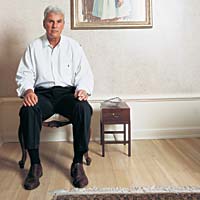
From the moment he arrives at Gene & Georgetti on this muggy late-summer day, it's apparent that Bob Lunn used to be a player. The valet who parks his black Mercedes sedan, the waiters and busboys who scurry up to greet him inside, the power lunchers who nod hello-they all seem to know Lunn. "Good to see you again, Bob," says a diner dismembering a massive New York strip. "How's the golf game?" asks someone else. Congressman Rahm Emanuel, holding court at a corner table, waves.
But it's a delicate minuet-cheerful cordiality at a safe distance. At this cathedral of cholesterol and clout, many of Lunn's acquaintances know about his spectacular flameout as a highflying money manager, and the troubling allegations that have shredded his reputation. Except for a bankruptcy lawyer who, like a vulture sniffing carrion, sidles up to gossip, no one actually comes over to talk. Lunn is still radioactive. "At one time," Lunn says, surveying the lunchtime throng of movers and shakers, "all these people wanted a piece of me-back when I was hot."
In his glory years from the mid-nineties to the early days of the new millennium, Lunn, now 55, was a swaggering financial guru straight out of central casting. He had compiled a stellar résumé that included top positions at prestigious Wall Street firms, then launched his own money management outfit, Lunn Partners, to guide the financial affairs of the wealthy. Tall, athletic, handsome, and charismatic, Lunn wore tailored suits, traveled by private jet, and tooled around sometimes in a Ferrari. He belonged to expensive country clubs where he dazzled the rich, powerful, and famous in his foursomes with his ability to birdie a hole when big money was on the line. And he could drop names with the best of them, boasting of his business dealings with Warren Buffett, of his rounds of golf with Michael Jordan, or of having dated a beautiful young stockbroker long before she became famous as Martha Stewart.
At his peak Lunn had, by his account, "significant relationships with a who's who" of Chicago's moneyed elite, who put their assets under his firm's management or poured money into his private deals. But that was before Lunn's deals started blowing apart, before his stories stopped holding together, and before his relationship with his most famous client, Scottie Pippen, the former Chicago Bulls star, turned poisonous, setting off a succession of calamities that left Lunn bankrupt, his business shuttered, and his life in ruins.
Just a few years ago, Bob Lunn and Scottie Pippen made a great team, sharing a warm personal relationship. "I considered Scottie a friend," Lunn says. When Pippen wasn't too busy with basketball, Lunn spoke to him two or three times a day-to gossip or give an update on an investment or run a new idea past him. Sometimes Pippen called Lunn with "cockamamie" investment ideas of his own, Lunn says, which Lunn would usually advise against. When schedules permitted, the two dined together or played golf at one of the clubs where Lunn was a member. Pippen had been a guest at Lunn's house, and Lunn had visited Pippen's. "I held his kids," Lunn says.
But beneath the sunny surface, perhaps the potential for conflict had always lurked. While Pippen could be a big spender, especially when adorning his life with the luxuries befitting a superstar athlete, he could also be prickly and petty when it came to money. Early in his career, he gained such wide notoriety for leaving skimpy gratuities at Chicago restaurants and nightclubs, he earned the nickname "No-tippin' Pippen." In his years with the Bulls, Pippen's sulking over the size of his paycheck became a seemingly annual rite. And though Pippen's Memphis-based agents did a masterful job of structuring his post-Bulls deal-which made him among the game's highest-paid players despite his declining skills-Pippen bridled so much at the standard fees they received, according to Lunn, that he severed his ties with them before re-signing with the Bulls in 2003.
That was not the only instance in which Pippen's relationship with a longtime adviser turned sour. The odyssey that brought him to Lunn began after Pippen came to believe he had been burned by his previous money manager, whom he dumped in 1999 (but did not sue). Lunn says now he should have seen that acrimonious split as a flashing red light and steered clear of Pippen. But at the time, he saw only the chance to raise the profile of his business by landing a star client.
Just as Pippen was not always the amiable, laid-back jock he often seemed, maybe Lunn was not quite all he was cracked up to be, either. By all accounts Lunn was a back-slapping, fast-talking master of the sale and a brilliant charmer who beguiled his way into people's affection and trust. But today, at least some who once thought they knew him are no longer sure where the truth stopped and the embroidering of it began. It isn't just that Lunn apparently lied about his education, as revealed last December in the Chicago Sun-Times. Too many of his other stories, they say, failed in the end to stand up to scrutiny. As a former Wall Street colleague puts it, "In a business with a lot of cowboys-a lot of people who push the envelope in terms of what's true and what isn't-Bob is a cowboy's cowboy."
Perhaps those people would still give Lunn the benefit of the doubt if he had managed to maintain his aura as a dealmaker extraordinaire. But "over time Lunn's losers outweighed his winners, and people finally had enough," says one of Lunn's creditors, who, like several other people quoted in this article, spoke on the condition of anonymity. Maybe Lunn could have survived even that loss of luster, another source adds, except that "he pissed off the wrong guy at the wrong time."
Last year that "guy," Scottie Pippen, sued Lunn in a dispute over an airplane and blamed Lunn in another suit for saddling him with staggering losses in a slew of risky investments. Those legal salvos touched off a chain reaction of other lawsuits-what Lunn calls a "run on the bank" by his creditors-that brought down his investment advisory firm, pushed him into bankruptcy, and rendered him an outcast among the wealthy elites he once cultivated. Now, as he surveys the wreckage, Lunn admits he's "not perfect" and made "mistakes in judgment." But he also feels "betrayed" by Pippen-a "spoiled brat," he says, who prefers to blame others rather than take responsibility for his own actions. "He hurt me, my wife, and my children," Lunn says, his choler rising. "He put me out of business. I'm broke. I wish to God I had never met the guy."
Retired since last year from professional basketball, Pippen appears to have traded the gamesmanship of the basketball court for the brinkmanship of the courtroom. Besides his actions against Lunn, he has also filed lawsuits against his longtime law firm, now called Katten Muchin Rosenman, and his former accountants, Wineberg and Lewis, claiming they failed to exercise proper oversight while Lunn was able to "steal" his money. Pippen declined repeated requests through his lawyers to comment for this story, preferring to let his allegations speak for him. But based on his claims that he is out at least $14 million (and possibly as much as $30 million), it seems certain that the former basketball great wishes he had never met Bob Lunn, either.
Like a dotcom stock levitating before the bubble burst, Robert J. Lunn rose high from humble roots. But the story of his ascent is tinged with mystery, if only because of the difficulty in getting parts of it to check out. He started life in the working-class neighborhood of Bridgeport, on Chicago's South Side, the youngest of Bill and Rose Lunn's five children. Rose, a pious Italian American woman, dreamed that her altar-boy child, born when she was 42, might someday be a priest or a doctor. Bill worked in a steel mill and eventually drank himself to death, Lunn says. By the time Bill and Rose divorced, around the time Bob was 13, Bill had moved the family to Oak Lawn, at 87th and Cicero, and become a journeyman roofer. In the summers between his years at Brother Rice High School, Bob worked for his dad, hauling buckets of gravel onto rooftops and spreading 500-degree tar in stifling heat. It was miserable, dirty work that hardened his determination "to figure out another way to make a living," he says.
A standout athlete growing up, Lunn says he went to Northwestern University starting in 1968 and played outfield for two seasons on the school's baseball team. Three decades later, serving on the board of trustees of the University of Chicago Hospitals, he claimed in a biographical sketch that he had earned a bachelor's degree in anthropology from Northwestern and a master's in finance from the University of Chicago. Yet the U. of C. has no record of Lunn's enrollment as a student (he says now that he took night school classes there in economics and finance). A spokesman for Northwestern says Lunn did not receive a degree there, and the school's athletic department says Lunn's name does not show up on any of its baseball team rosters from the years in which he claims to have played. The only Robert J. Lunn that turns up in the school's files took some continuing education classes in 1977 and 1978. (Lunn says he can't explain why his name is missing from the school's records.)
At some point in the early seventies, Lunn got a job as a runner for a grain exporter at the Chicago Board of Trade. Soon he became "obsessed," he says, with the workings of financial markets. After a day of hustling in the pits, he would head upstairs to the offices above the trading floor to soak up everything he could from the brokers and salesmen.
Lunn's early career included stints trading convertible bonds at what became known as Drexel Burnham-where he sat a few feet away from a young hotshot named Michael Milken-and trading equities at William Blair & Co. in Chicago. Around the mid-seventies he got his big break, landing a job at Morgan Stanley with a six-figure salary. The blue-collar kid from the South Side of Chicago hardly fit in among the Harvard MBAs at the patrician Wall Street firm. But his apprenticeship in the trading pits of Chicago and on the bond trading desk at Drexel had equipped him to excel at a moment when options and other esoteric financial products were exploding in variety and complexity on Wall Street. He rose quickly through the ranks, in 1987 becoming a member of the equity division operating committee and a co-head of private client services, the unit that offered asset management advice to Morgan Stanley's high-net-worth customers.
Lunn was briefly married around 1977, and the relationship produced a daughter before the couple were divorced. He married his current wife, Laura, in 1984. (They live in Hyde Park with their two sons; a daughter died in infancy in 1991.) Although Lunn made his home in Chicago, he spent his workweeks in New York. Needing a break from the grind, he left Morgan Stanley in 1993 and vowed to stick closer to home. But soon Lehman Brothers offered him the chance to run its retail business and bring home a fat paycheck, and he again began spending his weeks in New York. At Lehman, Lunn served on the eight-person operating committee, putting him near the top of the food chain there.
A former co-worker during Lunn's Lehman Brothers years says, "Bob always had the salesman in him. I don't think he had the investor in him." He remembers a colleague given to excess and flash-Lunn stayed at the posh St. Regis in New York and traveled by corporate jet. "I saw this grandiose persona," the former colleague recalls. "The private jet was all part of the image, all part of what was important to Bob. He lived like a rock star."
Whatever Lunn's merits as a financial whiz, he had an undeniable gift for winning the hearts-and the accounts-of wealthy, sophisticated clients. Indeed, few people could mount the kind of charm offensive for which Lunn became known. The Lehman Brothers colleague recalls one day when Lunn was taking clients to lunch at the Standard Club, a few blocks away from his office. "Anybody in the whole world would just walk over to the Standard Club," he says. "Bob had a big white stretch limo show up. That was his kind of showmanship."
The former Lehman hand remembers another occasion when Lunn took a long-distance call in his office. The person on the other end apparently complained about the weather where he was, and Lunn, looking out his window at a beautiful, sunny day, replied, "‘It's pouring down rain here,'" the colleague recalls. "Now, why would anybody make that up?" Another person who has dealt extensively with Lunn offers a theory: "He was empathizing with the guy. Lunn is a great empathizer, maybe to a fault. He is like eating comfort food-a great guy to be with."
In my own conversations with Lunn-at his house, in my office, over lunch, on the phone-I could see why people were drawn to him. He's articulate, engaging, and likable, and he didn't just talk about himself. He also learned things about me-including that I grew up in Cincinnati and that my father had been a minor-league pitcher in the Chicago White Sox organization. Then one day Lunn mentioned that he too had been a minor-league baseball player, having signed for a $15,000 bonus in 1970 with the Cincinnati Reds-the team I had grown up rooting for. He said he played for a summer before concluding that a career in professional baseball could not satisfy his financial cravings. "Willie Mays had recently signed a contract for [only] about $100,000, and I knew I wasn't Willie," he told me.
Baseball, my hometown-it seemed that Lunn and I now had things in common, a basis for becoming buddies. At first I had no reason to doubt him, but when I later asked what team he had played for, he couldn't remember. A check with Minor League Baseball revealed that his name did not appear in its database of former players. When I brought this to Lunn's attention and asked what town he had played in, he replied, "Lexington," which is not far from Cincinnati. The problem is that the Reds did not have a minor-league affiliate there; indeed, by 1970 Lexington had not been home to a minor-league franchise for several decades. (Eventually Lunn said he could not "confirm" his baseball claim.)
In 1991, Scottie Pippen made a prudent financial decision that he soon came bitterly to regret. Facing the uncertainty of free agency when his contract expired in 1993, he asked the Bulls for a five-year, $18-million extension. For Pippen, who had grown up poor in tiny Hamburg, Arkansas, and whose ailing back raised questions about his future longevity and earning power, the extension was a chance to lock in personal financial security, even if it meant locking out the potential to earn greater riches as a free agent. Jerry Reinsdorf, the Bulls chairman who negotiated the deal, warned Pippen he would feel underpaid within three years. But Pippen replied, "You'll never hear from me."
Yet by 1994, with Pippen a star and player salaries skyrocketing, he was indeed earning well below his market value. He demanded to have his contract renegotiated or be traded—both of which the Bulls refused to do. Over time his grievance festered while the Bulls continued to ignore his demands. It probably didn't help his cause that Pippen had racked up an arrest on a gun charge (later dropped), two paternity suits, and an arrest on domestic battery charges (also dropped)-and that he had childishly refused to play the final 1.8 seconds of a playoff game because he wasn't going to get the ball for the final shot. By the 1997-98 season, Pippen already had been named one of the 50 greatest players in the history of the National Basketball Association, yet he was making less money than five of his own teammates. When free agency beckoned in 1999, he couldn't wait to claim the riches, perks, and respect he had long been denied.
In January 1999, Pippen signed a complex deal, negotiated by his Memphis agents, Jimmy Sexton and Kyle Rote Jr., that finally made him a very wealthy man. Over the next five seasons, Pippen would haul down nearly $100 million in salary, incentives, and endorsement fees. The year he signed that deal, Pippen made another significant change in his financial affairs-he terminated his relationship with Morgan Keegan, the Memphis company that long had served as his money adviser. Pippen claims the firm took "undue advantage" of him, according to court filings. (A spokesman for Morgan Keegan said the company would not comment on any past client dealings.)
Whatever Pippen's grievance, it's possible that he had also grown impatient with Morgan Keegan's conservative—some would call it prudent—investment strategy. Pippen's portfolio was loaded with "the traditional broker stuff," says Lunn. "He was ‘long' the S&P 500"—meaning he owned the bluest of blue-chip stocks. Yet in 1999, there was a gold rush going on in the kind of technology highfliers Pippen apparently didn't own. As Lunn puts it, "He'd socialize with his buddies and hear they were making a ton of money in some dotcom deal."
Lunn had served a little more than two years at Lehman Brothers when the younger of his two sons was diagnosed with ataxia, a nervous system disorder that causes gradual deterioration of the brain stem (the condition subsequently stabilized, Lunn says). Once again the grind of spending his workweeks in New York became too much, Lunn says, so he left Lehman and in 1996 launched his own financial services business in Chicago.
Lunn Partners was set up as a boutique for wealthy investors, offering an asset management service that invested clients' money in several actively managed funds, and an investment advisory service offering advice on risk and asset allocation. But what really differentiated the firm was its private equity side, which made risky but potentially lucrative investments in small, usually nonpublic companies. "Bob sold Lunn Partners as a place where rich people congregated, and for a fee he could raise money for people who needed capital," says the creditor. "And so people pitched deals to Lunn, and Lunn then tried to peddle the deal among his clients and circle of wealthy contacts. In the late 1990s and early 2000s there were quite a number of these deals, until Lunn Partners became, in effect, a loose private equity shop."
By then Lunn's well-established status as a Wall Street big shot had brought him into contact-and friendship-with an exclusive network of Chicago's wealthiest, savviest wheelers and dealers. Perhaps no relationship was more crucial to Lunn than his friendship with Peer Pedersen, a well-connected Chicago lawyer and investor with an impressive track record of successful deals. Lunn had first met Pedersen in the late eighties, while still at Morgan Stanley, and the two had become increasingly close. "Peer and Bob were at one point inseparably good friends," says the creditor. "They'd fight sometimes like cats and dogs, but if they were on a golf outing they were the best of friends." (Pedersen did not return phone calls seeking comment for this article.)
Lunn says his relationship with Pedersen was "more personal than business." But the two of them invested alongside one another in numerous private equity deals, and Pedersen's law firm, Pedersen & Houpt, did legal work for Lunn Partners. Having Pedersen's stamp of approval meant that Lunn "had been blessed," says the creditor, in the eyes of other wealthy investors. And so people such as Donald Kelly (former chief of Esmark), Dean Buntrock (former chairman and chief executive of Waste Management), Craig Duchossois (CEO of Duchossois Industries and son of the horseracing mogul Richard Duchossois), Richard Heise Sr. (developer of One Financial Place and other commercial properties), and other big hitters wound up investing in Lunn's deals or turning over money for Lunn Partners to manage.
For a time, at least, Lunn's touch was golden. An investment he regularly cites as evidence of his acumen is Continental Community Holdings, a private owner and operator of manufactured housing parks that by several accounts was a home run. Lunn unearthed enough other winners that some investors still swear by him. "I've done a lot of deals with him, and most have been very successful," says Howard Conant, a former chairman of Interstate Steel Company and a creditor of Lunn's. And C. Barry Montgomery, a Chicago trial lawyer, says the performance of his investments with Lunn has been "heavily on the plus side."
When they learned in the summer of 1999 that Scottie Pippen was unhappy with his Memphis money manager, lawyers at Katten Muchin, the Chicago firm that had served as Pippen's legal counsel for much of his career, pitched in to help him find a replacement. They lined up representatives of several financial institutions-from brand-name national shops like Goldman Sachs and Salomon Smith Barney to the local Lunn Partners-to meet with Pippen and tell him about their services. Lunn's 20-employee operation might have seemed outclassed against such bigger and better known competition. But because of his small size, he could provide a level of personalized service they couldn't. What's more, Lunn could offer Pippen entrée into the go-go world of private equity investing alongside big-time financial players. "I wasn't an orthodox money manager-you couldn't put me in a cookie-cutter box," says Lunn. "We were looking to do deals, and I was willing to go and look at Pippen's investment ideas, too. A place like Northern Trust isn't going to do that." On the appointed day, Lunn showed up at Katten Muchin's West Loop office, where Pippen and his wife, Larsa, were ensconced in a conference room. Lunn says that he and Pippen "hit it off from the get-go." By the end of the day, Pippen had selected Lunn, based, Pippen claims in a lawsuit, on Katten Muchin's recommendation. (A spokesman for the law firm declined to comment.)
Lunn's first move was to liquidate most of Pippen's stock portfolio, he says, sparing Pippen the trauma that began a few months later when the stock market crashed in March of 2000. Over the three years starting in January 2000, Pippen transferred a net total (excluding cash that went back to him) of about $15 million for Lunn to invest, according to one of Pippen's lawyers. (Lunn says the net total was about $10 million.) Lunn's task, as spelled out in an agreement Pippen signed in December 1999, was to assemble a portfolio exposed to "moderate" risk.
But instead of investing in publicly traded and relatively liquid assets, such as stocks and Treasury bonds, Lunn began pouring Pippen's money into relatively illiquid private placements in fledgling companies and stakes in commercial real-estate developments. In time, Pippen owned equity in Continental Community Holdings; Fisher Island, a posh real-estate development in Miami's Biscayne Bay; Fox & Obel, the gourmet grocer in Chicago; a small airline called Indigo that operated charter flights between Chicago and Teterboro, New Jersey; a private maker of guitars; an Internet venture; and more.
At some point in early 2001, Lunn says, an associate of Peer Pedersen approached with a deal that seemed promising: lending money, at 13 percent interest, to a prominent local real-estate developer called Urban Investment Trust to fund the development of some commercial properties. Urban was led by two men, Rudy Mulder and John Terzakis, with solid credentials. Mulder, the chairman and Lunn's chief contact, "was touted as the hot new developer in town," Lunn says. Lunn rounded up several people to lend about $12 million to Urban through Lunn Partners, but the biggest stake-a total of $3.5 million, Lunn says-belonged to Pippen. (Pippen claims in court filings that the figure was more than $12 million.) Indeed, Lunn says, "I elbowed" Pippen into the deal "to the exclusion of other investors I would have gone to. I had to put some of his money to work."
With his stellar career winding down as a member of the Portland Trailblazers, Scottie Pippen was finally savoring the financial fruits that had eluded him during his glory years with the Bulls. Hauling down more than $15 million a year, he was rich enough to splurge on a $10-million yacht (the 85-foot, leather-and-marble-lined Lady Larsa, with seven-foot ceilings designed specially for Pippen's tall frame), build a palatial dream house on the Intracoastal Waterway in Fort Lauderdale, and indulge in other fast-lane extravagances.
In recent years he had come to covet the ultimate bling for a star athlete: a large corporate jet that could whisk him to his destination in pampered style. "He's a big dog," Lunn says. "His buddies are flying around in private jets; he wants to fly around in a private jet. It was an ego thing."
Lunn, himself a frequent flier by private jet, argued in a September 1999 letter to Pippen's accountant that maintenance and financing costs made owning a plane a stupendous waste of money. It made far more sense financially, he advised, for Pippen simply to lease time on private charters whenever he wanted to fly. But over the following months Pippen "kept pounding me," Lunn says. "He had a serious ambition to own his own airplane."
In time Pippen took a liking to a Gulfstream II he had flown on. Piloted by a Florida charter operator Pippen had befriended named Craig Frost, the plane was almost as big as a small DC-9, with an interior roomy enough to stand up in, plush leather seating for about 16 passengers, and plenty of other creature comforts.
At Pippen's insistence and against Lunn's advice, according to court documents, in early 2002 Lunn worked out a deal that made Pippen the co-owner of the Gulfstream II along with Frost. The agreement gave Pippen 51 percent of the equity in the $7.4-million plane and enabled him to share in the revenues it generated in Frost's charter service, thereby helping him cover the maintenance costs and the monthly payments on the $5 million he and Frost had borrowed.
Over the next several months, the Pippen-Frost partnership was "all seashells and balloons," Lunn says, as Pippen embraced his inner big shot, flying to and fro with Frost at the controls. But soon enough there was turbulence. In late October 2002 Scottie and Larsa called Lunn to tell him they believed Frost was not maintaining the plane properly, Lunn says. Larsa said she no longer felt safe on board. Scottie had become interested in an even fancier plane and insisted that Lunn get him out of the deal on the Gulfstream. The conversation ended on an ominous note: "‘We should have never bought this plane,'" Larsa said, according to Lunn. "‘We hired you to prevent us from making decisions like this. You're supposed to protect us from ourselves.'"
Despite Pippen's desire for a moderate-risk investment strategy, by the middle of 2003 Lunn had allocated 90 percent of his funds to "risky and speculative non-public investments" instead of publicly traded companies and other "safer" investments, according to court documents.
Lunn says today that he believed at the time that those investments offered a higher margin of safety and better returns than stocks or bonds. But financing small privately held startups is inherently risky, and by some accounts many of Lunn's deals were turning out to be losers. "He started getting sloppy with his investment strategies, and the deals became crazier and crazier," says the source familiar with several of Lunn Partners' deals. By the end of 2003, says the Lunn creditor, "the people Bob could go to to raise money were drying up. Nobody trusted him anymore." Meanwhile, Lunn found himself in an increasingly precarious financial condition, relying on a growing list of creditors to keep his investments-and himself-afloat.
Of all the troubled investments weighing on Lunn, the one that threatened to devour him was the loan to Urban Investment Trust. Over the course of 2002, Urban had fallen further and further behind on its interest payments to Lunn Partners. At a tense meeting in January 2003 with Rudy Mulder and John Terzakis, Lunn says, he learned that Urban was unable to repay the $12 million it had borrowed. (Mulder would file for personal bankruptcy that September.) Faced with this catastrophe, in the spring of 2003 Lunn worked out a deal in which he would take personal possession of several commercial properties-including a South Side parcel at 119th Street and Marshfield Avenue and a 49-acre site at 26th Street and South Kostner Avenue in the Hispanic neighborhood of Little Village-in exchange for releasing Urban from its debt obligations to Lunn Partners.
The two most valuable properties, the South Side and Pilsen parcels, carried mortgages totaling $40 million, but Lunn believed they might be worth substantially more than that. If he could find a buyer, he thought, he could pay back Pippen and the other bondholders in the Urban deal, as well as his other creditors. But Lunn was not a real-estate developer, and these would be complicated transactions that would take time to play out. Meanwhile, Lunn would have to shoulder the $200,000-plus in monthly interest payments on the mortgages. With other investments foundering, this huge new obligation left Lunn badly "strapped," he admits now. "I was working seven days a week; I had my hand in many dikes. Every ounce of cash flow we had at Lunn Partners was going to pay the carry [on the properties]. In retrospect, clearly I got stretched too thin."
In the spring of 2003, Lunn took Pippen golfing at Beverly Country Club. By then friction had developed between them over the Gulfstream II. Although Lunn had helped arrange a buyout from Frost in which Pippen would "suffer no financial loss and even retain a minority stake in the airplane," court papers say, Pippen, "believing his interest was worth more," refused to accept. As the stalemate wore on, Pippen was not making his share of the loan payments, Frost says. Eventually Frost stopped making payments as well and mothballed the plane. (Eventually U.S. Bank National Association sued Pippen and Frost on the delinquent loan, and Pippen is potentially liable for the entire $5 million still owed.)
In Lunn's version of events, the plane was the principal cause of Pippen's turning against him. But it seems plausible that Pippen had plenty of other reasons to be unhappy with Lunn. Pippen alleges in court filings, for example, that Lunn failed to answer Pippen's questions or provide reports about investment transactions and performance. Even Lunn admits that although he had learned of Urban Investment Trust's troubles in January 2003, he didn't tell Pippen about it until the May golf outing, when Pippen also learned that Lunn now owned the properties. Lunn tried to reassure Pippen that he would get his money back. "At the end of the day, this is going to be more than OK," he told Pippen on the drive back from the country club, "because the property is now worth more than what we were owed."
To give Pippen further comfort, Lunn did something he now regrets. He ordered his lawyer to draw up a written pledge, he says, personally guaranteeing he would buy Pippen out of his investments with Lunn Partners, including the real estate, for about $7.6 million-the amount Lunn says Pippen had put into the various Lunn Partners private equity deals and the real-estate developments. "I just wanted to get him out of my life and out of my business as delicately and fairly as I could, but I also wanted to protect him," Lunn says. He hoped that by giving Pippen a personal guarantee, he would forestall a possible lawsuit. But in fact he had handed Pippen a powerful legal cudgel to use against him.
Over the course of 2003, Pippen's patience apparently was running out. In February he inquired about the status of his investments. In the fall he retained a Cleveland financial adviser named Joe Lombardo-who has aided other professional athletes in disputes with money managers-to help extricate him from his Lunn Partners investments. Lunn tried without success to negotiate a settlement with Lombardo (who declined to comment for this article). But he also failed to deliver on promises to liquidate various investments of Pippen's, according to court documents.
Finally, in March of last year Pippen sued Lunn (and Pedersen & Houpt, which had handled the legal work) over the Gulfstream II. Pippen claims in court papers that Lunn "introduced" him to the deal and mismanaged the agreement, to Pippen's detriment. And he calls the plane an "investment" that should have allowed Pippen to "realize a profit." Lunn responds that rather than bring the deal to Pippen, he "did all he could to counsel Pippen against it," court papers say. And he now bristles at the claim that the plane was an investment. "It was a toy, a consumption decision, an ego decision," he says.
A month after filing the airplane suit, Pippen followed up with a suit accusing Lunn of rampant misconduct in connection with his investments. Among the allegations are that Lunn failed to invest Pippen's money prudently, failed to document investments or value them properly in monthly statements, and converted millions of dollars of Pippen's for his own use.
Today Lunn admits that some of Pippen's investments were unsuccessful. "But that's the business," he says. "You're going to miss a few." And he admits that some were "speculative." But, he adds, "you've got to have some risk to make money. I believed in everything we invested in, and on balance I think I was correct." Finally, he calls allegations that he pocketed any of Pippen's money for his own use "an outrage-it's so far off the beam it's beyond belief."
In the months that followed his filing suit, Pippen ratcheted up the pressure on Lunn, going through several sets of legal teams in the process. In October of last year Pippen won a $7.6-million judgment on the guarantee Lunn had issued. Lunn now regrets not contesting the judgment, because it gave Pippen the ability to sweep money out of Lunn's bank accounts, effectively shutting down what was left of his business (he had already sold the asset management side to Mesirow Financial in January 2003). In December, Lunn was stung by the appearance of a story in the Sun-Times portraying Pippen as the victim of a Wall Street hustler and disclosing that Lunn had made false claims about his academic credentials.
Meanwhile, despite Pippen's assertions that Lunn had put him into a host of bad investments, it turned out that the two commercial real-estate properties, at least, really were valuable. At a public foreclosure auction this past January, a California company called Primestor, which had previously attempted to buy the land from Lunn, emerged with the winning bid of $62.4 million, enough for Lunn to pay off the $40-million mortgage with $22 million left over to distribute to Pippen and his other creditors. But when Pippen's lawyers persuaded a state court judge to intervene in the sale-alleging that Lunn had colluded with Primestor to sell the property far below its market value-one of Lunn's other creditors filed a motion to move the case to federal bankruptcy court, where it subsequently played out. The bankruptcy court rejected Pippen's later attempt to claim that he, not Lunn, owned the properties, and the sale to Primestor was finally approved in June.
After legal fees are subtracted, Lunn's bankruptcy estate is likely to have about $20 million, his lawyers say. At press time, Lunn was still working with his creditors to devise a plan for the equitable distribution of the money. Given that the creditors' claims are likely to total more than $30 million, Pippen could wind up with substantially less than what Lunn had previously offered, and Pippen rejected, to avoid bankruptcy: a settlement valued at more than $10 million-$7.6 million in cash plus the assumption of his obligation on the Gulfstream II. As often happens when two parties go for the jugular in litigation, the real winners may turn out to be the lawyers.
Today Lunn says he feels vindicated that the commercial properties turned out to be as valuable as he had believed, and that he'll be able to substantially pay off his debts. But, he says, "the personal price I paid was too high." Humbled by the bankruptcy process, he says he spent every cent he had-more than $2 million-on legal fees trying to fend off Pippen and his other creditors. Meanwhile, Lunn's days as a financial guru are over. "Lunn Partners is done," he says. "It's not coming back." For one thing, "it would be difficult to resurrect the same kind of close relationships I had," he says, because from now on there will "always be an element of doubt. I'm always going to have to explain what happened."
Today, many of the high-powered investors who once clamored for inclusion in Lunn's deals, golfed with him, socialized with him, won't take his calls. "You really find out who your friends are," Lunn says. "When we were humming for all those years, everybody was trying to get to me. And when I was at my low point, many of those people you couldn't find. Some of them wouldn't have what they have today if it wasn't for Lunn Partners."
Lunn shouldn't hold his breath waiting to be welcomed back into the fold. "He is now a pariah, persona non grata," says the source familiar with several Lunn Partners deals. "He lost a ton of money for people, and I don't think he ever truthfully told where all the money went. Then came the legal trouble. People feel let down-especially if the résumé fraud is true. It's embarrassing to people who knew him well."
In Lunn's eyes, the villain of this tale is Scottie Pippen, who started a pointless legal battle that accomplished nothing more than delaying by more than a year the day when Lunn could pay him what he owed. But by some accounts, Lunn's wounds were self-inflicted, his flaws fatal enough to have made this reckoning inevitable. "I think his ego front-ran him, and he got to the point where he thought he couldn't make a mistake," says the former Lehman Brothers colleague. "Instead of buying General Electric and Monsanto and Procter & Gamble and building a [conventional] portfolio, he was always swinging for the fences, doing these weirdo private deals." Had Lunn stuck to stocks and bonds, "there wouldn't have been any lawsuit."
On that point even Lunn agrees. "In hindsight, I wish I would have put Scottie in an index fund, because I couldn't be criticized for that," he says. "But he wasn't paying for that. He was paying for something that was different and unique."
Today Lunn is starting over with little but his health and his family. Over the past two years, he says, he has gotten a Ph.D., figuratively speaking, in commercial real-estate development, and in the future he hopes to do more of it along with private equity investing. He now has the opportunity to take a 30-percent stake in Primestor Chicago, which owns the two commercial properties, provided he can fund that share of the debt when he emerges from bankruptcy. "I will survive in the real-estate business and just go back to living off my wits again," he says.
But even now, Lunn can't help thinking that "none of this had to be. What bothers me the most, in retrospect, is that if Scottie and I would have managed to get along, which was prevented by the airplane suit, we'd be playing golf somewhere today," Lunn says, as if that heartwarming tableau were almost close enough to touch. "And I'd be saying, ‘Look at how badly you would have done if you had stayed in the stock market-versus where you are now.'" It's a lovely thought-Lunn and Pippen together again, teammates again, friends again. Just like old times.