

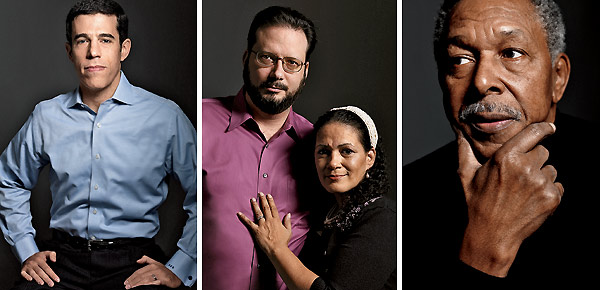
Meet the plaintiffs: These four Chicago residents (from left), Adam Orlov, David and Colleen Lawson, and Otis McDonald, have sued to repeal the city’s ban on handgun possession. Their case will be heard by the Supreme Court in February.
When Otis McDonald bought his house in Morgan Park in 1971, the purchase represented a generational milestone of sorts: One of 12 children born to Louisiana sharecroppers, McDonald left the farm at 17 to find work in the big city, and, after struggling for many years in low-paying seasonal jobs, was hired as a janitor by the University of Chicago in the early sixties. He eventually earned a coveted skilled union position as a building-maintenance engineer, a job he kept until he retired.
Today McDonald, a bright-eyed and trim 76-year-old grandfather, considers himself one of few defenders of peace and security on the leafy, house-lined street where three of his children grew up and played. The gangbangers and drug dealers have taken over, he says. “You go out there in the morning and pick up bottles and things on the lawn,” he explains, describing events of the past summer. “They’re out there at three in the morning, in the middle of the street, drinking and smoking their stuff. They throw stuff all over your lawn, and you can’t say anything, because they might up and shoot you.” McDonald says his house has been broken into three times and his garage twice—most recently, early one morning this past August by a man McDonald recognized from around the neighborhood. Does McDonald think the robber planned to sell the stolen possessions for drugs? “Of course, of course,” he says matter-of-factly.
Otis McDonald wants a handgun—a pistol to carry around the house and keep on his bedside table at night. An avid hunter, he has two shotguns in the house, but he says those weapons are too unwieldy to use when facing a midnight intruder. More to the point, McDonald believes that if Chicago residents were allowed to keep handguns in their homes, criminals would think twice before breaking in—a fairly common rationale among gun-rights supporters. McDonald, however, is no ordinary gun-rights supporter: In 2008, he joined three other residents in a lawsuit to get rid of the city’s handgun ban, the most restrictive gun law in the country and probably the most far-reaching because of Chicago’s size.
Fulfilling a longtime goal of the gun lobby, two years ago the Supreme Court upended a 70-year-old precedent and ruled that the Second Amendment guarantees an individual the right to own a handgun—at least in Washington, D.C., and other areas under federal jurisdiction. Now McDonald v. City of Chicago, to be argued in February, will determine if the ruling applies to the states and cities. If Chicago’s law falls, will the city be flooded with guns and a resulting wave of deadly shootouts? No one really thinks so—but the ramifications may be far-reaching in other important ways.
* * *
The conditions that created Chicago’s law have long faded into memory: The city’s ban followed a surge of anti-handgun sentiment triggered by the assassination attempts on President Ronald Reagan and Pope John Paul II in 1981. Proposed by Mayor Jane Byrne and passed in 1982, the city’s ordinance bans the possession of handguns, except for those registered before the law took effect. Morton Grove had passed a similar ban the year before—a first in the nation. At the time, the laws were hailed as commonsense attacks on what newspapers had begun to call the “epidemic” of crime and gun proliferation.
Until recently, the Supreme Court had stayed away from the issue for years: Its position, as written in a 1939 decision, was that the “keep and bear arms” language of the Second Amendment protected only the right of states to raise armed militias. In 2001, the federal appeals court in New Orleans challenged the precedent, stating tangentially in a ruling that it believed the amendment grants to individual private citizens the right to own guns. Pushed along by Attorney General John Ashcroft, the sentiment became the de facto position of the Justice Department—virtually guaranteeing that sooner or later the issue would reach the Supreme Court.
That moment came in 2007, when a security guard named Dick Heller sued Washington, D.C., for blocking his right to keep a loaded handgun in his home for self-defense. The Heller case turned out to be the product of sophisticated legal maneuvering, funded by a rich libertarian lawyer from the D.C. area named Robert A. Levy. At the time, Levy told The New York Times that he—along with the lawyers Alan Gura and Clark M. Neily III—modeled the strategy on the work of Thurgood Marshall, the Supreme Court justice. As a civil rights lawyer, Marshall fought racial segregation in the schools through the then-novel approach of assembling an attractive panel of plaintiffs to challenge specific laws. Since Marshall’s time, this kind of organized litigation has become a common and effective strategy for civil rights and class-action lawsuits.
In preparation for the Heller case, Levy and his associates interviewed dozens of potential plaintiffs who lived in Washington, D.C. “We wanted gender diversity. We wanted racial diversity. We wanted age diversity. We wanted income diversity,” Levy told the Times, describing their criteria. Today the chairman of the Cato Institute, a libertarian think tank in Washington, D.C., Levy prevailed in the Heller case, but because Washington, D.C., is considered part of the federal system, the ruling does not apply to state and local governments.
Which brings us to McDonald v. Chicago. Led by Alan Gura, the Virginia lawyer who argued the Heller case, the petitioners hope the Supreme Court will decide that states must follow the same Second Amendment rules as the federal government. That would mean that the Heller decision invalidates Chicago’s law (almost identical to D.C.’s) and, by extension, any other blanket handgun ban in the country.
This time the plaintiffs’ case is being underwritten by the Second Amendment Foundation (SAF), an anti-gun-control group based in Bellevue, Washington. The SAF and the Illinois State Rifle Assocation are coplaintiffs along with a diverse group of Chicago residents: Otis McDonald, the African American homeowner with an urban gang problem; Adam Orlov, a 40-year-old entrepreneur and former Evanston police officer who lives with his wife in Old Town; and Colleen and David Lawson, a mixed-race, middle-aged couple who live on the Far Northwest Side.
Gura readily acknowledges that in order to neutralize unflattering gun-culture stereotypes, he and his team methodically sought people with whom average Americans can “identify and empathize.” None had ever considered suing the City of Chicago individually, but Gura rejects the suggestion that the plaintiffs were put up to the task. “We didn’t give anyone the idea that these laws were wrong and violated their rights,” says Gura, who lives in Alexandria, Virginia, and is part of a three-person civil rights practice. “All of the plaintiffs in this case have believed for a very long time that these laws were restricting, and they were happy to hear that there are lawyers interested in representing them.”
Orlov actually sought out Gura—and Levy before him. A partner in an equity-options-trading business in the Loop called Anthem Capital, Orlov is probably the opposite of anyone’s idea of a Second Amendment crusader. “I grew up in Rogers Park . . . in a very liberal household,” he says. “No firearms, no hunters, nothing like that.” A Cato contributor who describes himself as a bit of a constitutional law nut, Orlov followed the Heller case with interest, even managing to get a seat for oral arguments at the Supreme Court. Soon after, he contacted Gura.
Similarly, David Lawson, a 43-year-old software engineer originally from California, says he has long opposed Chicago’s handgun ban and got in touch with Levy and Gura after reading early reports about the Heller case. Colleen, Lawson’s wife and a 51-year-old hypnotherapist, says she became personally interested in the issue after their home was broken into by three men one afternoon when she was there, sick with the flu.
In 2007, a volunteer for a gun-rights rally in Springfield met Otis McDonald at the event and later put him in touch with Gura. To some, the picking of McDonald, an older, soft-spoken African American South Sider, as the lead plaintiff seems both brilliant and pandering as PR moves go.
Adam Samaha, a constitutional law expert and a professor at the University of Chicago Law School, argues that McDonald’s race is more than just PR—it’s a tactic. He points out that in the Heller opinion, the majority—Justices Scalia, Roberts, Thomas, Alito, and Kennedy—revisited an interesting episode in history involving freed slaves and guns. Scalia wrote: “Blacks were routinely disarmed by Southern States after the Civil War. Those who opposed these injustices frequently stated that they infringed blacks’ constitutional right to keep and bear arms. Needless to say, the claim was not that blacks were being prohibited from carrying arms in an organized state militia.” In expressing sympathy for freed slaves, Samaha says, the justices signaled that they were interested in framing the Second Amendment in a broader civil liberties context. Does casting Otis McDonald as the lead plaintiff help draw the link? “That’s perfect,” Samaha says.
Theatrics don’t count for much with the city’s lawyers. Benna Ruth Solomon, deputy corporation counsel in the appeals division, says that whatever the Supreme Court decided about how to interpret the Second Amendment, the case is really a test of how to apply the “incorporation” theory of the 14th Amendment, through which the Heller ruling would invalidate Chicago’s law. The city’s position is that only “fundamental rights” are incorporated by the 14th Amendment.
The Supreme Court’s ruling in the Heller case recognized the individual’s right to own a handgun on the grounds that it was a weapon in common use in 1791, when the amendment was added to the Constitution. “Our argument is that there is no fundamental right to weapons in common use in 1791,” Solomon explains. “Most other things that were done in 1791 are not considered fundamental just because they were done in 1791. One needs to have a more modern analysis to decide whether it serves the purpose of the society that we are trying to create and maintain in 2010.”
What’s at stake for Chicago residents? Lifting the ban probably won’t result in a sudden surge in gun ownership, says Jens Ludwig, a public policy professor at the University of Chicago, who has written extensively on the subject with Philip J. Cook, a Duke University economist. Compared with other cities nationally, Chicago before the ban was “not a gun-loving city,” he says. “There has been some population turn-over, but I would be surprised if the ban was lifted and we discover there had been this superhuge demand for guns.”
The statistics are inconclusive on whether handgun bans work. In Chicago, homicides showed a modest decline after the ban took effect but then jumped to a high of 943 in 1992; the number has been gradually decreasing since then. In the early 1980s, Washington, D.C., experienced a large drop in gun murders—but so did Baltimore. Neither trend, says Ludwig, can be solely attributed to handgun bans. Ludwig also notes that although Chicago is not the most dangerous city in the United States (Detroit and Baltimore have higher murder rates), the homicide rate here—today equivalent to 16 per 100,000 residents—is still a third higher than in Los Angeles, which has a gang problem at least as severe, and fully three times that of New York City.
That said, the handgun ban may have reduced the flow of illegal weapons to the city’s underground market, as described in a fascinating recent study by Ludwig and Cook with Sudhir Venkatesh and Anthony Braga. In interviews, gang members reported difficulty getting guns, stymied by the fact that Chicago has no gun shops. Why, the researchers asked, wouldn’t they just drive to a gun shop in a nearby suburb? Few have cars. Plus, Ludwig says, “there’s this weird provincialism.” Some neighborhood entrepreneurs have made a business of bringing in guns from the suburbs. “But those guys need to be compensated for providing that service,” Ludwig notes, “which raises the price.”
A future issue may be whether Chicago will explicitly ban the sale (as opposed to possession) of guns. Chicago’s municipal code does not prohibit gun sales; but the possession ban seems to have effectively constrained the marketplace of potential buyers—there are no active gun dealers in the city (police officers buy their guns elsewhere or directly from manufacturer reps). However, a sweeping opinion in favor of the plaintiffs could limit what cities can do to regulate guns. “Suppose [the Supreme Court] strikes down the Chicago ban, and [it] happens to add some language saying that Chicago can’t tax gun ownership,” says Ludwig, giving just one example of what the Court could include in its ruling. “So it depends on how the thing is written.” For example, New York—which imposes a difficult registration process—may become a new target.
Immediately after the Heller decision, Wilmette, Morton Grove, Evanston, and Winnetka voluntarily repealed their bans; the village of Oak Park, which, like Chicago, prohibits handgun possession and sale, is a party to the Supreme Court case. Will Chicago be the next to go? Stay tuned.